

When I walk into a client meeting these days, the same question often comes up: “What about AI? Do we want to do GEO? What are we doing wrong if ChatGPT doesn’t show us?” Over the years I’ve got used to the fact that there’s always some topic or trend having its boom, and everyone wants it without knowing what’s behind it.
The reaction to change is always one of two things: resistance or adaptation. Fortunately, my clients want to adapt, but they often have no idea what that means in practice or how much they need to add to what they already do. Often it’s enough just to stay consistent with your current activities and add a little here and there or shift the focus slightly. An adaptation mindset is great.
GEO is not a revolution. It’s an evolution of SEO. That said, it’s the most fundamental evolution of recent years, because it changes the space we monitor. If you do classic SEO and classic PR well, your brand will also be visible in ChatGPT, Perplexity, Claude, Gemini and Google AI Overviews. Some things really are changing, though, and they’re worth knowing about. Above all, it’s also a good idea to measure prompts in some way. I use two methods, one of which is Marketing Miner.
This article is about how SEO and GEO work, where they overlap, where they really differ, and what specifically to do differently. I’m writing it as a consultant who closely follows what is genuinely changing in AI answers and what is just marketing fluff. With both SEO and GEO, I try to look beyond surface-level optimisation and follow the customer journey (where customers are and what they’re dealing with).
Updated 26 September 2026. I’ve added where ChatGPT and Perplexity get their results today, how AI breaks down queries, and new data on AI citations, structured data and measurement.
What SEO is and how it really works
A short definition, so we share the same foundation.
SEO (Search Engine Optimization) is the process of increasing your website’s visibility in search engines. Primarily in Google, in the Czech Republic also in Seznam (Czech search engine), and marginally in Bing. I also like the broader term “findability optimisation”. The goal is to rank as high as possible for relevant keywords and gain organic (unpaid) traffic from that.
The balance of power in the Czech Republic is still clear. According to StatCounter, in August 2026 Google brought 79% of search engine visits, Seznam just under 16% and Bing just under 4%.
I covered the detailed definition in my article What is SEO. For the purposes of this article, it’s enough to say that SEO consists of three types of activity.
The three layers of classic SEO
1. Content SEO. Working with what is written on the website. Keyword research, mapping keywords to URLs, heading structure, text quality, depth of topic coverage, answering user intent. I put particular emphasis on setting up the website’s structure and architecture and on faceted filtering for e-shops.
2. Technical SEO. Working on whether a search engine can actually read and understand your website. Code, crawl budget, indexing, schema markup, sitemap, robots.txt, Core Web Vitals, speed, mobile-friendliness, URL structure, site architecture and internal linking. This layer answers the question “can Google correctly process, see and understand your website?”
3. Link building and brand. Working on domain authority. Earning quality backlinks, brand mentions, PR, digital PR, building your brand as an entity in the eyes of the search engine. This layer answers the question “why should Google treat you, of all sites, as an authoritative source?” I like today’s modern term “external validation”. Over the last 10 years, link building has moved away from scattering links indiscriminately towards working with entities and the brand.
None of these three layers is enough on its own.
SEO only works when you do things well on all three layers. And rhythm matters. SEO is continuous work, not a one-off project. You’ll never be done.
As an SEO consultant, I mostly reported SEO primarily in Google Search Console. Year-on-year comparisons and, ideally, a calculation of the revenue the client gained thanks to my work (connected with GA and internal tools). In the age of AI the situation is changing, because reporting findability in AI tools isn’t so simple.
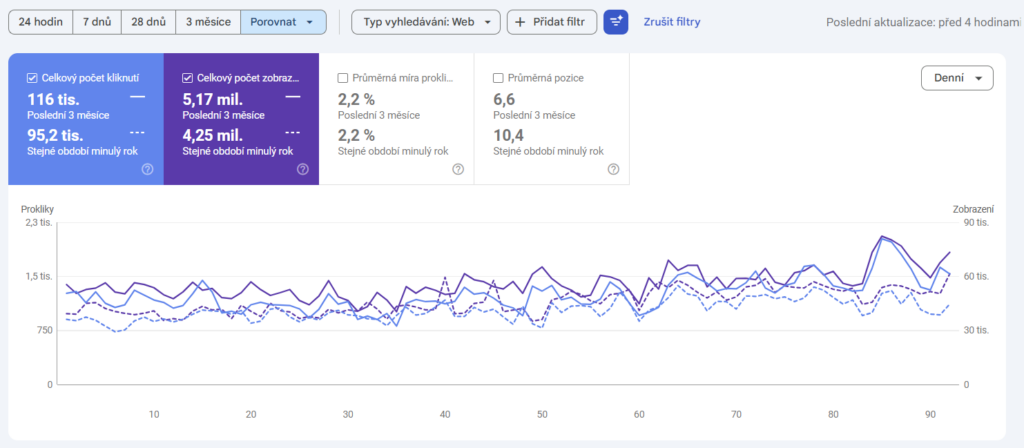
Since 31 August 2026, Search Console has been moving in that direction. All websites in it now have a Generative AI performance report, which shows impressions in AI Overviews and AI Mode by page, country, device and day. However, it doesn’t include clicks, positions or queries, so you can’t read the impact on traffic from it.
How Google actually decides on rankings
A search engine works in two phases.
First, it has to find and index your website. A crawler goes through the pages, processes the content and stores it. Then, when a user enters a query, it has to select the most relevant answers from the index in a fraction of a second and put them in order. This is called ranking.
Let’s not leave it purely abstract. Before you even get into the game, the bot has to go through your site, which is called crawling, and add it to the index. Only then does it select and rank results from it on the results page. Without the first two steps, the third doesn’t happen, and this applies both to Google and to AI search engines, which in the next step draw on the index of Google, Bing or their own.
Ranking today isn’t a single algorithm. It’s a set of systems that together evaluate hundreds of factors: text relevance, links, brand signals, user click data, query context, location, user history and more. There are confirmed and unconfirmed signals, as well as direct and indirect ones. On top of that, Google has gradually brought in machine learning and language models (RankBrain, BERT, MUM, and today a whole layer of transformer models), which understand the meaning of text and entities, not just keywords.
And this is exactly where GEO comes in.
The same language models that drive Google rankings today are, at their core, very similar to the technology that ChatGPT, Gemini and Perplexity are built on. That’s no coincidence. The Transformer architecture, on which today’s language models are built, was published by Google researchers in 2017.
What GEO is and why everyone is suddenly talking about it
GEO stands for Generative Engine Optimization. In practice, it’s optimisation for generative AI search and answer engines, i.e. ChatGPT, Perplexity, Gemini, Claude, Copilot, Google AI Overviews and other systems that answer the user directly instead of sending them to ten blue links.
The name itself comes from a 2023 study by researchers from Princeton and other institutions. In the Czech Republic it’s still a new term. According to Marketing Miner, people search for “co je geo” (“what is GEO”) around 40 times a month, whereas a year ago almost nobody searched for it. “AI overview” is searched 390 times a month, 52% more year on year.
The term took off with the rise of AI search engines. It suddenly became clear that AI answer engines were starting to take a noticeable share of search activity.
People ask Perplexity instead of Google. ChatGPT answers with links to sources. Google itself shows AI Overviews directly above the organic results for many queries, and users often click only there. As a result, traffic from classic search engines is starting to decline slightly and fragment.
The numbers confirm it. Google has shown AI Overviews (in Czech “Přehledy od AI”) in the Czech Republic since May 2025, and AI Mode (Režim AI) since October 2025. In March 2025, Pew Research Center tracked the browsing of 900 American adults. With an AI summary, they clicked on a result in 8% of visits, without one in 15%. They clicked a link directly in the summary in 1%.
This raises a strategic question. How do you actually get into that AI answer? When ChatGPT answers the question “who are the best SEO consultants in the Czech Republic” with three names, how do you make sure yours is among them? That’s what GEO is.
Other acronyms have also emerged around the same problem.
- LLMO (Large Language Model Optimization), optimisation for LLMs in general
- AEO (Answer Engine Optimization), optimisation for answer engines (Featured Snippets, AI Overviews)
- LLM SEO, the same thing under another name
All these terms describe a very similar problem from slightly different angles. In practice, we’re talking about one discipline. For the purposes of this article, I’ll stick with the term GEO, which is catching on the most.
AEO and good old position zero
One of those terms, AEO, targets something specific you already know from classic Google: the featured snippet, the extracted answer above the results. AI Overviews work very similarly, except the model composes the answer directly in your SERP (search results page). If you know how to get into the featured snippet, you’re well on your way to the AI answer too, because both reward a clear, well-structured answer right at the query.
Google confirms this in its documentation. No special adjustments are needed for AI Overviews and AI Mode. A page must be indexed and eligible to appear in results with a snippet, i.e. meet the same condition as for a featured snippet. Since 31 August 2026, it also must not be excluded via the new generative AI toggle in Search Console.
How GEO really works
Here’s an important point that most articles on GEO skip.
Generative models themselves don’t have their own web index like Google. Only the search engines they work with have an index, either a third-party one or their own. Let’s break it down.
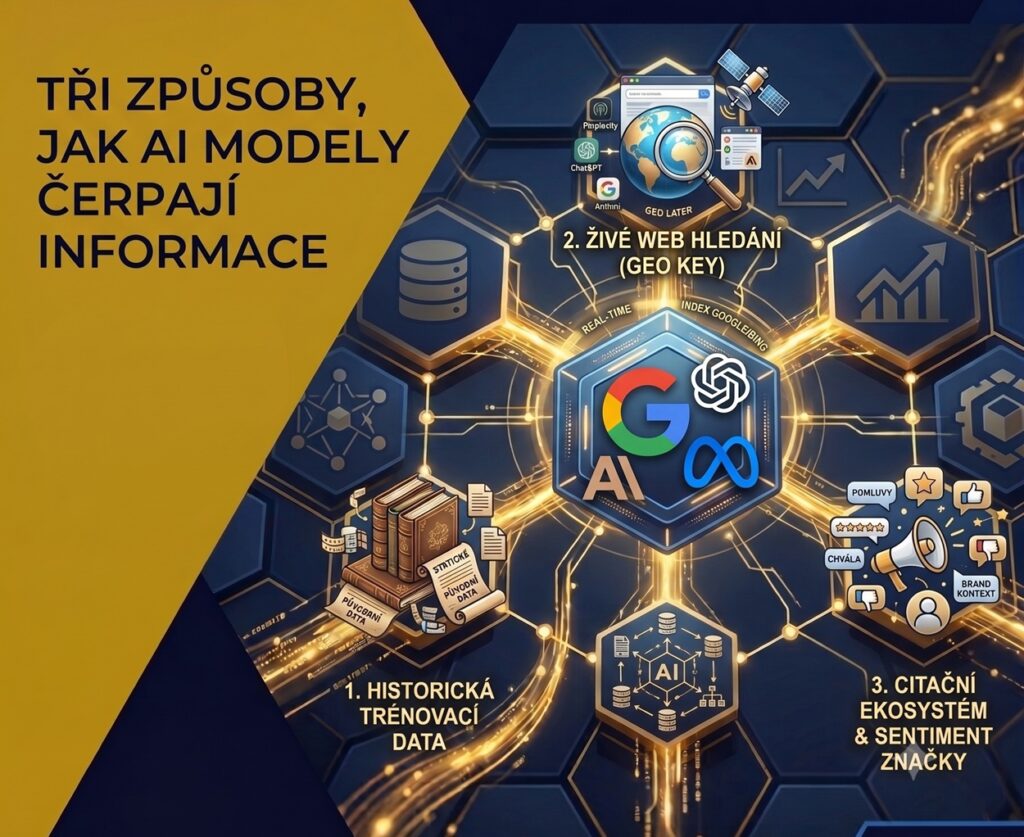
Three ways AI models get information
1. From training data. When OpenAI, Google, Anthropic and others trained their models, they used a huge amount of text from the internet. If your website was in there, it may have become part of what the model “knows”. The key word is “may”. It’s not a guarantee, and you have no influence over what specifically made it into the training data.
The practical consequences? Training data is static and goes out of date. If your website was launched recently, you simply are not in an older version of the training corpus. This changes gradually in later training cycles, but it is not something you can influence in the short term. At the same time, newer models increasingly work with current data.
2. From live web search at query time. Most of today’s AI answer engines (Perplexity, ChatGPT, Google AI Overviews, Gemini) do not just consult their trained “knowledge”. The moment a user enters a query, the system searches the web live. Typically through the Google index, the Bing index or its own crawler. It then picks sources from the results, processes their content and puts together an answer. It also links to those sources.
For you, this layer is the key one in GEO.
If your website ranks well in the traditional search engines that a given AI system relies on, you have a good chance of getting into the AI answer. According to OpenAI, ChatGPT searches through third-party search providers and its own crawler, OAI-SearchBot, and no longer names Bing specifically. Perplexity has its own index of hundreds of billions of pages. Google AI Overviews draws directly on the Google index. This is one GEO technique you can partly influence. You can get your link or your brand into the cited sources. I added this technique to my link building strategy as soon as the first AI models started citing sources.
So traditional SEO is a prerequisite for appearing in AI live search results.
3. From the citation and reference ecosystem. The third layer is the most subtle and also the most underestimated. AI models assess how often your brand is cited, how often people talk about it, in what contexts and who is talking about it. Today this is also called brand sentiment. If your customers badmouth you, your sentiment is poor, and vice versa.
When an AI model says “Nike is a sports brand associated with performance and innovation”, it does not say so because it found that on one page. It says so because across millions (fine, maybe tens) of texts the model has seen, Nike consistently appeared in that context.
This layer is exactly what in traditional SEO we call brand entity signals and brand associations. It is nothing new. It is just even more important now.
Where ChatGPT, Perplexity and others get their results
This changes faster than anything else in GEO. Not long ago you could write that ChatGPT searches through Bing and Perplexity through Google. Today the big players are building their own indexes.
| Platform | Where it gets web results | Who not to block in robots.txt |
|---|---|---|
| Google AI Overviews and AI Mode | Google index | Googlebot |
| Gemini | Google index | Googlebot (the Google-Extended token also controls grounding in the Gemini app) |
| ChatGPT | Its own crawler and search providers that OpenAI does not name | OAI-SearchBot |
| Microsoft Copilot | Bing | Bingbot |
| Perplexity | Its own index of hundreds of billions of pages | PerplexityBot |
| Claude | Brave Search and its own crawler | Claude-SearchBot, Claude-User |
| Seznam Asistent | Seznam search, news websites, Zboží.cz, Firmy.cz | SeznamBot |
In its help centre, OpenAI only mentions third-party search providers and its own crawler, OAI-SearchBot. In September 2026, Peec AI analysed ChatGPT traffic data and, according to its findings, ChatGPT combines its own index with results from other providers. OpenAI has not confirmed this. Perplexity described its index of hundreds of billions of pages itself.
If you are not in the index a given AI draws on, you will not be in its answer either. And if you block AI search bots in robots.txt, you will drop out of their answers. Training bots (GPTBot, ClaudeBot) are a different matter, and blocking them is a business decision.
How ChatGPT and AI Mode search when they get a question
According to Marketing Miner, how ChatGPT works is one of the most searched questions about AI overall, with around 600 searches a month and 87% more year on year. For GEO, what matters is what happens when the model searches the web.
It breaks a more complex question down into a series of sub-searches. Google calls this query fan-out. For the question “how to choose an SEO consultant for an online shop”, the AI will look up things like SEO prices, references, the difference between an agency and a freelancer, or reviews. From each search it takes a few pages, splits them into passages and builds the answer from the best ones.
That is why the origin of citations is changing. In July 2025, Ahrefs calculated that 76% of citations in AI Overviews point to pages in Google’s top 10. In March 2026, its figure came out at 38%. The numbers are not fully comparable: the first study only looked at the three most visible citations in each answer, while the second looked at all of them. Ahrefs still considers the drop to be real and gives query fan-out as a possible explanation.
What is more, you will mostly not find these sub-queries in keyword tools. According to AirOps, 95% of the queries ChatGPT runs when searching have zero search volume. So you also score points on questions around the topic, not just on the main query, and every passage of your text should make sense on its own.
So where do AI models get their “truth”
A simple heuristic I use.
- for facts and current information → live web search → traditional SEO decides
- for brand context and associations → training data + references in texts → brand and PR decide
- for expert authority → who talks about you and in what quality → digital PR and citations decide
And now the key idea I wanted to anchor in this article. None of these three layers is, in principle, something you were not already doing in SEO. The proportions and emphasis shift slightly. You cannot measure as well. But in link building, I really just changed the parameters and put links in the background in favour of the brand. Nothing more. Of course, there is a bit more to it, but for the core understanding I think this is enough.
SEO vs. GEO point by point
A table, for the record.
| Discipline | SEO | GEO | Difference |
|---|---|---|---|
| Keyword research | KW research, search volume, intent | Question queries and prompts, conversational phrases | Prompts are a simulation, whereas keywords were far more precise |
| Content | Depth, quality, structure | Structured, citable, with data, names and entities | Greater emphasis on citability |
| Technical SEO | Crawling, indexing, structure | The same, plus access for AI bots and content readable without JavaScript | The same, just more emphasis on communication itself |
| Structured data | Rich results, an unambiguous entity | Adding it alone does not increase AI citations | Overrated, worth it for search engines |
| Link building | Quality links | Brand mentions with context | Shift from links to mentions (partly) |
| Brand | Increasingly important in SEO over time too | Key, and building on its importance in SEO | The biggest change |
| Citations and sources | Mainly for credibility | Key to getting AI to cite you | More important |
| Statistics and data | Nice to have | Even more important. AI loves specific numbers | Much more important |
| User signals | Click-through, dwell time | Less relevant | AI does not see them, but it draws on SEO results |
| Localisation | Local SEO | Individual results based on the AI model’s context for each user | GEO is mostly global today |
What does the table tell us?
In nine of the ten disciplines, GEO is very similar to SEO or only slightly shifted. GEO often builds on SEO and continues along the same line. The genuinely new emphasis is on just two things. Citability of content (citations, statistics, an authoritative tone). And the brand as an entity (associations, mentions, context).
Both are things you should be doing in modern SEO anyway.
What works in GEO exactly as it does in SEO
This section matters because GEO is a heavily overhyped marketing topic.
I have had clients come to me saying “we need a completely new GEO strategy” and wanting to discuss it in a three-hour meeting. That makes me break into a sweat. Nine times out of ten, it means they need to finish off traditional SEO that has not been done well. And then connect it with the brand strategy and communication. An SEO specialist has to understand marketing better and not just be a technical geek, which used to be common.
Google sees it the same way, after all. In its guide to optimising for generative AI, it says that from Google Search’s perspective, optimising for generative AI is still SEO.
Content quality and depth
AI models favour content that is in-depth, well structured and contains specific information. That is exactly what Google expects from content too. A shallow article without its own perspective will not rank in Google or appear in an AI answer.
Freshness plays an even bigger role in AI. Across 17 million citations, Ahrefs found that pages cited by AI assistants are on average a quarter younger than Google’s organic results (1,064 days versus 1,432). According to Seer Interactive, 75% of the pages that ChatGPT, Gemini and Perplexity cited between March and June 2026 had been updated in the previous twelve months.
Structured data and schema markup
AI models understand structure well. When you have FAQ schema, Article schema, Product schema, Recipe schema or BreadcrumbList, the model can extract the individual entities and relationships. Schema markup helps search engines understand what exactly your content says and in what format. At the same time, I would not overrate structured data. My estimate is that more advanced models handle content without structured data well too.
I have written about structured data separately. For GEO, I definitely do not give it as much weight as is often claimed.
The data now prove me right. In May 2026, Ahrefs compared 1,885 pages that added JSON-LD with 4,000 similar pages without this change. It found no significant increase in citations in ChatGPT, AI Mode or AI Overviews. In its guide to generative AI, Google states that structured data is not needed for AI features. And since 7 May 2026, Google no longer shows FAQ rich results at all.
Internal linking and architecture
During live search, AI models crawl a website much like a traditional crawler.
Good architecture, good internal linking, a logical URL structure. All of this helps AI process your website faster and more thoroughly.
Technical hygiene applies to AI too
The rest of technical hygiene applies here too. A fast website measured through Core Web Vitals, a working mobile version under mobile first, no unnecessary duplicate content. What helps a traditional crawler also helps AI models get through your content afterwards. A website that is hard to process has a harder time getting into Google and into AI answers. That is why many SEO consultants say that almost nothing has really changed from SEO to GEO. I would not go quite that far, but in my view the change is a 90-degree turn, not a 180-degree one.
Two things, however, set AI crawlers apart from Google. According to measurements by Vercel, the crawlers of OpenAI, Anthropic and Perplexity do not run JavaScript, so they cannot see content loaded by a script. And AI bots can be silently blocked by a CDN or a firewall. Cloudflare has done this by default for new domains since July 2025.
Brand search and brand mentions
Identifying a brand as an entity is crucial for AI. Just as it is for Google.
If people know your brand, talk about it, search for it and cite it, the model will remember you in that context. Traditional branding is not the opposite of GEO. It is the foundation of GEO.
Off-page authority
High-quality backlinks. PR coverage. Expert quotes in relevant media. Podcast appearances. Authorities from within the company.
All of this strengthens your brand entity for both Google and AI models. It is not double the work. It is the same work.
It also has a framework, e-E-A-T
All of this also has a framework shared by Google and the models: E-E-A-T (experience, expertise, authoritativeness, trustworthiness). High-quality backlinks with meaningful anchor text raise your domain authority and, together with brand mentions, the model’s trust in your content. For Google and for AI, it is the same signal, just measured differently.
In short, if you do content, technical SEO, PR and branding well, you have roughly 80% of GEO done along the way. The remaining 20% is about what is genuinely new to the AI world.
What really changes in GEO (and what you should start doing differently)
Here is a list of what is new. Nothing dramatic, but worth having in your plan.
Most of the points are backed by the study that gave GEO its name. In it, adding source citations, quotes and statistics increased a page’s visibility in generated answers by up to 40%, while keyword stuffing did not help. It helped weaker pages the most. However, it was measured on a simulated search engine where the page was already among the sources.
1. Cite sources and name authorities
In their answers, AI models favour content that itself cites specific sources, figures, research and expert opinions. When you write “according to Stanford research…” in your article, the model sees it as a signal of credibility. And it may then cite your article as one of the sources in its answer.
Practical action. Start citing sources specifically in your articles.
Link to studies, quote experts, give figures with attribution. Not just for AI, but primarily for the reader’s trust. AI then benefits from it as a secondary effect.
2. Your own statistics and original data
AI models love specific numbers and original research. If you work your own data into an article (“I analysed 200 websites and this is what I found”), AI is happy to cite it. It is an even stronger signal than the previous point.
It is not just a GEO trick. It is classic linkbait content, which also earns traditional backlinks. It pays off, and I always tell my clients to think about what we could publish in this way. This activity often has a business impact too.
Practical action. Run your own analyses and publish them. From your GA, client data or market data. Even small datasets are valuable if they are original. Or carry out your own quantitative or qualitative surveys and research.
3. An authoritative tone and a clear answer structure
AI models extract answers from text that is structured as an answer. A short opening summary. Then the detail. Then the conclusion.
If your article opens with a long-winded marketing intro such as “in today’s digital age…”, the model will extract nothing from it.
Kevin Indig analysed 18,000 citations from ChatGPT, and 44% of them came from the first 30% of the text. The beginning of an article is therefore the most cited part.
Practical action. Rewrite your article intros so that the first paragraph answers the main question. Then the detail. Then everything else.
4. Question-based queries in your content
People ask AI in full sentences. “What is the best way to optimise an e-shop for Google?”
While in traditional SEO the keywords were things like “e-shop seo”, in the GEO world full questions are what matters. If you have FAQ sections on your website, AI loves them and often pulls the answer straight from them.
Practical action. Add FAQ sections and question-based H2/H3 headings to your articles. They also work directly for Google PAA (People Also Ask). Ideally, use your customer support team to come up with the questions, as they deal with these questions and also have the answers.
FAQ schema on its own will no longer do anything for you in Google. Since 7 May 2026, Google no longer shows FAQ rich results. What counts is the text actually on the page.
5. Your brand as an entity with consistent associations
I described this in SEO in the context of backlinks. Today, Google evaluates entities, not just domains. In GEO, the same applies even more strongly.
An AI model builds an internal representation of your brand based on the contexts in which it appears. If your brand consistently talks about one topic (for example, “SEO consulting for the financial sector”), AI will remember you in that context. If you talk about everything, the model will not really place you anywhere. A narrower niche where you add value is therefore better.
Practical action. Have a clear topical identity and stick to it. No drifting into twenty unrelated topics.
6. Active digital PR and expert quotes
If five journalists in two major media outlets quote you as an expert on topic X, AI models will pick it up. Either directly (your content goes through a training cycle) or indirectly (live search finds those articles and the model extracts the context “X is an expert on topic Y”).
Practical action. Actively be a source for journalists. Reportér, Mediář, LinkedIn, podcasts, expert comments on current news.
“Brand is the new link”, why this line is meant literally
If you take away one idea from this article, let it be this one.
Brand is the new link. Not metaphorically. Literally. I wrote this back in 2022, when it started to become clear from the context. And I was proved right. Because I have been doing link building this way for several years, my clients have a head start in this area.
In traditional SEO, a backlink was the main signal of authority. When an authoritative website linked to you, Google took it as proof that you were worth mentioning. Link building was the means of building that authority.
In the GEO world, where AI models draw on text from across the internet, a link is not required. A mention is enough.
When someone writes about you in Hospodářské noviny (“according to SEO consultant Patrik Pilous…”), for an AI model it is the equivalent of an authoritative link for Google (if we go back to 2019, that is).
The data support this. In December 2025, Ahrefs compared 75,000 brands and looked at what relates to how often ChatGPT, AI Mode and AI Overviews mention them. The strongest relationship was with brand mentions on YouTube and on the web (in AI Mode, correlations of 0.74 and 0.71). Domain Rating, i.e. the strength of the link profile, was related much more weakly (0.29). It is a correlation, not proof of causation, but it points in the same direction.
What does this mean strategically?
- Brand mentions without a link have a value they never had before
- PR and digital PR are part of SEO and GEO strategy, not a parallel discipline, and SEO consultants should have a solution for it
- Investing in people remembering you and talking about you is the best long-term SEO investment, even as the rules of the game keep changing
- Link building is still important, but it is no longer the only way to build authority, and it is done differently than in 2015 or even in 2020
This idea extends a direction Google has been heading in for some time. AI models simply deepen that logic.
A practical checklist for doing SEO and GEO at the same time
A long list of actions to finish with.
If you do even half of them, you will cover both.
Content layer
- Write in-depth pillar articles with your own perspective, not shallow research summaries
- Make the first paragraph of an article answer the main question and then build on it like a snowball, as has been true for years
- But write news pieces too
- Use question-based H2/H3 headings (or handle it technically in another way)
- Also cover the sub-questions of the topic that AI asks when it breaks down a query
- Make use of your data and publish parts of it
- Add FAQ sections to every article where it makes sense
- Cite specific sources, studies, figures and authors
- Publish your own analyses and original data
- Update your important articles regularly
- Keep your topics consistent. Decide what matters most to you (or where you want to break in) and build explicitly around it
Technical layer
- Implement Article, Product, Organization and Person schema (for search engines, not for AI citations)
- Keep a clean URL structure and a logical architecture for both your website and your brand
- Contextual internal linking and clear priorities in the menu
- A fast website that is also easy to navigate
- Sitemap, robots.txt, indexing checks and, above all, crawl budget
- Allow AI search bots (OAI-SearchBot, PerplexityBot, Claude-SearchBot) through both robots.txt and your firewall
- Keep your main content in the HTML, not loaded only after JavaScript runs
- HTTPS, good hosting, no mixed content errors
Off-page and brand layer
- Active digital PR. Be a source for journalists
- LinkedIn, Facebook and Instagram as the primary channels for an expert brand
- Podcast appearances and expert commentary
- YouTube: in the Ahrefs study, mentions on YouTube were the most strongly correlated with AI visibility
- Your own content marketing, aiming to be a cited source and to own the topic
- Brand search as a KPI. Track how many people search for you directly and what associations you have
- Backlinks from relevant websites in your field
- Consistent NAP (Name, Address, Phone) across the web if you are a local business. In the Czech Republic, this includes a Firmy.cz profile, which Seznam Asistent also draws on
Measurement
- GSC for classic rankings and CTR
- GSC, the generative AI performance report for impressions in AI Overviews and AI Mode
- Bing Webmaster Tools, the AI Performance report with citations in Copilot
- GA4 for visitor behaviour and conversions
- Marketing Miner or another prompt monitoring tool
- Manual monitoring in ChatGPT, Perplexity and Gemini: ask about your brand and see what the AI says. But one screenshot is not data. SparkToro found that AI gives the same list of brands twice less than once in a hundred times
- Brand search volume in Ahrefs and Google Trends
- Brand mentions in Google Alerts and Ahrefs
If you are working on all of this, GEO will happen along the way. You have to do most of it anyway for classic SEO, visibility and your brand.
What next?
Let me clear up a few things that are overhyped in discussions about GEO.
“ChatGPT will kill SEO.” It won’t. ChatGPT and similar tools are taking a certain share of search activity, especially informational queries. But for transactional queries (“buy shoes”), local queries (“café Prague 5”) and commercial queries, Google remains dominant. On top of that, Google itself is integrating AI Overviews, so the classic battle for rankings on Google still matters. Over time, though, SEO will certainly transform and keep changing.
Traffic from AI is still small. According to Conductor, between May and September 2025 it made up roughly 1% of traffic to large US websites. But it is growing fast.
“We need a completely new strategy for GEO.” Usually not. If you do SEO, brand and PR well, GEO happens in the background. Start by fine-tuning what you already do, not by building a second, parallel discipline. Also start measuring, at least in some way, how you appear in AI and what happens when people enter queries that matter to you.
“There’s some GEO trick that will get us into ChatGPT.” There isn’t. Nobody today can guarantee inclusion in an AI answer. What you can do is systematically improve your chances through content quality, your brand, citations and influencing the sources that get cited. It is a long game, not a hack.
“We just need to add schema and we’ll be in AI.” Not enough. Schema helps, but it is only one small, overrated piece. Without quality content and brand signals, schema on its own does nothing. In fact, a controlled comparison by Ahrefs did not find that adding JSON-LD alone significantly increased AI citations.
“We just need to upload llms.txt.” No again. In its guide to generative AI, Google says you don’t need any special files for AI and that they neither help nor harm your visibility in search.
Frequently asked questions about SEO and GEO
What is GEO?
GEO (Generative Engine Optimization) is optimising your website and brand for generative AI answers, such as ChatGPT, Perplexity, Gemini, Claude or Google AI Overviews. The goal is not a position in a list of links, but for the AI to mention or cite you in its answer.
What is the difference between SEO and GEO?
SEO optimises visibility in search engines (Google, Seznam, Bing). GEO optimises visibility in generative AI answer engines (ChatGPT, Claude, Perplexity, Gemini, AI Overviews). In practice, 80% of the activities overlap, and both disciplines require quality content, technical SEO foundations, a strong brand and PR. GEO puts more emphasis on citations, statistics and brand entities.
Do I need GEO, or is SEO enough?
It is actually a bit of an amateur question. If you do classic SEO well, you have a large part of GEO done along the way. I recommend fine-tuning your SEO and brand first, then tackling GEO-specific adjustments (citations, statistics, FAQ sections, an authoritative tone). Starting with pure GEO without an SEO foundation makes no sense, and it rather suggests the person doesn’t really understand the field.
How do I get into ChatGPT’s answers?
There is no guarantee, but there are systematic steps. Quality content marketing with your own data and citations, a strong brand with consistent associations, good rankings in the classic Google index (ChatGPT Search draws on the web), active PR and expert quotes in relevant media. Regularly ask ChatGPT, Perplexity and Gemini about your brand yourself and see what the AI says. And don’t block OAI-SearchBot in robots.txt, as this is how websites get into ChatGPT search.
Does ChatGPT search via Bing?
It can no longer be put that simply. In its help pages, OpenAI mentions unnamed third-party search providers and its own crawler, OAI-SearchBot. According to an analysis by Peec AI from September 2026, ChatGPT combines its own index with results from other providers, but OpenAI has not confirmed this. Microsoft Copilot definitely searches via Bing.
What are AEO and LLMO, and how do they relate to GEO?
They are essentially synonyms. AEO (Answer Engine Optimization) emphasises optimisation for answer engines and featured snippets. LLMO (Large Language Model Optimization) emphasises optimisation for language models. GEO is the broadest term and the one catching on most in practice. In professional discussion, these are not three different disciplines, just three names for a very similar problem.
Does schema markup work for AI search engines?
It helps search engines, but according to the available data it doesn’t help with AI citations. A controlled comparison by Ahrefs from May 2026 found no significant increase in citations after adding JSON-LD, and Google says you don’t need any special schema for generative AI. For search engines, I recommend Article, Organization and Person schema, plus Product and BreadcrumbList for e-shops. But schema alone is not enough. Without quality content and brand signals, it won’t help.
What does “brand is the new link” mean?
It is a catchphrase describing a shift in how search engines and AI models assess authority. In classic SEO, the main authority signal was a link from an authoritative website. In the era of AI and entities, an unlinked brand mention is just as important: a mention of your brand in a context that an AI model can read and take into account. PR, citations, podcasts, expert commentary in the media. All of this now works as the “new link”.
How much does GEO consulting or a GEO service cost?
In the Czech Republic, GEO has no separate pricing. Most reputable consultants include GEO in their SEO services, because 80% of the work is the same. I have covered the prices of SEO consulting and monthly retainers in more detail in my article on SEO pricing.
GEO is not a revolution, it is an extension of SEO
Let me return to the point I made at the start.
GEO is not a new discipline you have to build from scratch. It completes what has already been true in SEO for a few years: an emphasis on content depth, working with your brand as an entity, quality citations, structured data and digital PR.
If you do good classic SEO, backed by a strong brand strategy and active PR, you will get into AI answers. Or at least you will have the best possible chance.
If your SEO is shallow and you neglect your brand, brandishing the latest GEO tips from LinkedIn really won’t help you.
The practical advice is boring, but it works. Get your SEO right. Consolidate and strengthen your brand. Do digital PR linked to link building. Try to measure it. The GEO results will follow on their own.
If you are wondering how to make sense of this for your specific project, take a look at my SEO consulting services or my page on “GEO consulting“. Or get in touch with me directly via the contact form or on LinkedIn.

