
Clients think everyone has long known how people buy from them. In most cases, though, it is just a mix of feelings and unquantified experience.
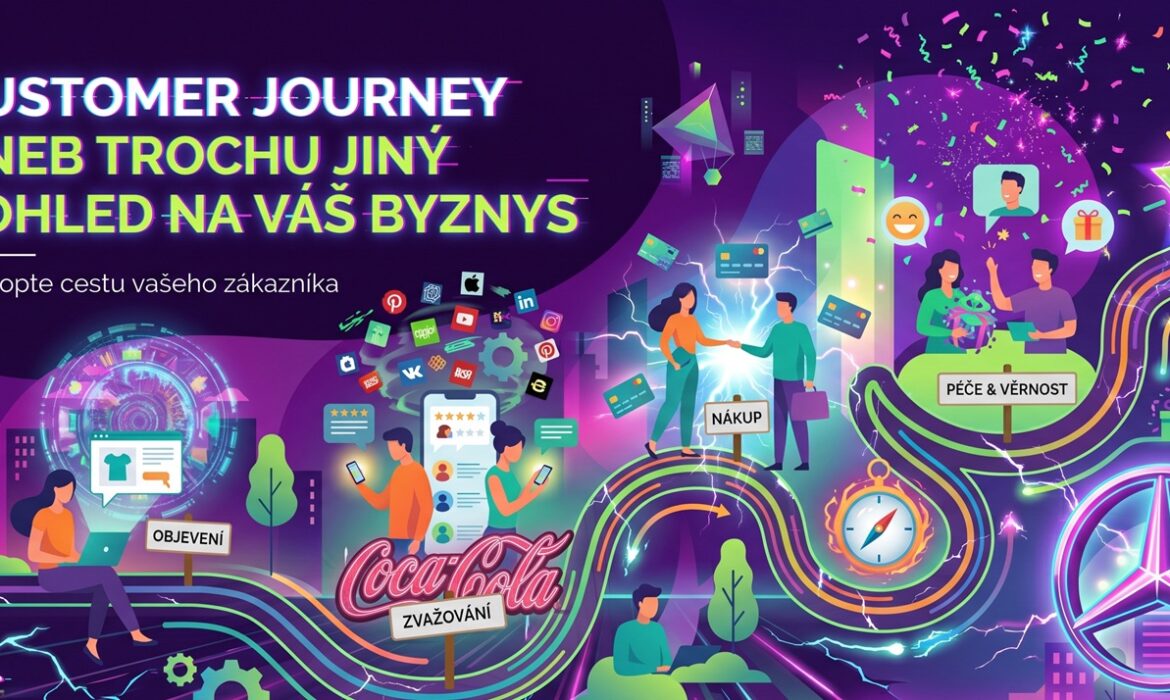
The customer journey is a description of everything that happens between a customer and your brand, from the moment they first hear about you to the moment they recommend you to others. It is not the CMO’s vision. It is a map of reality.
This article covers what the customer journey is, why most companies get it wrong, how to map it step by step and, above all, what to do with it next. I am writing it as a consultant who tries to think through the lens of the customer journey.
What the customer journey is and why you need it
A short definition. The customer journey is the sequence of all interactions between a customer and your brand across all channels and touchpoints. It starts long before the purchase, often before the customer even realises they have a problem that your brand solves. And it does not end with the purchase. It continues with retention, service, recommendations and repeat purchases. Try looking at your own buying decisions through this lens. It is interesting, and of course you can never fully see back to the start of the journey (the first contact).
Most companies look at their relationship with the customer through their own framework, or think about it even less. What we do for them, where to move them, how to push them to convert, what we spend money on. The customer journey reverses the perspective. It looks at the same relationship from the customer’s point of view: what they are going through, what interests them, where they get stuck, where they see us, how they see us and what question they have at that stage.
This change of perspective sounds like a small thing.
Customer journey, sales funnel, customer experience, three terms that get mixed up
Three terms get mixed up in discussions about the customer journey. Let us separate them.
The sales or marketing funnel is the company’s view of acquisition. At the top is a broad group of potential customers, at the bottom the small number who bought. The funnel describes how we move them down. It is measured by the conversion rate between the layers.
The customer journey is the customer’s view of their whole relationship with the brand. It does not start with acquisition and does not end with the purchase. It also includes stages where the company does no active acquisition, such as the awareness stage, where the customer is only just learning about the problem.
Customer experience (CX) is the sum of all the experiences and emotions the customer goes through during the journey. CX is the result; the customer journey is the map that shapes that result.
You do not need to choose one of the three. You need all three. They are different angles or lenses on a similar thing. Just do not confuse them. When I consult for companies, I see in nine cases out of ten that the team has chosen its channels and the customer journey is reduced to naming whatever is currently bringing in measurable orders.
The five stages of the customer journey
The classic model recognises five stages. Some schools talk about four, others about seven. Five is the distillation that works in practice and is the easiest to work with for content and channels.
1. Awareness
The customer realises they have a need or a problem. They do not yet know who solves it, or whether they should actively look for a solution at all. At this stage your brand is typically not on their mind.
What really happens at this stage? The customer reads articles on the topic, follows LinkedIn, asks a colleague, watches YouTube. These days they ask ChatGPT and Perplexity (yes, this is where it pays to have your SEO and GEO sorted) to understand whether they should deal with the problem and how.
Brand goal: get into their awareness (or subconscious) as one of the relevant brands for that need.
2. Consideration
The customer now knows they want to solve the problem. They start actively comparing options. They look for specific brands, read reviews, compare specifications, talk to colleagues and follow comparison articles.
What really happens at this stage? They open Google. They type “best X for Y”, “X vs. Y”, “X review”. In B2B they invite several suppliers to a first call. In e-commerce they browse rankings and reviews.
Brand goal: make the shortlist and answer specific decision-making questions. Be a relevant alternative for the problem in question.
3. Decision
The customer is making a decision. At this stage they often reach for one last piece of information, a specific guarantee, a review that helps them take the step. Sometimes they decide on price (yes, DISCOUNTS work extremely well as a trigger in the Czech Republic), sometimes on emotion, sometimes on a small detail nobody predicted.
What really happens at this stage? They come back to your website, check the pricing details, look at the FAQ, use the web chat and form an impression from the product presentation.
Brand goal: remove the last doubt and make conversion simple. A clear price list, an FAQ, easy contact, a short purchase process.
4. Retention
The customer has bought. Most companies stop investing in the relationship at this point, which is a business mistake. Acquiring a new customer is usually 5 to 25 times more expensive than keeping an existing one. For some retention-driven businesses (groceries, supplements, dog food), getting the customer to make a second purchase is absolutely key.
What really happens at this stage? The customer uses the product, runs into their first questions, looks for support, receives the newsletter and makes their first service contact.
Brand goal: turn the customer into a loyal repeat customer and maximise CLV. I wrote about how to calculate CLV and what influences it in a separate article on Customer Lifetime Value.
5. Advocacy
A loyal customer starts recommending the brand. And that is the most powerful thing. Research shows that if two people independently recommend a product to you, it multiplies the chance of a purchase. They write reviews, talk about you on LinkedIn, recommend you to colleagues and share your content. This stage is the most valuable marketing channel in the world and also the one companies underestimate the most.
What really happens at this stage? The customer writes a Google review. They reply to a colleague on Slack asking who would recommend your product. They share your LinkedIn post and recommend you in Facebook comments. In B2B they refer a potential client with a similar problem to you.
Brand goal: systematically build advocates and use their trust to acquire new customers. Referral programmes, reviews, case studies, an advocate community, a good product.
An important note. These stages are not linear. In practice customers skip between them, go back, abandon the journey and return months later. The customer journey describes the dominant flow.
The customer journey map, what it is and what it looks like
A customer journey map is a visual document that maps this journey. In detail, at the level of individual touchpoints and the questions the customer asks at each stage.
A classic customer journey map has six columns.
| Column | What goes in it |
|---|---|
| Stage | Awareness, Consideration, Decision, Retention, Advocacy |
| Customer actions | What exactly they do (google, read, compare, buy) |
| Touchpoints | Where they interact with your brand (website, social media, email, support) |
| Questions and needs | What they ask, what they need to know |
| Emotions | How they feel (frustration, excitement, distrust, calm) |
| Opportunities for the brand | What you can do better at this stage |
Some authors add a seventh column, “pain points”: the problems the customer runs into. I often include them in the “Emotions and questions” column. It depends on your style.
The map does not have to be complicated. For a small company, a single A3 sheet with all five stages and basic notes is enough. For a corporation it may be a wall poster with dozens of cells. More important than the visual design is whether the map lives in your company or ends up gathering dust on the CMO’s shelf.
What else does a customer journey map capture? Emotions and moments of truth
Traditional marketing funnels ignore emotions. A customer journey map does not. Emotions (sentiment) are a key input for understanding why the customer makes the decision they make at a particular stage.
A concrete example. A client sold SaaS for accountants. Customer journey mapping showed that the lowest-rated stage was onboarding. Customers felt overwhelmed by it, not excited, as the company had assumed. After the onboarding was redesigned, the churn rate fell from 8% to 3% a month. Without the customer journey map, the team would not have seen the problem. Revenue from existing customers doubled within a year.
Then there are moments of truth: moments when the customer makes a decision in their head that shapes their relationship with the brand for the whole cycle. The first contact with support. The first newsletter opened. The first experience of a broken promise. The map should mark these moments explicitly. They are the fixed points around which you build your CX strategy.
How to map the customer journey step by step
1. Define the persona. There is no customer journey in general. It exists for a specific type of customer. If you have three segments, you map three journeys. The persona tells you who is going through the journey. Without it you are mapping a generic stereotype that matches no real customer. Personas are complicated, but try to approach them with a bit of distance.
2. Collect data. You cannot map a customer journey based on what you think about your customers. You need data: GA4, customer support exports, GSC, CRM, reviews, surveys, NPS feedback, customer interviews, interviews with sales and support staff. The real map is built from these layers.
3. Identify touchpoints. List every place where customers come into contact with your brand. Website. Blog. Social media. Email. Newsletter. Webinar. Support. Third-party reviews. Marketplaces. A recommendation from a colleague. The more detail, the better.
4. Map the stages. For each touchpoint, decide which stage of the customer journey it belongs to. Some touchpoints appear in several stages (the website is a touchpoint in awareness, consideration and decision). Work out which content on the website fits which stage.
5. Find the gaps and moments of failure. Which stages do you cover poorly? Where do customers drop off? Where is your churn high? Where do you fail to persuade? These are your future investment priorities.
6. Build an action plan. A customer journey map without an action plan is not a map. It is artwork. The map must lead to specific tasks: new content for the awareness stage, a better comparison page for consideration, a simpler purchase process in decision, new onboarding for retention.
Repeat this process every 12 months. The market changes, customers change, technology changes. Last year’s customer journey may no longer apply today.
Customer journey vs. sales funnel, differences worth understanding
The sales funnel and the customer journey are two complementary views of the same relationship. The sales funnel looks at it from the company’s perspective. The customer journey looks at it from the customer’s perspective. When you understand them as two views rather than competing concepts, you can use both in your strategy.
| Attribute | Sales funnel | Customer journey |
|---|---|---|
| Perspective | The company and its goals | The customer and their needs |
| Shape | Linear, top to bottom | Cyclical, often non-linear |
| Goal | Conversion to purchase | A relationship that goes beyond the purchase |
| Measurement | Conversion rates between layers | Emotions, touchpoints, moments of failure |
| What it addresses | Acquisition | Acquisition + retention + advocacy |
| Where it ends | With the purchase | With a recommendation and a repeat purchase |
| Typical user | Sales team | Marketing, product, CX, support |
In practice, the sales funnel is good for managing acquisition, while the customer journey is good for managing the entire relationship lifecycle. If you care about CLV and long-term growth, the customer journey matters more.
Customer journey in B2B vs. B2C
Classic customer journey textbooks are based on B2C. In B2B, things work differently in several key respects. It is more individual.
Cycle length. A B2C customer journey can take hours (an impulse e-shop purchase) or days. A B2B journey takes weeks, months, sometimes years (enterprise SaaS, corporate procurement). The awareness stage in B2B lasts considerably longer and requires continuous brand building. That is why PR and content marketing play a key role there, which I also covered in my article on how PR and marketing work.
More people involved in the decision. A B2C purchase is usually made by one person. A B2B purchase is made by a decision-making unit (DMU): the user, the approver, the influencer, the technical expert, the lawyer, the finance director. A B2B customer journey has to map each of these roles separately, because each has different questions and different touchpoints.
Balancing emotion and ROI. In B2C, emotions dominate decision-making (even for rational purchases). In B2B, emotions do not disappear, but they must be backed by hard ROI arguments for every approver. Of course, there are also schools of marketing thought that say B2B is subject to the same marketing laws.
Touchpoints. B2C touchpoints are TikTok, Instagram, reviews, blogs and comparison websites. B2B touchpoints are LinkedIn, industry conferences, podcasts for professionals, demos, RFPs and sales calls. A B2B customer journey map looks fundamentally different from one for an e-shop. I wrote about B2B specifics in detail in my article B2B marketing.
The practical consequence. If you run a B2B business, do not copy publicly available customer journey templates, as the vast majority are created for a B2C context. Doing your own mapping is a must.
Which content and channels belong to which stage
This section is key for me, because a customer journey is useless if it does not lead to decisions about what to write, where to publish it and how to measure it. Let us go through each stage in terms of content and channels.
Awareness, be visible, do not sell
Goal: get the brand into the mind of a customer who does not yet know they want to solve the problem.
Content that works:
- Educational blog articles about the problem, not about your product. “Why use multichannel marketing”, “What is a content audit”. This is where strong SEO and keywords with informational intent come in.
- LinkedIn content for B2B: expert views, debates, case studies.
- Podcasts and guest appearances: be a source for journalists, experts and podcasters.
- YouTube and video: for brands with a product that can be shown.
- PR and digital PR: media mentions, expert commentary.
Touchpoints: blog, social media, podcasts, YouTube, industry media, AI search engines (ChatGPT, Perplexity, Google AI Overviews).
KPIs: organic traffic, brand search volume, share of voice, social reach.
Consideration, answer the decision-making questions
Goal: make the shortlist and provide the answers the customer needs to decide.
Content that works:
- Comparison articles (“X vs. Y”, “The best solution for Z”). This is exactly what customers google.
- Case studies and reference stories with specific results and figures.
- In-depth pillar articles on how your type of solution works and what to expect from it.
- Webinars and online presentations: in-depth enough to persuade.
- Third-party reviews and ratings: Heuréka, Trustpilot, G2, media reviews.
- Demo videos, product use case examples.
Touchpoints: website (especially landing pages and the content hub), review platforms, webinars, comparison articles, sales calls.
KPIs: time on site, click depth into content, demo requests / contact forms, case study views.
Decision, remove the last doubt
Goal: simplify the decision, remove the last doubt, shorten the path to purchase.
Content that works:
- Transparent pricing (or at least a price range with an explanation of the variable component).
- FAQ section with the questions customers actually have in the decision stage.
- Guarantees, refund policy, trial versions: they reduce purchase risk.
- Sales materials tailored to the different roles in the DMU (B2B).
- Personalised demos or a consultation call.
- For B2B: ROI calculators, business case templates.
Touchpoints: product pages, pricing, FAQ, contact, sales calls, demos, web chat.
KPIs: conversions (orders, completed forms), shopping basket, completed demos.
Retention, turn a customer into a repeat customer
Goal: maximise CLV, reduce churn, build long-term loyalty.
Content that works:
- Onboarding sequences (email, video, in-product tutorials).
- A newsletter that offers value, not a sales pitch. Tips, guides, news.
- Knowledge base and self-service support.
- Loyalty programme for e-shops.
- Upgrade offers in the context of a genuine need.
- Community and expert content for advanced users.
Touchpoints: email, in-product, support, knowledge base, community, webinars for existing customers.
KPIs: churn rate, NPS, repeat purchases, upgrade rate, time to next purchase.
Advocacy, turn a loyal customer into an advocate
Goal: systematically build advocates who recommend the brand to others.
Content that works:
- Referral programmes with concrete benefits.
- Case studies in which the customer is the hero (not you).
- Reviews, ratings, testimonials: actively ask for them.
- Brand community (Discord, Slack, FB Group).
- Co-marketing with key clients.
- PR opportunities in which the customer gets the spotlight.
Touchpoints: referral platform, review platforms, social media, client community, joint campaigns.
KPIs: NPS, number of referrals, number of reviews, lifetime value of referred customers.
The five most common mistakes in customer journey mapping
I see these mistakes again and again. If you avoid them, you are ahead of 80% of companies.
1. The map lives in PowerPoint, not in the product. A customer journey that is drawn and saved in Notion or Miro, but that nobody uses to make decisions, is pointless. It must be part of the brief for every new piece of content, every new campaign and every new product decision.
2. Mapping without data. If you build a customer journey based on what you think about your customers, the result is fiction. GA4, GSC, CRM data, NPS, customer interviews: without them, the map is fantasy.
3. A linear approach. Real customers do not move through the stages as if on a track. They go back, skip ahead, drop out and return months later. A map that does not reflect this is not useful.
4. No persona. There is no customer journey for one generic customer. If you have three segments, you map three journeys. One universal map is usually worse than three specific ones.
5. A map that is never updated. A customer journey you put together three years ago may no longer hold today. AI search engines, social media, buying behaviour: everything changes. The map needs a review at least once a year.
The customer journey in the era of AI and digital search engines
This section is a newer layer that classic textbooks have not caught up with yet. I consider it the most important change to customer journey practice in the last decade.
AI search engines (ChatGPT, Perplexity, Gemini, Google AI Overviews) are becoming a new touchpoint in the awareness and consideration stages. The customer no longer asks only Google. They ask an AI answer engine. And based on how the AI answer engine informs them, they form their first layer of awareness about the problem and the brands that solve it.
Practical implications.
The awareness stage is moving into AI answer engines. If AI does not talk about you, you lose the entry point to the journey. Classic SEO visibility is necessary today, but it is not enough. You also need to appear in AI answers. I covered this in detail in my article on how SEO and GEO work.
The consideration stage is getting shorter. A B2B customer who used to compare five suppliers now lets ChatGPT do the comparison for them. The three names the answer engine mentions make it into the final selection. If you are not there, you are not in the game.
The brand as an entity is decisive. AI search engines assess brands by how consistently they appear in texts across the internet and in which contexts. The same principles I described for brand associations now apply to algorithms. A brand mention without a link has a value it did not have before.
The decision stage needs a strong brand signal. When an AI answer engine mentions your brand in the consideration stage and the customer arrives on your website in the decision stage, the brand signals must confirm that the answer engine was right. Topical consistency, your own data, citations, authority.
What does this mean for customer journey strategy? Add AI touchpoints to your customer journey map. Ask ChatGPT, Perplexity and Gemini the questions your customer would ask in the awareness and consideration stages. Check whether the answer engines mention you. If they do not, you have a gap you need to address deliberately.
Frequently asked questions about the customer journey
What is the customer journey?
The customer journey (zákaznická cesta in Czech) is the sequence of all interactions between a customer and a brand across all channels and touchpoints. It begins in the awareness stage (the customer becomes aware of a need) and typically includes five stages: awareness, consideration, decision, retention, advocacy. The customer journey is a framework for planning content, channels and campaigns.
What is the difference between the customer journey and a sales funnel?
A sales funnel is the company’s view of acquisition: how to move a customer from the top down to a purchase. The customer journey is the customer’s view of their entire relationship with the brand, including the stages before and after the purchase. The two perspectives complement each other. The funnel is good for managing acquisition, the journey for managing the whole lifecycle of the relationship.
What is a customer journey map?
A customer journey map is a visual document that records in detail what the customer goes through at each stage: what questions they have, what emotions, which touchpoints they come into contact with, and where the opportunities for the brand lie. A classic map has six columns: stages, actions, touchpoints, questions, emotions, opportunities.
How do you create a customer journey in six steps?
Define the persona. Collect data (GA4, GSC, CRM, NPS, interviews). Identify all touchpoints. Map them to stages. Find gaps and moments of failure. Put together an action plan with specific tasks. Repeat the process at least every 12 months.
What are the stages of the customer journey?
The classic model recognises five stages: Awareness (recognising a need), Consideration (weighing up solutions), Decision (deciding to buy), Retention (maintaining loyalty), Advocacy (recommending and spreading the brand). Some schools of thought talk about four or seven stages, but five is the distillation that works best in practice.
Does the customer journey differ in B2B and B2C?
Yes, significantly. The B2B journey is longer (weeks to years), involves more people in the decision (the decision-making unit), puts more emphasis on ROI arguments and has different touchpoints (LinkedIn, conferences, podcasts, demos). The B2C journey is shorter, often impulsive, with emotions dominating the decision and different channels (social media, reviews, price comparison sites).
What content belongs in which stage of the customer journey?
Awareness: educational blog, podcasts, PR, social media. Consideration: comparison articles, case studies, webinars, reviews. Decision: pricing, FAQ, demo, sales call. Retention: onboarding, newsletter, knowledge base. Advocacy: referral programmes, case studies, community, co-marketing with clients.
How do you measure the customer journey?
Each stage has its own KPIs. Awareness: organic traffic, brand search, share of voice. Consideration: time on site, demos, forms. Decision: conversions, basket. Retention: churn rate, NPS, repeat purchases. Advocacy: number of referrals, reviews, lifetime value of referred customers.
How often should you update a customer journey map?
At least once a year. More often if there is a major change in product, segment or market. AI search engines, social media and buying behaviour change quickly, and a map that is three years old often no longer reflects reality.
Conclusion, the customer journey as a discipline, not a presentation
The customer journey is one of the few marketing concepts with a genuinely transformative impact, provided the company uses it as a discipline, not as a presentation.
Let me return to the thesis from the introduction. The customer journey is not the CMO’s vision. It is a map of reality. And like any map, it only works if someone reads it and acts on it.
If you take three things away from this article, let them be these. Start the customer journey with data, not discussion. Map it per persona, not universally. And finally, the map must lead to an action plan, not a PDF hanging on the wall.
If you are working on the customer journey for your project and want to approach it strategically, take a look at my marketing strategy or inbound marketing services, where I work with the customer journey on a daily basis. Or get in touch with me directly via the contact form or on LinkedIn. The first call is free, and we will discuss whether it makes sense to go deep into the customer journey or start with a different strategic step.

