

What is behind the success of the biggest brands? Is it a great product? Not only that. The biggest and best brands strengthen their connection with their audience using established marketing techniques. Today, we will look at marketing and purchase decisions from a slightly different angle.
Brand connection and identity play a bigger role in purchase decisions than it might seem. This can come through shared values, identification, an emotional experience or a great advertising slogan. A strong connection helps people go beyond ordinary decision-making. This is where brand association can be useful.
What is association in general? In general, association is a psychological term for the link between two or more thoughts, ideas, brands, objects or perceptions in general. When one of these ideas appears, a thought of the other follows automatically. In other words, it is the process by which the brain connects different pieces of information, experiences or stimuli so that one thing reminds you of another.
What is brand association?
Brand association is the mental connections, feelings and reactions that appear when you think of a particular company, its products, services and ethos. For example, Apple uses sleek, minimalist branding to reinforce the simplicity of its products. Nike connects itself with athletes and messages that support associations with energy, overcoming obstacles, a focus on performance, vitality and sporting spirit. Simply “Just do it”.

Cultivating positive brand associations is key to a company’s success. It helps support brand recall and brand equity. It also increases customer retention and loyalty.
Although brand associations do not have to be only positive, they help your company stand out and stay memorable.
How are associations formed?
For such a connection to form, there must be many references and links between the brand and the association in question.
The resulting associations are the outcome of extreme effort and activity. There can be millions of outputs building an association before this linked information gets into the minds of a significant group of people. In the past, Alza tried extremely hard to associate itself with and take over the electronics category, and it succeeded. However, it later stopped supporting this association, because the e-shop came to cover almost every product range. Even so, when you say “electronics e-shop” today, Alza is the clear number one.
Beyond our brains, we can say that search engines and AI tools such as ChatGPT also form associations, each using a slightly different method. If you want to learn the general associations with a brand or category, ChatGPT will probably give you much more objective information than what is stored in your own mind.

Why are associations interesting for a brand?
Brand associations help build identity and brand positioning, which are crucial factors for the marketing strategies of big brands. They also help a brand differentiate itself from competitors and attract customers who are open to the connections you evoke. They strengthen your brand identity and link personal feelings to your product or service. At best, a positive association improves brand loyalty by making the brand more recognisable and memorable.
Positive brand associations offer:
Brand awareness – Associations make your brand more recognisable. When customers remember your brand identity, they may follow your new products or spread positive word about you. When I have visitors at home, they often admiringly point out my Dyson vacuum cleaner. This makes me even more convinced that it is a quality product that is widely known and admired.
Customer loyalty – A positive brand association strengthens ties with customers. If they identify with the brand, they may stay with it longer. For example, with Apple or Tesla, customers often do not think about which phone or car to buy next. They simply wait for the new model from their favourite brand.
Competitive advantage – Brand associations help you stand out from the competition. If buyers think of you first, that is one customer fewer for your competitors. This is where category ownership comes in.
Types of associations
Brands can create different associations based on their strengths or target market in order to reach wider groups of customers. The most popular types include:

01 Products: In recent years, Dyson has taken off. The brand is known for its innovative, high-performance vacuum cleaners. It focuses primarily on this product and has become synonymous with it. With consoles (XBOX and PlayStation), as with football boots (Nike and Adidas), two main dominant brands rule the market.
02 Categories: A category is a broader area than a single product. Often it works like this: if you want to buy something to wear, you go to Zalando, and if you want electronics, you go to Alza. It is a battle to be the first choice in the category.
03 Brand attributes: If you want to improve your sports performance, you reach for Nike. If you want more performance from your car, you reach for BMW.
04 Competing brands: Sometimes one brand makes us think of another, as with Coca-Cola vs. Pepsi, Nike vs. Adidas or Xbox vs. PlayStation.
05 People and characters: Association with a founder is not only about people linking a name with a brand. People often project the founder’s characteristics onto the brand’s qualities as well. For example, Steve Jobs and Elon Musk are seen as innovators, and this supports the brand proposition of an innovative brand at Apple and Tesla too. This is the case even though Steve Jobs died long ago.
06 Other related words: Coca-Cola spent millions on advertising so that people would associate it with Christmas. It worked. Today, many people around the world drink far more Coke at Christmas than at any other time. Coke has become an unofficial Christmas tradition, and many people answer Christmas = Coke when asked for an association.

And ChatGPT sees it the same way.

The strongest brand associations are triggered when a person thinks of your brand at the right moment. When someone says Nike, everyone thinks of something. If we go through the individual types:
- 01 Shoes,
- 02 Sport,
- 03 Performance,
- 04 Adidas,
- 05 LeBron James,
- 06 Just do it.
Whenever you see their iconic logo, it comes to mind immediately. When you hear the words “Just Do It”, Nike is probably the first thing you think of. Do you need new running or basketball shoes? Nike is likely to be one of the first websites you visit.
Brand associations are also divided into positive and negative ones. A brand usually wants to support and strengthen positive associations and work with them in its marketing communication. On the other hand, a brand wants to control, suppress, refute and change negative associations. Let us look at two examples of each type.
Positive associations
Coca-Cola – The iconic Coca-Cola brand runs various successful campaigns, but one of them stands out enormously by aligning the brand with the biggest holiday in the Western world, Christmas. The bright red of the Coca-Cola brand matches Santa Claus’s colours, red and white, in its seasonal marketing campaigns, reinforcing a happy holiday message linked to the brand. And it works brilliantly!
Pilsner Urquell – “jednu dvanáctku” (“a twelve, please”). You will often hear this in Czech pubs, and people mean Pilsner Urquell, the most popular beer in this category and the best-known brand in the country overall. Pilsner Urquell also plays on premium quality and tradition.

Negative associations
Volkswagen – In 2015, Volkswagen was caught falsifying emissions test records. This received huge media coverage and provoked a negative public reaction. The scandal tarnished the brand and still haunts it today, not to mention the huge losses.
Brašnářství Tlustý – In the small Czech market, there was a leather goods workshop that tried to help itself and unfortunately wrote to customers that it was on the verge of bankruptcy and needed help. Sadly, this was not true, and the media backlash that followed created the association that the business is made up of fraudsters who do not keep their commitments, and that the current owner pushed out the founder. This brand faces a lot of hard work if it wants to replace these associations with something positive.
Association maps
Brand association maps are visual representations of the associations linked to your brand. They show how customers imagine and perceive your brand by mapping all possible associations and connections, and they help you come up with new ones you want to add to your map. Yes, an association map is partly a managed process. You can also create brand association maps for your competitors and analyse their strategies and reach.
A brand association map works like this: the closer an attribute is to the central circle, the more likely consumers are to associate it with the brand (the association is more frequent). These are often percentage results from a survey of the target group, in which respondents are asked about a set of statements or attributes and rate, on a five-point agreement scale, how much they agree that each one applies to the brand.
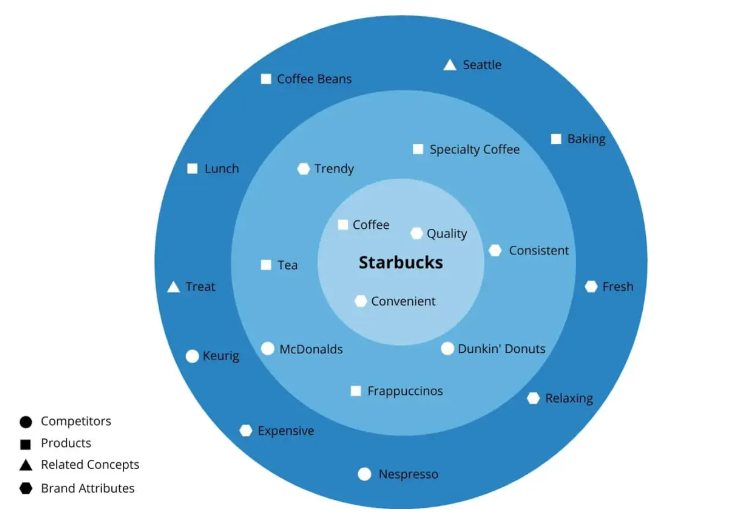
Where can you get the data? Qualitative and quantitative research will help you most. Search data is also very revealing: you can analyse not only what people search for in connection with your brand, but also what those same people search for otherwise.
The threat of an unclear vision: customers cannot form the right associations if they are unsure what your brand stands for. Define a clear style and brand positioning, and apply them across all of your brand’s channels.

