

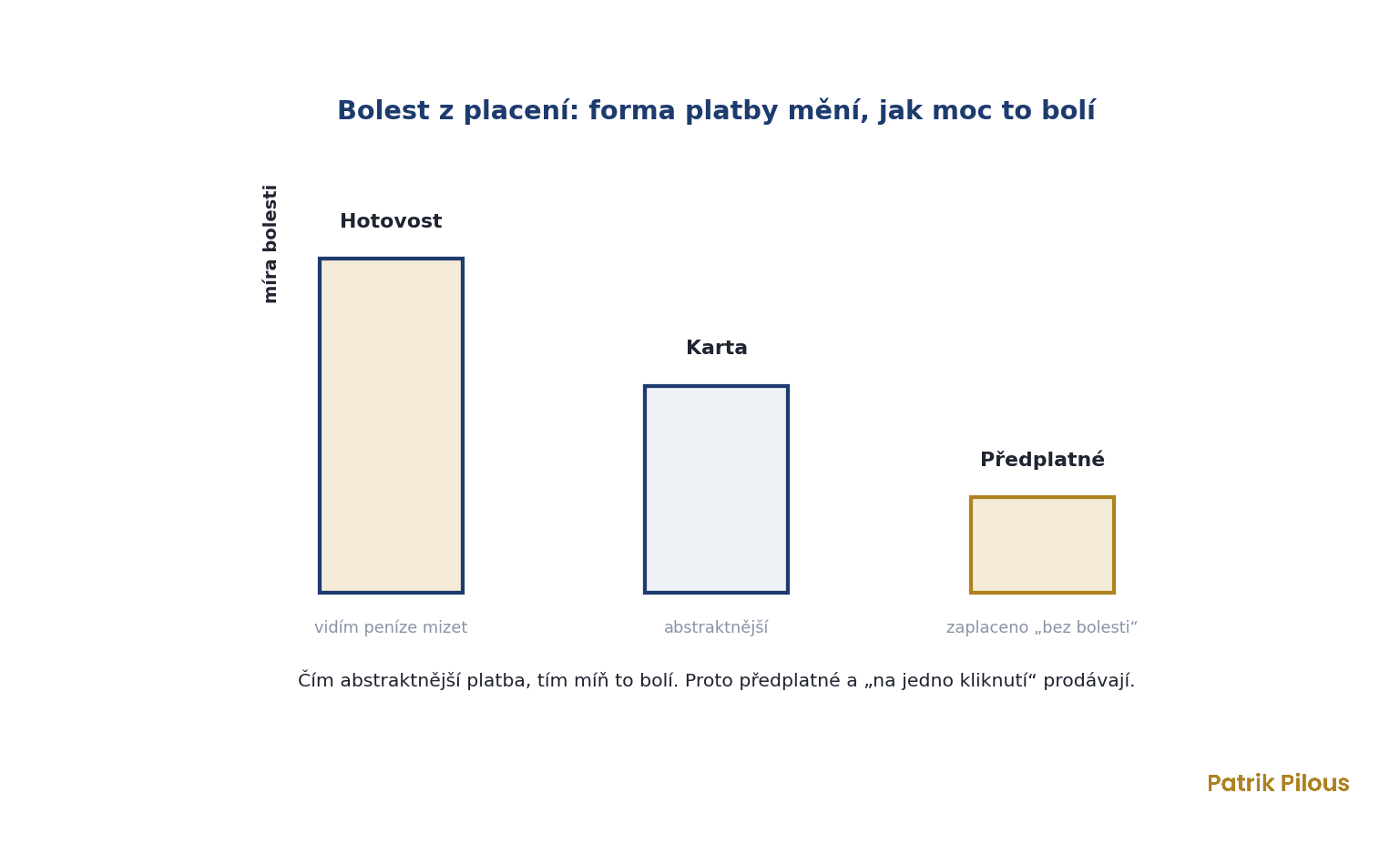
The pain of paying is a cognitive bias in which we experience parting with money as something genuinely unpleasant, almost like a mild pain. We do not like paying, and not only because of the size of the amount but also because of how much we see and feel the payment. The more visible and immediate the payment, for example counting banknotes out of your wallet, the more it hurts. The more abstract and distant it is, such as a subscription charged in the background, the less unpleasant it feels. For marketing and pricing, this has a key implication: the way you let a customer pay affects their willingness to buy just as much as the price itself.
Classification
- Cause (Cognitive Bias Codex): The need to act fast
- Mental area: Decision-making and emotional
- Marketing function: Price and value
- Customer journey: Decision and payment
- Cialdini’s principles: not applicable
- System 1 / System 2: System 1 (fast, automatic)
In a nutshell
- What it is: we experience paying as unpleasant, almost painful.
- Why we do it: the brain processes losing money much like physical pain.
- Where you will meet it: cash versus card, subscriptions, one-click payment.
- How to use it: make payment as invisible and painless as possible.
A real-life story
Brain scanning experiments using magnetic resonance imaging have also shown that paying really does activate areas of the brain associated with discomfort. The economists Drazen Prelec and George Loewenstein described this phenomenon in 1998 in a paper with the telling title The Red and the Black. It was they who helped popularise the term pain of paying. The core idea is simple: the brain hates losses, and money leaving your hands is exactly that kind of loss.
You know this from everyday life. When you pay cash in a pub, you feel specific banknotes disappearing from your wallet, and you remember the bill well. When you pay by card or phone, it is just a beep and numbers on a screen, and the spending somehow does not hurt as much. And a streaming subscription that quietly leaves your account every month often goes unnoticed, even though over a year you spend more than you would on individual titles you would buy after careful thought. Same money, different pain.
How the pain of paying works
A purchase decision is always a contest between the pleasure of what you get and the pain of what you give for it. When the pain of paying wins, you do not buy, even if you want the product. This pain does not depend only on the amount but mainly on how noticeable and immediate the payment is. The effect is closely linked to loss aversion, because paying is a form of loss, and losses hurt us roughly twice as much as gains of the same size. It is also connected to mental accounting, because it matters which “pot” the money comes from, and to the zero price effect, where the word free wipes out the pain of paying entirely.
Use in marketing
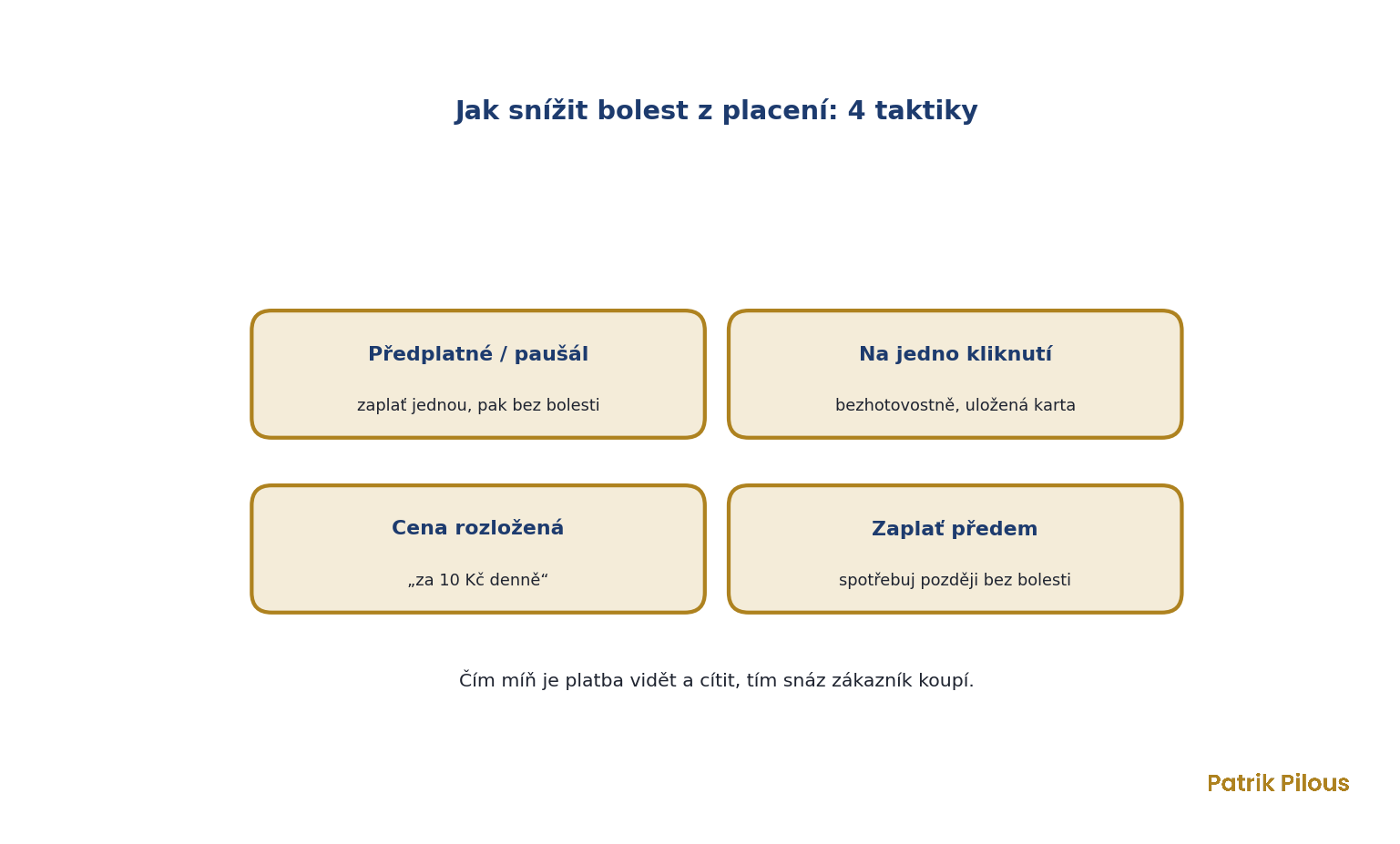
- Cashless and fast payment. A card, Apple Pay or one-click payment hurts less than cash. The fewer the steps and the more abstract the payment, the easier it is for the customer to buy.
- Subscriptions instead of one-off payments. A flat fee charged in the background is something the customer barely feels. That is why so many companies have moved from one-off sales to subscriptions.
- Pay now, consume later. Prepaid credit, a season pass or a holiday paid in advance separates the pain of paying from the pleasure. At the moment of consumption, people are no longer paying, so they enjoy it fully.
- Break the price down. “Just 10 CZK (about 0.41 EUR) a day” hurts less than 1,000 CZK (about 41 EUR) in one go, even though it is the same thing. This relates to framing and to how we read the left digit of a price.
- Bundles and flat fees. When everything is in one price, the customer does not feel the pain for each item separately. That is why people on all-inclusive holidays spend more than those paying meal by meal.
- Price as part of value. The right anchoring and context for a price reduce how painful it feels. This fits into the broader view of price in the marketing mix and makes use of anchoring.
How to reduce the pain of paying in practice
If you walk through the customer journey on your website, you will find plenty of places where paying hurts unnecessarily: a slow basket, having to type in card numbers, hidden fees revealed only at the end. Every bit of friction like this increases the pain and, with it, the number of abandoned baskets. On the other hand, four proven tactics ease the pain and can be used almost anywhere.
How to protect yourself from the pain of paying
- Make your spending visible. Write down what you do not feel with subscriptions and cashless payments. The pain that marketing dampens is actually your healthy brake.
- Review your subscriptions. Precisely because you do not feel them, they often keep running needlessly. Check them every so often.
- Treat prepayment as spending. Having paid earlier does not mean it is free.
How it interacts with other biases
The pain of paying rarely acts alone. Take a streaming subscription. A low monthly amount charged in the background almost erases the pain of paying. Your reluctance to cancel the service because you would “lose” access is loss aversion, and making yourself at home in your account adds the endowment effect. When the first month is free, the zero price effect kicks in and the barrier to entry drops to a minimum. Together they create an offer where you hardly feel you are paying at all. You can find more about how these biases work together in the encyclopedia of cognitive biases.
Frequently asked questions
What is the pain of paying?
A cognitive bias in which we experience parting with money as unpleasant, almost like a mild pain. The more visible and immediate the payment, the more it hurts.
Why does a card hurt less than cash?
Because it is more abstract. With cash, we see specific banknotes leaving; with a card, it is just a beep and numbers, so we do not feel the loss as much.
How can you use the pain of paying in marketing?
Through fast cashless payments, subscriptions, prepayment and broken-down pricing, in other words tactics that make paying invisible and more pleasant.
Euro amounts are approximate, converted at the Czech National Bank rate of 24.34 CZK per EUR on 29 October 2026.

