

The endowment effect is a cognitive bias in which we value things we own more highly than identical things we do not own. Once something is “ours”, we do not want to give it up and we want more for it than we would be willing to pay ourselves. Simply owning something raises its value in our eyes. When we buy a car, we try to push the price down, but when we later sell it, we often overestimate the car and its value. It happens to me too.
Classification of the cognitive bias
- Cause (Cognitive Bias Codex): Need to act fast
- Mental area: Decision-making
- Marketing function: Price and value
- Customer journey: Decision
- Cialdini’s principles: not applicable
- System 1 / System 2: System 1 (fast, automatic)
In a nutshell
- What it is: once we own something, we value it more than we would pay for it.
- Where you will come across it: free trials, test drives, easy returns, auctions, selling your own flat.
- How to use it: get the product “into the customer’s hands” so they start to see it as their own.
A real-life story
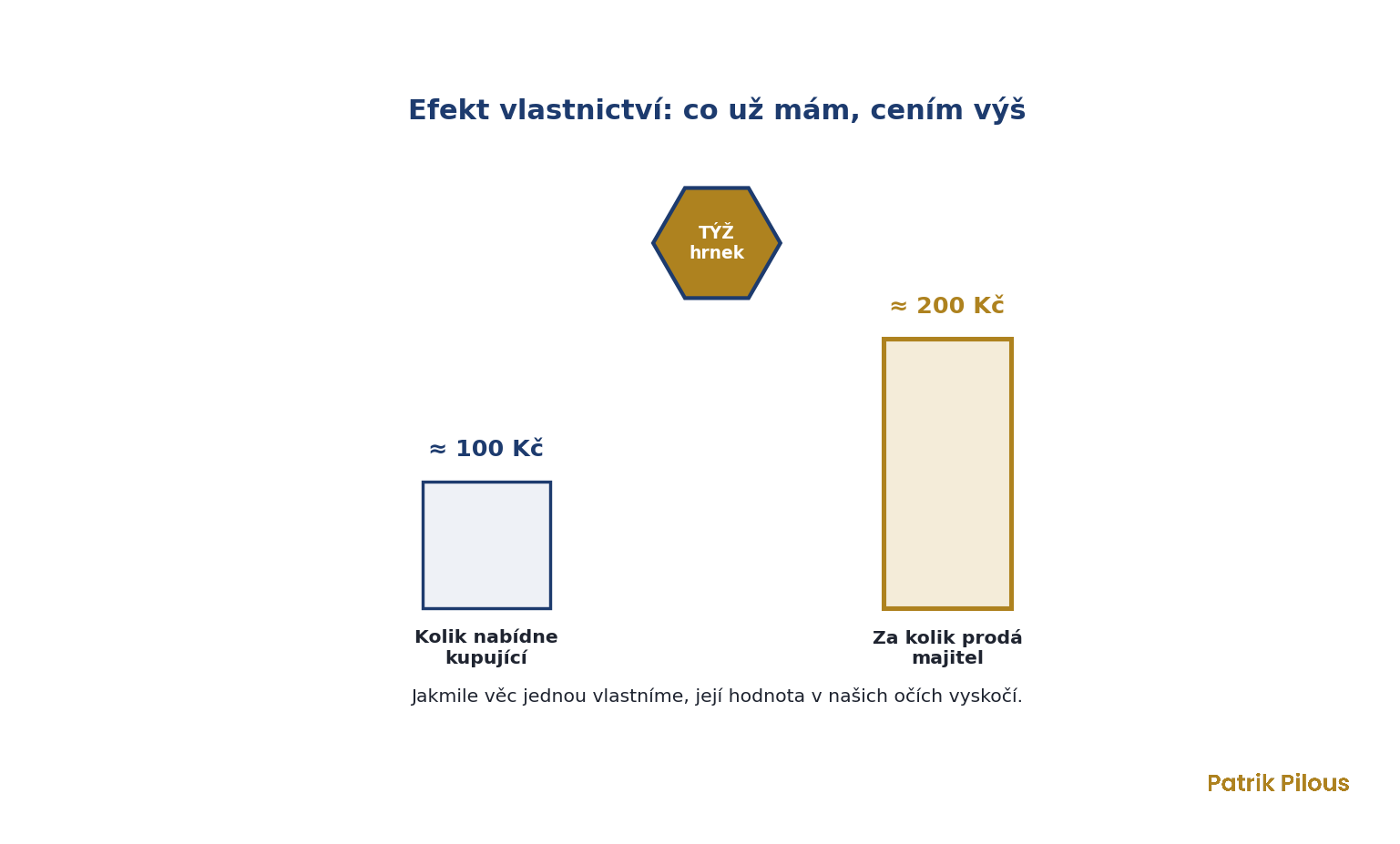
The classic evidence comes from an experiment run by Daniel Kahneman, Jack Knetsch and Richard Thaler. They gave mugs to some of the students and asked them how much they would sell them for. The other students, who had no mugs, were asked how much they would pay for the same mug. The result was consistent: the owners wanted roughly twice as much for the mug as those without one were offering. An identical mug, just a few minutes of ownership, and its value in the owner’s eyes shot up.
Imagine Marek on a weekend test drive. The car dealership lends him a car for two days “just to try it out”. Marek drives his children to school in it, parks it outside his house and gets used to the smell of the interior. By Monday it is no longer a car from the showroom, it is almost his car. Suddenly, handing it back and leaving empty-handed hurts. That is exactly what the dealership was counting on.
The effect also works in auctions. Anyone who leads an auction for a while starts to feel like the future owner, and then overpays so as not to lose “their” item. And animal shelters know very well that the offer “take a puppy home for the weekend, no strings attached” ends in adoption far more often than a visit to the kennel.
Fun fact: estate agents deal with the most expensive form of the endowment effect every day. Owners almost always value their house above the market price. They count not only the bricks, but also the memories and the feeling of “this is my home”, which buyers, of course, do not pay for.
How the endowment effect works
The effect is driven mainly by loss aversion. We perceive giving up something we already own as a loss, and a loss hurts roughly twice as much as an equal gain pleases us. Once we have acquired something, our reference point shifts and we measure everything from the new state of “I have it”. Closely related are the IKEA effect, where we also put our own work into something, and the sunk cost fallacy, where we hold on to something because of what we have already invested.
Use in marketing
- Free trials. A 30-day trial is not generosity, it is the endowment effect. Once customers have a service and use it, they do not want to lose it.
- Home trials and test drives. “Take it home” or a weekend with a car turns a prospect into an owner before they sign anything. If you have ever looked for a flat, you may have had an estate agent tell you “you’ll lie down here, make your coffee here and walk out onto the sunny terrace”. The agent is already creating the feeling that the flat is yours.
- Configurators and personalisation. When customers build or name a product themselves, they start to see it as their own even before buying it.
- Easy refunds. Paradoxically, a money-back guarantee increases sales. It removes the fear of buying, but once people have the goods, few actually return them.
- Saved data and settings. The more customers save and set up in an app, the more they “own” it and the harder it is for them to cancel.
- Samples and reservations. “Reserved for you” or a sample sent home creates a sense of ownership that people then do not want to lose. It is also linked to FOMO.
How to protect yourself from the endowment effect
- Ask as a buyer. “How much would I pay for this if I did not own it right now?” That brings the price back to reality.
- A test drive is not a need. The fact that you tried something and liked it does not mean you need it.
- Watch out for free trials. Set a reminder before the trial ends and decide with your head, not out of fear of loss.
The endowment effect is one of the most powerful silent salespeople. The best offer is the one where customers feel it already belongs to them. As a seller, use it fairly; as a buyer, be on your guard.
Frequently asked questions
What is the endowment effect?
A cognitive bias in which we value things we own more highly than identical things we do not own, and want more for them than we would pay ourselves.
How is the endowment effect related to loss aversion?
It stems directly from it. We perceive giving up something we own as a loss, and a loss hurts more than an equal gain, so we value the item more highly.
How can the endowment effect be used in marketing?
Through free trials, test drives, personalisation and easy returns. The aim is to get the product into the customer’s hands so they start to see it as their own.

