
FOMO stands for “fear of missing out”. It is a cognitive and emotional bias in which the thought of missing something drives us to act quickly. We do not buy because we necessarily want the product, but because we fear losing an opportunity, a discount or an experience that others have. The term gained importance with the rise of social media, when younger people experienced the FOMO effect with various events, for example: they saw footage from events and it affected them negatively, because they were sad to have missed something. Social media also highlights only the beautiful side of things (which made the effect on people even stronger).
For some people FOMO is so strong that it spills over into a form of anxiety and can significantly affect a person’s mental state and motivation to act.
Classification of the FOMO cognitive bias
- Cause (Cognitive Bias Codex): The need to act fast
- Mental area: Decision-making and emotional
- Marketing function: Scarcity
- Buying journey: Decision
- Cialdini’s principles: Scarcity
- System 1 / System 2: System 1 (fast, automatic)
In a nutshell
- What it is: the fear of missing an opportunity, which pushes you to act immediately. Another effect is anxiety about missed opportunities.
- Where you will see it: countdowns, “last items”, time-limited offers, social media and shared experiences.
- How to use it: show real scarcity and real time limits, but never make them up.
A real-life story
You open a flight booking app just to check prices. The flight you picked shows “last 2 seats at this price” and next to it “15 people are viewing this flight right now”. Your heart beats a little faster and suddenly you are booking something you were only considering a minute ago. That is FOMO live. You did not buy because of the flight, you bought because you feared losing that price. Most people do not even compare the price with the usual one. They simply act.
You know the second story from social media. You scroll and see that everyone was at an event you missed. An unpleasant feeling arrives that life is happening elsewhere, without you. You see that your good friends were there and did not tell you. That the girl you like most was there, and with someone else. And you are sitting at home on the sofa watching reels. This very feeling, also called FOMO syndrome, now drives a lot of impulsive decisions, from purchases to taking part in things you would otherwise skip.
And the third one is purely about sales. A clothing e-shop shows a message on an item you viewed: “last one left in your size”. Suddenly “maybe some day” becomes “better do it now”. Some e-shops even do this completely artificially. Scarcity is one of the strongest levers in sales.
How FOMO works
FOMO rests on two older biases. The first is loss aversion: losing an opportunity hurts us more than an equal gain pleases us, so we try to avoid it.
The second is social proof: when we see others doing or buying something, we take it as a signal that we should too. When one trustworthy person has a Dyson vacuum cleaner, we may let it pass, but when three more people have one, it influences us significantly. Add time pressure and the brain switches into “decide fast so you don’t miss out” mode, and careful thinking goes out of the window.
Scarcity also raises perceived value on its own. Whatever is available only in limited amounts, we automatically consider more valuable. That is why limited editions and “while stocks last” work even where an ordinary offer would leave the customer cold.
Use in marketing
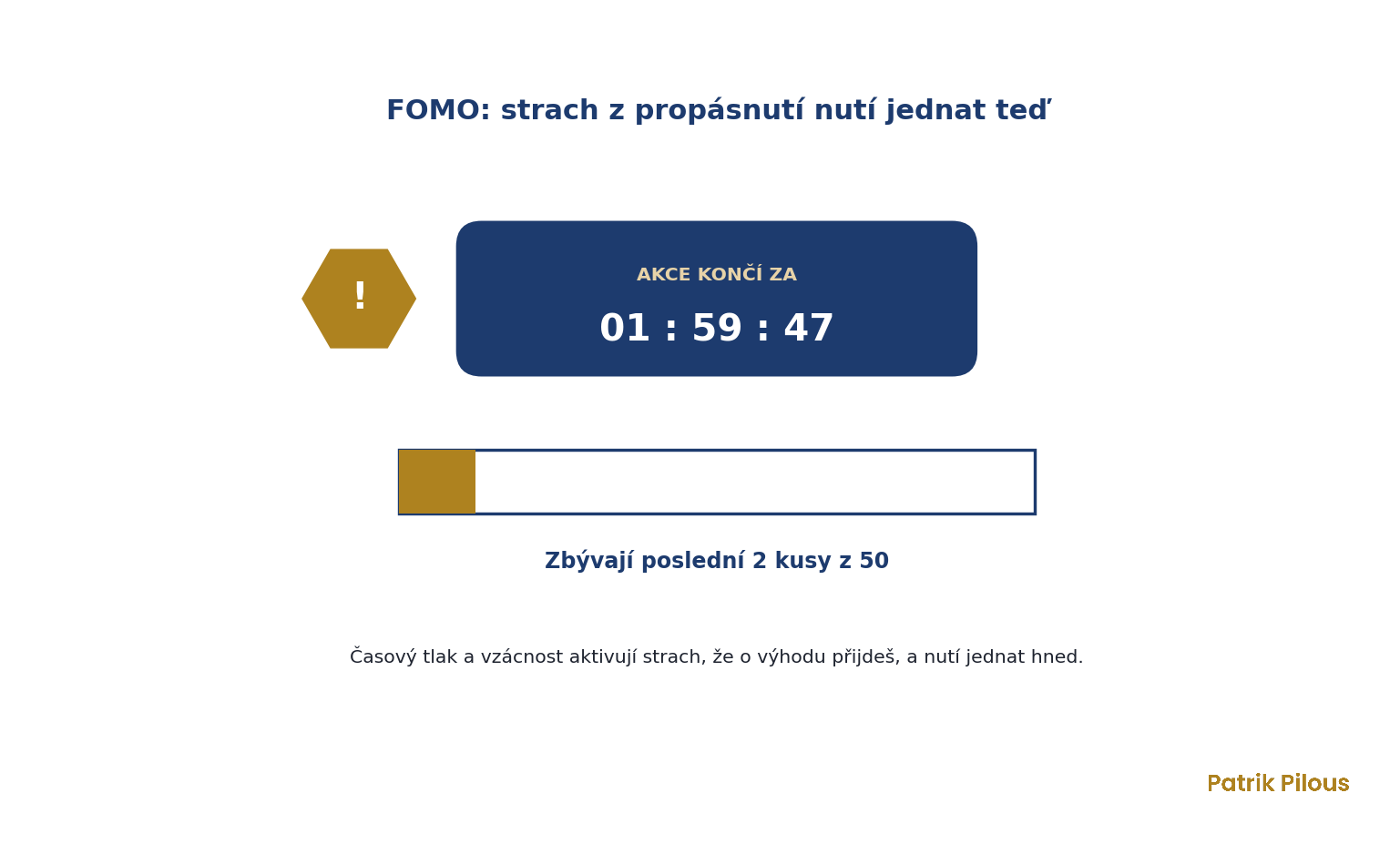
- Time-limited offers. A countdown and “today only” give the decision a deadline. Without a deadline, people put things off indefinitely.
- Limited stock. “Last 2 items” or “almost sold out” raise urgency. But it has to be true.
- Limited editions. Scarcity increases value by its very nature. Seasonal and numbered editions sell themselves.
- Early bird and pre-sales. “Only for the first 100” combines scarcity with a reward for speed.
- Live demand signals. “X people are viewing this right now” or “last bought 5 minutes ago” show that the opportunity is disappearing before your eyes.
- Combining with anchoring. A countdown next to a crossed-out price links the fear of losing a good price with a reference point. A powerful pair.
How to resist FOMO
- Take a break. Artificial urgency aims at immediate action. Postpone the decision by a day and see whether you really want it or just do not want to miss out. Set yourself daily blocks without social media.
- Check the scarcity. Countdowns often restart “by themselves” once they expire, and the “last items” stay in stock. Then false urgency is easy to see through. Always check elsewhere too, to see whether it really is the best deal.
- Go back to the need. “Would I buy this even if the offer lasted forever?” If not, it is FOMO, not a need.
Frequently asked questions
What does the abbreviation FOMO stand for and what does it mean?
FOMO comes from the English “fear of missing out”, in Czech “strach z propásnutí”, the fear that we will miss something.
What is the FOMO effect?
The tendency to act quickly and impulsively out of fear of missing an opportunity, a discount or an experience that others have.
What is FOMO syndrome?
A longer-lasting and more anxious form of FOMO, often linked to social media and the feeling that life is happening elsewhere, without us. It creates the feeling that life is slipping through our fingers.
How to use FOMO in marketing?
Through real time limits, limited stock, limited editions and live demand signals. Always truthfully, otherwise the customer loses trust.

