
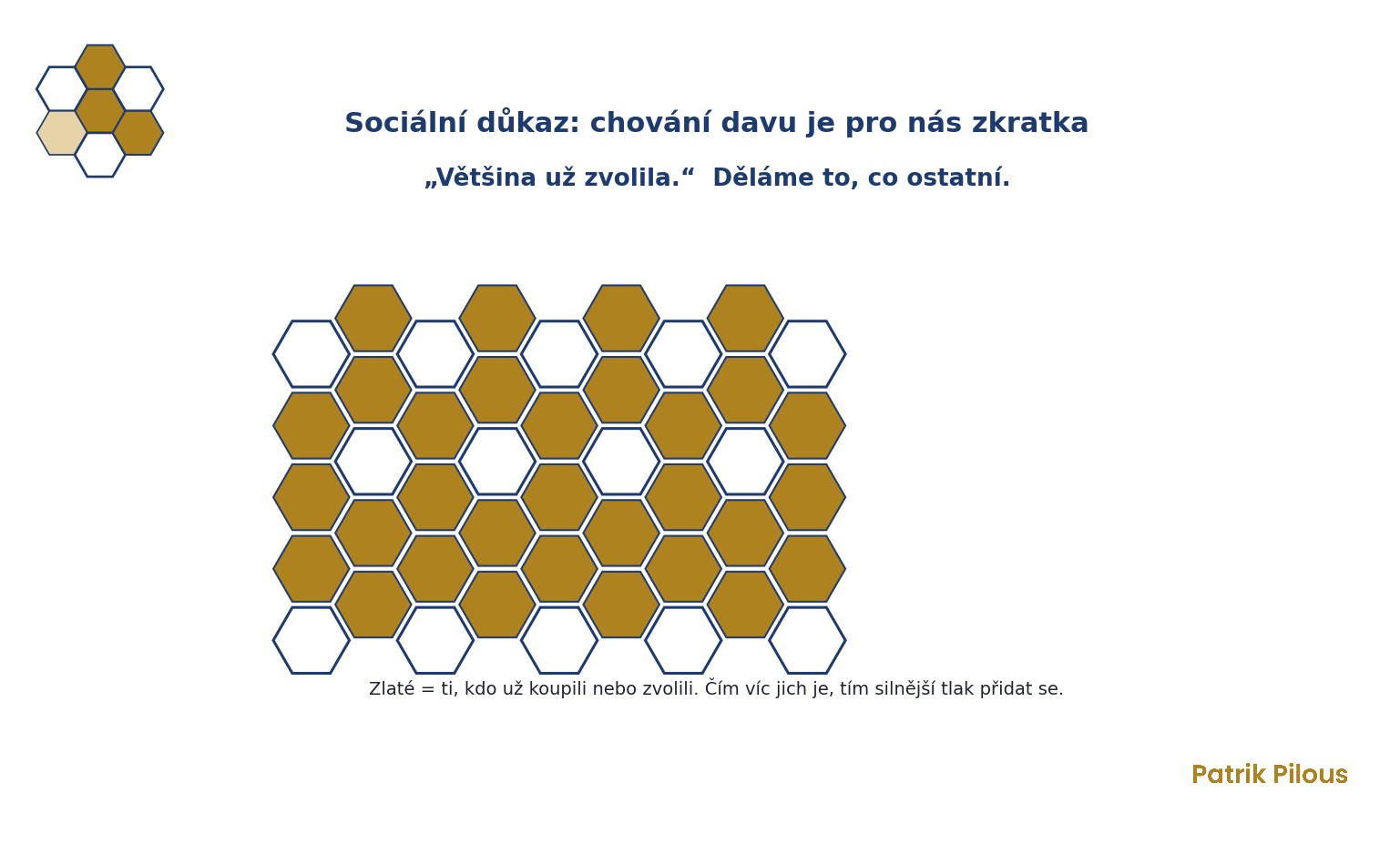
Social proof (sociální důkaz in Czech) is a cognitive bias that makes us consider correct whatever other people are doing. When we don’t know how to decide, we look at which way the crowd is going and take that as a shortcut to the “safe” choice. The more people do something, the more we believe it is good. And the better known or more trusted the people taking those steps are, the more it matters to us. A large part of marketing today runs on this bias. Probably the most visible example right now is influencers, who create social proof in exchange for a clearly defined reward.
Classifying the cognitive bias
- Cause (Cognitive Bias Codex): Not enough meaning
- Mental domain: Social
- Marketing function: Social influence
- Buyer journey: Consideration and decision
- Cialdini’s principles: Social proof
- System 1 / System 2: System 1 (fast, automatic)
In a nutshell
- What it is: we treat other people’s behaviour as a guide for our own.
- Where you’ll come across it: reviews, star ratings, “1,200 customers bought this”, queues, subscriber counts, UGC videos, influencers.
- How to use it: show how many people have already bought or recommend something, specifically and credibly.
A real-life story
You’re walking through an unfamiliar city in the evening, looking for somewhere to eat. You pass two restaurants side by side. One is half empty, the other almost full, with a few people waiting outside. Where do you go? Almost everyone heads for the full one, even though you know nothing at all about the quality of the food. You simply assume that if so many people go there, there must be something to it. That is social proof in its purest form. Going into a restaurant you’ve never been to and being the only one there just feels very strange.
The psychologist Solomon Asch demonstrated this with an experiment in which people had to compare the length of lines. When the others in the group (planted actors) deliberately gave the wrong answer, a large share of participants went along with the obviously incorrect choice, just to avoid going against the crowd. Robert Cialdini later included social proof among his six principles of persuasion. In one famous test, a sign saying “75% of guests in this room reuse their towels” increased willingness to save towels more than an appeal to the environment did.
How social proof works
It is a shortcut for dealing with uncertainty. When we lack enough information or time, it is rational to follow what others are doing, because they may know something we don’t. The problem is that the crowd can be wrong and we still join in. Social proof is strongest in two situations: when we are unsure and when we are looking at people similar to us. That is why “verified customer” reviews work better than abstract star ratings. Closely related are the herd effect and priming, which determines what we notice in the first place.
Use in marketing
- Numbers and counts. “Join 12,000 subscribers” or “bestseller” provides more reassurance than even the best description. A specific number is more credible than a vague “thousands of happy customers”.
- Reviews and ratings. Authentic, specific reviews from people similar to the customer are the strongest form. They work well combined with PR, where a third party speaks on behalf of the brand.
- Logos and references. “Trusted by” with the logos of well-known clients transfers their authority to you, much like in branding.
- Influencers and recommendations. A recommendation from someone the audience trusts is social proof and liking rolled into one.
- Live notifications. “Someone just bought…” shows the crowd moving in real time. It works, but only as long as it is true.
How to protect yourself from social proof
- Ask about the source. Who exactly is recommending it, and can it be verified, or is it just a number without context?
- Separate popularity from quality. Just because a lot of people buy something doesn’t mean it is the best choice for you.
- Watch out for fake social proof. Bought reviews and inflated numbers are common. Look for details that are hard to fake.
Frequently asked questions
What is social proof?
A cognitive bias in which we consider correct whatever the majority is doing and treat other people’s behaviour as a guide for our own decisions.
What types of social proof are there?
Reviews and ratings, customer or subscriber counts, references and client logos, recommendations from experts and influencers, and crowd behaviour in real time.
How can you use social proof in marketing?
Show specific and credible numbers, authentic reviews from similar customers, reference logos and recommendations from trusted people.
What is fake social proof?
Bought reviews, inflated numbers or made-up notifications. They boost sales in the short term, but once exposed they damage trust in the brand.

