

Duplicate content is when the same or very similar text (or HTML content in general) is available at more than one address, either within one website or across several websites. The problem also often arises when pages of a different nature are given an identical heading and meta title. For example, the main category, a subcategory, the homepage and an article all have “Sportswear” as their heading. This creates duplication on the website. Firstly, it confuses Google and makes it harder to reach the best page. Secondly, it costs traffic to the duplicate pages, which could have been indexed and visited if they had the right title and heading.
The problem is not that Google penalises it across the board, as is often wrongly claimed. The problem is that the search engine does not know which version to treat as the original and which one to show in the results. The strength is split between several addresses instead of building up one. The result is lower rankings, a wasted crawl budget and confusion in the index. For e-shops, it is one of the most common technical problems of all.
Where the word comes from
The word duplicate comes from the Latin duplex, meaning double or twofold. A duplicate is a copy, a second version of the same thing. On a website, this is exactly what it means: content that exists in several copies in different places. It need not be deliberate or theft. Most often, duplication happens entirely by accident, through a technical oversight. That is what makes it so insidious, because you often do not know about it until it drags down your SEO results.
A short history of duplicate content
Duplication has troubled search engines from the start, but the major turning point came in 2011 with Google’s Panda update. It began to penalise websites with thin and copied content heavily, meaning pages that offered nothing of their own.
Panda taught the whole industry that originality and added value matter. This emphasis on unique and useful content is stronger today than ever, especially in a world where anyone can generate text at scale, as I explain in my article on how SEO and GEO work.
How duplicate content works from an SEO perspective
Most often, duplication does not come from copying but from variants of one and the same URL. The same page is available via http and https, with and without www, with and without a trailing slash, or with filter parameters after a question mark. For a person, it is the same page. For a bot, it is four different addresses with the same content.
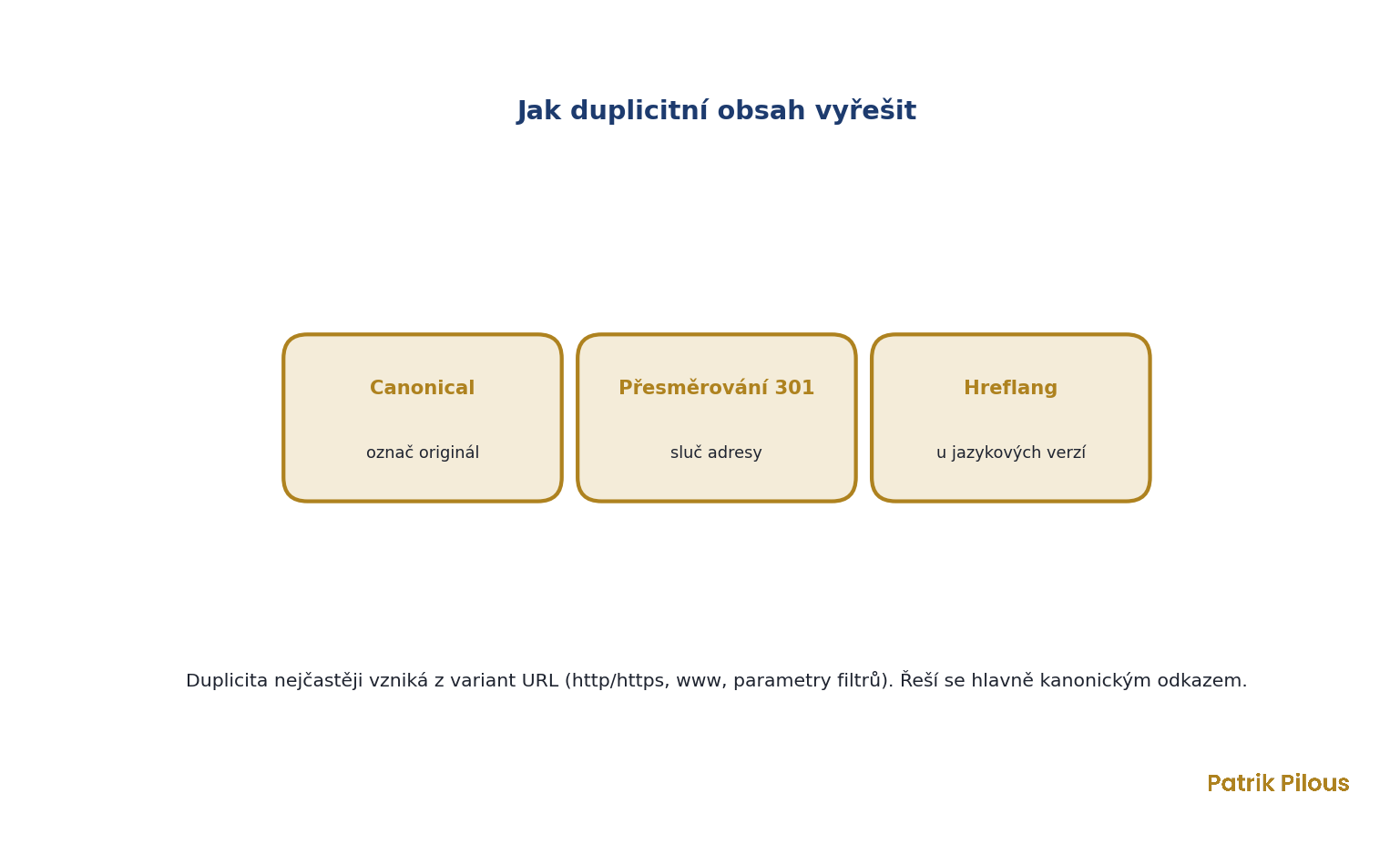
The main tool for fixing this is the canonical link, which tells search engines which version is the original. For permanently removed duplicates, you use a 301 redirect, and for language versions you use hreflang so that Google does not mistake them for duplicates. A clear website structure also reduces the risk of duplication in itself.
Another common cause is that nobody on the project understands SEO even a little. Many different pages end up with duplicate titles and headings. The right approach is to crawl the whole website, identify the priority pages and remove the duplicates.
Why duplicate content matters
Duplication robs you of results without you knowing it. Instead of one strong page that could rank high, you have several weak ones taking rankings from each other. This is called cannibalisation, and it is a common reason why a website stalls despite having good content.
Finding and cleaning up duplicates is therefore part of basic technical work and a standard part of every SEO audit. It is also linked to keywords, because cannibalisation happens when several pages target the same keyword at once.
Where it goes further
Duplicate content is really the technical form of a simple truth: if you say the same thing in ten places, it loses its force. The value lies in the original, not the copy. It is also a question of trustworthiness, a pillar of E-E-A-T, which copied content undermines. In a world where artificial intelligence churns out text by the thousands, uniqueness and your own point of view become the most valuable things you have. This applies not only to Google but also to the models that choose whom to cite. They have no reason to reach for the tenth copy of the same thing either.
Most common mistakes
- Believing that Google penalises duplicate content across the board. It does not, it just does not know which version to show.
- A missing canonical link on an e-shop with thousands of URL variants from filters and sorting.
- Handling duplicates by blocking them in robots.txt instead of using canonical tags or redirects.
- Identical product descriptions taken from the manufacturer, which another fifty e-shops also have on their websites.
Questions about duplicate content
What is duplicate content?
The same or very similar content available at more than one address. The search engine then does not know which version to treat as the original and which one to show in the results.
Does Google penalise duplicate content?
Not across the board. The problem is rather that strength is split between several addresses and that it is unclear which version to index. The exception is deliberately copied, worthless content.
How do you fix duplicate content?
Most often with a canonical link that marks the original. For permanently removed addresses, with a 301 redirect, and for language versions, with hreflang.

