
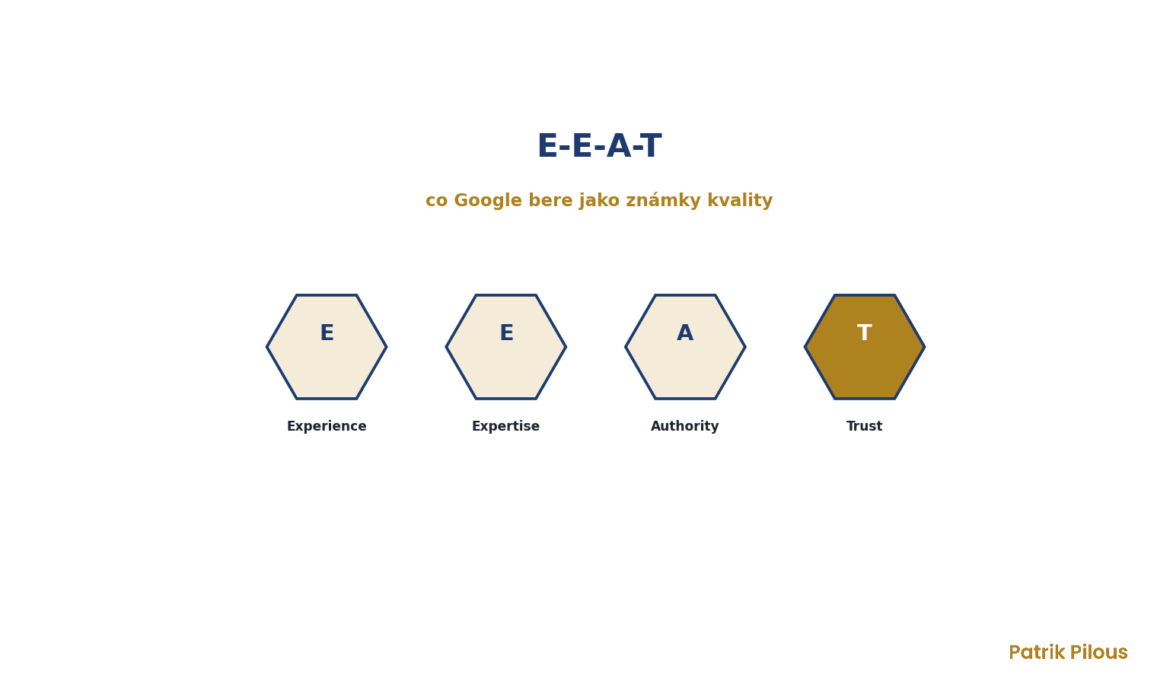
E-E-A-T is an acronym made up of four English words: Experience, Expertise, Authoritativeness and Trust.
It is a set of criteria Google uses to judge whether content is high quality and trustworthy. It is not a direct ranking factor that can be measured with a single number, but a framework followed by human quality raters and by the algorithms themselves. The more important (or risky) the topic, the more E-E-A-T matters. For health and finance it is crucial; for a recipe for a sweet bun, less so. For SEO it is a reminder that good content must be backed by a trustworthy source. That is why, as an SEO consultant, I always want all of a company’s assets to be clearly visible and readable for search engines (if you have renowned lawyers, praise them and put them on show, and the same goes for doctors).
Where the term comes from
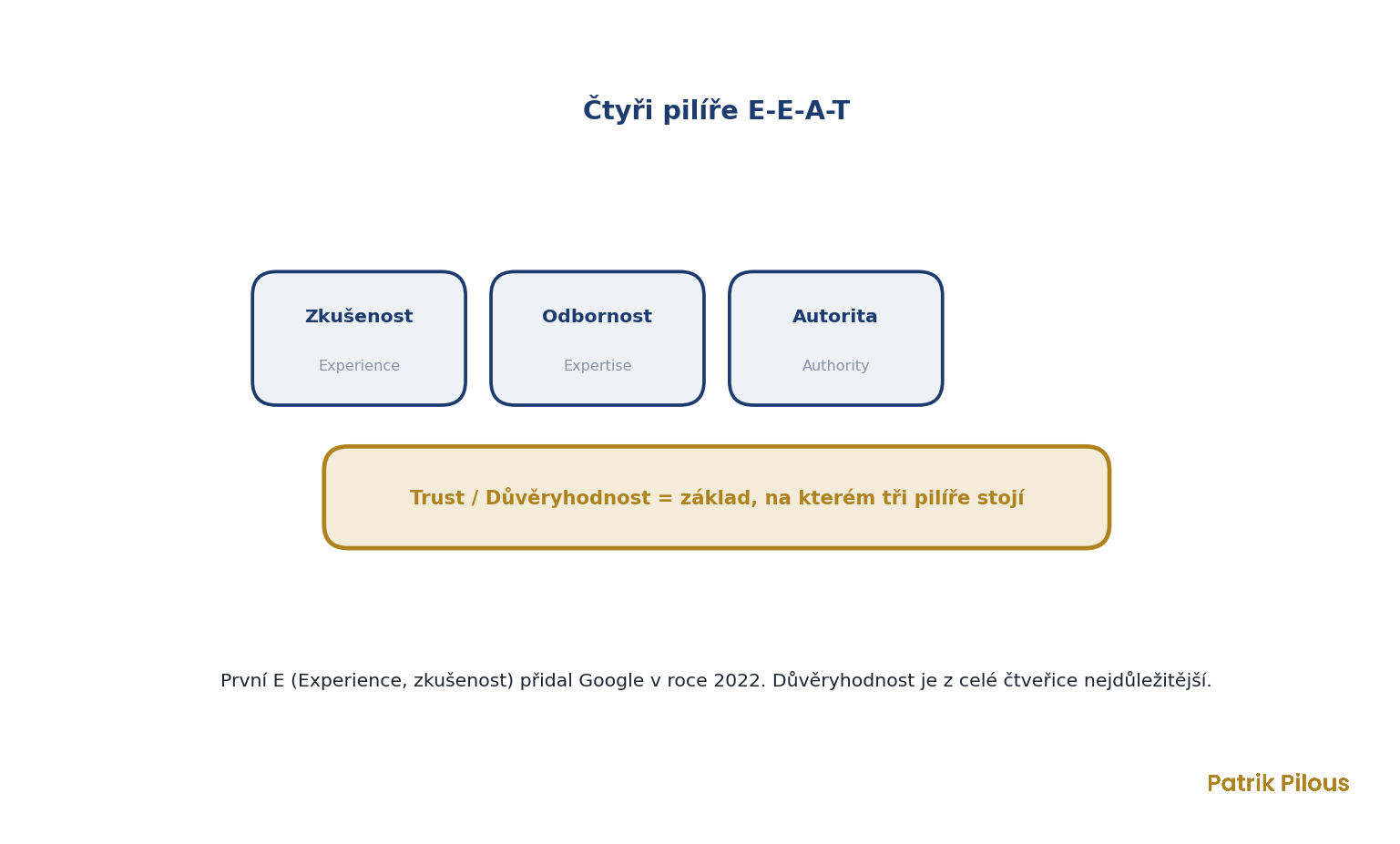
Each letter of the acronym carries its own meaning. Experience is first-hand experience, meaning the person writing about a product has actually used it. Expertise is deep knowledge of the topic. Authoritativeness is recognition from others in the field, close to how strongly the authority effect influences us. And Trust is the overarching pillar on which everything else rests. Without trust, the rest is meaningless.
A short history of E-E-A-T
Originally it was just E-A-T, three letters. The acronym first appeared in 2014 in the Search Quality Rater Guidelines, a manual for people who manually assess the quality of search results for Google. It quickly became one of the most cited terms in SEO.
In December 2022, Google added a second E, Experience, at the beginning, creating today’s E-E-A-T. It was a response to the flood of content written from behind a desk without real experience, and this emphasis is only growing as the role of artificial intelligence in search increases.
How E-E-A-T works from an SEO perspective
E-E-A-T cannot be switched on with a single setting; it is built over the long term. You demonstrate expertise through the depth and accuracy of your content and through a named author who has something meaningful to say about the topic. Authority is confirmed by backlinks and mentions from elsewhere, which is also reflected in domain authority.
Trust then rests on details: contact information, references, a secure website, cited sources. In practice, it is a combination of high-quality copywriting and an honest presentation of who is behind the content. No shortcut works here, because trust cannot be bought, only earned.
Why E-E-A-T matters
E-E-A-T is Google’s way of trying to tell content from a genuine expert apart from text that merely pretends to understand something. In an era when anyone can generate thousands of words in a few seconds, trustworthiness becomes the most valuable thing you have. That is exactly why I treat it as the core of a long-term strategy in every SEO audit.
Psychology plays a strong role here too. When a website comes across as trustworthy, people believe it thanks to social proof and the halo effect before they even check the facts. Trust signals therefore help not only in Google’s eyes, but above all in people’s eyes.
Where it goes further
E-E-A-T is really just a modern name for what has always been called reputation: whom we trust, whom we listen to and whose word means something to us. Google is trying to imitate this human trust in an algorithm. But beware of thinking traps. A claim we hear repeatedly starts to sound credible thanks to the illusory truth effect, even when it is not true, and we readily believe what we already think because of confirmation bias. Real trustworthiness is therefore not about sounding confident, but about genuinely having something to stand behind. And that applies to people as well as to artificial intelligence, which today chooses whom to cite.
Most common mistakes
- Content without a named author, or by someone with no connection to the topic.
- Missing source citations and links that would support claims and strengthen authority.
- A website without contact details, references and basic trust signals.
- Relying on AI-generated text without real experience or expert review, in other words without the first E.
Questions about E-E-A-T
What is E-E-A-T?
An acronym of Experience, Expertise, Authoritativeness and Trust. It is a framework Google uses to assess the quality and trustworthiness of content.
Is E-E-A-T a ranking factor?
It is not a direct factor that can be measured with a single number. It is a set of criteria for quality raters and algorithms. It matters most for topics around health and finance.
What is the difference between E-A-T and E-E-A-T?
E-E-A-T is the newer version from December 2022, in which Google added the first E, Experience, meaning first-hand experience. The original E-A-T had only three letters.

