

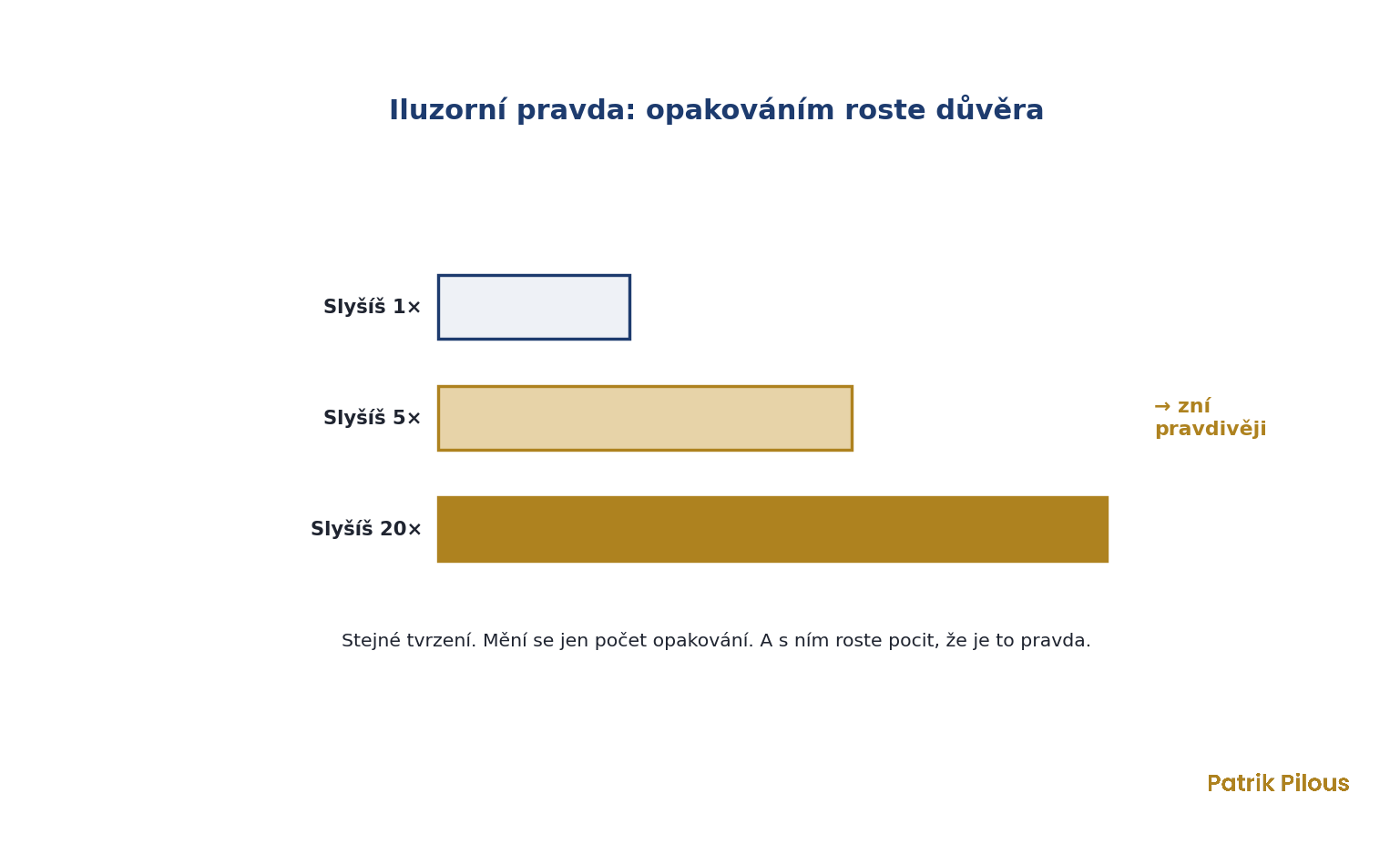
The illusory truth effect is a cognitive bias in which we start to believe a statement we hear repeatedly, even when it is not true. In our minds, repetition quietly replaces evidence. The more often we have heard something, the truer it sounds to us, regardless of whether it actually is. Propagandists have used this effect throughout human history.
Classification of the cognitive bias
- Cause (Cognitive Bias Codex): Too much information
- Mental domain: Memory and beliefs
- Marketing function: Memory and communication
- Customer journey: Consideration
- Cialdini’s principles: not applicable
- System 1 / System 2: System 1 (fast, automatic)
In a nutshell
- What it is: a repeated statement starts to sound true to us, even when it is false.
- Where you’ll come across it: slogans, propaganda, fake news, brand claims repeated over and over.
- How to use it: repeat one true key message across channels and over time.
Real-life stories
The darkest example comes from the history of propaganda. The principle that a lie repeated a hundred times becomes the truth turned into a notorious tool of the totalitarian regimes of the twentieth century. It was not about evidence or arguments. It was about sheer repetition. When people hear the same claim again and again from many sides, it stops sounding like an opinion and starts to feel like common knowledge.
But we don’t have to go that far. Think of the advertising slogans stuck in your head without you wanting them there. Many of them are claims about quality, freshness or value that nobody has ever proved. Yet you sort of believe them, because you have heard them a thousand times.
Imagine a grandmother who receives the same alarming message by email for the sixth time, and every time she also sees it shared on social media. Even though the message is nonsense, after several encounters she starts to take it seriously. “It’s everywhere, after all.” That is not stupidity. It is the illusory truth effect, and absolutely everyone falls for it.
Fun fact: the trickiest part is that the effect works even for claims we deep down know are doubtful. Research shows that repetition increases credibility even among people who know the subject well. Repetition simply sneaks past critical thinking through the back door.
How the illusory truth effect works
It was first described scientifically by Lynn Hasher and her colleagues back in 1977. The key, once again, is processing fluency. When we have heard something many times, the brain processes it easily and quickly, and it mistakes this pleasant feeling of ease for truth. In other words, the brain confuses “I know this and it’s easy to process” with “this is true”. The effect is closely related to the mere exposure effect, where repetition increases liking, and to priming. And when the people around us repeat the same claim too, social proof joins in and the effect grows stronger.
Use in marketing
- One main message. Choose one key message about your brand and repeat it everywhere, and I mean aaall the time. Fragmented communication doesn’t stick, consistent communication does. Consistency is essential in marketing.
- Slogans and claims. A short, repeated sentence gradually settles in as the “truth” about a brand. I write about creating them in my article on advertising slogans.
- Repetition in a campaign. The same message shown several times works better than many different messages, each shown only once. Frequency beats variety.
- Repetition from multiple sources. When the website, emails, social media and reviews all say the same thing, the claim gets stronger. Combined with social proof, it is powerful.
- PR and media. Repeated media coverage turns a claim about a brand into something “everyone knows”. That is what good PR is for.
- The ethical line. What you repeat should be the truth. A repeated falsehood works in the short term, but once exposed it destroys trust, and in the Czech Republic it may even be illegal as misleading advertising.
How to protect yourself from the illusory truth effect
- Ask for evidence, not a count. Having heard something a hundred times is not an argument. How many times ≠ whether it’s true.
- Check the source. For important claims, trace their origin. You will often find that the same thing is just being copied over and over without verification.
- Watch out for familiarity. The feeling of “I know this already” is the biggest trap when it comes to disinformation. Familiarity is not truth.
The illusory truth effect is the reason repetition is so powerful in marketing and, at the same time, so dangerous in the world of disinformation. As a brand, repeat what is true and you will earn trust. As a person, learn to tell the difference between what has been verified and what you have merely heard often.
Frequently asked questions
What is the illusory truth effect?
A cognitive bias in which we start to believe a repeated statement is true, even when it is not. In our minds, repetition replaces evidence.
Why does repetition work?
The brain processes a familiar claim easily and mistakes this feeling of ease for truth. The technical term is processing fluency.
How can you protect yourself from the illusory truth effect and disinformation?
Ask for evidence rather than counting repetitions, check the source of claims and don’t mistake a feeling of familiarity for truth.

