

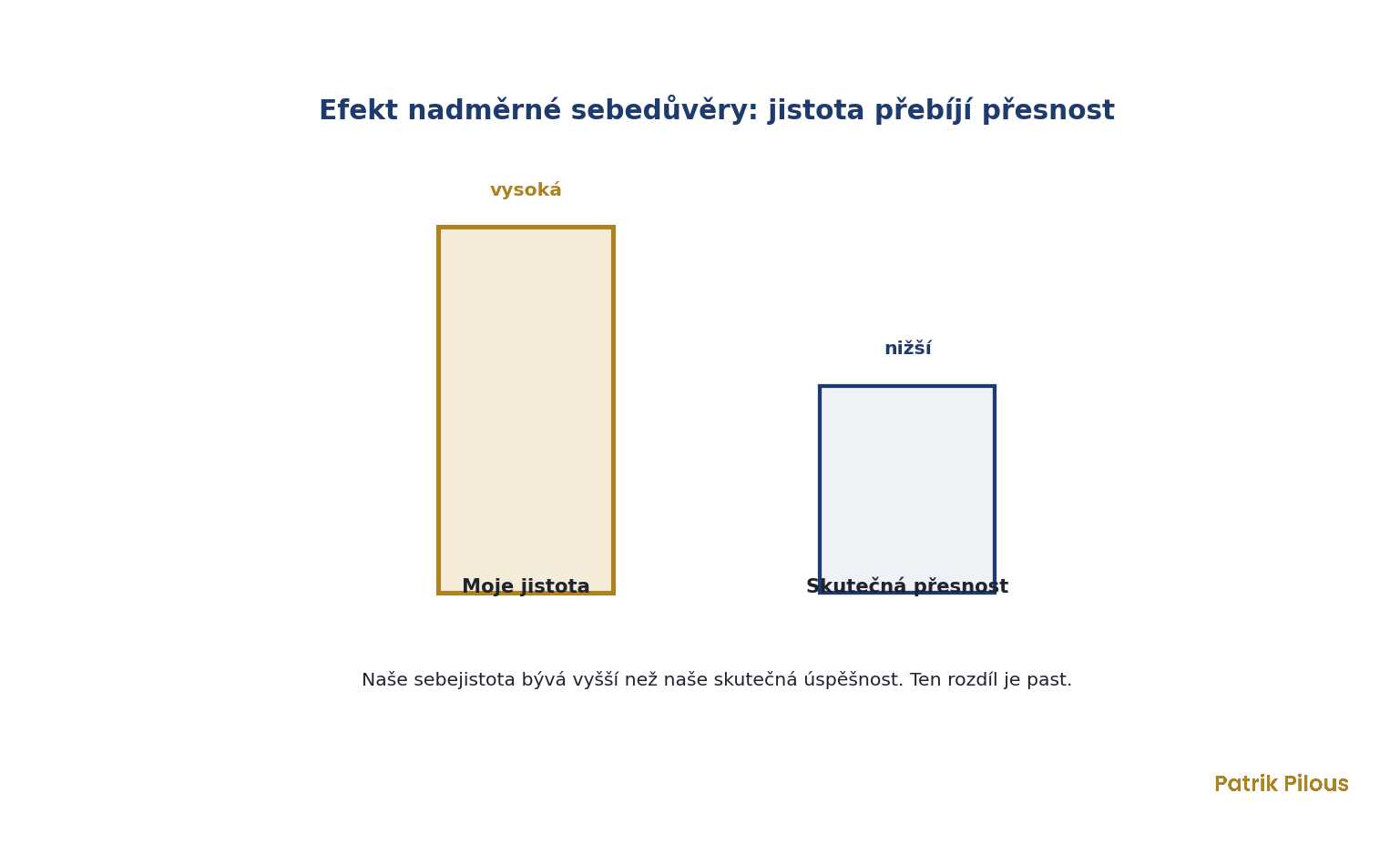
The overconfidence bias is a cognitive bias in which we are more certain of ourselves and our estimates than our actual track record justifies. We overestimate our abilities, our knowledge and how well we can predict the future. Most people consider themselves above-average drivers, businesspeople or judges of character, which obviously cannot be true for everyone. This excessive certainty pushes us into decisions and action, which can be useful, but it often costs us money, time and unnecessary mistakes.
Classification of the cognitive bias
- Cause (Cognitive Bias Codex): The need to act fast
- Mental area: Self-assessment and judgement
- Marketing function: Ego and beliefs
- Buyer journey: Consideration
- Cialdini’s principles: not applicable
- System 1 / System 2: System 1 (fast, automatic)
In brief
- What it is: our confidence tends to be higher than our actual success rate.
- Why we do it: self-confidence encourages us to act and protects our ego.
- Where you’ll encounter it: deadline estimates, planning, betting, “it’ll work out for me”.
- How to use it: offer a low barrier to trying where people overestimate their ability to follow through.
A real-life story
Overconfidence was also studied in depth by Nobel Prize winner Daniel Kahneman in his 2011 book Thinking, Fast and Slow. He describes the so-called planning fallacy, where we consistently underestimate how long something will take and how much it will cost, even though we know from experience that it almost always overruns. Research also repeatedly shows that the vast majority of drivers rank themselves as above average, which is statistically impossible.
Imagine Klára, who has resolved to use a new workout app every day. When she buys an annual subscription, she is absolutely convinced of it. The reality, however, is that her enthusiasm fades after a few weeks. She bought the subscription mainly because of her overconfidence in how persistent she would be. And gyms and apps alike count on this overestimation.
How the overconfidence bias works
Self-confidence is the brain’s fuel for action. Without it, we would never embark on anything uncertain. The problem is that our inner sense of certainty is driven more by how good a story we tell ourselves than by hard data. That is why confidence often runs ahead of actual accuracy. The effect is closely related to the Dunning-Kruger effect, where the least experienced overestimate themselves the most, and to confirmation bias, because we mainly notice whatever confirms our certainty.
Use in marketing
- Low barrier to entry. People overestimate how much they will use something. Free trials and subscriptions are built on this.
- Subscriptions and memberships. Customers buy into a future version of themselves that will be more active than they will actually be.
- Tools for DIYers and creators. “You can do it yourself” is appealing because we overestimate our abilities.
- Betting and competitions. The belief that “it’ll work out for me” drives participation in lotteries and games.
- Realistic onboarding. Helping customers reach their first success turns inflated expectations into genuine satisfaction.
How to guard against overconfidence
- Start from the past. Ask how similar plans turned out before, not how you want them to turn out now.
- Build in a buffer. Add a buffer to deadlines and budgets for the unexpected.
- Look for critics. Get the view of someone who will try to challenge your plan.
How it connects with other biases
The overconfidence bias forms a family with two relatives you will already find on this website. The Dunning-Kruger effect explains why the least experienced are the most confident, and confirmation bias then feeds our certainty because we mainly see evidence in our favour. In marketing, free trials and subscriptions make excellent use of this. Thanks to overconfidence, customers buy access to their ideal future selves, and if the product also triggers the endowment effect, they stay with it even if they don’t use it that much.
Frequently asked questions
What is the overconfidence bias?
A cognitive bias in which we are more certain of ourselves and our estimates than our actual track record justifies.
What is the planning fallacy?
A form of overconfidence in which we consistently underestimate how long a task will take and how much it will cost, even though past experience tells us otherwise.

