
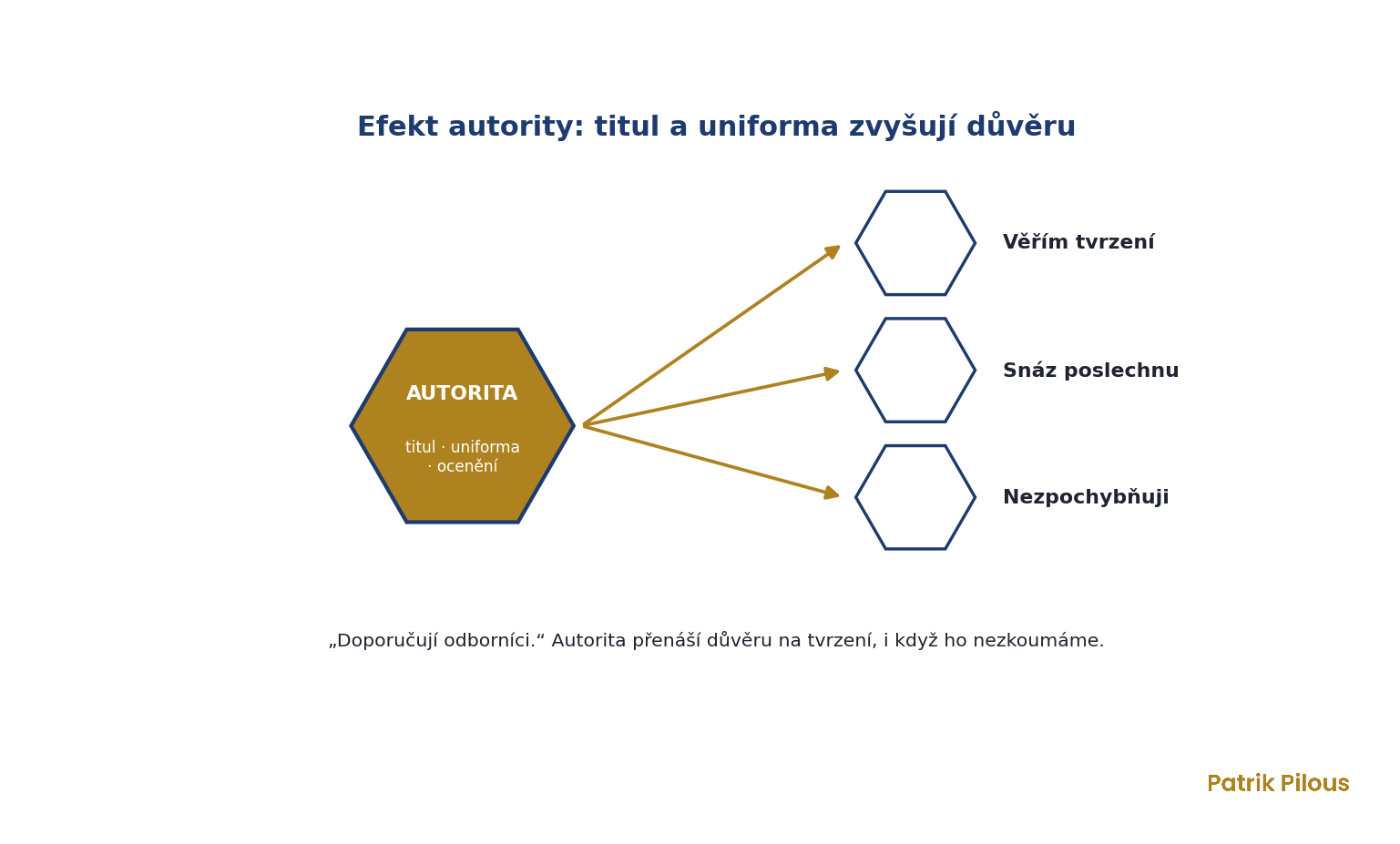
Authority bias is a cognitive bias in which we give more weight to the opinion of someone we see as an authority and look less closely at whether they are actually right. A title, a uniform, an award or a confident manner is enough to make us believe a claim and act on it more readily. I used to go to the doctor thinking they were always right, but only experience shows you that it is often the other way round.
Classifying the cognitive bias
- Cause (Cognitive Bias Codex): Not enough meaning
- Mental domain: Social
- Marketing function: Social influence
- Buyer journey: Consideration
- Cialdini’s principles: Authority
- System 1 / System 2: System 1 (fast, automatic)
In a nutshell
- What it is: we trust an authority’s opinion more without checking it.
- Where you’ll see it: “recommended by doctors”, titles, media logos, an expert in a white coat.
- How to use it: show credible expertise and references, but never fake them.
A real-life story
For decades, toothpaste adverts showed actors in white coats saying “recommended by dentists”. The coat did not make the toothpaste any better, but it sold it. A symbol of authority was enough to create trust. “If it’s good enough for dentists, it must be the right choice.”
Much harder evidence came from the psychologist Stanley Milgram. In his famous experiment, ordinary people, instructed by a man in a white coat, gave another person (in fact an actor) what appeared to be painful electric shocks, simply because an authority told them to. They did not follow their own judgement, they followed the role. This shows how strongly authority affects us, even when it goes against common sense. It is often linked to Nazi Germany, where practically everyone (except one) obeyed someone above them. And we know how Germans are about following rules. It did not end well.
And one example from everyday life: when a person in a suit in a smart office gives you financial advice, you take it more seriously than the same advice from a friend in a T-shirt, even if your friend understands money better. The trappings of authority often outweigh the substance.
How authority bias works
It is a shortcut for uncertainty. When we cannot judge for ourselves what is right, it makes sense to rely on someone who understands it better. The problem is that the brain reacts to signals of authority (a title, a uniform, confidence), not to real expertise. And those signals are easy to fake. Authority also often spills over into the halo effect: if someone seems like an expert in one thing, we trust them in areas they know nothing about. Social proof is closely related, because both are the shortcut “I don’t need to think, someone trustworthy said it”.
Be especially careful when it combines with the Dunning-Kruger effect. The least competent people often come across as the most confident, and confidence is exactly one of the signals we mistake for authority.
Using it in marketing
- Expertise and certification. Real titles, certificates and awards increase trust. “Laboratory tested”, “recommended by experts”, as long as it is true.
- References and media. “As featured in” logos or well-known clients transfer third-party authority. PR works in a similar way, with someone else speaking for you.
- An expert as the face. A founder or specialist with clear qualifications comes across as more credible than an anonymous brand.
- Content that proves knowledge. High-quality articles and data build authority over the long term, and more cheaply than advertising. That is the foundation of strong branding.
- Visual signals. A professional website, clean design and industry language signal competence on their own, before anyone even reads the content.
- Authority plus social proof. “Recommended by experts and 12,000 customers” combines the two strongest trust shortcuts.
How to protect yourself from authority bias
- Separate the role from the argument. Ask yourself: “Is this true because of the facts, or because of who is saying it?” Is the authority real, or just dressed up as one, like in an advert?
- Check real expertise. A title in one field does not mean competence in another. Look for real results, not trappings. Doctors are a good example again. People trust them so much that doctors do better than any other profession in both local and national elections. Yet they have no particular competence for it.
- Beware of confidence. A confident voice is not proof. It is often a sign of the opposite.
Frequently asked questions
What is authority bias?
A cognitive bias in which we give more weight to the opinion of a perceived authority and look less closely at whether they are actually right.
What is an example of authority bias?
An actor in a white coat “recommending” a product in an advert, or Milgram’s experiment, in which people obeyed authority even against their own judgement.
How can you protect yourself from authority bias?
Separate the speaker’s role from the content of the claim, check their real expertise in the field and do not mistake confidence for competence.

