

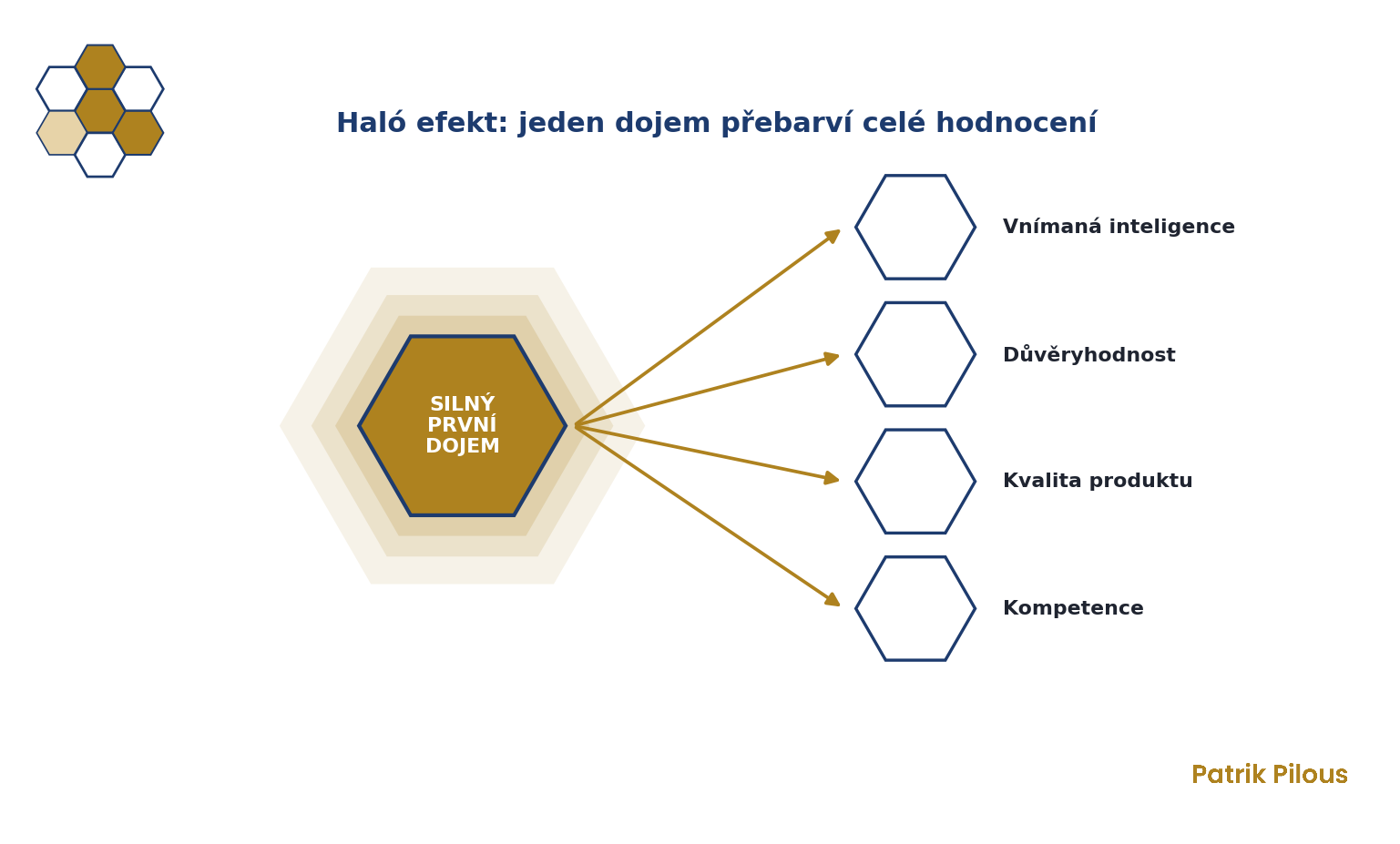
The halo effect (haló efekt in Czech) is a cognitive bias in which one strong impression, such as an attractive appearance, a well-known brand or a single good quality, colours the overall judgement. When the first detail about someone or something appeals to us, the brain automatically credits them with other qualities we have never checked. One trait seems to radiate onto all the others.
Classification of the cognitive bias
- Cause (Cognitive Bias Codex): Not enough meaning
- Mental domain: Social and perceptual
- Marketing function: Social influence
- Buyer journey: Attention and consideration
- Cialdini’s principles: Liking and authority
- System 1 / System 2: System 1 (fast, automatic)
In brief
- What it is: one positive trait influences how everything else is judged.
- Where you will meet it: a good-looking website, a celebrity face in an advert, premium packaging, a first impression of a person.
- How to use it: invest in one strong first impression, usually the visuals, and it will carry over to how the whole offer is perceived.
A real-life story
You are running a job interview and two candidates sit in front of you. The first arrives well groomed, in well-fitting clothes, with a firm handshake and a smile. The second is crumpled, unsure of himself and avoids eye contact. Before anyone has said a single word about their abilities, most people already know whom they would hire. And that is exactly the trap. Appearance and manner say almost nothing about who will do the better job, but our brain makes the connection on its own.
Psychologists confirmed this long ago. In the “what is beautiful is good” study, people attributed greater intelligence, kindness and success to attractive people, without a single piece of evidence. A photo was enough. We take the same shortcut with websites, brands and products. A premium photo or attractive packaging, and suddenly we believe the product inside will be of higher quality, even if it is identical to a cheaper competitor.
That is why established and prestigious brands have it easier. People buy them without checking the quality.
How the halo effect works
The term was coined by the psychologist Edward Thorndike in the 1920s. When he asked officers to rate soldiers, he found that the individual ratings were strikingly correlated. A soldier who seemed physically fit also received high ratings for intelligence and leadership, even though the rater could not have known these. One visible trait radiated onto everything else, hence “halo”.
The brain does this because it has neither the time nor the energy to assess each quality separately. It takes the strongest available signal and fills in the rest. It is fast, and that is what makes it treacherous. The most common triggers are attractiveness, brand familiarity, price and packaging, and authority. There is also an opposite version, the so-called horn effect: one bad impression, such as a typo on a website, turns the whole perception negative.
Use in marketing
- First impression of a website. Users form a view of an online shop’s trustworthiness within a few seconds, before reading a single word. An outdated design means “I’m not giving this site my card number”, even if the offer is objectively better than the competition’s.
- Product photo and packaging. A premium photo raises perceived quality as well as the price a customer is willing to pay. This relates to how people build brand associations.
- Ambassador and celebrity. A likeable famous face transfers its popularity to the brand. That is why cosmetics companies pay celebrities: you are not buying a cream, you are buying a piece of their halo. The same principle lies behind the power of good brand positioning.
- Flagship product. One top-of-the-range model lifts the perception of the whole line. That is why carmakers build expensive sports cars that hardly anyone buys: the whole brand benefits from them.
- Slogan and first sentence. A strong claim works like a halo over the whole offer. I explain how to do it in my article on the best advertising slogans.
How to protect yourself from the halo effect
- Ask what you are judging. “Am I judging the product, or just the impression?” This question breaks the halo down into facts.
- Split the decision into criteria. Price, specifications, reviews, service: score each one separately. A single overall impression then loses its power.
- Be careful with people. In job interviews and with suppliers, the halo effect is at its most costly. Likeable does not mean competent.
Frequently asked questions
What is the halo effect?
A cognitive bias in which one strong positive trait (appearance, brand, price) influences how all other qualities are judged, including those that have not been checked.
What is an example of the halo effect?
We automatically credit an attractive person with greater intelligence and trustworthiness, or assume premium packaging means higher quality for the product inside.
What is the opposite of the halo effect?
The horn effect, in which one negative impression turns the whole judgement negative.
How does the halo effect show up in marketing?
Through the first impression of a website, premium photos and packaging, celebrity faces and strong slogans, which raise the perceived value of the whole offer.

