
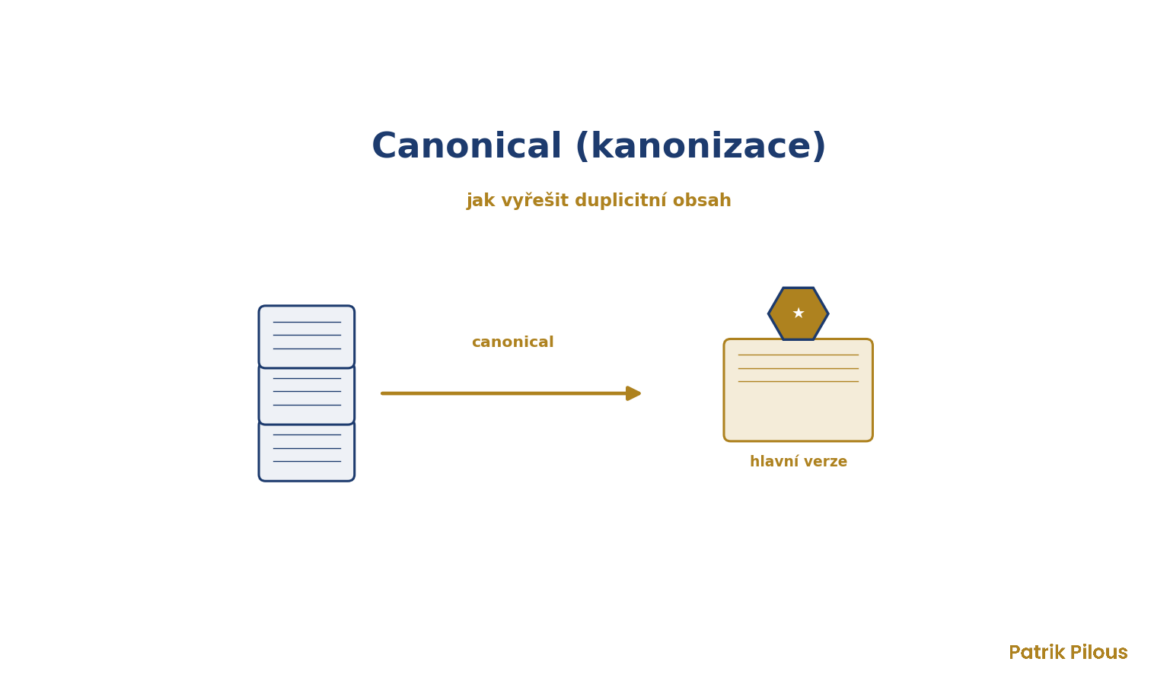
A canonical (in Czech, kanonizace) is a tag in a page’s code (a rel canonical link) that tells search engines which address is the main version of content that appears on several URLs. It solves one of the most common technical problems: duplicate content. When the same page is available at several addresses, the search engine does not know which one to index and rank, so the page’s strength gets split. A canonical shows it clearly where to focus its attention. In practice, it is one of the most underrated yet most effective tools in technical SEO. Or is it?
Where the word comes from
The word canonical comes from the Greek kanon, which was a measuring rod or rule, in other words a model and a standard. This gave us the church canon as a set of binding rules, and canonisation as the official declaration of someone as a saint, that is, as true and recognised. On the web, the logic is the same. The canonical URL is the true, recognised, official version of a page, and all the other versions simply refer to it. So when we want to canonicalise, we add a “link” to the preferred page URL.
A short history
The problem of duplicate content arose naturally with the growth of dynamic websites and e-shops, where the same product is often available at dozens of addresses depending on filters, sorting or tracking parameters. Search engines struggled with this for a long time and dealt with duplicates only by guesswork. The turning point came in 2009, when Google, Yahoo and Microsoft jointly introduced the rel canonical element as a standard. For the first time, website owners had a tool they could use to decide the main version of a page themselves. Since then, the canonical has been a basic tool for every decent SEO consultant.
How canonicals work from an SEO perspective
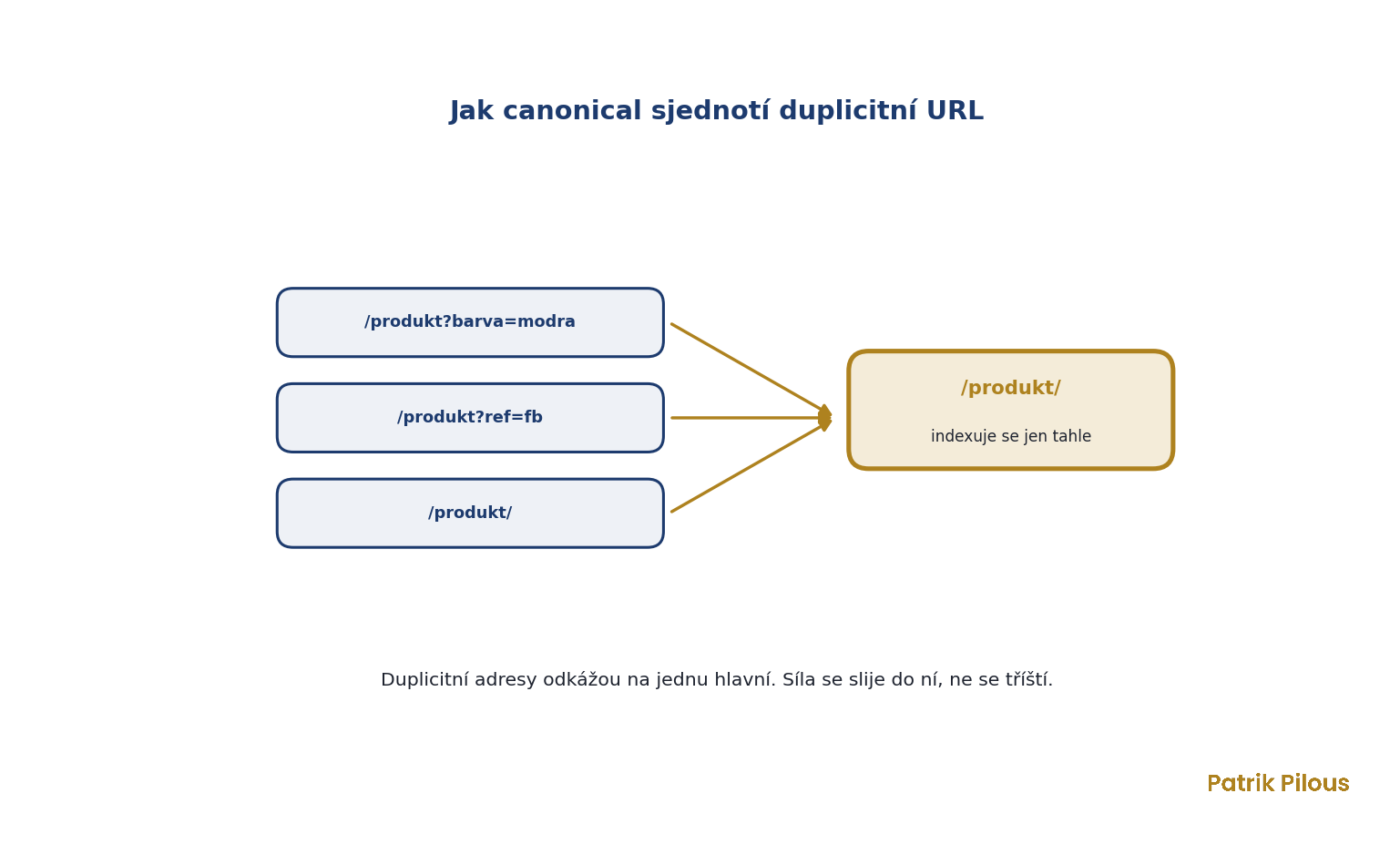
A link pointing to the preferred, main address is placed in the page’s head. When several URLs with the same or very similar content have a canonical pointing to one of them, the search engine understands that they are duplicates and indexes and ranks that main one. Signals such as links and relevance are then consolidated into one address instead of being split across many variants. It is worth knowing that for Google a canonical is a recommendation, not a strict command. That is why it must be used consistently and supported by a good website architecture.
Why canonicalisation matters
Duplicate content weakens a website in two ways. It dilutes link strength across several addresses and wastes crawl budget on variants that should not be in the index at all. A correctly set canonical solves this. It directs all the value to one address, keeps the index clean and prevents pages from competing with each other in search results. For e-shops with filters and parameters, canonicalisation is often the difference between a well-organised website and a chaotic one. That is why checking canonicals belongs in every technical SEO audit.
The key point is that for Google a canonical is a recommendation, not a definitive command.
Where it goes further
What makes canonicalisation interesting is that it is really an old human principle carried over into code. We have always had to decide which version is the true and official one, whether it concerns saints, texts or rules. The web has simply turned this dispute into a technical form. A canonical is a way of choosing, from the chaos of many copies, one model that the others refer to. And just as with saints, declaring something the main version only carries weight when it is clear and consistent. Search engines ignore inconsistent or contradictory canonicals, much as nobody would take seriously a canon that contradicts itself.
Most common mistakes
- A canonical on every page pointing to the homepage, which removes almost the entire website from the index.
- A canonical pointing to a non-existent or redirected address.
- A conflict between the canonical and the sitemap, where the signals contradict each other.
- Relying only on canonicals where it would be better not to create duplicates in the first place.
- Using canonicals on website pagination
Questions about canonicals
What is a canonical URL?
The main, preferred version of a page, which all its duplicates point to using the rel canonical tag, so that the search engine indexes and ranks that version.
What is canonicalisation in SEO?
Consolidating duplicate content so that several similar addresses point to one main address, into which their value is merged.
Is a canonical a command or a recommendation?
For Google, it is a recommendation, not a strict command. That is why it must be used consistently and must not contradict other signals.

