

The Asch experiment (Asch conformity experiment) showed how strong conformity is, meaning the tendency to adjust your own judgement to a group. The psychologist Solomon Asch seated students among actors who deliberately claimed that a different line was the same length than the one that really was. More than a third of the answers, exactly 36.8%, went along with the majority’s mistake. In psychology, conformity means changing your opinion or behaviour under group pressure, even when nobody gives any orders.
Classification
- Type of phenomenon: a social psychology experiment on conformity
- Bias it reveals: we treat the group’s opinion as evidence, even when we can see the opposite
- Mental area: Social
- Marketing function: Reviews, social proof, team decision-making, company culture
- Buyer journey: consideration and purchase decision
- System 1 / System 2: group pressure works in System 1, resisting it takes System 2 effort
In brief
- What it is: an experiment in which people under group pressure deny what they see with their own eyes.
- Why it matters: the same pressure decides what people buy and what they vote for in a meeting.
- Where you will come across it: in reviews and star ratings, bestseller labels, customer counters and meetings where the boss speaks first.
- How to use it: show customers what other people do, and make sure your team has at least one genuine dissenting voice.
A real-life story
Solomon Asch of Swarthmore College in Pennsylvania published his first results in 1951 in the volume Groups, Leadership and Men. The experiment looked like a dull eye test. Seven to nine students sat in a classroom and, one after another, said out loud which of three lines on a card matched the reference line, with differences of roughly 2 to 4.5 centimetres.
Only one of them was a real participant. The others were Asch’s assistants. In 12 of the 18 rounds they unanimously gave the wrong answer, and the real participant sat almost at the end of the row, so he first heard everyone before him make exactly the same mistake.
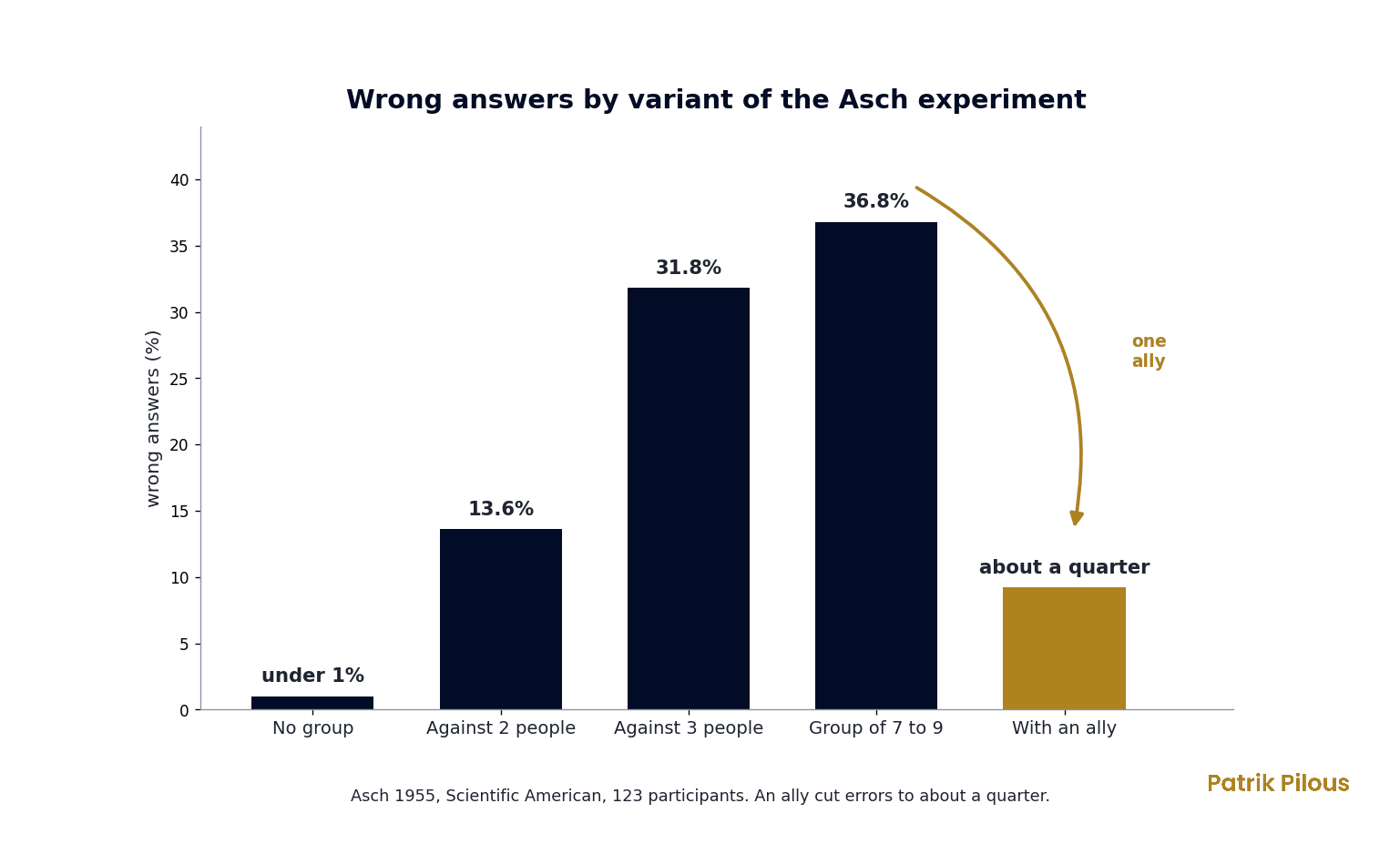
In November 1955, Asch summarised the results in Scientific American in the article Opinions and Social Pressure. A total of 123 students from three universities took part. Without group pressure they were wrong in less than 1% of cases, under pressure they accepted the wrong answer in 36.8% of choices.
About a quarter never gave in. The remaining roughly three quarters gave in at least once. Asch published the monograph Studies of Independence and Conformity in 1956 in Psychological Monographs.
The figure of 32% that circulates in textbooks comes from the first series with 50 participants in 1951. Both figures are correct. In Czech, the proverb “kdo chce s vlky výti, musí s nimi býti” (if you want to howl with the wolves, you have to run with them) sums it all up, except that Asch only needed a few unfamiliar students and some cards with lines.
How conformity works
Asch interviewed the participants after the experiment. Some of those who gave in concluded that they were wrong and the group was right, so the pressure changed their judgement itself. Others knew the group was wrong but did not want to stand out or, in their own words, “spoil the results”. All of those who gave in underestimated how often they had sided with the majority.
In 2005, Gregory Berns’s team moved the experiment into an MRI scanner. A total of 32 people compared rotated three-dimensional shapes and saw the answers of four actors. Without other people’s answers they were wrong in 13.8% of cases. When the group was wrong, they made mistakes in 41% of cases, and when a computer offered the same mistake, in 32% of cases.
Agreeing with the group was linked to changes in activity in the occipital-parietal network, the areas that process images and spatial perception. Disagreeing with the group was linked to higher activity in the amygdala (Biological Psychiatry). This is a correlation. It does not reveal the mechanism.
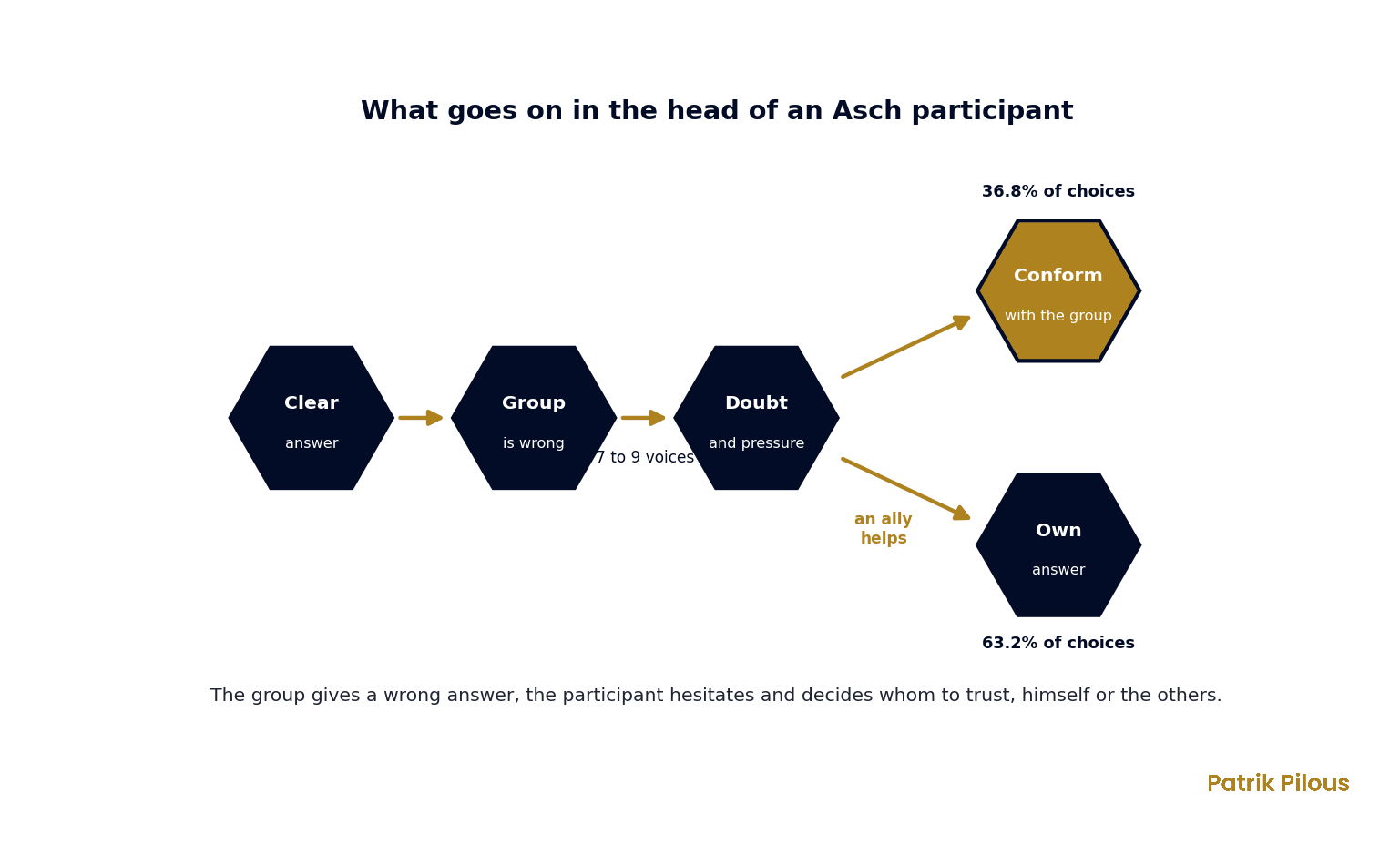
Textbooks often embellish Asch. In 1990, Ronald Friend and his co-authors pointed out in the article A puzzling misinterpretation of the Asch ‘conformity’ study that textbooks turned Asch into proof of near-total obedience to the crowd, even though he himself emphasised independence, and participants stuck to the correct answer in 63.2% of choices.
The 1996 meta-analysis Culture and Conformity by Rod Bond and Peter Smith summarised 133 studies from 17 countries. In American studies, conformity had been declining since the 1950s, and it came out higher in collectivist cultures than in individualist ones.
Conformity in marketing
Asch’s assistants were strangers, yet they pulled more than a third of the choices towards the wrong answer. In an online shop, the same role is played by reviews, numbers of units sold, bestseller labels and customer counters, all of which say that other people have already chosen. I explain the principle in the entry social proof and how to use it on your website.
- A few reviews do the most. According to the Spiegel Research Center at Northwestern University (2017), the likelihood of buying a product with five reviews is 270% higher than for a product with no reviews (How Online Reviews Influence Sales). Each additional review adds less and less. I take a figure from a single research centre with a pinch of salt. But it reminds me of Asch, where the pressure almost stopped growing after the third voice.
- A perfect score raises suspicion. According to the same study, the likelihood of purchase is highest for ratings of 4.0 to 4.7 and falls towards five stars. A few critical reviews remind me of Asch’s dissenting voice, except that here they tend to make the whole more credible.
- “Everyone has it” works with similar people. Asch’s assistants were the participants’ peers. Instead of a generic “bought by 1,200 people”, show logos and figures from companies in your customer’s industry. More on this under the bandwagon effect in purchasing.
- One loud critic breaks the impression of agreement. In my view, a negative comment under an ad works much like Asch’s ally, showing others that it is possible to disagree. Reply quickly and stick to the facts.
- Fake consensus is fraud. Made-up reviews are banned by EU Directive 2019/2161, which the Czech Republic transposed through an amendment to the Consumer Protection Act (zákon o ochraně spotřebitele), No. 374/2022 Coll. (EUR-Lex summary).
In addition, Section 5a(5) of the Consumer Protection Act requires an online shop to state whether and how it ensures that reviews come from consumers. State this specifically next to the reviews, for example that only people who have ordered the product can rate it.
One dissenting voice changes the outcome
Asch examined which matters more, the size of the group or its unanimity. Against a single opponent, participants answered correctly almost every time. Errors rose quickly up to three voices, after which additional people barely increased the pressure, even with groups of up to 15 members.
| Experiment variant | Participants’ wrong answers |
|---|---|
| No group, written answer | less than 1% |
| Against 1 person | almost none |
| Against 2 people | 13,6 % |
| Against 3 people | 31,8 % |
| Unanimous group of 7 to 9 people | 36,8 % |
| One ally in the group gives the correct answer | errors fell to roughly a quarter |
| The dissenter picks an even worse line than the group | 9 % |
| The ally switches to the majority after 6 rounds | almost as with a unanimous group |
Unanimity was decisive. In the 1955 series, errors with an ally fell to roughly a quarter. In the earlier 1951 series, the error rate with an ally who answered correctly throughout fell from 32% to 5.5%. A dissenter who picked an even worse line than the group did not offer the participant the correct answer, only broke the unanimity, and errors still fell to 9%.
A separate variant tested an ally who switches sides. For the first six rounds he answered correctly and 18 of 27 people stayed completely independent, then he joined the majority and errors jumped almost to the level without him. When he simply left instead, “to see the dean”, his influence partly persisted.
In a meeting where the director and two managers hold the same view, the fourth person faces three voices, the number at which the pressure in Asch’s experiment almost stopped growing. On top of that, they are superiors, so they add the pressure of authority to the group pressure, which Asch’s students did not face among themselves. The first dissenting voice makes the situation much easier for everyone else.
How to resist conformity in meetings
Asch showed that a group loses its power easily. You can apply most of these tricks at your next meeting.
- Let the boss speak last. Asch’s participant heard the others before answering. When a manager states their opinion first, the authority bias adds to the group pressure.
- Write first, then speak. Asch’s control group wrote their answers on paper and made almost no mistakes. Have everyone write their estimate in a shared document before the discussion.
- Look for genuine disagreement. In 2001, Charlan Nemeth found that groups with an authentic minority view came up with better solutions than groups with an assigned devil’s advocate (European Journal of Social Psychology).
- Quick agreement is a cue to ask a question. When everyone nods within a minute, ask what would have to happen for the proposal to fail.
- Praise the person who disagreed. Even if they were wrong, otherwise next time they will think twice about being Asch’s ally.
Before you approve a campaign because “everyone on the team likes it”, test it with customers.
How it connects with other biases
Asch’s experiment underpins how we interpret social proof and the bandwagon effect today. Social proof describes how we decide based on others when we are unsure, whereas the bandwagon effect goes further, because we side with the majority even without uncertainty, much like Asch’s students with lines they would otherwise have told apart without a mistake.
Right next to it is Milgram’s experiment on obedience to authority. In Asch’s study, peers apply pressure without any command; in Milgram’s, an authority gives orders. Conformity is further reinforced by the in-group effect, and the passivity of crowds is linked to the bystander effect.
Interesting questions on the topic
What did the Asch experiment prove?
That under pressure from a unanimous group, people often deny even clear sensory evidence. And that a single ally is enough for the pressure to weaken significantly.
How many people conformed in the Asch experiment?
In a series with 123 students, they accepted the wrong answer in 36.8% of choices. About a quarter never gave in once.
Does the Asch experiment still hold today?
Yes, but more weakly. According to a 1996 meta-analysis, conformity in American replications declined from the 1950s onwards, and it varies by culture.
What is conformity in psychology?
Changing your opinion or behaviour to match the group. It can be internal, when a person comes to believe the group, or merely external, when they agree out loud but keep their own view.

