

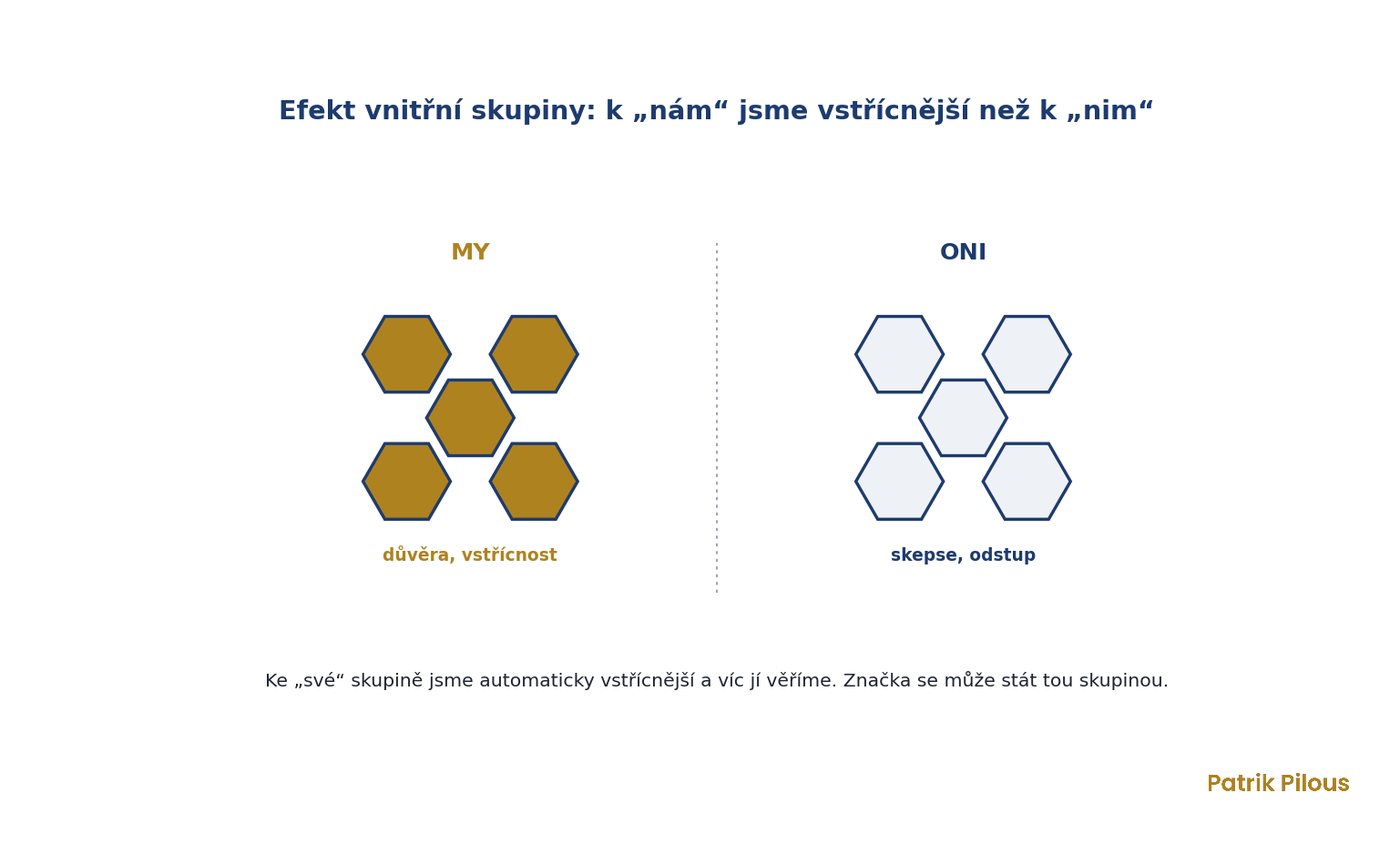
The in-group bias is a cognitive bias in which we automatically favour people we see as part of “our” group and are more sceptical of “the others”. We trust members of our own group more, attribute better qualities to them and forgive them more easily, while we judge outsiders more harshly. We divide the world into “us” and “them”, and we do it surprisingly easily, even on the basis of utterly trivial differences. For marketing, it is one of the most powerful tools for building a brand. When a brand manages to become part of the customer’s “us”, it gains loyalty, advocates and forgiveness for its mistakes, none of which money can buy. Some marketers say “build your tribe”.
Classification
- Cause (Cognitive Bias Codex): Not enough meaning
- Mental area: Social
- Marketing function: Brand and community
- Buyer journey: across all stages (loyalty and identity)
- Cialdini’s principles: Liking and unity
- System 1 / System 2: System 1 (fast, automatic)
In a nutshell
- What it is: we favour “our” group and are sceptical of “the others”.
- Why we do it: belonging to a group was essential for survival.
- Where you’ll see it: brand communities, “for people like you”, fans, identity.
- How to use it: turn your brand into a group the customer wants to belong to.
A real-life story
How easily the division into “us” and “them” arises was shown by psychologist Henri Tajfel in the early 1970s in the so-called minimal group experiments. He divided people into groups based on something completely trivial, for example whether they had supposedly preferred the paintings of one painter or another. Even though the members did not know each other and nothing important was at stake, they immediately began to favour their own group and disadvantage the other one. Tajfel and Turner then built the influential social identity theory on this finding.
Brands use this masterfully. Harley-Davidson owners are not just a customer base but a proud community with its own symbols and rituals. Apple fans define themselves against Android users and vice versa, even though we are talking about phones. And when a brand tells you “this is for people like you”, it tempts you with the very promise that you will belong among “your own”. You are then buying not just a product, but membership and identity too.
How the in-group bias works
The need to belong is one of the strongest human needs. Historically, belonging to a group meant safety and survival, which is why we feel trust and affection towards “our people” almost automatically. Our identity is also tied to the group, so we experience the success of a brand we support as our own. The bias is linked to the liking effect, because we feel closer to people similar to us, to social proof, because we follow our group, and to the bandwagon effect, where we do not want to be left out.
Use in marketing
- Build a community. A space where “our” customers meet turns buyers into members. A community holds loyalty better than any discount.
- Speak the language of “us”. “For people like you” and shared values create a sense of belonging. Customers recognise themselves and join in.
- Your own symbols and rituals. Terminology, visuals and traditions that only “insiders” share strengthen the sense of a group. This is connected to strong brand positioning.
- A shared goal or value. A brand that stands for something becomes an ally, not a supplier. People like to join something bigger.
- Ambassadors from the community. A recommendation from “one of us” works better than advertising because it comes from inside the group. This ties in with social proof.
- Reward belonging. Club benefits and membership programmes give belonging a tangible form and strengthen loyalty. This also fits with reciprocity.
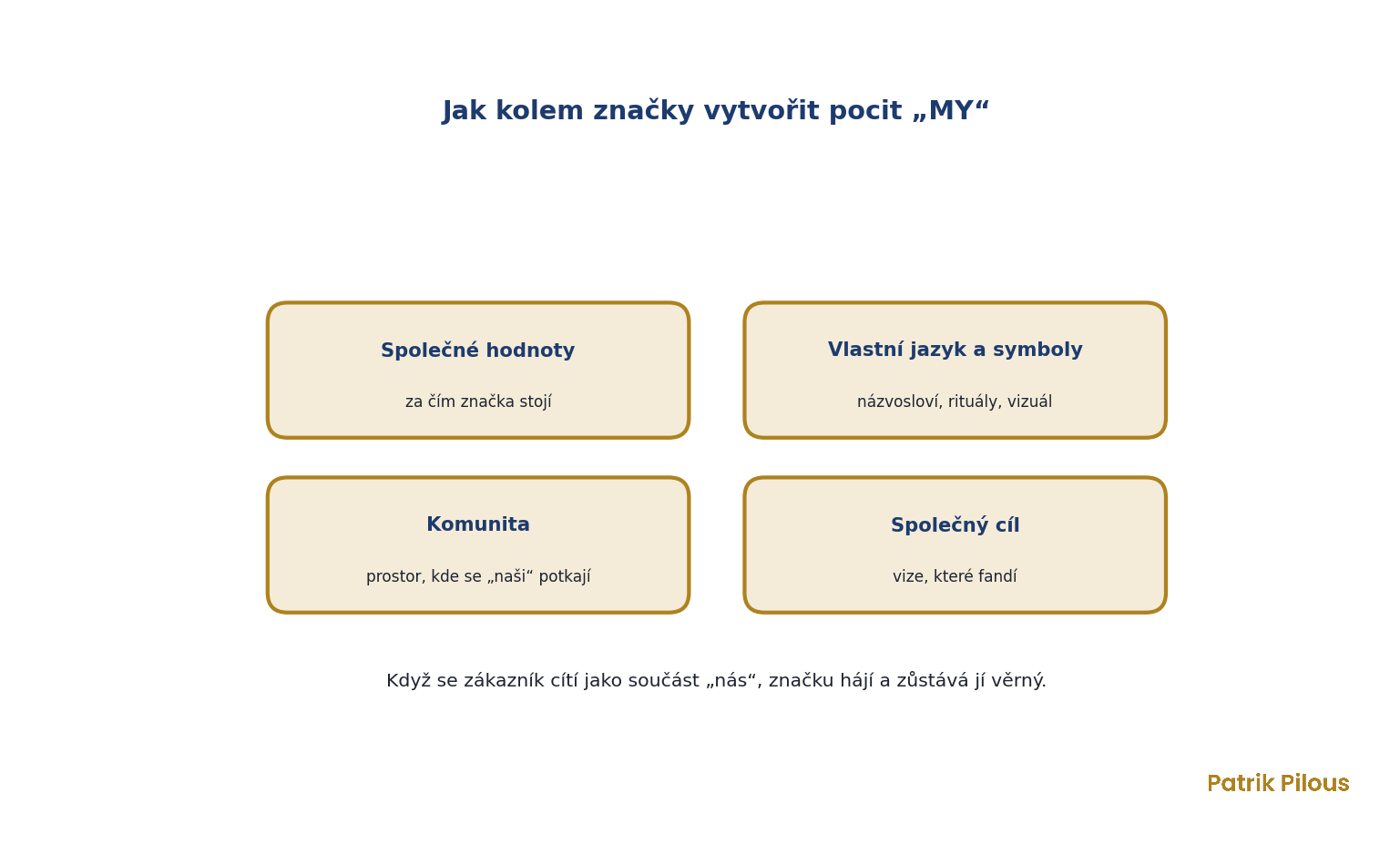
How to create a sense of “us” around a brand
A strong brand community does not happen by chance, but through deliberately building several elements. It needs clear values it stands for, its own language and symbols by which “our people” recognise each other, a space where they can meet, and a shared goal they support. When these elements fit together, the customer stops being just a buyer and becomes part of something. In return, they repay the brand with loyalty and by defending it even when it stumbles.
How to protect yourself from the in-group bias
- Judge by substance. Ask yourself whether you are evaluating fairly or just favouring “your own”.
- Beware of belonging as a trap. Brand loyalty is fine until it makes you overlook better or cheaper options.
- Listen to “the other side” too. The strongest opinions often form inside the bubble of your own group.
How it connects with other biases
The in-group bias is the glue that holds brand communities together, and it works alongside several other biases. We feel closer to “our people” thanks to the liking effect, we follow their behaviour because of social proof, and we do not want to be left out because of the bandwagon effect and FOMO. When a brand connects these forces, it creates a group around itself that people want to be part of and will defend. You can find a full overview of these principles in the encyclopedia of cognitive biases.
Frequently asked questions
What is the in-group bias?
A cognitive bias in which we favour people from “our” group and are more sceptical of “the others”, even on the basis of trivial differences.
Who researched the in-group bias?
Psychologist Henri Tajfel, in the minimal group experiments in the early 1970s, on which he built social identity theory.
How can the in-group bias be used in marketing?
By building a community around the brand with shared values, language and symbols, so that customers feel part of “us” and stay loyal.

