

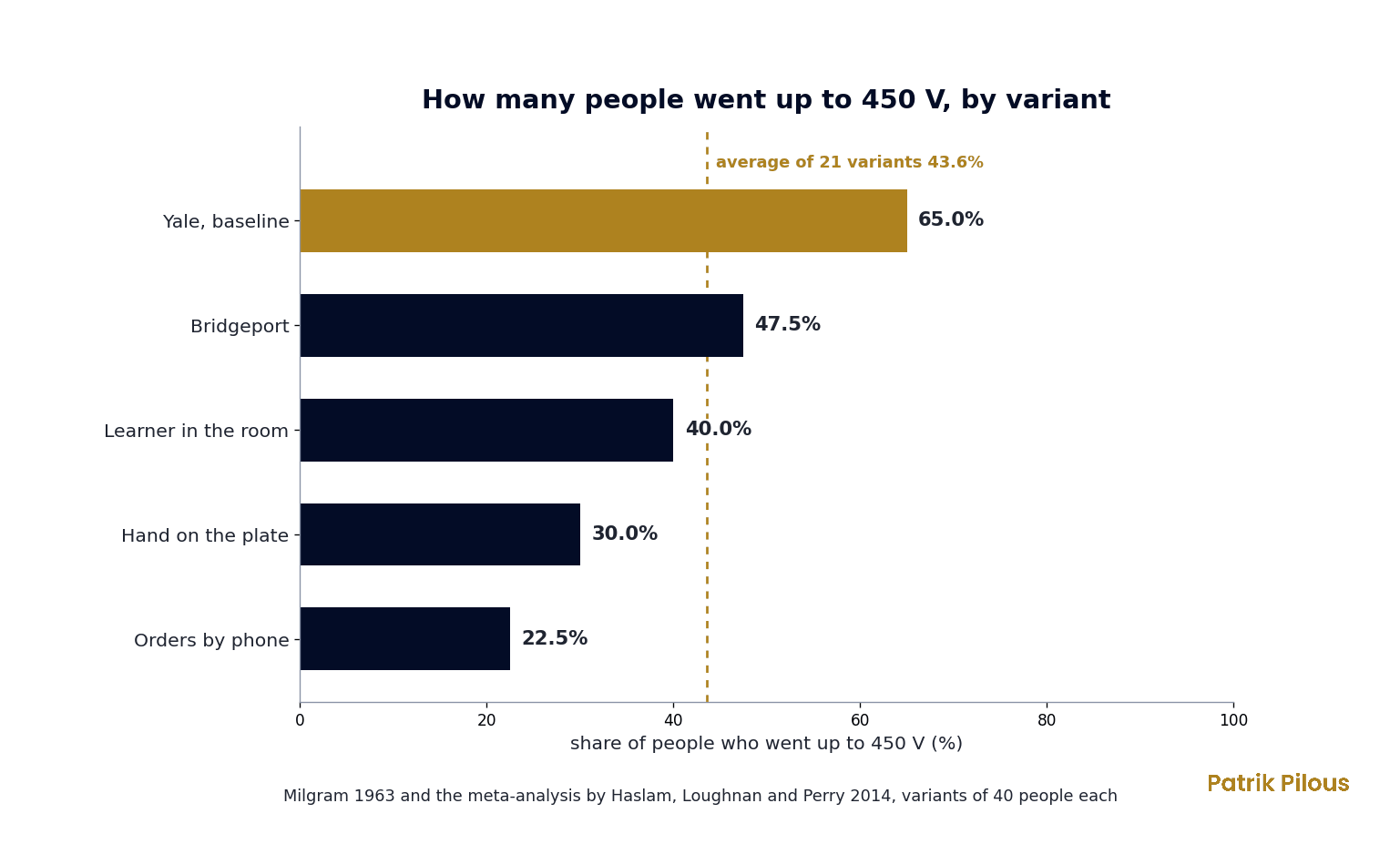
The Milgram experiment is a psychological study of obedience to authority, which the American psychologist Stanley Milgram began in 1961 at Yale University. On the experimenter’s instructions, participants were to give another person shocks from 15 to 450 volts. In reality the shocks were fake, because the “learner” was an actor. In the baseline version, 26 of the 40 men, or 65%, went all the way to the end of the scale, and in other versions often fewer did. It is one of the most cited and most criticised experiments in psychology.
Classification
- Type of phenomenon: experiment on obedience to authority
- Bias it reveals: authority bias, the tendency to overvalue instructions from people with a title or a white coat
- Mental area: Social
- Marketing function: Persuasion, team management
- Cialdini’s principles: authority
- System 1 / System 2: System 1 (obedience runs automatically, and doubts only slow it down gradually)
In brief
- What it is: an experiment in which two thirds of ordinary men “hurt” a stranger all the way to the end of the scale on the instructions of an authority.
- Why it matters: it shows that behaviour is often determined more by the situation and by who gives the instruction than by a person’s character.
- Where you will meet it: a doctor in an advert, an “expert recommended” label, a course from a guru with a title, or an instruction from the boss that nobody likes but everyone follows.
- How to use it: in marketing, build authority on real expertise, and in the company, set out who is responsible for an instruction and who is allowed to say no.
A real-life story
Milgram began in the summer of 1961, a few months after the trial of the Nazi Adolf Eichmann opened in Jerusalem. He wanted to know whether anyone would follow the same orders. He recruited participants through a newspaper advert and letters. They were men aged 20 to 50 from New Haven and the surrounding area, and they received $4.50 for taking part.
The results were published in 1963 in the Journal of Abnormal and Social Psychology as Behavioral Study of Obedience. The generator had 30 switches in steps of 15 volts. When a participant hesitated, the experimenter repeated scripted prompts such as “please continue”. Of the 40 men, 14 stopped earlier, when the “learner” protested and stopped answering.
At a meeting, the sales director announces that from Monday an extended warranty will be offered with every washing machine, even to customers who have no use for it. Nobody likes it. Almost everyone does it, and when a customer complains, the sales assistant replies with a sentence Milgram would have recognised straight away: it is an instruction from head office.
How the Milgram experiment works
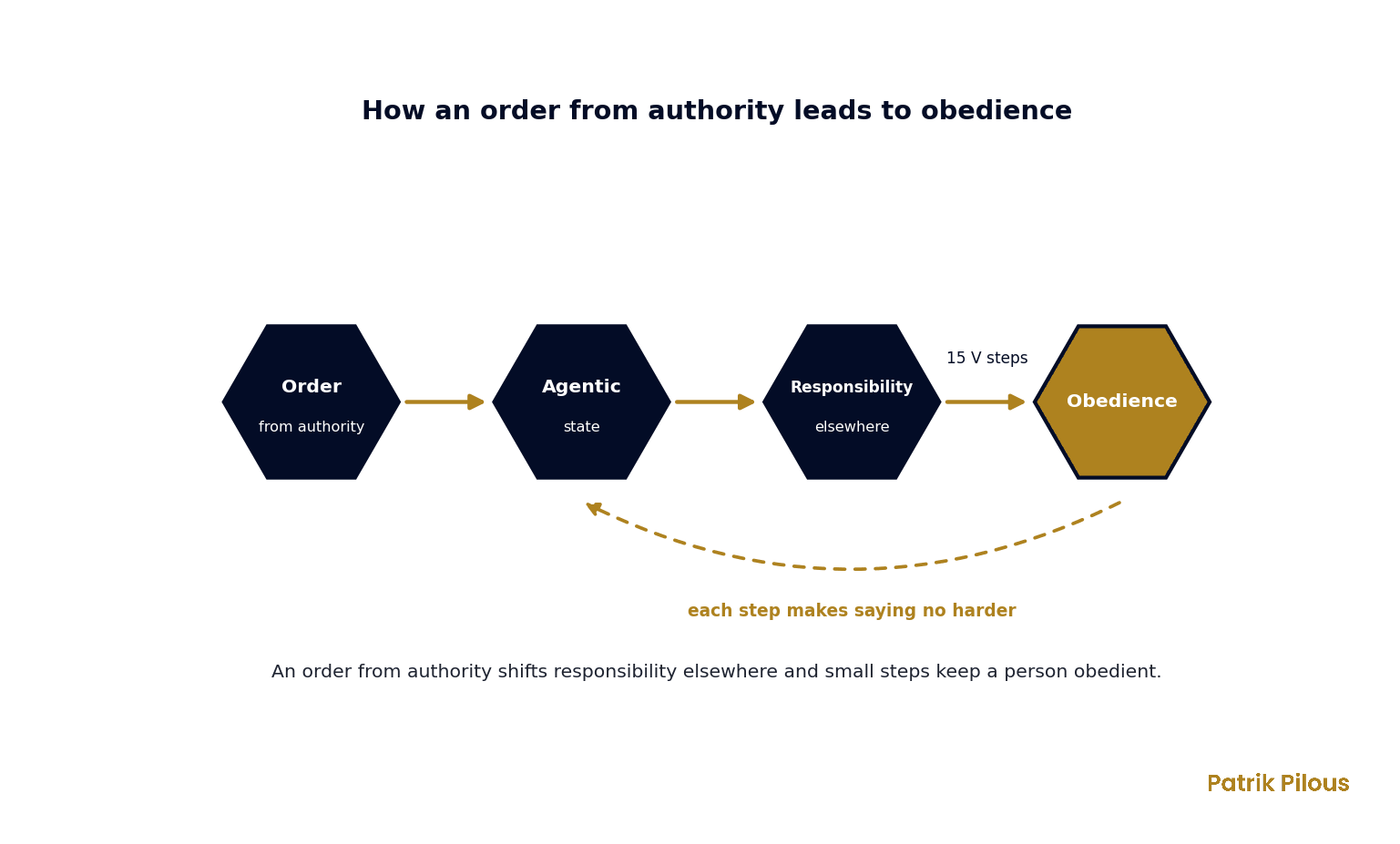
Milgram developed the explanation in his 1974 book Obedience to Authority and called it the agentic state. A person who enters a hierarchy stops seeing themselves as the author of their actions and starts seeing themselves as the instrument of someone else’s will. In their mind, responsibility shifts to whoever gave the instruction.
The second driver is gradual escalation. Each shock was only 15 V stronger than the previous one, so there was no clear point at which a person would say enough. Someone who has given 300 V will struggle to justify refusing 315 V, because doing so would mean admitting that all the previous steps were wrong too, and the brain prefers to avoid this uncomfortable cognitive dissonance by carrying on.
Milgram then varied the conditions and watched when obedience fell. Distance from the victim played a role. When the participant had the “learner” in the same room, 40% obeyed, and when he had to press the learner’s hand onto a metal plate himself, only 30% did. When the experimenter left and gave instructions only by telephone, 9 out of 40 (22.5%) went to the end.
The figures come from a meta-analysis of all the variants, published in PLoS ONE in 2014 by Nick Haslam and colleagues. According to it, the strongest factor was how firmly the experimenter gave orders. When he merely left the choice to the participant, 12% of people obeyed, and with a clear instruction 49% did. Obedience was also reduced by a group that refused to continue.
The legitimacy and prestige of the institution mattered less. When an ordinary person gave the instructions instead of a scientist, 38% obeyed compared with 44%, and in an ordinary office in Bridgeport with no link to Yale, 47.5% obeyed.
The Milgram experiment in marketing and in the company
Marketing has used authority for decades, and Milgram simply showed how powerful a lever it is.
- The white coat in advertising. From 1946, for six years, R. J. Reynolds claimed that more doctors smoked Camels than any other brand. The survey of 113,597 doctors was run by its own advertising agency, according to the authors mostly right after the doctors had received free cartons of Camels, as described by Gardner and Brandt in the American Journal of Public Health. Today the Czech Advertising Regulation Act (zákon o regulaci reklamy) prohibits references to recommendations by scientists and health professionals in advertising for medicines (explanation on epravo.cz).
- A number attached to experts. In 2007 the British regulator ASA banned a Colgate poster claiming that more than 80% of dentists recommend it. The dentists in the survey could name several brands at once.
- An expert behind the content. In its E-E-A-T guidelines, Google wants to see who wrote a text and what experience they have. An invented “team of experts” is a white coat with no person inside.
- A unified voice. When two experimenters disagreed in front of the participant about whether to continue, 20% of people obeyed according to the meta-analysis, compared with 44% under a unified authority. A brand whose salespeople say something different from the expert in its advertising weakens its own authority.
- The boss’s instruction and responsibility. A “last items” campaign run while the warehouse is full often comes about because everyone was just following the brief. A questionable instruction should therefore carry the name of the person who gave it and a safe way to refuse it. This is one of the first things a fractional CMO or head of marketing should set up in a company.
The difference between good and bad use of authority is simple. Honest authority can withstand the question of who exactly recommends it, what experience they have, where the numbers come from and whether they were paid for the recommendation, while false authority falls apart at the first such question.
Does the Milgram experiment still hold today?
Partly, yes. Jerry Burger of Santa Clara University repeated the experiment with 70 people but stopped it at 150 V. That was the point where decisions broke in Milgram’s study, and the lower ceiling also helped Burger get past the ethics committee.
In Milgram’s data, 79% of those who went past 150 V continued to the end. Beyond 150 V, 70% of Burger’s participants continued compared with 82.5% in Milgram’s study, and the difference was not statistically significant (Replicating Milgram, American Psychologist 2009).
The critic Alan Elms nicknamed Burger’s study obedience lite. The Australian psychologist Gina Perry went through Milgram’s archive at Yale, including the audio recordings, and in 2012 published the book Behind the Shock Machine, which came out in the USA a year later (review in Science News). According to her book, the experimenter on the tapes improvised and pushed harder than the script with its four prompts allowed.
From the archive, Perry also concludes that some participants did not believe the experiment, but she has no exact figure. Haslam and colleagues then added up 21 variants, and according to them 323 of 740 people, or 43.6%, obeyed to the end.
As early as 1964, Diana Baumrind criticised Milgram in American Psychologist for not protecting participants from stress. Today’s APA ethics code, in standard 8.07, allows deception only when the research has significant value and cannot be done any other way. It never allows it in research that can be expected to cause physical pain or severe emotional distress, and the deception must be explained to participants no later than the end of data collection.
Besides the lower ceiling, Burger had applicants screened by a clinical psychologist. He told participants at least three times that they could leave at any time and would still receive $50.
How to resist blind obedience
Milgram’s participants were not bad people. They were in a situation that made obedience easy, so the defence lies in changing the situation.
- Ask yourself who will bear the consequences. Write down who will explain things to the customer if the instruction turns out to be wrong. The agentic state falls apart when responsibility is given a specific name.
- Stop at the first small step. Refusing 15 V is easier than refusing 315 V.
- Look for allies. In the variant where two fellow participants refused to continue, only 10% of people went to the end. A single disagreement in a meeting works as reverse social proof, and others find it easier to join in.
- Verify the authority, not the white coat. With an expert recommendation, look for the name, the field, any conflict of interest and the source of the numbers. According to Gardner and Brandt, the doctors in the Camel survey had mostly received free cartons just before being asked.
- Give people the right to say no. Agree in advance who a questionable instruction should be reported to, and that nobody will lose their bonus for reporting it.
You can still follow instructions. Just be aware that the signature under the result is still yours, even if the idea came from above and everyone around you is doing the same as you.
How it connects with other biases
The Milgram experiment measures authority bias in its pure form, but the same shift of responsibility also drives the bystander effect. There, responsibility dissolves in the crowd, while in Milgram’s study the man in the white coat takes it over. Among bystanders, the shift of responsibility means that nobody helps. In Milgram’s study, it means that the participant does not stop.
The placebo effect rests on a similar framing of the situation, where the laboratory, the white coat, the price of the product and a certain tone change what we expect from the situation. Ten years earlier, Solomon Asch showed submission to a group, while Milgram showed submission to a single person with an official role.
Interesting questions on the topic
How many people in the Milgram experiment went all the way to 450 V?
In the first study from 1963, it was 26 out of 40 men, or 65%. Across 21 variants, 43.6% of participants obeyed to the end, as calculated by Haslam and colleagues.
Were the shocks real?
No. The participant received only a single sample shock of 45 V so that they would believe in the generator, and the “learner” was an actor.
Why would the Milgram experiment not be approved today?
Today’s APA code of ethics does not allow participants to be deceived in research that can be expected to cause severe stress. Burger therefore stopped at 150 V, the point where decisions broke down in Milgram’s study, and so got approval from the ethics committee.
What can marketing take from Milgram?
Authority sells, but it has to be real and verifiable. A white coat without a name will sooner or later run into a regulator or a customer.

