

The Stanford Prison Experiment (Stanfordský vězeňský experiment) is a famous and now heavily disputed study by psychologist Philip Zimbardo from 1971. He split students into guards and prisoners and locked them in a prison in the basement of Stanford University. The experiment was meant to last two weeks but ended after six days. The Lucifer Effect (Luciferův efekt) is Zimbardo’s later name for the idea that situations and systems push people towards evil more than character does. For a company, this raises the question of how far people’s behaviour is shaped by the roles and targets it has set for them.
Classification
- Type of phenomenon: social psychology experiment and a theory about the power of the situation over character
- Bias it reveals: fundamental attribution error, we explain other people’s behaviour by their character and underestimate the situation
- Mental domain: Social
- Marketing function: Company culture and goal setting
- Buyer journey: across all stages, mainly sales and customer care
- System 1 / System 2: System 1 judges by character, only System 2 sees the situation
In a nutshell
- What it is: an experiment from 1971 in which students playing guards humiliated students playing prisoners.
- Why it matters: it reminds us that roles and pressure from above change behaviour more than we expect, even though the study itself has serious flaws.
- Where you will meet it: a sales team under a tough quota, a customer helpline measured only by call length, an agency that has to show growth every month, or an online shop where bonuses are calculated from revenue alone.
- How to use it: when people behave badly, look first at the system you have built, and only then at the people.
A real-life story
In August 1971, Philip Zimbardo placed adverts in the Palo Alto Times and The Stanford Daily looking for students for a study of prison life at $15 a day. From more than 75 applicants, he chose 24 men with no criminal record and no psychological problems and, by the toss of a coin, divided them into 12 guards and 12 prisoners.
Later archival criticism does not dispute the random assignment; the objections concern how the experimenters directed the guards. The experiment was funded by the US Office of Naval Research, which wanted to understand antisocial behaviour.
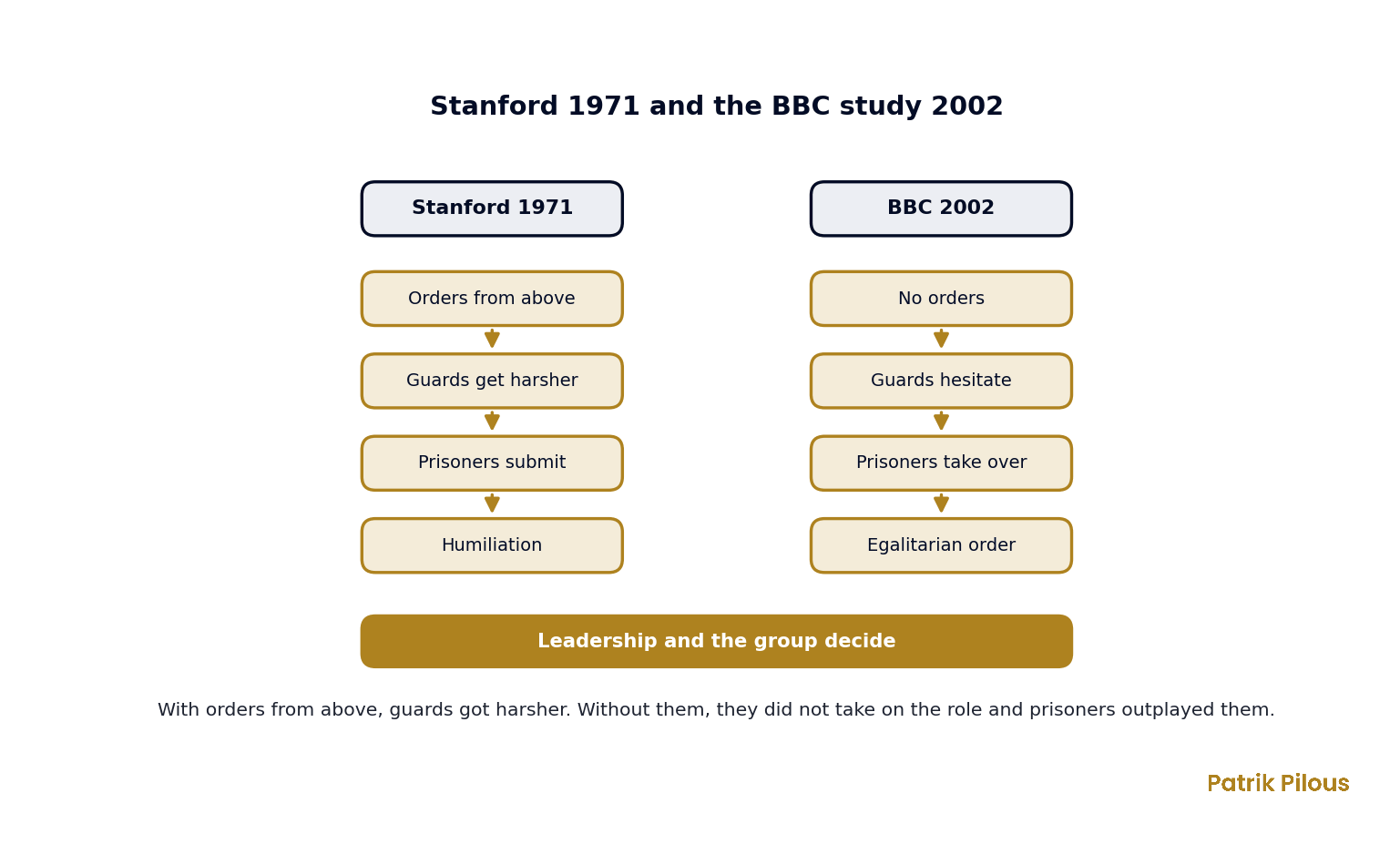
The prisoners were given uniforms with numbers. Following instructions, the guards were not allowed to call them by name. Within a few days, humiliating roll calls and punishments became more frequent, and some prisoners were sent home early.
Zimbardo was not a neutral observer, as he acted as the prison superintendent himself. The experiment was stopped by his former doctoral student Christina Maslach, later Zimbardo’s wife, when she told him he had stopped seeing the participants’ suffering. The experiment ended the next day. It was day six of fourteen.
The Lucifer Effect came more than thirty years later. Zimbardo testified as an expert witness for the defence of Sergeant Ivan Frederick, one of the guards accused of abusing prisoners at Abu Ghraib in Iraq, and Frederick was sentenced to eight years. In his 2007 book The Lucifer Effect, Zimbardo then set out his view that the blame lies not with bad apples but rather with a bad barrel. This is his interpretation; the experiment does not prove it.
As a model situation, imagine an insurance salesperson who promises a fair approach at a team meeting and, after a month below quota, sells a pensioner a policy she does not need.
How the power of the situation works
We overestimate character, Zimbardo argues. Above the individual stands the situation, and above that the system that creates and pays for it. When a guard behaves cruelly, we see a cruel guard. We do not see the instructions, the uniform, the daily schedule or the boss pushing for results.
In 1977, psychologist Lee Ross named this error the fundamental attribution error60357-3). An observer explains other people’s behaviour by their personal traits and systematically underestimates the power of the situation, so they see a bad person behind every failure. That is why, after a scandal, companies fire a few people and leave the system that pushed them to it unchanged.
According to Zimbardo, the second mechanism is deindividuation, which by his own account he had been studying for years before the experiment. He describes it as a state in which a person feels anonymous and more easily does what they would not do under their own name. During the guards’ orientation, he told them himself that they would take away the prisoners’ individuality, naming uniforms and numbers instead of names as the tools, as Le Texier documented.
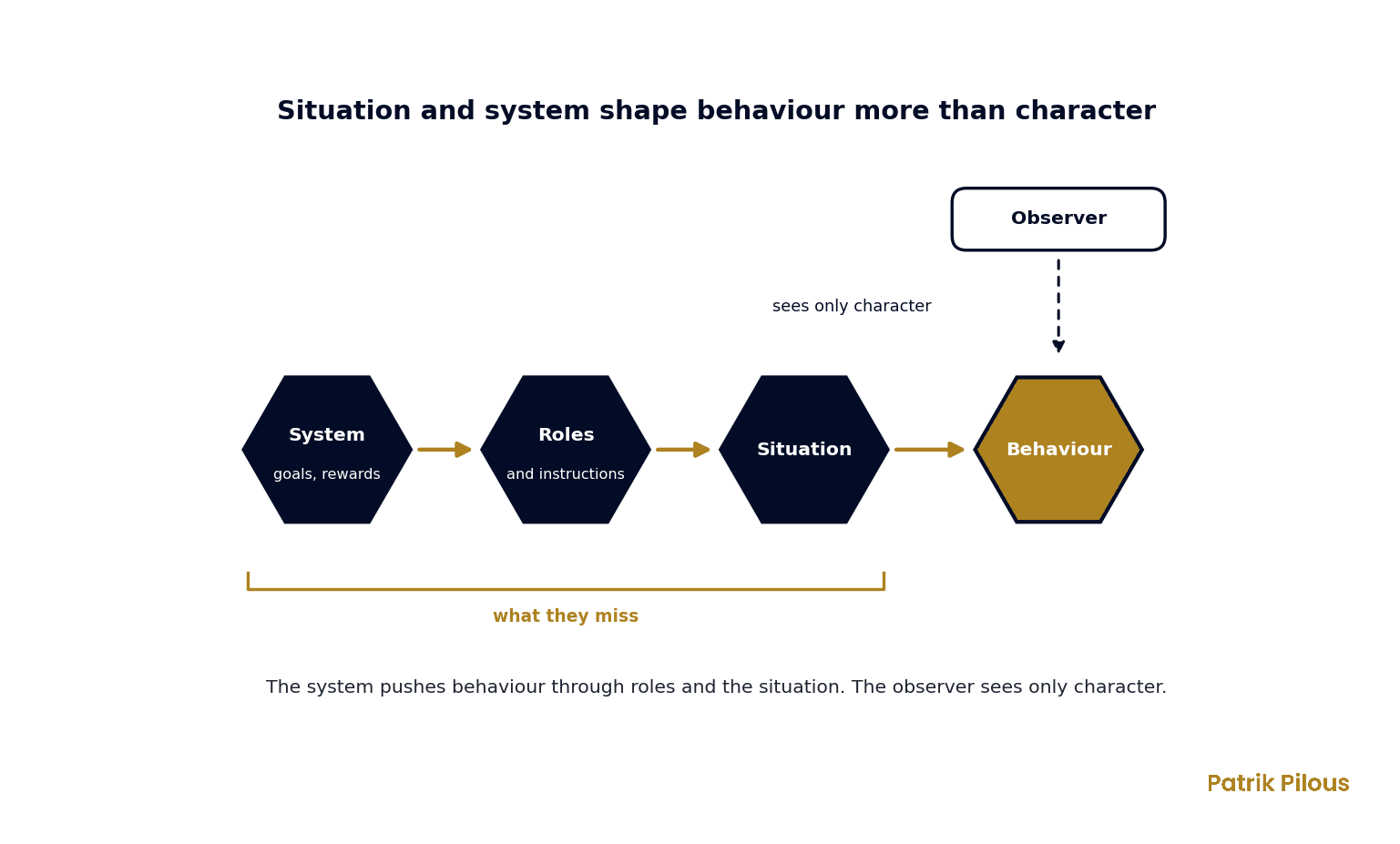
The third layer is gradual steps. Nobody starts with abuse. It starts with a stricter roll call, then a punishment for something minor, and each next step looks only slightly worse than the one before.
What the Stanford experiment means for marketing and business
Wherever targets and rewards are set, a situation is being built. The experiment itself measured nothing about companies, so distinguish between sources.
Point 1 is a documented case from a study on goals; points 2 to 5 are my own analogies from practice without any measurement of my own, so treat them as tips on where to look, which you still need to verify in your own team.
- Sales quotas. In the early 1990s, the Sears chain introduced a target of $147 per hour in its car service centres. Mechanics started charging for unnecessary repairs. The company’s chairman later admitted that it was the goal system that pushed employees to do it.
- Roles someone draws up. A job title tells people what behaviour is expected of them. Someone called a “hunter” will hunt.
- The customer as a number. A team that knows customers only as ticket IDs or segments makes harsher decisions. Zimbardo’s deindividuation shifts to the other side here: it is the customer who is anonymous.
- Instructions nobody writes down. A boss says “be more aggressive” in a meeting and is then surprised at what the team did. At Stanford, this is how the prison warden pushed the guards.
- Metrics without a counterweight. A helpline measured only by call length will shorten calls even if the problem goes unresolved. That is why it pays to always back up marketing KPIs with a quality metric.
The authors of the study on goals, Lisa Ordóñez and Maurice Schweitzer, compare goals to prescription drugs. They work, but they have side effects that need monitoring, and they should be dosed by someone who knows them.
Why the Stanford experiment is disputed
Thibault Le Texier went through Zimbardo’s archive, spoke with 15 participants and in 2019 published Debunking the Stanford Prison Experiment in American Psychologist. The guards knew the aim of the experiment. They were also given precise instructions on how to handle the prisoners. Of the prison’s 17 rules, the experimenters copied 11 from a student experiment devised three months earlier by students in Zimbardo’s seminar, so the guards did not even make up the rules themselves, as Zimbardo claimed for decades.
On the recordings, the “prison warden”, a student from the team, rebukes a soft guard, saying everyone has to be a tough guard. Less than 15% of the 150 hours of the experiment was recorded, and mainly the dramatic moments were filmed. The prisoner whose breakdown is shown in lectures later claimed he faked it so he could leave.
An experiment with a similar set-up was repeated for the BBC in 2002 by British psychologists Stephen Reicher and Alexander Haslam, who published the results in 2006. It turned out differently. Without pressure from above, the guards did not identify with their role and hesitated to use their power, and the prisoners eventually outmanoeuvred them and set up their own egalitarian order, which did not last long and opened the way to a harsher regime. According to the authors, tyranny arises where a group fails and people then accept a harsh regime, not automatically from a uniform.
The criticism offers a concrete lesson for companies. According to the recordings, the guards’ harsh behaviour was largely demanded by the prison warden, who wanted a result he could take to the media and the press.
How to defend against the power of the situation
Defence starts when you stop focusing only on people. When the same mistake repeats across different people and under different bosses, the cause is probably in the system you set for them rather than in their character, so start with targets and rewards.
- Review targets through a cynic’s eyes. For each quota, write down how it could be met at the customer’s expense. If it can be done, someone will do it.
- Have an independent brake. Bring in an outsider who is allowed to say stop and halt a campaign or process, just as Christina Maslach stopped Zimbardo. You will not see it from the inside.
- Give the customer a name. In meetings and reports, talk about specific people and their stories, not just segments.
- Write down what is not allowed, too. Every target needs a boundary, such as “we do not sell a product the customer does not need”, and a reward that does not penalise respecting it.
- After a failure, ask about the situation. Before you fire someone, find out who gave them which instructions and what pressure they were under.
Point five is aimed at management. Let a supervisory board member or an external consultant ask it.
How it connects with other biases
The Stanford experiment is taught alongside the Milgram experiment, which showed how far people will go on an authority’s orders. Zimbardo wanted to prove that the situation alone was enough, without an experimenter standing behind people, but the archive shows that one was there. Both experiments are more about the authority effect, and they are complemented by the Asch experiment on group pressure.
The results of the BBC study, in turn, lead to the in-group effect. People behave according to the group they identify with, so “us guards” and “them prisoners” work the same way as “us in sales” and “them customers”. The other guards who saw the abuse and did not intervene are a reminder of the bystander effect.
Interesting questions on the topic
What is the Stanford prison experiment?
An experiment by Philip Zimbardo from 1971 in which 24 students played guards and prisoners in a makeshift prison. It was meant to last two weeks and ended after six days.
What is the Lucifer effect?
Zimbardo’s name for the transformation of ordinary people into perpetrators under the pressure of the situation and the system. It comes from his 2007 book The Lucifer Effect, which he wrote under the impression of the abuse at Abu Ghraib.
Are the results of the Stanford experiment valid?
Not as proof that the role alone corrupts a person. The archive shows that the guards were given instructions, and the BBC study with a different set-up turned out differently.
Who stopped the Stanford prison experiment?
The psychologist Christina Maslach, Zimbardo’s former doctoral student and later his wife.
Why is this useful for a company when the study is disputed?
The guards’ behaviour was largely produced by the person running the experiment, and in the same way, salespeople’s behaviour is produced by whoever sets the quotas and the tone of meetings.

