
A marketing strategy is a decision about who you will sell to, what you will sell and how, so that the company meets its business goal. The plan, campaigns and posts are what follow from it. In my experience, a good strategy fits on one page. If you cannot write it on one page, it usually has not been decided yet.
Searches for the term peak in September and April, following the school year, so many of the people looking for it are students. The process below, however, is the one I use to build a strategy with business owners and leadership teams. The example is made up, but it reflects how things work in practice, not in a textbook.
Strategy, plan and tactics are not the same thing
Most documents that companies hand me as a strategy are actually a plan: a list of campaigns for the year, an allocated budget and deadlines. What they lack is the essential part, namely why this and not something else. The difference is easiest to see side by side, using a made-up e-shop selling speciality coffee.
| Strategy | Plan | Tactics | |
|---|---|---|---|
| What it answers | Where and why | What and when | Exactly how |
| Horizon | One to three years, figures for one year | A year or a quarter | Weeks |
| Example | Being the first choice for people who make coffee at home and want advice | Subscription from September, gift boxes before Christmas | A French press brewing guide linking to ground coffee |
Strategy rarely changes, the plan changes every year and tactics can change every week. If the strategy changes with every campaign, it is not a strategy.
Richard Rumelt, a professor of strategy at UCLA, builds good strategy on three parts: a diagnosis that names the problem, a guiding policy for dealing with it, and coherent actions that carry it out. In the process below, steps 2 to 4 correspond to the diagnosis, step 5 to the guiding policy, and steps 6 and 7 to the coherent actions.
“Strategy is about action, about doing something. The kernel of a strategy must contain action.”
Richard P. Rumelt, Good Strategy/Bad Strategy, 2011, according to a review in strategy+business
A seven-step process
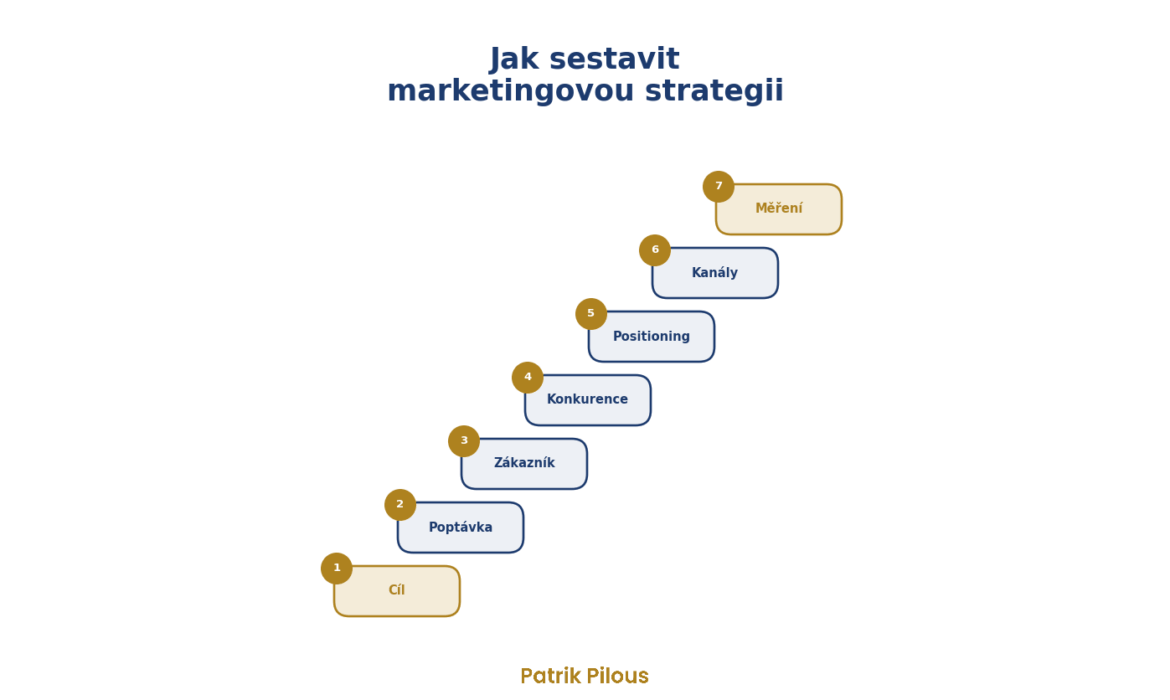
The steps follow one another and each builds on the previous one. The most common mistake is to start with step six, the channels, and work out the rest backwards.
Most of the time, though, goes into steps two and five, because that is where you decide where the demand is and how the company will stand out. The other steps are largely craft.
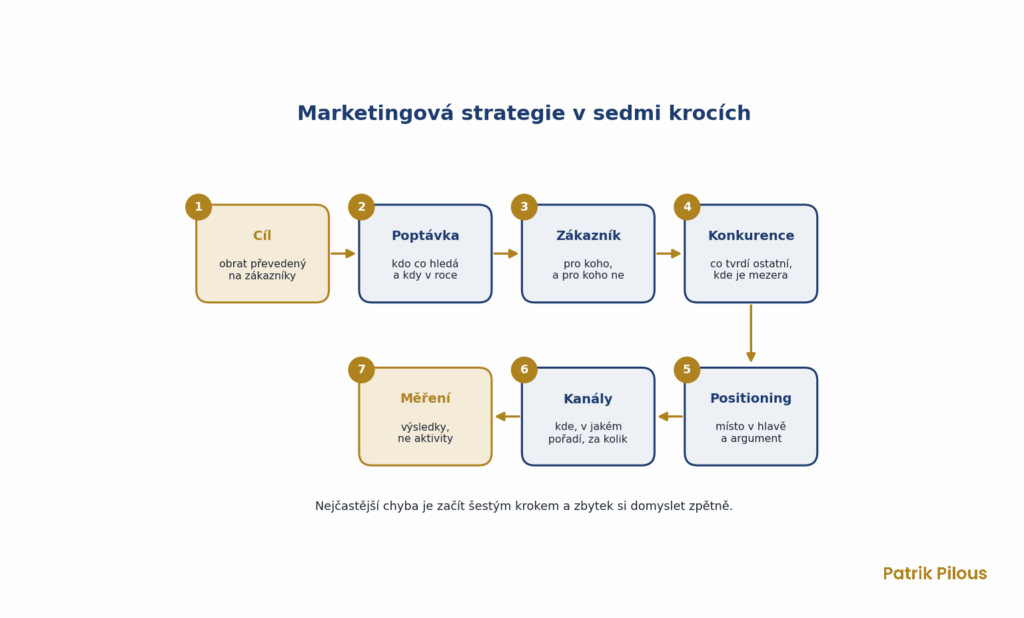
1. Business goal translated into a marketing goal
You start with the figure the company wants to reach, not with marketing: turnover, margin, number of customers. Only from that do you work out what marketing has to do.
For the coffee e-shop, it might look like this. Current turnover is 10 million CZK (about 410,000 EUR) and the goal is 30% more over the next 12 months, which means an extra 3 million CZK (about 120,000 EUR). If a new customer with an average order of 800 CZK (about 33 EUR) buys twice during those 12 months, they spend around 1,600 CZK (about 66 EUR), so roughly 1,900 new customers are needed.
Two orders is an assumption that needs checking against your own data. The calculation also assumes that all the growth comes from new customers and that existing ones do not leave. The marketing goal is then no longer “be more visible” but, rounded up, 2,000 people making their first purchase.
2. Where the demand is
How many people actually search for what you sell, what words they use and at what time of year. For a small or medium-sized business, search data and your own sales data are usually enough. Paid market research pays off mainly where search data is not enough. For example, with a new product that nobody searches for yet, or when you need to know why people buy from competitors.
Keyword research shows you seasonality, growing topics and where demand exists but you have nothing to show for it. This is often where it turns out that the demand is somewhere other than the company expected.
3. Customer and segment
Who exactly you sell to, and who you do not. “Anyone who drinks coffee” is not a segment. “People who make coffee at home, own a coffee machine or a French press and want better coffee than they can find in the supermarket” is a segment.
The data from step two helps here, because it shows what words people search with and what they are trying to solve. It is just as important to write down who you are not targeting. Office coffee machines? Cafés? If you do not say it out loud, the budget spreads in every direction.
4. Competition
Who else solves the same problem for your customers and what they claim about themselves. Not only direct competitors, but also the alternative a customer considers instead of you, which for coffee might be the supermarket or capsules.
You are looking for a gap: what nobody says, what nobody backs up, what customers complain about with others. Competitors’ negative reviews tell you a lot, because customers write exactly what they were missing.
5. Positioning and USP
Steps 2 to 4 show what place in the customer’s mind you want to occupy (brand positioning) and what argument will defend it (USP). For the coffee e-shop, for example, “the roastery that helps you brew at home”.
This is the hardest step, because it requires admitting how you do not differ. And most companies find they differ less than they thought.
In their book Playing to Win, A. G. Lafley, former head of Procter & Gamble, and Roger Martin built strategy on five questions, two of which matter most: where will we play, and how will we win there. Steps 2 to 4 answer the first, this step answers the second.
6. Channels and budget
Only now is it the turn of channels. Where the people in the segment are, where the demand is and where the company has a chance to compete with the budget it has. The order matters more than the list, because you cannot launch everything at once.
The budget is split according to what has the best chance of meeting the goal from step one. Not according to what was done last year, nor what competitors happen to be doing. I show how to arrive at the total amount below, using the same example.
7. Measurement
For each goal, one or two figures to track, and who is responsible for them. Without this, in six months nobody will know whether the strategy is working or whether it simply happened.
I describe which metrics to choose in the article Marketing and KPIs. For strategy, a simple rule applies: base your goals on results, and track activities only so you know why the results did or did not come.
How much to spend on marketing
Owners ask this almost every time, and the answer they hear most often is a percentage of turnover. A percentage is a good check but a poor starting point. The budget can be calculated from the goal, and only then compared with what others spend.
For the coffee e-shop, four figures are enough. For the example, let us set the margin at 40%; in reality the owner knows it exactly. By gross profit I mean revenue minus the purchase cost of goods. Shipping and packaging reduce it further, which is why the cost per customer in the table includes a buffer.
| Item | Value | How it was calculated |
|---|---|---|
| Gross profit per order | 320 CZK (about 13 EUR) | 40% of the average order of 800 CZK (about 33 EUR) |
| Gross profit per new customer per year | 640 CZK (about 26 EUR) | two orders in 12 months |
| Maximum cost of acquiring a customer | 350 CZK (about 14 EUR) | roughly half the first-year profit, the rest is a buffer for shipping, packaging and estimation error |
| Budget for new customers | 700,000 CZK (about 29,000 EUR) | 2,000 customers times 350 CZK (about 14 EUR) |
A budget of 700,000 CZK (about 29,000 EUR) is 7% of current turnover. If the calculation came out at 25% of turnover, the problem would not be marketing. Either the goal is unrealistic or the margin is low, and that is a message for the owner, not for the agency.
For B2B companies and services with long sales cycles, the process is the same, just with different figures. Instead of the order, the contract value; instead of repeat purchases, the length of the relationship; and on top of that, the share of enquiries that turn into contracts. From this you get how much a single enquiry may cost.
As a check, two figures from international surveys. According to Gartner, large companies in North America and Europe are spending 7.8% of revenue on marketing in 2026, and according to the spring CMO Survey, US companies, including smaller ones, spend 9.0%.
Both figures are averages from a different market and different company sizes, so they serve as a check, not a target. The coffee e-shop, at 7%, fits within that range.
The budget for new customers is not the whole of marketing, though. Emails, content and looking after existing customers cost extra, so the total will likely come out above 7% of turnover.
A one-page strategy template
The whole strategy can be summarised in a single table. I fill in this framework with clients as the first deliverable, and only then does the plan come out of it.
| Field | Example for a speciality coffee e-shop |
|---|---|
| Business goal | Turnover 30% higher within 12 months |
| Marketing goal | 2,000 new customers, each making two purchases on average within 12 months |
| Customer | People who make coffee at home and want advice |
| Who we do not target | Offices and cafés |
| Positioning | The roastery that helps you brew at home |
| USP | Every coffee comes with a guide and the recommended grind for your coffee maker |
| Channels and budget | Search and content, email, performance advertising. 700,000 CZK (about 29,000 EUR) for new customers, at most 350 CZK (about 14 EUR) per customer |
| What we do not do | Blanket discount campaigns, influencers without sales tracking |
| Measurement | New customers, repeat purchases, customer acquisition cost |
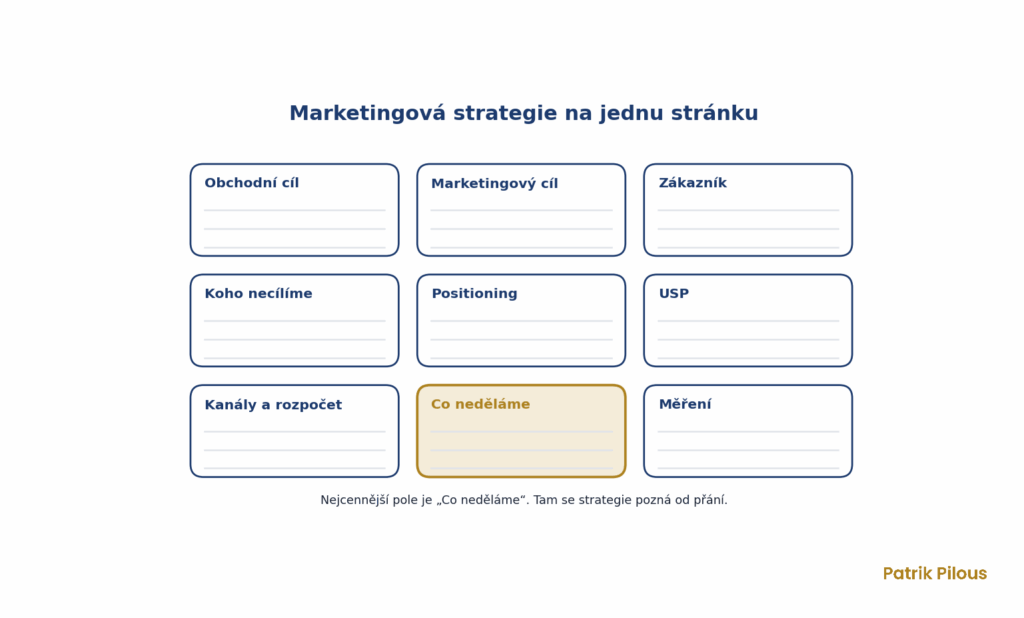
Why search and content first? Because people in the segment search for how to make coffee, and a roastery that gives advice has the answer (in a real strategy, the data from step two would back this up). Advertising comes in only for those who already know what they want. And email is second because of the second purchase, on which the whole calculation rests.
The most valuable row is “What we do not do”. That is where you can tell a strategy from a wish list fastest. If you cannot fill it in, you have not decided yet.
“The essence of strategy is choosing what not to do.”
Michael E. Porter, What Is Strategy?, Harvard Business Review, 1996
Porter wrote this about corporate strategy, but in marketing it applies doubly. Every extra activity takes money and attention away from the ones the whole calculation rests on.
How a strategy becomes a one-year plan
A plan is a strategy spread out over time. Every item in it must trace back to one row of the table above, otherwise it does not belong in the plan.
| Quarter | What gets done | Which strategy row |
|---|---|---|
| First | Brewing guides for each coffee, pages by type of coffee maker, launch of performance advertising | USP, search and content |
| Second | Email series after the first purchase, recommendation of the next coffee | second purchase in the marketing goal |
| Third | Subscription for those who have bought twice | repeat purchase |
| Fourth | Gift boxes, the largest share of the performance advertising budget | season, advertising aimed at people who know what they want |
The table shows where the emphasis lies in a given quarter, not what stands still for the rest of the year. Performance advertising runs all year, and content from the first quarter only starts bringing people in after several months, which is why work on it starts straight away.
Notice what is missing from the plan. No blanket Black Friday discount, even though the whole market runs one. The strategy ruled it out in the “What we don’t do” row, and the plan simply sticks to that.
Where strategy most often breaks down
Why are so many strategies written and then never followed? Most often because nobody allocates the budget according to them, so nothing depends on them. The second reason is length: nobody reads a thirty-page document. Beyond that, a strategy typically breaks down in four places.
- A strategy without a budget. Without a figure in crowns, it is a wish, not a plan.
- A goal without a number. “Strengthen the brand” can be neither met nor missed.
- The “everyone” segment. The budget then dissolves into advertising for people who will never buy.
- A strategy in a drawer. Without a quarterly review, it goes out of date before it has a chance to show results.
All four mistakes lead to the same end. The strategy is written once and then no longer guides decisions. That is why the template above is deliberately short, so you can come back to it at every budget meeting.
Rumelt adds in Harvard Business Review that most company strategies lack a proper diagnosis and actions with real impact. In my view, the most common form of weak strategy is a list of goals with the company logo on it.
How often to review the strategy
Once a quarter, in one meeting, with three questions. Are the numbers from the first step being met? Do the assumptions behind the calculation still hold, namely two purchases a year and the cost per customer? And has anything changed in the market, such as a new competitor or a drop in demand?
If an assumption no longer holds, you change the strategy. If the assumptions hold and only the campaigns are underperforming, you change the plan or the tactics. This distinction saves a lot of needless “new strategies” that are really just a new campaign plan.
Who should write it
The strategy should be owned by someone responsible for the outcome, not for a single channel. In a larger company, that is the marketing director; in a smaller one, the owner together with a senior strategist or an outsourced CMO. An agency can write it, but the budget part should be signed off by someone who does not sell any channel themselves.
Where to start? From the table above, fill in the first and the second-to-last rows first, that is, the goal and what you will not do. The rest follows more easily from them. And if you want to build your strategy with someone who knows both search data and how an online shop runs, see how I work as a marketing strategist, or simply write to me.
Euro amounts are approximate, converted at the Czech National Bank rate of 24.34 CZK per EUR on 29 October 2026.

