
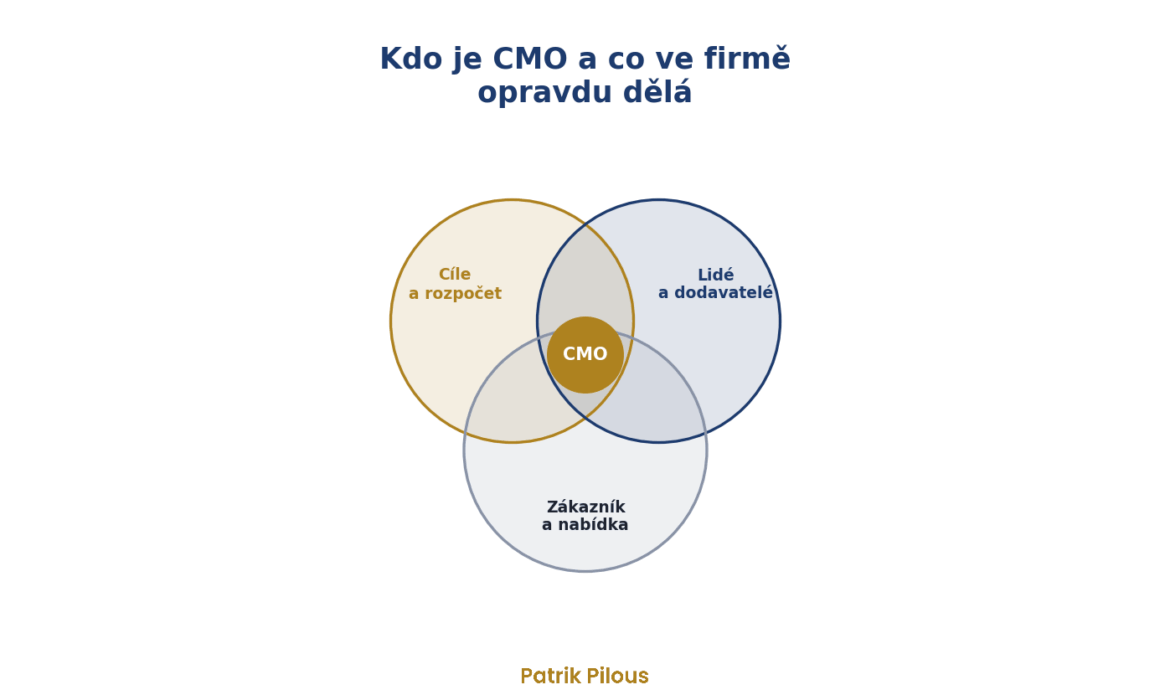
CMO stands for Chief Marketing Officer. It is the person in the company’s leadership who is responsible for what marketing brings in terms of revenue and customers, not for how many campaigns it launches. The CMO decides where the money goes, who does what and which numbers show that it is working.
Czech companies rarely use the abbreviation, but they do have the role under other names: head of marketing, marketing director or simply “the person in charge of it”. The title does not matter. What matters is whether someone actually holds the role.
What a CMO does in practice
On paper, strategy. In practice, mostly deciding what will not be done. Marketing always has more ideas than money and people, and whoever is responsible for it must be able to say no even to a good idea when it would bring in less than another one. Specifically, a CMO holds six things that have to fit together.
- Goals and numbers. Turns a business goal, such as turnover or the number of new customers, into marketing goals and keeps track of them.
- What sets the company apart. What it claims about itself, which positioning it wants to own and which unique selling proposition will back it up.
- Budget. How much money goes where, and in what order according to the season.
- People and suppliers. Who does what inside and outside the company, and how they get a brief they can actually work from.
- Measurement. One version of the numbers that both leadership and marketing trust.
- Link to sales. What salespeople and customer support hear, and what is missing from the offer.
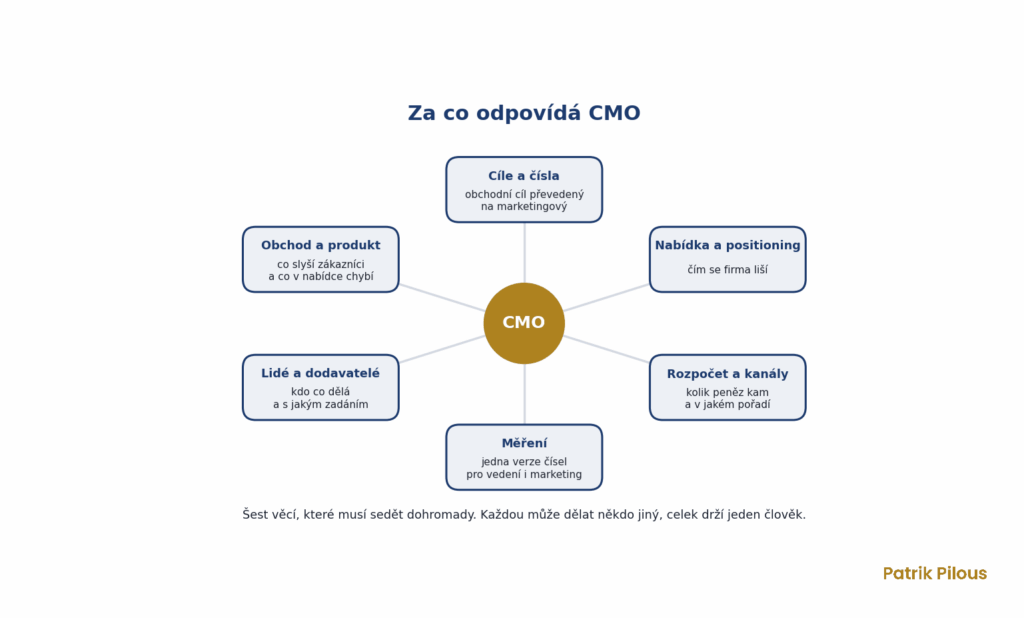
How much of this does the CMO do personally? It depends on the size of the company. In a large company, the CMO mainly manages a team. In a smaller one, they handle a lot themselves, because waiting for a supplier would cost more than just doing it (and that is how I work too).
How a CMO differs from a marketing manager
The difference lies mainly in the question the person in the role asks. A manager asks how to launch a campaign. A CMO asks whether to launch it at all.
| Role | Responsible for | Measured by | Typical question |
|---|---|---|---|
| Marketing specialist | one channel | channel performance, such as ROAS or rankings | How can I improve the campaign? |
| Marketing manager | the plan and its delivery | meeting the plan and budget | How do we get it done in time and at what cost? |
| CMO | the results of marketing as a whole | revenue, margin, new customers | Is it worth doing at all? |
In a small company, one person often fills two roles at once. The problem arises when they only do the managerial one and the strategic role stays empty. The company then delivers a plan that nobody knows is right.
When a company needs a CMO
Here is a simple test. Ask three people or suppliers who handle your marketing how things are going. Do you get three answers with numbers that cannot be put together into one picture? Then you are missing someone who holds the whole. There are other similar signals.
- The budget keeps growing, but nobody can say what part of it brought in revenue.
- The owner deals with marketing in the evening after work, because there is no time for it during the day.
- The company is entering a new market and needs not only to open it but also to manage it over the long term.
On the other hand, you do not need one if you have a single channel that works and one person who runs it well. There, a CMO would be an expensive extra layer. And if you only need to set the direction once, for example before entering a new market, a one-off strategy or consulting session is enough, not ongoing leadership.
Who can fill the CMO role
An in-house, full-time CMO makes sense in a company where marketing consists of several full-time people, the budget runs into millions per year and decisions are made every day. Finding such a person also takes time. An agency, in turn, knows the work in the channels it handles. However, it is usually not responsible for the whole, and it will hardly advise you to move budget anywhere other than to itself (with honourable exceptions that can keep the two apart).
In between sits the outsourced, fractional CMO. A senior person working part-time who sets the direction, manages people and suppliers and handles part of the work personally. The company pays only for the part it really needs.
Fractional leadership roles are on the rise. According to data from Revelio Labs, only 5 in 1,000 new leadership positions mentioned a fractional arrangement in 2018, compared with 18 in 2024 (data from a company that sells labour market analytics, so take it with a pinch of salt). And among people who present themselves on their profiles as fractional leaders, CMO is the most common role after CFO.
For this to work, decisions inside the company have to be made quickly. Otherwise, the outsourced CMO turns into an outside adviser whose recommendations wait in a queue. How I set up this kind of collaboration, how much time it takes and who it suits is described on the outsourced and fractional CMO page.
How much a full-time CMO costs
According to a survey by Platy.cz, 80% of marketing directors in the Czech Republic earn roughly 68,000 to 198,000 CZK (about 2,800 to 8,100 EUR) gross per month. With a salary of 130,000 CZK (about 5,300 EUR), roughly in the middle of that range, the company pays around 174,000 CZK (about 7,200 EUR) a month including social security and health insurance contributions (33.8%), which is over 2 million CZK (about 82,000 EUR) a year. And that is without bonuses, recruitment and equipment.
On top of that comes the search and onboarding before the new person starts making decisions. And the comparison with the budget is unforgiving. A company with a turnover of 30 million CZK (about 1.2 million EUR) that spends 7.8% of revenue on marketing, like the large companies in the Gartner survey, has roughly 2.3 million CZK (about 95,000 EUR) a year for all of its marketing. A full-time director would swallow almost all of it.
That is why smaller companies either leave the role unfilled or fill it part-time. The first option is only cheaper on paper, because budget decisions are then made by whoever has the least time for them.
What working with a fractional CMO looks like
A fractional CMO is not in the company every day, so the arrangement relies on a fixed rhythm. Without a rhythm, it is like a coach who only turns up for matches and never sees the team train. The rhythm that works for outsourced marketing leadership has three layers.
| How often | What happens | Who attends |
|---|---|---|
| Every two weeks | a meeting on numbers and priorities for the coming weeks | owner, someone from operations, CMO |
| Every month | results overview by channel, budget shifts | leadership, CMO, main suppliers |
| Every quarter | review of strategy and priorities for the next quarter | leadership, CMO |
Between meetings, the CMO manages suppliers and in-house staff directly and does part of the work personally. The CMO must have access to all the data rather than asking for each number separately. (In my view, waiting for an export from accounting is the most expensive time in the whole collaboration.)
Why CMOs do not last long in companies
CMOs turn over faster than any other members of company leadership except chief operating officers. According to a Spencer Stuart study from January 2026, current CMOs at companies in the US S&P 500 index have been in the role for an average of 4.1 years. The average across all top leadership roles is 5 years, and for chief operating officers 3.3 years. Almost a third of those companies (31%) do not have a CMO role at all. These are large American corporations, but the cause described in the research below applies just as much to a company with a turnover in the tens of millions.
Why? Kimberly Whitler and Neil Morgan in the Harvard Business Review identified a poorly designed role as the main cause. Every company imagines something different under the CMO title (and in my view, people most often fail on expectations that nobody ever voiced).
“There is no clear and widely accepted answer to the question of what a CMO does.”
summary of the article Why CMOs Never Last by Kimberly A. Whitler and Neil A. Morgan, Harvard Business Review, 2017
The authors distinguish three types of role: strategic, focused on bringing products to market, and with responsibility for the profit and loss of the whole company. Anyone who expects the third type and hires the first will be disappointed, even if the person does their job well.
How much this varies in practice is shown by the spring 2026 The CMO Survey of American companies. Marketing is responsible for the brand in 94% of them, for the growth of the whole company’s revenue in 43%, for pricing in 28% and for sales in only 19%. So whoever leads marketing can have a completely different scope of responsibility in each company.
Before a company looks for a CMO, it should write down what the CMO will own and what they will only influence. Without this, it hires someone who is supposed to be responsible for revenue, and they then discover that they have no say over pricing, the product range or the sales team.
| Area | CMO owns | CMO influences |
|---|---|---|
| Marketing budget | yes | |
| Positioning and communication | yes | |
| Choice of marketing suppliers and staff | yes | |
| Pricing and discounts | yes, provides data | |
| Product range and product | yes, provides demand data | |
| Sales team | yes, a shared definition of a good customer |
Which numbers a CMO tracks
No single number is enough on its own. A CMO looks at several at once, because each can be improved at the expense of another. Attributing revenue to individual channels precisely and indisputably is also only rarely possible, so a trend tells you more than one precise number. These are the ones most often tracked.
| Metric | Why track it |
|---|---|
| Revenue and margin from marketing | the numbers owners care about most |
| New and returning customers | shows whether the company is growing or just milking existing customers |
| Cost of sale (PNO) or ROAS | how much advertising costs relative to revenue |
| Customer acquisition cost | how much a new customer costs across channels |
| Share of non-brand demand | whether people who do not know the company yet can find it |
| Visibility in AI answers | how often ChatGPT or Gemini mention the company for the same questions |
The pressure on numbers is also growing because budgets are barely increasing. According to Gartner, large companies in North America and Europe are spending 7.8% of revenue on marketing in 2026, compared with 7.7% the year before. And 56% of the CMOs surveyed say their budget is not enough for their planned strategy. So a CMO usually does not get more money and has to find it by reallocating.
AI visibility is the newest metric in the table and is measured differently from traffic. The same questions are regularly put to the models, and you count how often they mention the company. I describe how to do this in my article on associations and entities in SEO and AI.
And what does a CMO not track as a goal? The number of posts, likes or newsletters sent. These are activities, not results. You can read more about the individual metrics in the article Marketing and KPIs.
A new CMO’s first 90 days
The first month is about data: where the money goes, what it brings back, which tools the company has and whether they can be trusted. The output is a simple map of what each channel costs and what it delivers. Without it, no decision will stand up.
In the second month, decisions are made: priorities, budget by channel, what stops and who is responsible for what. The result is a one-page marketing strategy that the company can be run by.
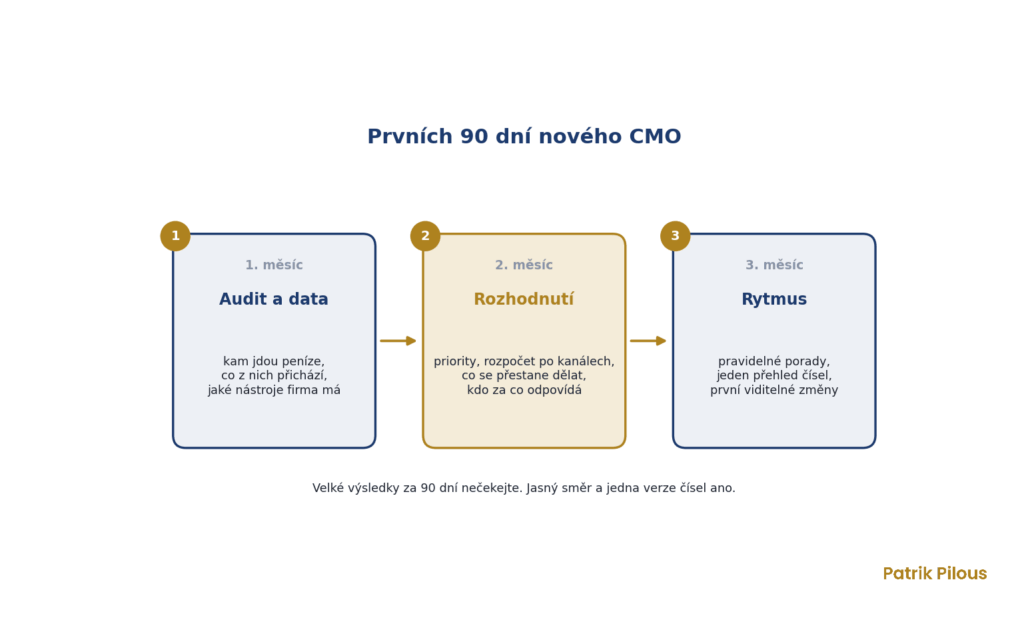
By the third month, a rhythm should be in place: regular meetings with a clear agenda, one overview of the numbers and the first visible changes, such as a shifted budget or a channel that brought nothing being switched off. Do not expect big revenue results within 90 days, but do expect a clear direction and order in the numbers.
Five questions for choosing a CMO
Almost anyone can talk about strategy in an interview. The difference shows in questions that cannot be answered in general terms. These five apply equally to in-house and external candidates.
| Question | What you want to hear | Warning sign |
|---|---|---|
| When did you last take money from a channel that was working and put it elsewhere? | a specific case, numbers before and after | only theory about optimisation |
| How will you find out where our money goes in the first month? | data sources, interviews, a channel map | a ready-made campaign plan without data |
| What would you stop doing here? | “I need to see the numbers first”, then hypotheses | a confident answer after ten minutes |
| How will you agree with sales on who a good customer is? | a shared definition and one number | “that’s a matter for sales” |
| What numbers will you send me each month? | three to five numbers linked to revenue | reach, likes, number of outputs |
The second and third questions go together. Anyone who can say what they would stop doing without seeing the data is answering off the top of their head. They will then do the same with your budget.
What a CMO does not do
A CMO does not decide alone what the company buys and what it sells it for. That is a matter for the owner or sales, and the CMO contributes data on demand. At the e-shop where I run marketing, the owner decides on the product range and prices, and I bring him data on what people search for and what is missing from the offer.
Nor is it someone who does everything. When a CMO drowns in day-to-day operations, nobody keeps sight of the whole and the company is back to three suppliers with three sets of numbers. If you are considering whether such a role would suit you, write to me.
Euro amounts are approximate, converted at the Czech National Bank rate of 24.34 CZK per EUR on 29 October 2026.

