

The Matthew effect describes how advantage breeds further advantage. Whoever already has a lead in attention, money, links or reviews gains more of them disproportionately easily, and the gap between them and everyone else widens. It is named after a verse from the Gospel of Matthew, which says that to whoever has, more will be given, and from whoever has not, even what they have will be taken away. In marketing and SEO you can see it in almost every ranking.
Classification
- Type of phenomenon: a social and economic phenomenon of cumulative advantage, driven by mental shortcuts
- Bias that feeds it: we take success as proof of quality and familiarity as proof of trustworthiness
- Mental area: Social, judgement of quality
- Marketing function: Brand, SEO, reviews
- Buyer journey: Awareness and consideration
- System 1 / System 2: System 1 (fast, automatic)
In brief
- What it is: whoever has a lead gains further advantages faster than others.
- Why we do it: we take popularity as a signal of quality, so we give attention where it already is.
- Where you meet it: top positions in Google, bestsellers in online shops, products with the most reviews, citations of scientists.
- How to use it: be first in a smaller pond and keep feeding the lead you gain.
A real-life story
The term was introduced by the American sociologist Robert K. Merton in 1968 in the journal Science. In the article The Matthew Effect in Science he quoted verse 25:29 from the Gospel of Matthew and showed that famous scientists receive more credit for the same discovery than their less well-known colleagues. When two people publish the same idea, the one with the name gets cited.
The MusicLab experiment showed that it is not only about quality. In 2006, Matthew Salganik, Peter Dodds and Duncan Watts from Columbia University had 14,341 people listen to and download songs by unknown bands, as reported in the journal Science. Some participants could see how many times others had downloaded each song, and they were divided into separate worlds.
The stronger the social influence, the greater the inequality between songs and the harder it was to predict in advance which one would win. The result was surprising. In each world, slightly different songs rose to the top, depending on what the first listeners happened to download.
How the Matthew effect works
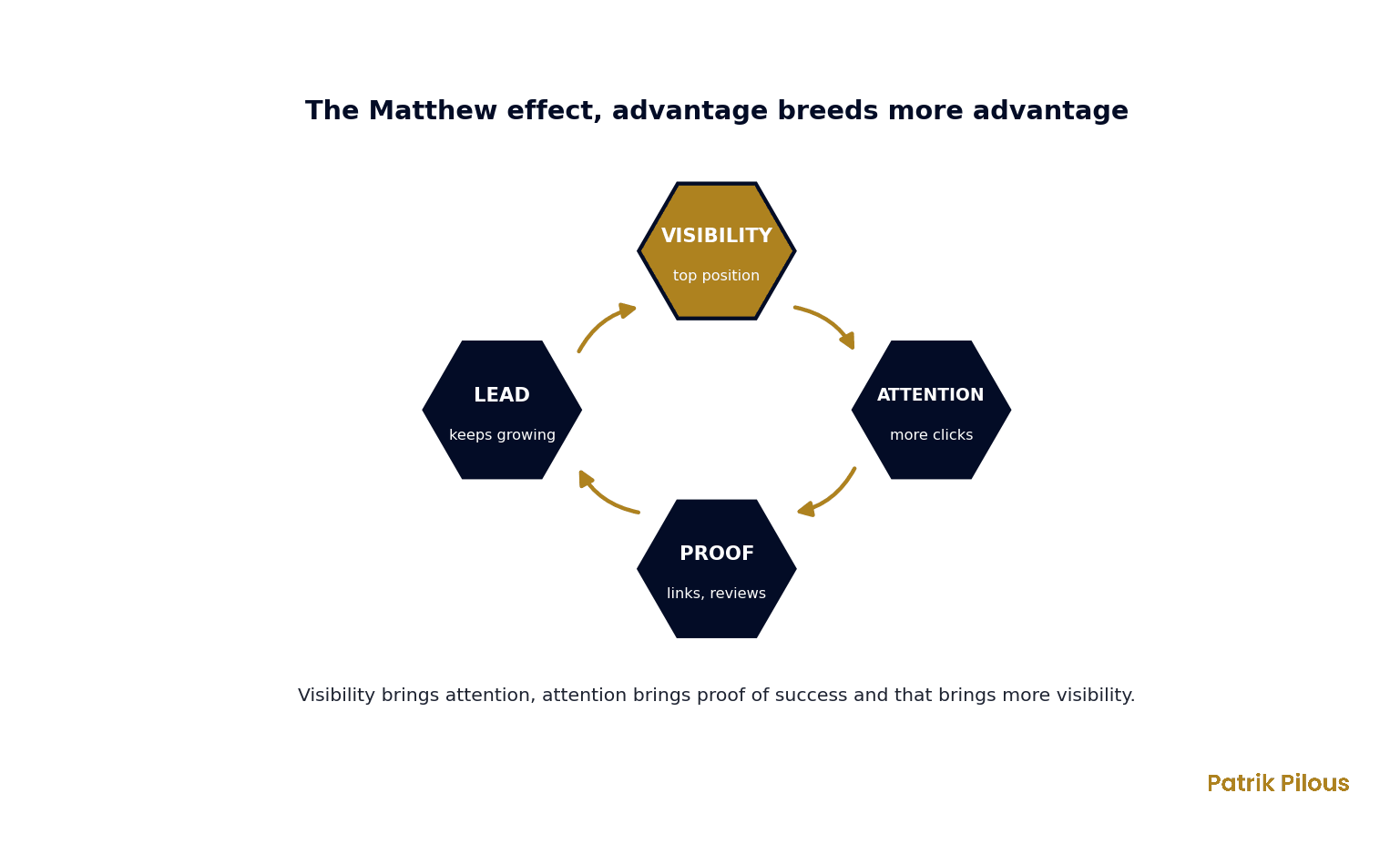
The advantage multiplies through a feedback loop. Visibility brings attention, attention brings proof of success such as clicks, reviews or links, and these bring even more visibility. In 1999, the physicist Albert-László Barabási and Réka Albert showed in Science that this is how networks grow. A new node prefers to connect to one that already has many connections, and physicists call this preferential attachment.
Psychology drives the loop. Social proof tells us that what many people have chosen must be good, and the halo effect transfers success in one thing to everything else. Neither shortcut asks whether the lead was earned or came about by chance.
The Matthew effect in SEO
According to a Backlinko analysis of around 4 million results, the first organic result has an average click-through rate of 27.6% and is ten times more likely to get a click than the tenth position. This is an average across all query types; the figures differ for branded queries and for results with AI answers. The gap between first and tenth place, however, is always large.
More visits mean more people who might link to the page. Another Backlinko analysis of 11.8 million results from 2020 found that the page in first place has on average 3.8 times more backlinks than pages in positions 2 to 10. This is a correlation, not proof of cause, but it fits the loop exactly. At the other end, according to an Ahrefs study from 2023, 96.55% of pages in their index get no traffic from Google.
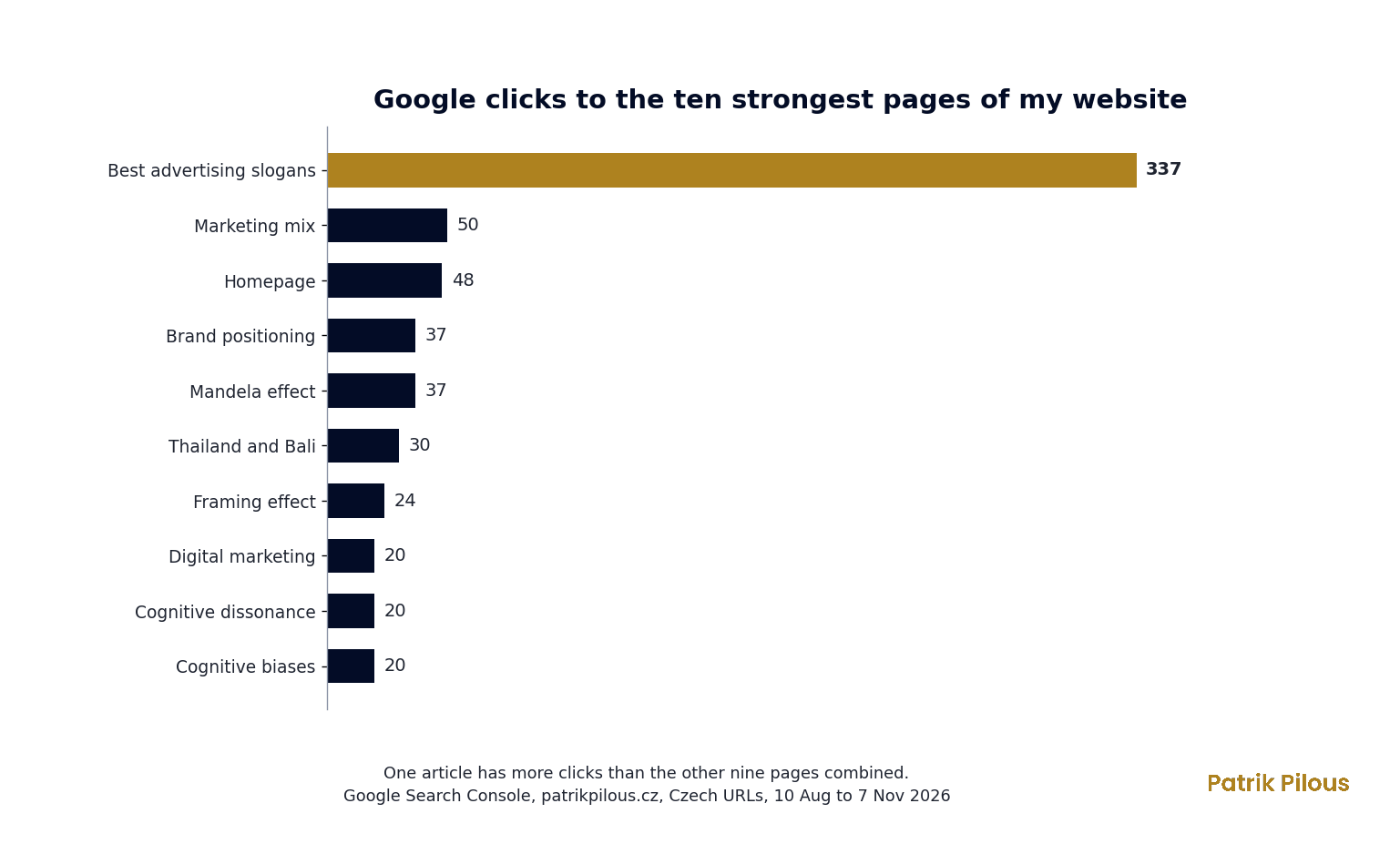
I see it on my own website too. One article brought more clicks from Google over three months than the next nine strongest pages combined. It is at the top, so people click on it, and because people click on it, it stays at the top. I show the full distribution of my pages under the Pareto principle.
Use in marketing
The Matthew effect works for whoever is already ahead. A smaller player can trigger it too, though, by choosing a playing field where they have a chance to be first.
- Win a small category. In a broad category, the leader is long established and their lead keeps growing. In a narrower niche, you can be first. Well-chosen positioning helps.
- Actively collect your first reviews. A product without ratings is hard to sell because social proof is missing. The first reviews are worth a targeted email or a personal request. Once there are a few dozen, more come in more easily.
- Back the winners. When an article or campaign starts working, give it more budget and care. A lead is best built where one already exists.
- Make success visible. A “bestseller” label, the number of customers or client logos trigger another round of attention. They must be true.
- Work with those who have a lead. A guest spot on a podcast or a link from a strong industry website transfers part of someone else’s advantage to you. That is why backlinks from authorities carry so much weight.
All these points rest on the same principle. A small initial lead, created deliberately, then grows on its own.
How to guard against the Matthew effect
Guarding against it mainly means not confusing popularity with quality, and this applies to buying just as much as to running your own marketing.
- Separate popularity from quality. A bestseller is a bestseller because it sells. It may not be the best for your needs.
- Test what has no lead, too. Evaluate a new channel or product under the same conditions as established ones. Otherwise, whoever was already winning will win.
- Watch concentration. When a third of your clicks from Google come through one page, a single algorithm update can cost you a third of your search visits.
- Look below the winners too. Less popular pages and products often just have less chance of being seen, not lower quality.
Most companies only realise the concentration risk when the winner drops, which is why it is better to spread traffic and revenue across more pages and channels before an algorithm or a competitor does it for you.
How it connects with other biases
The Matthew effect explains why the world is so often distributed according to the Pareto principle. A small initial difference, multiplied over and over, turns into extreme inequality. Anyone who then studies only the winners falls into survivorship bias and believes that their quality alone explains their success.
The mere exposure effect works alongside it. The more often we see a brand, the more we like it, so big brands buy affection along with attention, while a smaller player has to find places where they are the one being seen.
Interesting questions on the topic
What is the Matthew effect?
A phenomenon in which advantage brings further advantage. Whoever has a lead gains more faster than others.
Why is it called the Matthew effect?
After verse 25:29 of the Gospel of Matthew, which says that to whoever has, more will be given. The term was introduced by the sociologist Robert K. Merton in 1968, when he described how famous scientists receive disproportionately more credit.
How does the Matthew effect show up in SEO?
Pages in the top positions get the most clicks, so they also have more opportunities to earn links. These help them hold their position.
How can a smaller brand break through?
Find a smaller category where it can be first, actively collect the first reviews and links, and then keep strengthening the lead.

