

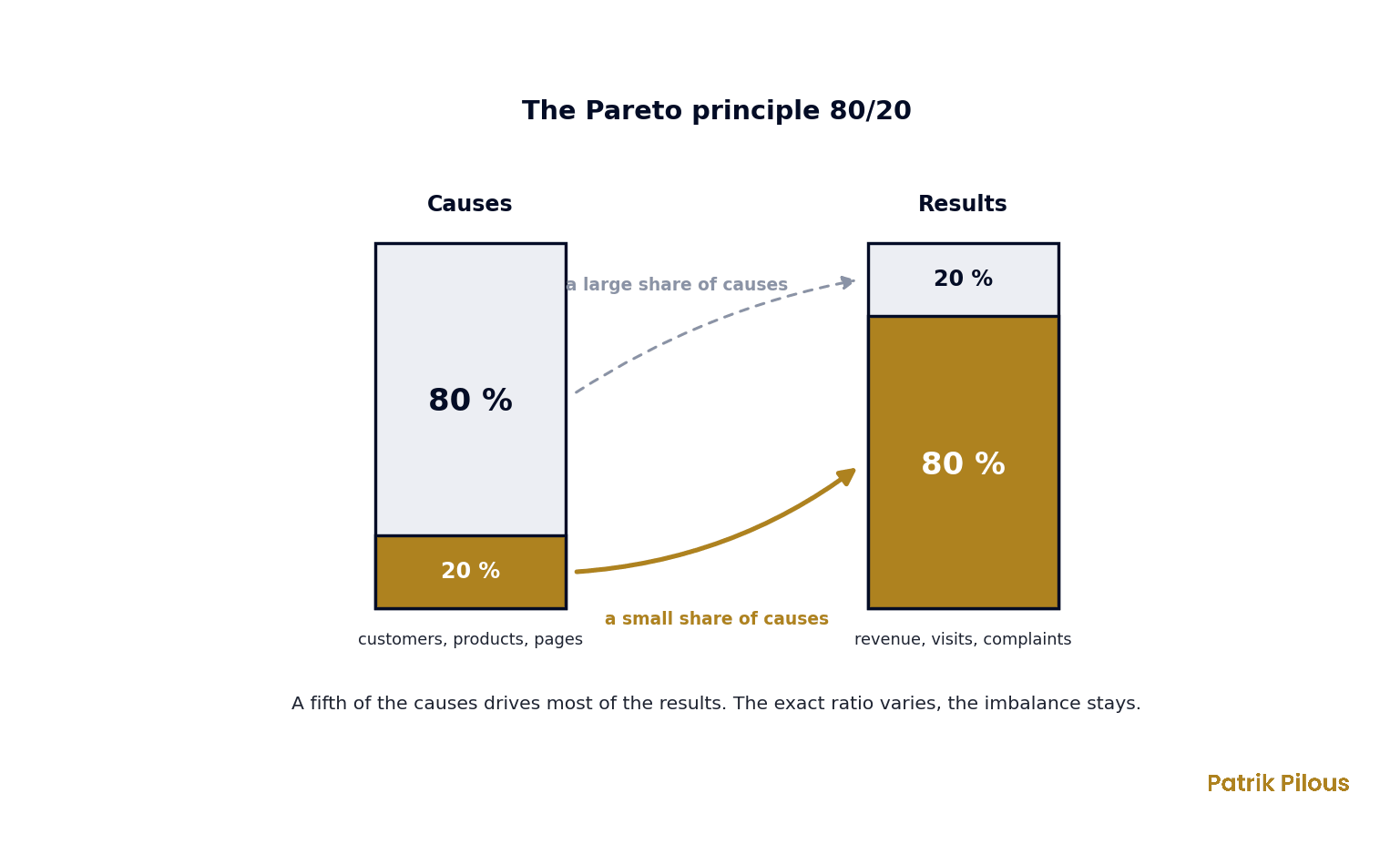
The Pareto principle, also known as the 80/20 rule, says that a minority of causes produces most of the results. Typically, roughly 80% of the effect comes from 20% of the inputs. A fifth of customers bring in most of the revenue, and a fifth of a website’s pages bring in most of the visits. The exact numbers vary by industry and company. Sometimes it comes out at 70/30, other times at 95/5. But in marketing data you will almost never find a distribution where every item carries the same weight.
Classification
- Type of phenomenon: a statistical rule of uneven distribution, not a cognitive bias in itself
- Bias it reveals: we intuitively expect every customer, product and page to carry roughly the same weight
- Mental area: Decision-making, prioritisation
- Marketing function: Strategy and budget
- Customer journey: across all stages, most of all loyalty and repeat purchases
- System 1 / System 2: System 2 (conscious work with data)
In brief
- What it is: a small share of causes produces a large share of results.
- Why it matters: the brain expects an even distribution, so we spread our time and budget in equal portions.
- Where you will see it: revenue by customer, visits by page, sales by product, spend by keyword.
- How to use it: find your 20%, give it a disproportionate share of attention, and do not write off the rest without testing.
A real-life story
At the end of the 19th century, the Italian economist Vilfredo Pareto taught in Lausanne and studied how incomes were distributed. In his work Cours d’économie politique, published in 1896 and 1897, he showed that a small share of people held a large share of the wealth and that the distribution followed a power law. The popular line that 80% of the land in Italy belonged to 20% of the people does not appear in the original.
There is also a story that Pareto found the same ratio in his garden, where a fifth of the pea pods produced most of the peas. A nice tale, but there is no evidence for it.
It was the American quality expert Joseph M. Juran who turned Pareto’s observation into a rule for managers. In his Quality Control Handbook from 1951, he named it the Pareto principle and spoke of the vital few and the trivial many. In 1974 he admitted himself that he had attributed things to Pareto that Pareto had not done, and that the principle should really be named after him.
Juran later changed the trivial many to the useful many. He did not want managers to write off the rest. The rule found its way into practice everywhere. For example, in 2002 Steve Ballmer wrote to Microsoft customers that 20% of the bugs in their software caused 80% of the reported crashes.
The Pareto principle on my website
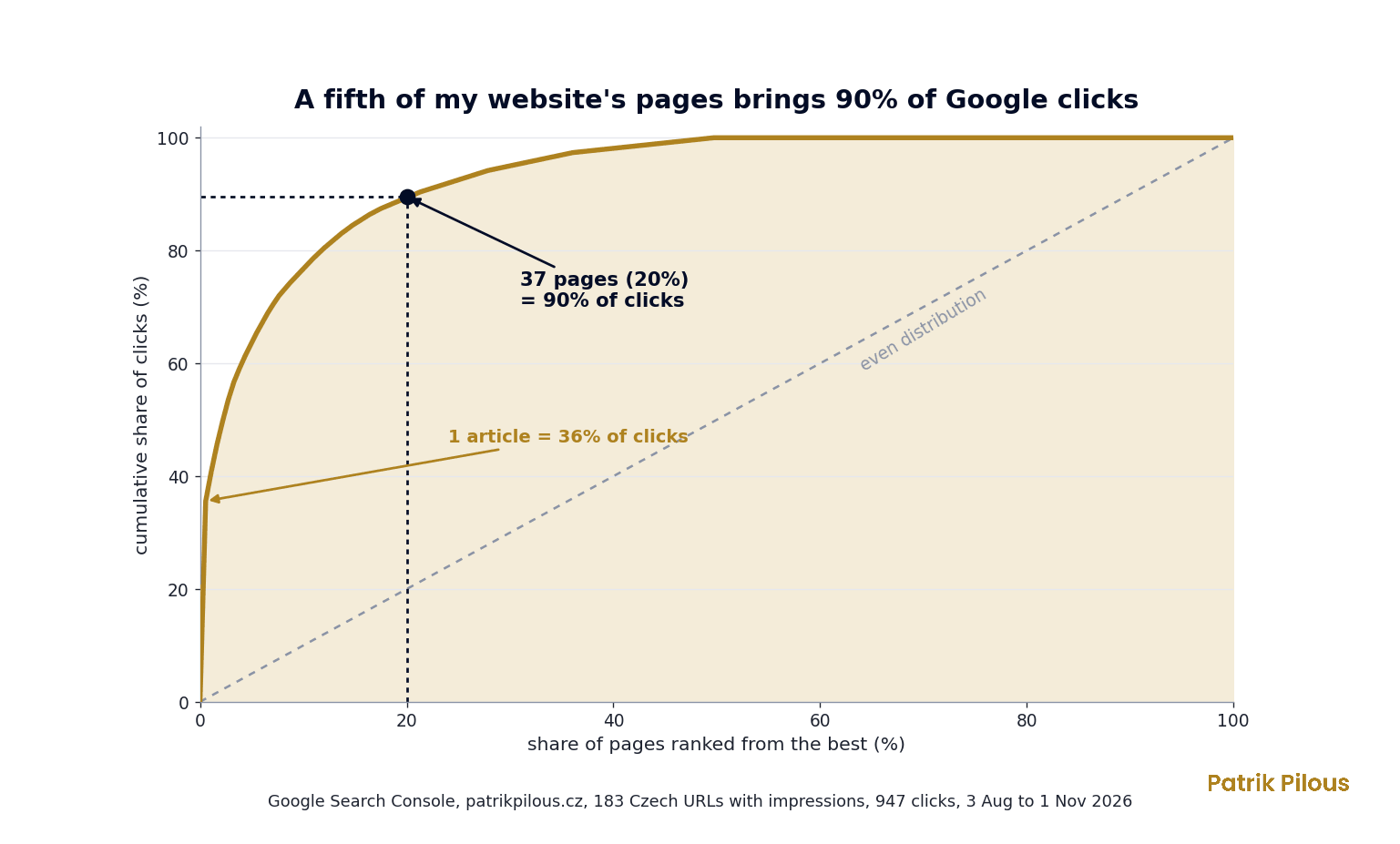
I did the same exercise with my own data. For 3 August to 1 November 2026, Search Console records 183 Czech URLs on patrikpilous.cz that had at least one impression in search, with a combined 947 clicks from Google. I ranked them from best to worst and added them up.
37 pages, exactly a fifth, brought in 90% of all clicks. A single article collected 337 clicks on its own, which is 36% of all search traffic. And 92 pages did not get a single click in three months. So for me it is not 80/20 but an even more dramatic 90/20.
How the Pareto principle works
Inequality arises where success attracts more success. Let me show it with an article. When it reaches the first page of Google, more people read it, some link to it, and those links help it hold or improve its position. So a year later it does not have twice as many visits as an article on the second page, but easily ten times as many. Similarly, a satisfied customer buys more often and buys more expensive things. Sociologists call this the Matthew effect.
Economists call this kind of distribution a Pareto distribution, and the 80/20 ratio is just one point on it. That is why the two numbers do not have to add up to a hundred. It can be true that 10% of customers generate 60% of revenue. One number describes the causes, the other the results.
The cognitive bias kicks in when we do not have the data in front of us. We assume that every item contributes roughly the same, so every category in an online shop gets an equally long text and every channel a similar slice of the budget. Such equality feels fair, but in practice it means the best-performing parts of the business get as little attention as the parts that bring in almost nothing.
Use in marketing
In marketing, the Pareto principle is above all a prioritisation tool. When your budget and time are limited, it tells you where to look first. The method is the same for every example. You rank the items from best to worst and look for the point where the running total breaks.
- ABC customer analysis. Export your customers for the last 12 months, rank them by revenue (or better, by margin) and calculate the cumulative share. Group A covers roughly the first 80% of revenue, B up to 95%, and the rest is C. Give group A personal contact and priority care. Calculating CLV also helps, so you know how much a customer will bring you over the whole relationship.
- Content and SEO. In Google Search Console, rank your pages by clicks over three months. Update and interlink the top fifth first, because you already have rankings there and a small improvement shows quickly.
- Product portfolio. In an online shop, a small share of products usually generates most of the revenue. Keep an eye on their stock, price, photos and copy. A bestseller going out of stock hurts more than twenty dead items.
- PPC and keywords. In Google Ads, a handful of search terms often spend most of the budget. Review them first.
- Customer service. Sort support queries by type. A recurring problem can often be solved by a single change to the website, such as clearer delivery information.
What all these points have in common is that the outcome is a ranking, not cuts. What sits at the bottom of the table is not necessarily useless. It just does not get priority.
Where the Pareto principle misleads in marketing
The rule tempts you to conclude that it is enough to pamper your best customers and leave the rest alone. Data from consumer goods show something different. In 2019, Byron Sharp, Jenni Romaniuk and Cathy Graham from the Ehrenberg-Bass Institute went through purchase data for many brands, and the most active 20% of buyers accounted on average for roughly half of sales, not 80%.
That is why they titled their working paper Marketing’s 60/20 Pareto Law. Light buyers, who purchase once a year, still make up a large share of revenue when taken together, and brand growth depends mainly on them.
The second counterexample is the long tail. In 2008, Anita Elberse of Harvard Business School analysed in HBR data from the music service Rhapsody. The top 10% of tracks accounted for 78% of all plays, and the top 1% of tracks for 32%. Hits pull more weight than long tail advocates claimed, but the rest of the catalogue gets played too.
Items that sell little can therefore still make sense in your range. They add breadth to the assortment and bring in searches for less common terms. Decide based on margin and their role in the range, not on their position in the revenue table.
How to work with the rule so it does not fool you
The biggest mistake is treating 80/20 as a finished result. It is only a question worth asking of your own data.
- Measure first, then decide. Calculate the actual ratio. A spreadsheet and ten minutes are enough.
- Do not expect exactly 80/20. On my website it is 90/20, for another business it might be 50/20. Your strategy changes depending on how steep the curve is.
- Look at profit, not just revenue. The customer with the highest revenue may have the lowest margin and the most complaints.
- Track movement over time. Today’s top fifth will change within a year. If you stop feeding the bottom, you have nowhere to find new stars.
Repeat the process at least once a quarter. Google rankings, seasonality and new products quickly reshuffle the order.
How it connects with other biases
The Pareto principle often goes hand in hand with survivorship bias. If you only study the top 20% of products or articles, you see what succeeded, but not what had the same qualities and failed.
Another connection is with the availability heuristic. Bestsellers and the biggest clients are always on our minds, so we overestimate their share even without data. The fifth that the whole company talks about is sometimes really only a tenth of revenue.
Interesting questions on the topic
What is the Pareto principle?
The 80/20 rule, according to which a minority of causes produces most of the results. For example, 20% of customers bring in roughly 80% of revenue.
Does the 80/20 rule always apply exactly?
No. It describes an uneven distribution, and the actual ratio varies with the data. On patrikpilous.cz it came out at 90/20, while for consumer brands the Ehrenberg-Bass Institute measures roughly 50/20 on average. Always calculate it from your own numbers.
How can the Pareto principle be used in marketing?
Rank customers, products, pages and keywords by results and spend most of your time on the top fifth. Do not drop the bottom without testing, as your future business grows from it.
What is the difference between the Pareto principle and Pareto optimality?
The Pareto principle describes the inequality between causes and results. Pareto optimality is an economic state in which no one can be made better off without making someone else worse off.

