

Dunbar’s Number is an estimate of how many stable relationships one person can maintain. The figure most often quoted is 150, but it is an estimate with a wide spread. It counts people you know personally, where you know them from, and whom you talk to from time to time. British anthropologist Robin Dunbar derived the number from the size of the cerebral cortex in primates. In 2021, researchers at Stockholm University showed that the same method allows almost any number between 2 and 520.
Classification
- Type of phenomenon: an estimate from evolutionary psychology, driven by limits on attention and time
- Bias it feeds: we treat one round number as a precise limit, even though it has a huge spread
- Mental domain: Social
- Marketing function: Community, team management, client care, social media
- Buyer journey: after purchase and referral
- System 1 / System 2: the limit applies to both; System 1 (fast, automatic thinking) turns the range into a fixed number
In brief
- What it is: an estimate that a person can manage around 150 meaningful relationships, arranged in layers of roughly 5, 15, 50 and 150 people.
- Why it matters: every relationship costs time and attention, and both customers and salespeople have limited amounts of each.
- Where you encounter it: the size of teams and branches, the number of clients per account manager, the active core of a community, friends on Facebook.
- How to use it: build teams and communities so that people know each other personally, and treat 150 as a guide with a spread.
A real-life story
In 1992, in the Journal of Human Evolution, Robin Dunbar compared neocortex size with group size across different primate species. The larger the share of cerebral cortex, the larger the groups that monkeys and apes could sustain. This built on the social brain hypothesis, which holds that large brains evolved mainly to keep track of relationships within a group.
A year later, in Behavioral and Brain Sciences, he plugged humans into the equation. The result was 147.8, which is where the famous 150 comes from. The 95% confidence interval, however, ranged from 100 to 231 people, because according to Dunbar humans have a cerebral cortex roughly half as large again as any other primate, so the equation was calculating far outside the data it was built on. Dunbar admitted this himself in the paper. He looked for support among hunter-gatherers, where mid-level groups averaged 148.4 people.
The best-known test came from Britain. Dunbar and Russell Hill of Durham University counted the Christmas cards that households send. The sample was small, with only 43 questionnaires returned covering 2,984 cards, and the average network of recipients came out at 153.5 people.
The spread was huge. The standard deviation was 84.5 people, and the number of cards sent ranged from 11 to 149.
How Dunbar’s Number works
Dunbar explains the limit with two constraints. The first is complexity. The brain has to track not only your relationship with each person but also the relationships between everyone else, and the number of pairs grows much faster than the number of people: a team of 15 has 105 pairs, while a group of 150 already has 11,175.
The second constraint is time. Monkeys maintain relationships through grooming, and in primates the time spent on it increases with group size. Dunbar applied this equation to humans and found that a group of 148 people would require 42% of the day for grooming. This is his calculation; nobody has measured it in humans. In his view, language emerged as a cheaper substitute, because you can talk to several people at once, whereas you can only groom one.
Relationships also vary in strength. In 2005, Zhou, Sornette, Hill and Dunbar found in data on human groups layers that grow by roughly a factor of three, from 3 to 5 people, through 9 to 15 and 30 to 45, up to 150. In popular form, this became 5, 15, 50 and 150.
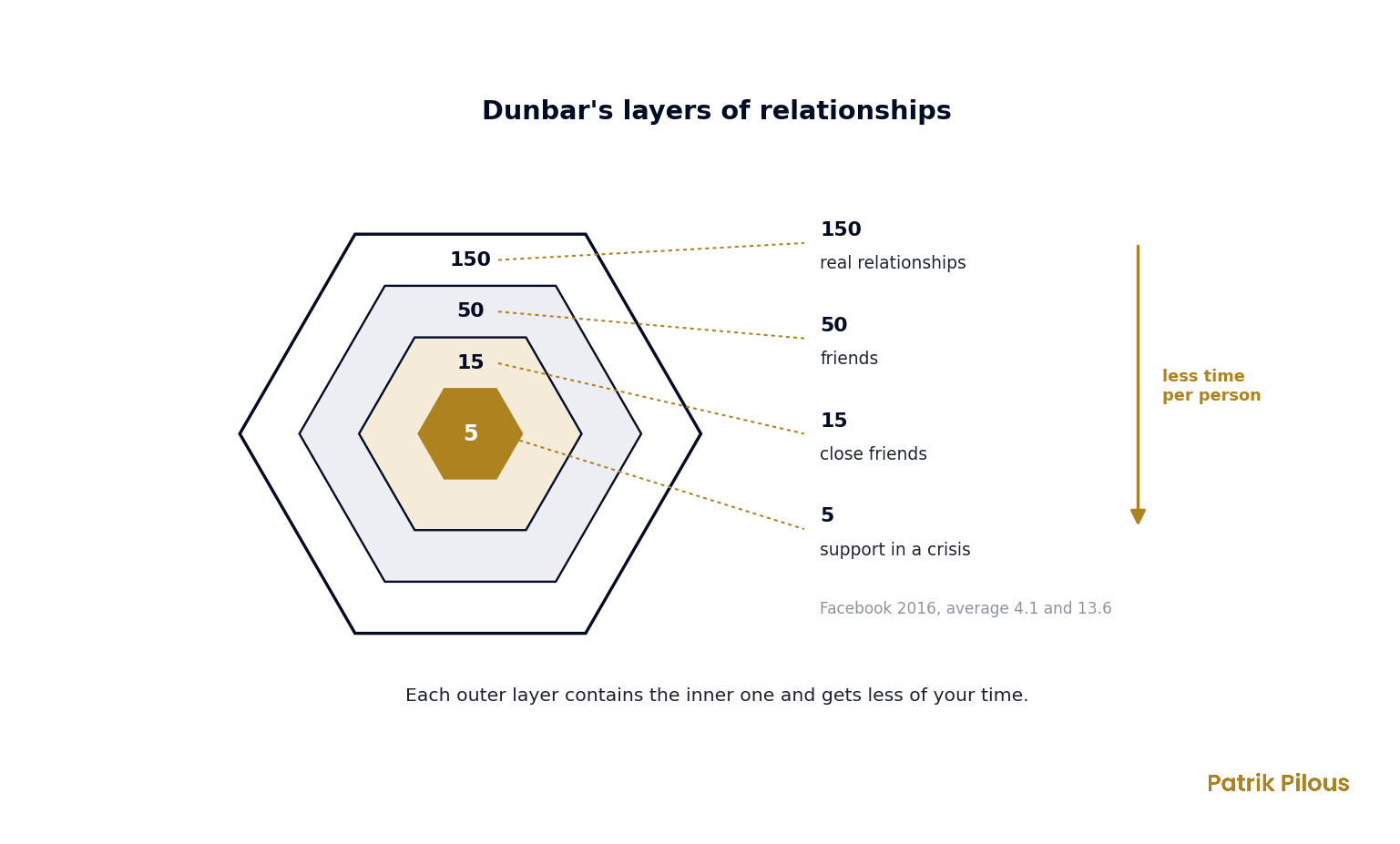
In 2016, Dunbar examined whether Facebook breaks the limit. Two British surveys with 2,000 and 1,375 respondents showed averages of 155.2 and 182.8 friends. In the first sample, people considered only 27.6% of them to be real friends.
The innermost support circle, meaning the people you turn to in a crisis, averaged 4.1 people, and close friends 13.6. Social media makes contact easier. According to Dunbar, however, a relationship still needs at least an occasional face-to-face meeting.
Dunbar’s Number in marketing
For a business, Dunbar does not offer a magic limit. What follows from it is rather that relationships are expensive and every person has a limited attention budget for them, whether that is a customer or your salesperson.
- Company and branch size. W. L. Gore, the maker of the Gore-Tex membrane, is run without a traditional hierarchy. According to IndustryWeek, the company says its lattice organisation works best when plants have no more than 150 to 200 people. It was only popular literature that linked it to Dunbar, chiefly Malcolm Gladwell in his 2000 book The Tipping Point.
- Team size. In my view, and this is a hypothesis derived from the layers, a team in which everyone knows what their colleagues are doing fits within roughly 15 people. Above 50 people, relationships across the whole company are unlikely to hold, and they need to be supplemented by processes and documentation.
- B2B client relationships. Imagine an account manager with 60 companies, each with three decision-makers. That is 180 contacts on top of family and friends, so some of them will inevitably go cold. In B2B marketing, this shows up as a client leaving without anyone noticing the signals.
- Brand communities and Facebook groups. In a group with 20,000 members, people do not know each other; it is an audience. So build a community from smaller groups by region or product, where people meet repeatedly and the in-group effect develops.
- Referrals and social proof. When people consider only a quarter of their contacts to be real friends, a recommendation from the inner layers carries far more weight than reach. Social proof from someone close works better than a thousand likes from strangers.
In my view, the main takeaway is a question of capacity. How many relationships do you want from your team, and how many can it realistically carry?
How much is 150 really
In 2021, Patrik Lindenfors and two colleagues at Stockholm University repeated Dunbar’s calculation in Biology Letters using newer primate data and more modern statistical methods. The estimates varied wildly and the confidence intervals were so wide that, according to the authors, it makes no sense to name a single number.
| Study | Method | Central estimate | 95% interval |
|---|---|---|---|
| Dunbar 1993 | primate neocortex regression | 147,8 | 100 to 231 |
| Lindenfors et al. 2021 | Bayesian phylogenetic | 69 to 109 | 4 to 520 |
| Lindenfors et al. 2021 | phylogenetic GLS | 16 to 42 | 2 to 336 |
| Hill and Dunbar 2003 | Christmas cards, 43 questionnaires | 153,5 | deviation 84.5 |
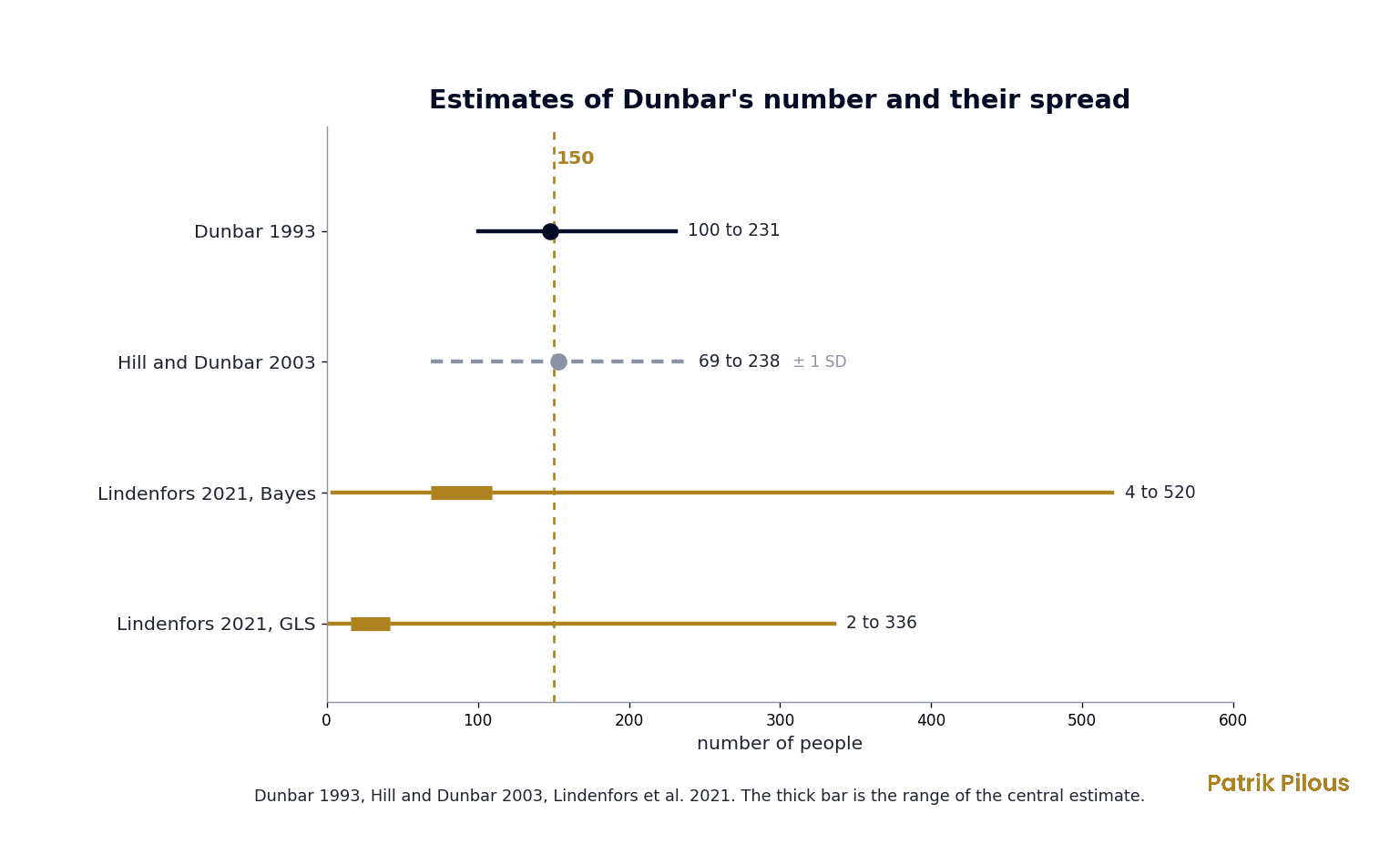
The university’s press release summed it up with a headline saying you can easily have more than 150 friends. The criticism targets the derivation from primate brains. Data on humans, such as Christmas cards or Facebook, often hover around 150, but with a spread wide enough to fit both 70 and 250 relationships.
How to work with Dunbar’s Number
There is no fixed limit. There is, however, a capacity for relationships, and you can plan around it more intelligently than with a single round number.
- Read 150 as a range. The original interval of 100 to 231 is more useful than the midpoint. People also differ: in the Facebook data, women had more friends than men, and younger people more than older ones.
- Measure your own limit. Track how many clients per person it takes before contract renewals or response times start to fall. That is your Dunbar’s Number for client care.
- Split before it falls apart. Gore split plants once they grew beyond roughly 150 to 200 people, and you can split a team, a community or a client portfolio in the same way.
- Give time to the inner layers. Keep key clients with the highest customer lifetime value (CLV) in the layer of 15, and serve the rest in a scalable way, for example with a newsletter.
- Do not count followers as relationships. With a thousand fans, the 27.6% share of real friends for an ordinary person is a reminder of how many of them you actually know.
When you need a number for a plan, take Dunbar’s interval of 100 to 231 and test it against your own data. Even science does not yet have a more precise estimate.
How it connects with other biases
Dunbar’s Number shares the fate of Miller’s Law. Miller wrote about seven plus or minus two items in short-term memory, and popular accounts turned this into a fixed seven. With 150, the same mechanism is at work as in anchoring, where the first number you hear pulls all further estimates towards it, even though the original author gave a wide interval.
In companies, Dunbar meets Parkinson’s Law. The more people join, the more work goes into coordination, and once a group outgrows the layer of 50 or 150, part of the time people used to spend on customers gets swallowed by meetings about who does what.
Interesting questions on the topic
What is Dunbar’s Number?
Most often 150. The original 1993 calculation gave 147.8, with an interval of 100 to 231 people.
Does Dunbar’s Number apply to social media too?
According to Dunbar’s 2016 survey, yes: the average was 155 to 183 friends on Facebook. However, people considered only about a quarter of them to be real friends.
Has Dunbar’s Number been disproved?
Questioned rather than disproved. A 2021 study showed that a precise number cannot be derived from primate brains, with the interval ranging from 2 to 520. The idea itself, that relationships have a capacity, still stands.
What are the layers of Dunbar’s Number?
Roughly 5 closest friends, 15 close friends, 50 friends and 150 acquaintances with a real relationship.
Why did Gore keep its plants small?
A company run without a traditional hierarchy relies on people knowing each other. According to Gore, this works up to 150 to 200 people per plant.

