

Parkinson’s Law states that work expands so as to fill the time available for its completion. A task that should take an afternoon takes a week if you are given a week. The British historian C. Northcote Parkinson wrote it in 1955 as a satire on bureaucracy. Parkinson’s laws also include the rule that expenditure rises to meet income, and the law of triviality about meetings that spend longer on trifles than on millions. Psychology experiments since the 1960s have shown that the core idea holds some truth, just less than motivational articles claim.
Classification
- Type of phenomenon: a satirical rule about work and bureaucracy, only partly confirmed by experiments
- Bias it reveals: we treat the available time and budget as a measure of how much work a task really needs
- Mental domain: Decision-making
- Marketing function: Project management, campaigns, budgets, meetings
- Buyer journey: not applicable, it concerns team work
- System 1 / System 2: System 1 (fast, automatic) infers the size of a task from the length of the deadline, while System 2 (slow, deliberate) has to estimate it from similar past projects
In brief
- What it is: a task stretches to fill the time you have for it, and a budget gets spent down to the last crown.
- Why it matters: a team reads the deadline and budget as a signal of how big the work should be, and inflates it accordingly.
- Where you will meet it: campaigns prepared until the very last day, website redesigns, annual budgets and meetings about the colour of a button.
- How to avoid it: estimate based on past projects and slice big jobs into short stages with their own deadlines.
A real-life story
The essay titled Parkinson’s Law appeared in the weekly The Economist on 19 November 1955. It opens with an elderly lady who has the whole day free, so writing and sending a postcard to her niece in Bognor Regis takes her the entire day. Someone in a hurry would manage the same in three minutes.
The British Admiralty served as the “evidence”. Between 1914 and 1928, roughly two thirds of the ships and a third of the sailors disappeared, yet the number of officials rose from 2,000 to 3,569, an increase of about 78%.
Parkinson explained this with two forces. An official wants more subordinates, because a subordinate is not a rival, and officials create work for each other. According to him, the number of officials grows by 5 to 7% a year regardless of how much real work there is.
The whole text is written tongue in cheek. Parkinson was a naval historian and, from 1950 to 1958, a professor of history at the University of Malaya in Singapore. Even the formula of 5 to 7% a year is part of the satire.
How Parkinson’s Law works
Laboratory experiments offer direct support for the expansion of work. In 1966, Elliot Aronson and his colleague Gerard described an experiment in the Journal of Personality and Social Psychology in which some participants, seemingly by mistake, were given more time for a task than they needed. On a similar follow-up task where they set their own pace, they worked longer than those who had previously had tightly measured time.
A year later, Judith Bryan and Edwin Locke classified the phenomenon in the title of their study90021-9) as a question of goal setting. A deadline works as a goal. In 1999, Laura Brannon and colleagues asked students to rate four sets of photographs of faces. Those who learned before the third set that the fourth had been cancelled spent longer on the third set than the control group.
A related phenomenon is the planning fallacy, where we underestimate the time a task needs. It is a different error from the expansion of work, but in practice it meets Parkinson’s Law. In 1994, Roger Buehler and colleagues asked 37 psychology students when they would hand in their thesis. On average they estimated 33.9 days, it actually took 55.5 days, and only 29.7% of them finished within their estimate.
For Parkinson’s Law, a side finding from the same article is more interesting. In a survey, students said they complete roughly three quarters of their projects (73%) on the day of the deadline. In another of the authors’ experiments, the moment of completion was very closely linked to the deadline (a correlation of 0.91).
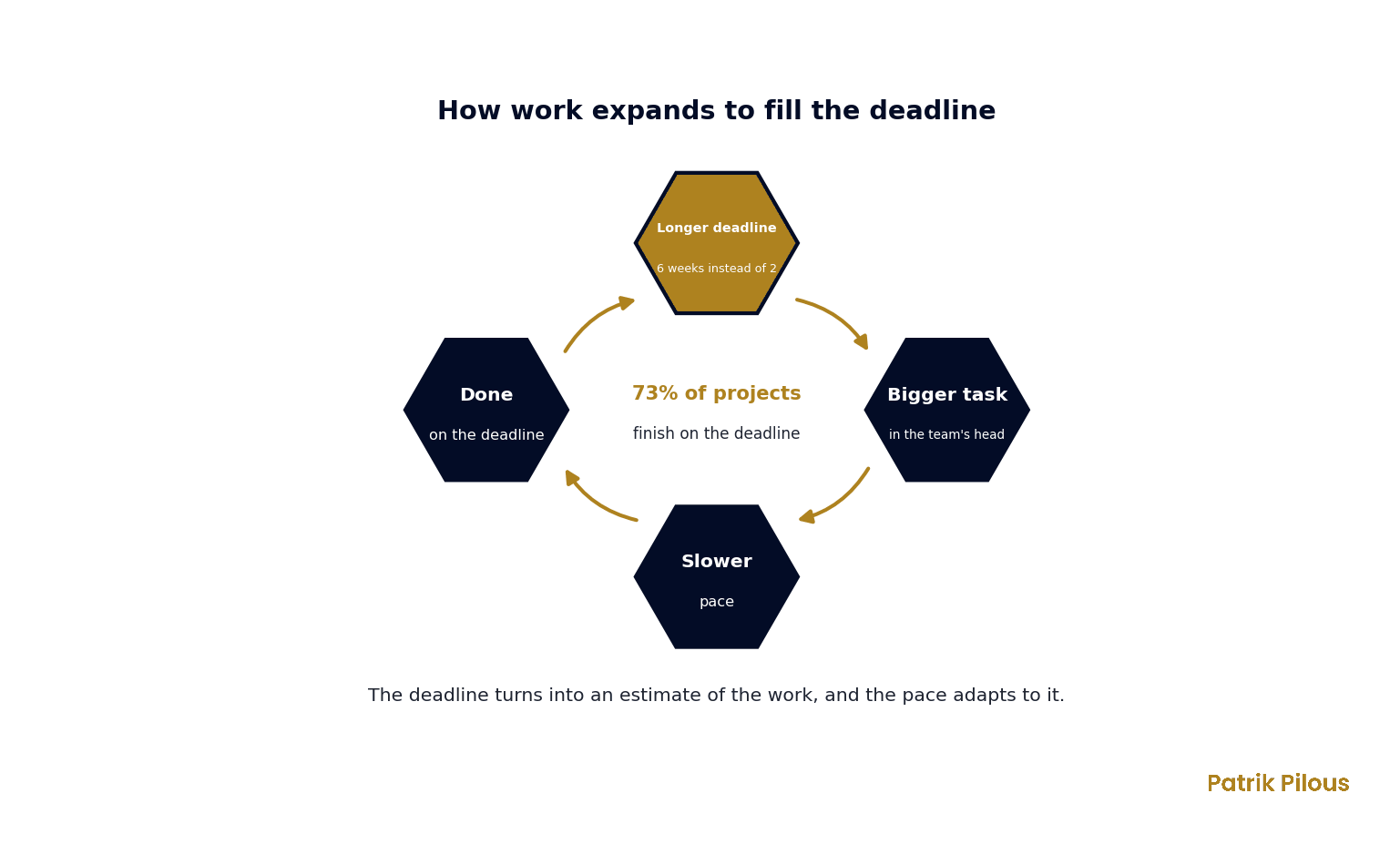
One explanation was offered by Indranil Goswami and Oleg Urminsky in 2020 in the journal Judgment and Decision Making. People estimating how long a task would take someone else gave higher estimates when the limit was longer, even when they knew the limit had been chosen at random and the person doing the work knew nothing about it. We associate more time with a bigger task.
Parkinson’s Law in marketing
Marketing runs on deadlines and budgets. A campaign, a website, a newsletter and a content plan all have a launch date, and that date quietly determines how big the job will become.
- Campaigns and deadlines. Imagine a sample campaign with a deadline six weeks away whose main work takes two. Preparation will take six weeks, and rounds of feedback will fill the rest. Split it into stages with their own dates, because according to the goal gradient effect, pace only picks up as the goal draws near.
- Website redesign. Here the planning fallacy joins Parkinson’s Law. The deadline is estimated optimistically, as with the students whose estimates fell short by 21.6 days on average, and any extra buffer the team gets is easily filled by the work.
- Budgets and the second law. In his 1960 book The Law and the Profits, Parkinson argued that expenditure rises to meet income. He was aiming at governments, but a marketing department that spends its remaining budget in December so it does not lose it next year does the same. Mental accounting adds to this, as money in one budget line feels free even when it is missing elsewhere.
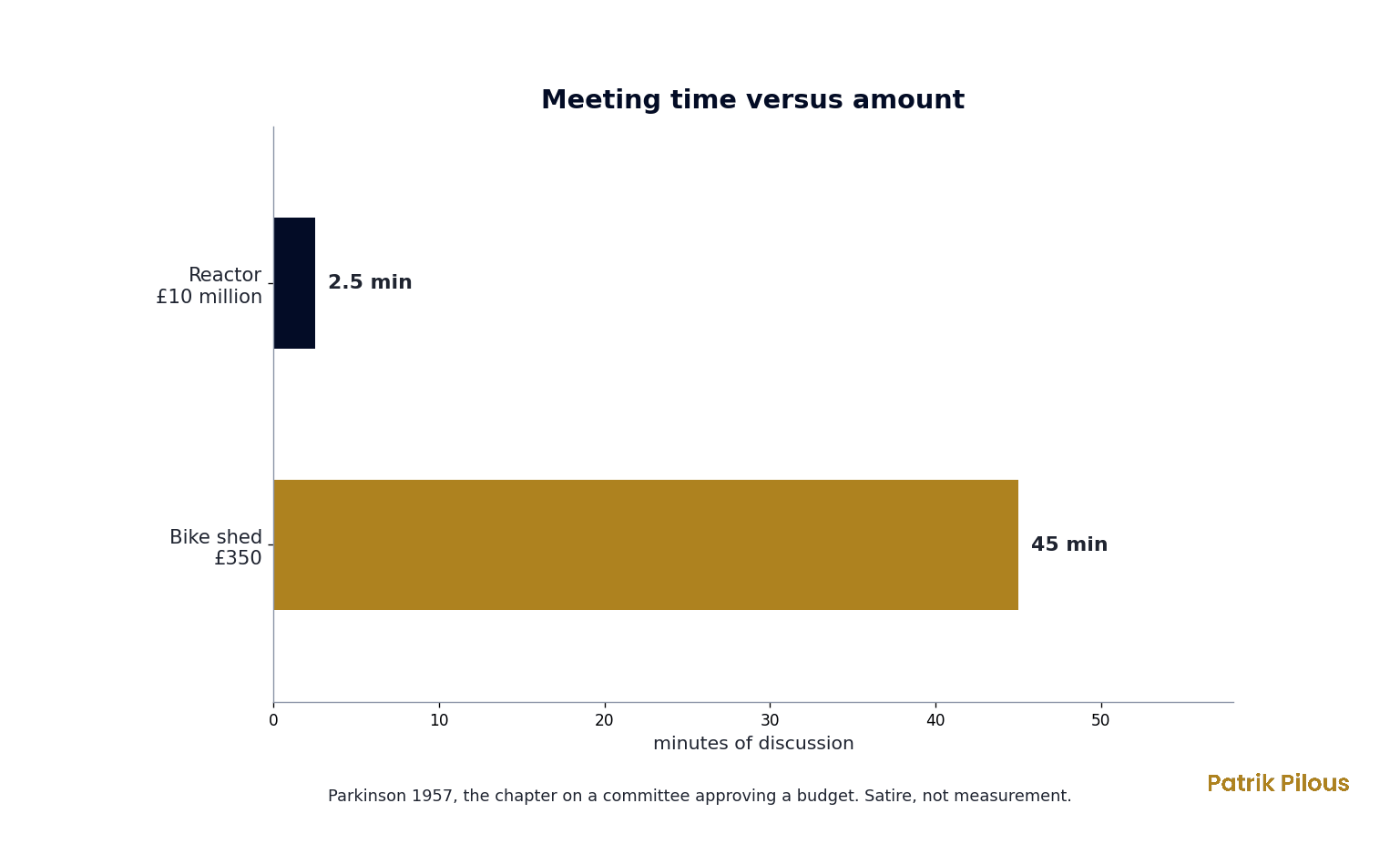
- Meetings and the law of triviality. The committee in Parkinson’s book approved a 10 million pound reactor in two and a half minutes and debated a 350 pound bike shed for the staff for 45 minutes. In marketing, the bike shed is the colour of a button, the shade of a logo, the photo on a banner or the word order in a tagline, while the target audience gets five minutes at the end.
- A growing team. Every new person brings meetings, reports, approvals and emails in copy, so four people can deliver the same output two did before, and everyone will be busy.
Work is quietly driven by the deadline, the budget, the size of the team and the order of items on the meeting agenda. That is why capacity planning belongs in your marketing strategy, where deadlines and money for the whole year are decided.
Where Parkinson’s Law falls short
The 1955 essay is a satire, and each of Parkinson’s three rules has a different level of support. Parkinson set two series of Admiralty figures side by side and turned the difference into a general rule, without looking for other explanations for the growth in officials.
There is laboratory evidence for the first rule about work and time, just weaker. Goswami and Urminsky sum up that several studies found longer work with a longer limit, but nobody has yet clearly described the conditions under which the effect appears, and in their own first experiment the length of the limit did not substantially change the actual working time.
The second rule about expenditure and income comes from a 1960 book and was aimed at government budgets. None of the cited sources mentions an experiment testing it in companies. The law of triviality is an anecdote about an invented committee, and direct measurement does not appear in the cited works either. In my view, it is therefore more useful to treat all three rules as warnings about how we read deadlines and budgets.
How to guard against Parkinson’s Law
You cannot avoid it completely, because no sensible person signs off a deadline without a buffer, and the buffer is exactly the space into which work expands when nobody tracks what the extra time was actually spent on. But you can reduce it.
- Estimate from the past. In the fourth study by Buehler and colleagues, 60% of people who first recalled similar past tasks and linked them to their plan met their estimate. In the control group, only 29.3% did.
- Stages and a separate buffer. Split a six-week project into two-week stages, each with an internal deadline and a finished output. Keep the buffer as a separate week at the end, visible in the plan, so it does not dissolve into the stages.
- Budget from the goal. Build it from what the campaign should achieve, and use last year’s figure only as a check. Do not treat an unspent remainder as a planning error.
- Agenda by money. Start the meeting with the item that has the biggest impact and give each point a time limit. The colour of the button then gets the last five minutes. Timeboxing works the same way: you assign a task a fixed block of time in advance and close the work when it runs out.
- Measure output. Track what the team delivered, not how many hours it logged. With an agency paid by the hour, stretching the work also has a financial incentive.
The second point works fastest. All it takes is replacing one date in the project with three.
How it connects with other biases
The planning fallacy is closely related to the overconfidence effect. We plan for the ideal scenario and blame past delays on external, one-off causes, so we give ourselves a longer deadline just in case, which Parkinson’s Law then fills. Present bias adds to this, pushing work to the end when everything is already on fire.
The law of triviality is linked to the availability heuristic. Everyone has an opinion on the bike shed because they can picture it, while those who do not understand the reactor stay silent. In 1999, programmer Poul-Henning Kamp popularised the term bikeshedding in a FreeBSD project discussion. You will find more related phenomena in the overview of cognitive biases.
Interesting questions on the topic
What does Parkinson’s law say?
That work expands so as to fill the time available for its completion.
Has Parkinson’s law been scientifically proven?
Partly. It began as a satire in 1955, but experiments since 1966 have shown that people with a longer time limit often work longer, although the effect does not always appear and its conditions are not well described.
What is the law of triviality?
Parkinson’s observation that the time spent on an agenda item is inversely proportional to the sum involved. In English it is known as bikeshedding, after the debate about the bike shed.
What is Parkinson’s second law?
Expenditure rises to meet income. Parkinson described it in his 1960 book The Law and the Profits, and he was targeting government budgets.

