

Weber’s Law states that the smallest difference a person can still notice grows with the size of the original stimulus. This smallest noticeable difference is called the difference threshold (just noticeable difference, or JND for short). The law comes from sensory physiology and does not literally apply to prices, but a similar ratio principle works there as an analogy. You are more likely to notice a 5 CZK (about 0.21 EUR) price rise on a bread roll than the same rise on a television costing 15,000 CZK (about 620 EUR).
Classification
- Type of phenomenon: a psychophysical law about perceiving differences that carries over into how we perceive prices
- Bias it reveals: we judge the same amount by its ratio to the price, so we notice it once and overlook it the next time
- Mental area: Perceptual
- Marketing function: Pricing, discounts, packaging, communicating changes
- Customer journey: purchase decision and repeat purchase
- System 1 / System 2: it arises in System 1 (fast, automatic perception), while converting to crowns is work for System 2 (slow, conscious)
In a nutshell
- What it is: we only notice a difference when it makes up a large enough share of the original value.
- Why it matters: customers judge both price rises and discounts relative to the price, so they sometimes feel the same 100 CZK (about 4.1 EUR) and sometimes do not notice it at all.
- Where you will come across it: price rises in small steps, smaller packs at the same price, discounts in percentages or in crowns, add-on charges to an expensive purchase.
- How to use it: show a discount in the unit in which it looks bigger, but in a way that lets the customer work out the real saving, and make any change you want them to appreciate above the threshold.
A real-life story
The German physiologist Ernst Heinrich Weber (1795 to 1878) studied the sense of touch. In his work De Tactu, published in 1834 in the Latin collection De pulsu, resorptione, auditu et tactu, he described how the ability to distinguish two stimuli depends on the ratio of their sizes. He gave people weights to hold and looked for the smallest increase they could still detect. He did not write a formula for it.
That was done by his former student and colleague Gustav Theodor Fechner. In 1860 he published Elemente der Psychophysik, named the rule Weber’s Law and added his own law, according to which the perceived strength of a stimulus grows with the logarithm of its physical size.
That is why both are still called the Weber-Fechner Law, even though the Israeli psychologist Daniel Algom, writing in Psychological Review in 2021, called this pairing probably the most widespread misnomer in psychology, because they are two logically independent laws.
Amos Tversky and Daniel Kahneman carried the principle over into the world of money. In the article The Framing of Decisions and the Psychology of Choice, published in Science in January 1981, they asked two groups the same question. You are buying a jacket and a calculator, and the salesperson tells you the calculator is 5 dollars cheaper at a branch 20 minutes’ drive away. Will you go?
When the calculator cost 15 dollars, 68% of 93 respondents would make the trip. When it cost 125 dollars, only 29% of 88 respondents would. The saving and the journey were the same.
People measured the five-dollar saving against the price of the calculator, so a discount of a third was worth the trip to them, but a 4% discount was not. In the same article the authors also mention John Pratt and his colleagues, who found that the spread of prices for the same product across shops grows roughly in proportion to its average price, which fits the idea that people put less effort into each crown saved on more expensive items.
How Weber’s Law works
Weber’s Law can be written in one line, ΔS = k × S. The difference threshold ΔS is a constant proportion k of the stimulus size S, and this proportion is called the Weber fraction, which has a different value for each sense. Put simply, if the fraction were 5% in our model, you would notice an increase of around 50 grams on a one-kilogram weight and around 100 grams on a two-kilogram weight.
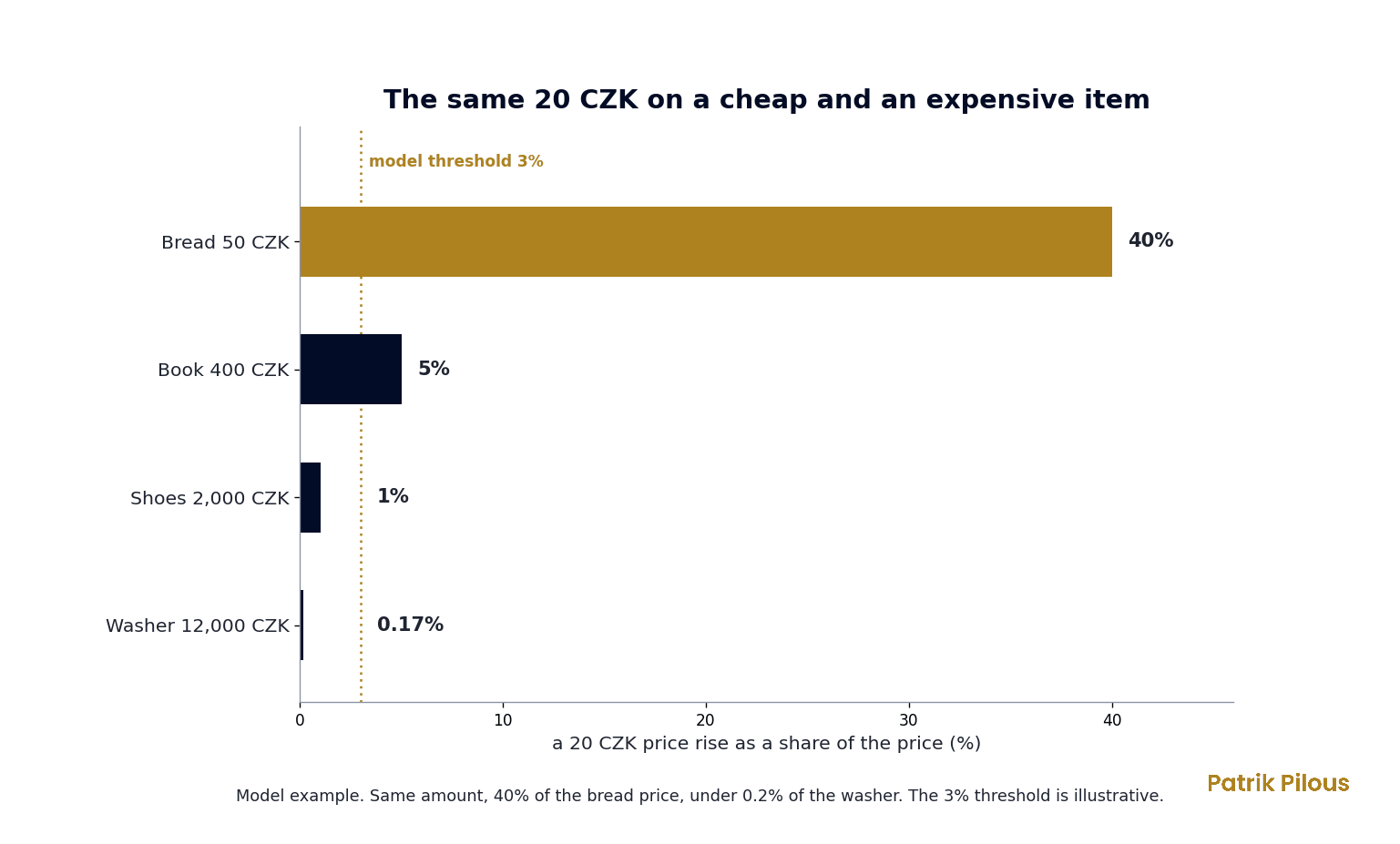
The model table shows what the same 20 CZK (about 0.82 EUR) price rise looks like on items at different prices.
| Product and price | Price rise | Relative change |
|---|---|---|
| bread for 50 CZK (about 2.1 EUR) | 20 CZK (about 0.82 EUR) | 40 % |
| book for 400 CZK (about 16 EUR) | 20 CZK (about 0.82 EUR) | 5 % |
| shoes for 2,000 CZK (about 82 EUR) | 20 CZK (about 0.82 EUR) | 1 % |
| washing machine for 12,000 CZK (about 490 EUR) | 20 CZK (about 0.82 EUR) | 0,17 % |
Algom points out that Weber’s Law does not literally apply to numbers, because any child can tell three from four. So you can tell price tags of 1,290 and 1,310 CZK (about 54 EUR) apart without any trouble. With prices, what matters is how big the difference feels to you. Algom calls this the Weber principle, according to which the perceived distance between two values is determined by their ratio, and he recommends keeping it separate from Weber’s Law.
Even for the senses the law does not hold everywhere; the Weber fraction changes mainly with very weak stimuli. In 1957 the American psychologist Stanley Smith Stevens proposed a power law in place of Fechner’s logarithm. Research does not point to a universal percentage below which nobody notices a price rise.
Weber’s Law in marketing
The ratio principle is used in pricing both deliberately and unwittingly. Some of the methods are fair and some end up in court, like the Milka chocolate dispute in May 2026.
- A smaller pack instead of a higher price. Shrinkflation (in Czech also smrskflace) bypasses the price tag entirely. In 2023 the US Bureau of Labor Statistics (BLS) described ice cream that shrank from 64 to 60 ounces for the same 5.99 dollars, making each ounce 6.7% more expensive. The Weber principle explains why a customer easily overlooks a loss of 4 ounces out of 64, roughly 6%, when the price tag stays the same. It does not explain why companies choose shrinkflation. According to the BLS, it raised overall inflation by only about 0.01% a year, but noticeably more for snacks and paper goods.
- Czech packs. Monika Kopčilová, an analyst at the price comparison site Kupi.cz, described to Novinky how Delissa wafers shrank from 33 to 30 grams and Bohemia salted sticks from 190 to 160 grams. In 2025 Milka switched from 100 to 90 grams. On 13 May 2026, in a case brought by the Hamburg consumer advice centre, the Regional Court in Bremen ruled that the bar in almost identical packaging was misleading. The judgment is not yet final.
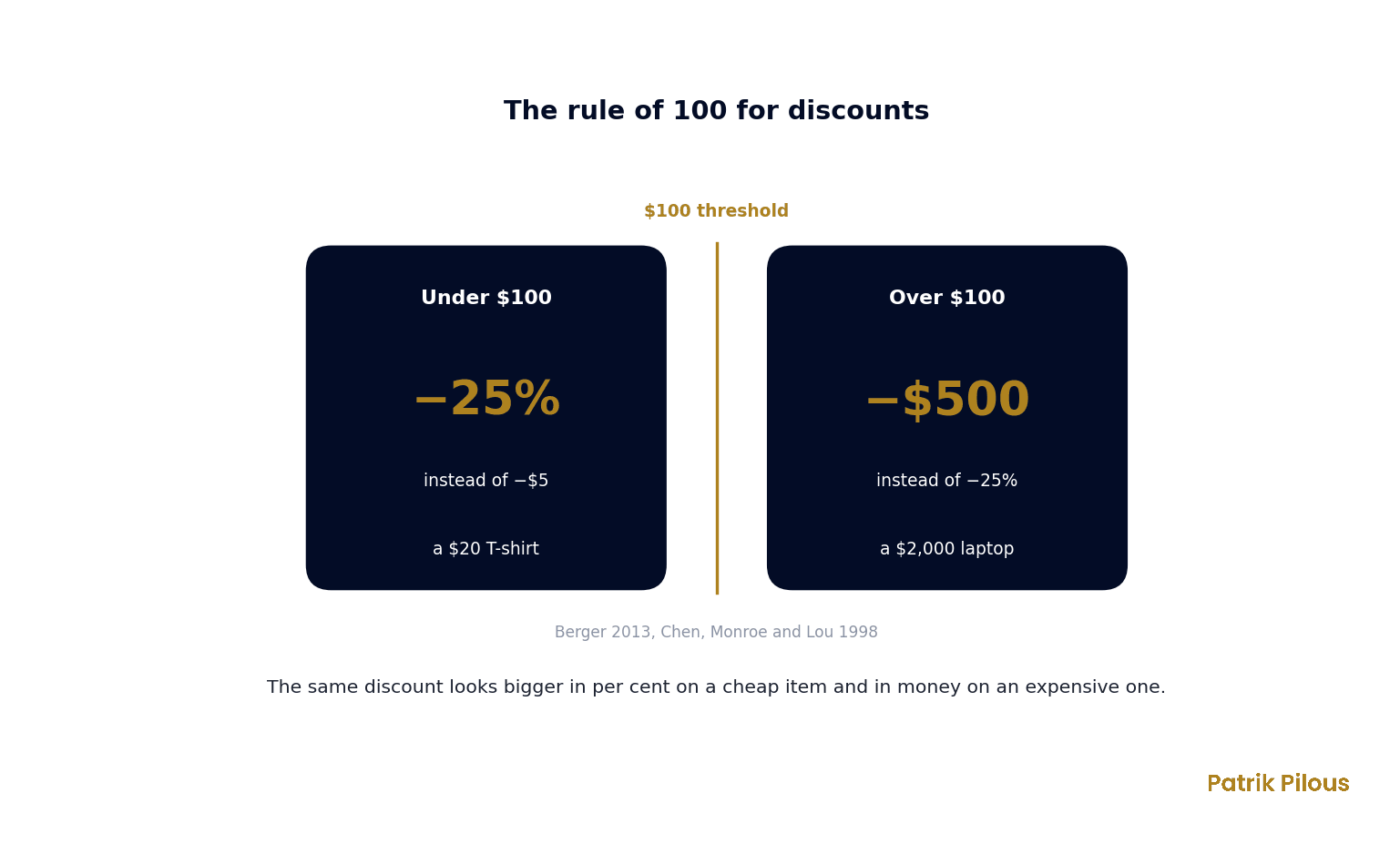
- Discount in percent or in crowns? In his 2013 book Contagious, Jonah Berger of the Wharton School formulated the rule of 100. Below 100 dollars, show the discount as a percentage; above 100 dollars, show it in dollars. It is supported by a 1998 study by Chen and colleagues80100-6), in which a percentage discount had a stronger effect on a cheap product and a dollar discount on an expensive one. Test the 100 threshold in crowns, and next to the percentage also show the price after the discount so the real saving can be worked out.
- Add-on charges to an expensive purchase. Delivery for 99 CZK (about 4.1 EUR) or an extended warranty for 990 CZK (about 41 EUR) on a washing machine costing 15,000 CZK (about 620 EUR) look like small change, because the customer measures them against the total. Mental accounting explains why they do not record such an amount separately.
- Nobody appreciates an improvement below the threshold. It also works the other way round. If you extend battery life by 3% or add 5% extra to a pack, the customer will probably not notice without being told. Both figures are purely illustrative; there is no verified threshold behind them. Make any change you want people to see big enough, or state it openly and in numbers.
In my view, the line between smart pricing and short-changing lies where the customer would disagree with the decision if they saw the change. Since 1 July 2024, France has required food shops over 400 m² to flag products whose contents have shrunk and whose unit price has risen, for two months.
How to protect yourself from Weber’s Law
Customers and companies have the same weapon. Converting to crowns, which System 2 can handle if you give it a moment and do not let your first impression of the percentage on the price tag make the decision.
- Watch the unit price. The price per kilogram or litre reveals a smaller pack before the packaging does. Eduarda Hekšová, director of dTest, reminded CNN Prima News that unit prices are exactly what helps you tell whether a purchase is really good value.
- Convert the discount into crowns. On an expensive purchase, ask yourself how many crowns the discount or add-on charge amounts to.
- Ask yourself the calculator question. Would you drive 20 minutes to save 300 CZK (about 12 EUR) on something costing 1,000 CZK (about 41 EUR)? Then it makes sense to make the trip for something costing 30,000 CZK (about 1,200 EUR) too.
- In your company, calculate margin in crowns. A 2% surcharge on a one-million-crown contract is 20,000 CZK (about 820 EUR).
- Tell customers about a pack change. The Bremen ruling shows that quietly shrinking a product in similar packaging is a legal risk in Europe. In my view, a customer who discovers it on their own is more annoyed by the concealment than by the price rise itself.
The quickest is the second step. Price times the discount percentage, a single multiplication.
How it interacts with other biases
Weber’s Law reinforces anchoring. The original price serves as the anchor and also as the denominator against which we measure every change. This links to the framing effect, because the same saving can be presented as a percentage or as an amount.
There is an interesting tension with the left-digit effect. The difference between 199 and 200 CZK (about 8.2 EUR) is only 0.5%, yet people perceive it as larger, because they read the left digit before the rest of the price. In my view, the pain of paying is connected to it too. On an expensive purchase it is mainly the total that hurts, and a small add-on charge easily gets lost in that pain.
Interesting questions on the topic
What is Weber’s Law?
A rule stating that the smallest difference we can perceive is a constant proportion of the size of the original stimulus. A heavier weight needs more grams added, a more expensive item more crowns.
What is the difference between Weber’s Law and Fechner’s Law?
Weber’s law describes when we notice a difference. Fechner’s law from 1860 describes how the perceived intensity of a stimulus grows, namely with the logarithm of its magnitude.
What is the difference threshold?
The smallest change in a stimulus that a person can still reliably detect.
How much can I raise prices without the customer noticing?
There is no universal number. It depends on the price of the product and how often the customer buys it. Quietly shrinking pack sizes will also damage trust once the customer finds out.
Euro amounts are approximate, converted at the Czech National Bank rate of 24.34 CZK per EUR on 29 October 2026.

