

Miller’s Law says that the average person can hold roughly seven items in working memory, plus or minus two. Our short-term memory simply has limited capacity, and once you overload it, information starts to drop out, and cognitive load and error rates rise with it.
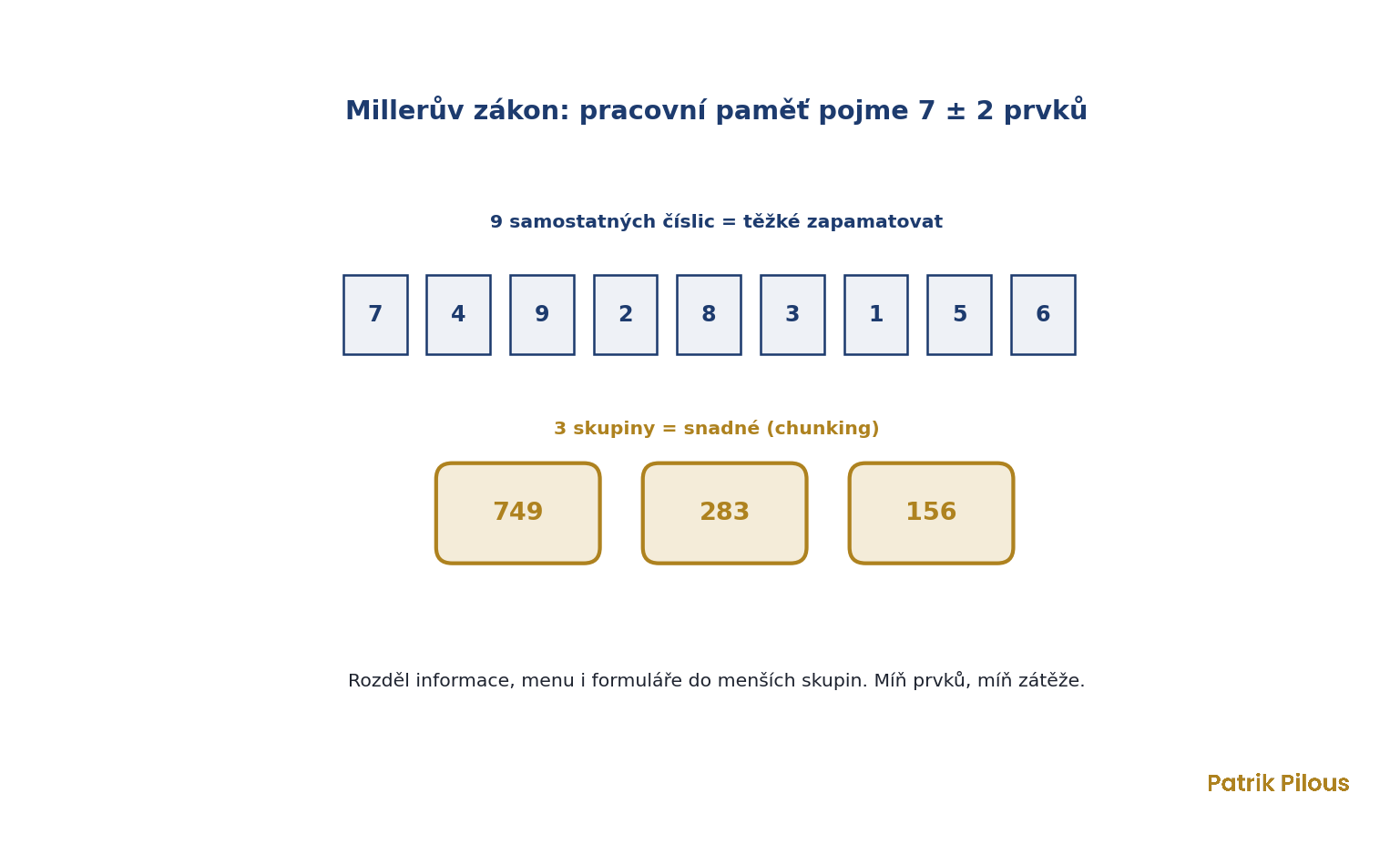
The key part, though, is the follow-up that people often forget: you can get around this limit with so-called chunking, which means grouping information into smaller, meaningful units. That is why a phone number split into groups is easier to remember than one long string. It is exactly why there is always a space after every 3 digits, and why a bank account number is split into groups of 4 digits. And it is exactly this principle that decides whether your website is clear or overwhelming. Whether your marketing is easy to understand or just an incoherent barrage.
Classification
- Cause (Cognitive Bias Codex): What should we remember
- Mental area: Memory
- Marketing function: UX and website usability
- Buyer journey: across all stages (navigation, forms)
- Cialdini’s principles: not applicable
- System 1 / System 2: System 1 (fast, automatic)
In a nutshell
- What it is: we can hold only 7 ± 2 items in working memory.
- Why it matters: overload increases cognitive load and error rates.
- Where you will find it: navigation, forms, phone numbers, lists and menus.
- How to use it: split information into smaller, meaningful groups (chunking).
A real-life story
The law is based on the legendary 1956 paper by psychologist George A. Miller, titled The Magical Number Seven, Plus or Minus Two and published in Psychological Review. In it, Miller showed that the capacity of our short-term memory is surprisingly small and stable. Interestingly, the magic number seven is often oversimplified today. Miller himself placed more emphasis on chunking, that is, on how we organise information.
The best example is in your pocket. You can remember the phone number 776 245 118 easily because it is split into three groups. Written as 776245118, it suddenly becomes a struggle. The digits are the same; only their arrangement has changed. A website works the same way. A menu with twenty items is a nightmare, while a menu split into five categories with a few items each is a breeze. More recent research shows that a single-level main menu should have only 4-5 items. Even here on patrikpilous.cz, you can see only 4 items in the main menu.
How Miller’s Law works
Working memory is like a small desk. Only a few things fit on it at once, and anything more falls on the floor. Chunking cleverly gets around this limit by turning several items into one meaningful unit that takes up just one space. Fewer items mean less cognitive load, faster orientation and fewer errors. The principle is linked to the serial position effect, because we mainly remember the beginning and end of a list anyway, and to the paradox of choice, because here too, fewer and clearer options are better.
Use in marketing and on websites
- Structure your navigation. Keep the main menu to roughly seven items and split a longer offering into logical categories and subcategories based on their nature.
- Split up forms. Break a long form into steps of a few fields each. It feels shorter and is easier to complete.
- Chunk your content. Break long text into paragraphs, subheadings and bullet points. Readers will then find their way around more easily.
- Group data. Split phone numbers, account numbers or codes into groups so they are easy to read and copy.
- Do not throw everything at once. Users cope better with information revealed gradually (step by step) than with one overloaded page.
How to work with it
- Count the items. If more than seven end up in one group, consider splitting it.
- Look for meaningful units. Chunking only works when the groups make sense.
- Save your users’ attention. Fewer items at once means less load and more completed actions.
How it relates to other biases
Miller’s Law and the serial position effect are closely related. Miller explains why we cannot hold a long list in mind all at once, and the serial position effect adds that of what we do hold, we remember the beginning and end best. For websites, this gives a clear guide. Short, structured menus and lists, the most important things at the edges, and everything else grouped into meaningful units. If you add a limited number of options in line with the paradox of choice, you get a clear website that does not overwhelm.
Frequently asked questions
What is Miller’s Law?
A principle stating that a person can hold roughly seven items in working memory, plus or minus two. You can get around the limit by grouping information into smaller units.
What is chunking?
Grouping individual pieces of information into meaningful units that then take up less space in memory. For example, a phone number split into groups.
How can you use Miller’s Law on a website?
Keep menus short and structured, split long forms into steps, and chunk content into paragraphs, subheadings and bullet points.

