
A fractional CMO pays off for a company that needs senior marketing leadership but has neither the work nor the money for a full-time director. An agency delivers results in the channels it sells, but it usually isn’t responsible for marketing as a whole. A full-time marketer is in the company every day, but usually can’t build a strategy for all of marketing on their own. An in-house director only makes sense once marketing has several full-time people and the director’s salary plus employer contributions doesn’t swallow most of the money that would otherwise go on advertising, content, tools and suppliers.
I’m writing this as someone who works as a fractional CMO myself, so I’ll admit the conflict of interest straight away.
Five ways to fill the marketing leadership role
Most owners know that marketing needs leadership. What’s less clear is what form it should take. The options differ mainly in two ways: how a senior person will lead marketing and how much of their time they will actually give the company. That determines the cost and who is ultimately responsible for the results.
- In-house marketer or marketing manager. They are in the company every day and know the product and the people. They can build a cross-channel strategy if they have the experience and the authority to decide on the budget.
- In-house marketing director. A senior full-time person who manages the team and is responsible for the results of marketing as a whole.
- Marketing agency. Delivers work in the channels it covers, from PPC to social media. It usually isn’t responsible for the whole.
- Fractional CMO. A senior person working part-time. They set the direction, manage people and suppliers, do some of the work themselves and are responsible for marketing decisions and the agreed numbers.
- Fractional CMO with suppliers. A combination in which the fractional CMO owns the strategy and the budget, and the channel work is done by specialists or agencies that the CMO manages.
In English it’s called a fractional CMO; in Czech it’s also called an outsourced CMO (externí CMO). In practice it’s the same thing.
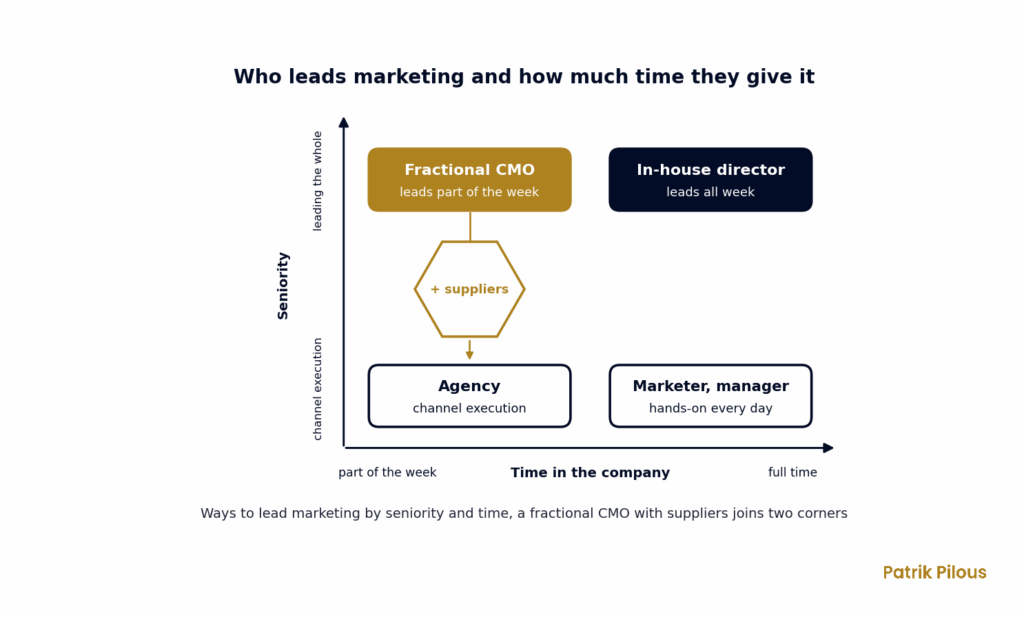
The matrix shows the main difference. Both the agency and the marketer mainly deliver execution. Leadership comes from the director and the fractional CMO, one for the whole week, the other for only part of it. The fifth option, a fractional CMO with suppliers, combines the top left and bottom left corners.
Comparing costs, responsibility and risks
The table compares all five options. Costs for full-time staff are based on the Platy.cz survey (a Czech salary survey) and statutory employer contributions. For agencies and fractional CMOs I only state what the price is made up of, because I couldn’t find verifiable Czech data on their prices.
| Option | Monthly cost | Responsible for | Speed of start | Seniority | Risk of conflict of interest | When it fits |
|---|---|---|---|---|---|---|
| In-house marketer or manager | specialist roughly 49,000 to 92,000 CZK (about 2,000 to 3,800 EUR), manager 59,000 to 142,000 CZK (about 2,400 to 5,800 EUR), always including employer contributions | the plan and its execution | slow, hiring and onboarding | medium | low | the direction is clear and you need hands |
| In-house marketing director | roughly 92,000 to 265,000 CZK (about 3,800 to 11,000 EUR) including employer contributions | the results of marketing as a whole | slowest, a senior hire is needed | high | low | a team of several people, a budget in the millions a year |
| Marketing agency | retainer or hourly fees per channel, plus the ad budget | performance of the channels it delivers | fast | depends on who actually works on the account | higher, it recommends its own services | performance in one or two channels |
| Fractional CMO | monthly retainer based on scope, a fraction of a director’s cost | direction, budget, suppliers, numbers | fast | high | low, unless they sell channels themselves | leadership for part of the week is enough |
| Fractional CMO with suppliers | CMO retainer plus suppliers | CMO the whole, suppliers their channels | fast | high in leadership, specialists in the channels | low, the CMO oversees suppliers | a growing company without an in-house team |
The risk of a conflict of interest with an agency depends on the contract and how it is paid. Whoever sells work in a channel will hardly recommend that you cut back on that channel, especially when their fee is tied to the size of the budget they manage. An agency on a fixed retainer with strategy in its brief has less of this risk.
A fractional CMO who delivers a channel themselves has the same risk (and so do I, because I do SEO and content with my own hands). A simple rule helps. The owner must be able to see the results of any channel the CMO runs personally in figures from the accounts and the online shop admin, which they can access without the CMO. Otherwise they have no way of telling whether the CMO is mainly protecting their own interests.
What a full-time marketer and director cost
According to the Platy.cz salary survey, 80% of people working as a marketing specialist earn roughly 37,000 to 69,000 CZK (about 1,500 to 2,800 EUR) gross a month. For marketing managers it is 44,000 to 106,000 CZK (about 1,800 to 4,400 EUR) and for marketing directors 69,000 to 198,000 CZK (about 2,800 to 8,100 EUR). On top of the gross salary, the employer pays 33.8% in social security and health insurance contributions.
This doesn’t include bonuses, recruitment, equipment or months of onboarding, nor at least 4 weeks of paid leave a year. The table only counts salary and contributions for rounded model salaries close to the middle of the range.
| Role | Model gross salary | Monthly cost to the company | Annual cost to the company |
|---|---|---|---|
| Marketing specialist | 50,000 CZK (about 2,100 EUR) | 66,900 CZK (about 2,700 EUR) | 802,800 CZK (about 33,000 EUR) |
| Marketing manager | 75,000 CZK (about 3,100 EUR) | 100,350 CZK (about 4,100 EUR) | 1,204,200 CZK (about 49,000 EUR) |
| Marketing director | 130,000 CZK (about 5,300 EUR) | 173,940 CZK (about 7,100 EUR) | 2,087,280 CZK (about 86,000 EUR) |
Now a model scenario. An online shop with a turnover of 40 million CZK (about 1.6 million EUR) spends 6% of revenue on marketing including people, which is 2.4 million CZK (about 99,000 EUR) a year. An in-house director on a salary of 130,000 CZK (about 5,300 EUR) would swallow over 2 million CZK (about 82,000 EUR) of that, leaving just under 313,000 CZK (about 13,000 EUR) for advertising, suppliers, content and tools. That’s why a company of this size usually doesn’t hire a director. In reality it is choosing between a manager on 75,000 CZK (about 3,100 EUR), who takes 1.2 million CZK (about 49,000 EUR), roughly half the budget, and a fractional CMO.
A fractional CMO costs a fraction of a director, so most of the money stays available for execution. Plug the specific amount from the quote you receive into the model.
The model is simplified and the six per cent is only an assumption, so take your own figure from your accounts.
According to Gartner, large companies in North America and Europe, mostly with revenue above one billion dollars, spend 7.8% of revenue on marketing, and 56% of their CMOs say their budget isn’t enough for their planned strategy. For a Czech company this is only a rough guide.
An in-house director carries one more risk: they may not stay. According to a Spencer Stuart study, current CMOs of companies in the US S&P 500 index have been in the role for 4.1 years on average, and only chief operating officers have shorter tenures in the leadership team. Nearly two thirds (62%) of departing CMOs also move to the same or a more senior position, so the best people often leave the company that invested in them.
Why fractional leadership roles are on the rise
The term fractional leader is spreading fast, at least in US data. According to Revelio Labs, only 5 in 1,000 new leadership positions mentioned a fractional arrangement in 2018, rising to 18 in 2024. Among people who describe themselves in their profile as fractional leaders, CMOs make up 14.3%, and only finance directors are more common, at 18.8%.
Lightcast paints a similar picture. In 2025, at least 34,000 Americans had the word fractional in their job title, 265% more than in 2019. Of the job ads for fractional roles in 2026, 97% were posted by small and medium-sized businesses, marketing and PR account for 10% of the ads and finance for 46%. Profiles and job ads are different metrics, and neither proves that the model makes money for companies. Both firms sell labour market analytics, so take the numbers with a pinch of salt. I couldn’t find comparable Czech data.
Tomoko Yokoi and Amy Bonsall write in Harvard Business Review that fractional leaders typically have 20 to 30 years of experience and are hired mainly by startups and small and medium-sized businesses.
“Small and medium-sized organisations often struggle to find and pay for the senior people that growth requires.”
Tomoko Yokoi and Amy Bonsall, How Part-Time Senior Leaders Can Help Your Business, Harvard Business Review, 2024
In their April 2026 article 5 Questions Leaders Should Ask Before Turning to Fractional Work, Joy Batra and Dorie Clark add a reason on the company side: the pressure to do more with fewer resources at a time when nobody knows what AI will do to the market.
It doesn’t follow directly from the US data, but in my view a Czech company with a turnover in the tens of millions is exactly the size the model was made for. It usually can’t afford a full-time director, and without senior leadership it spends money on marketing that nobody can say what it brings in.
What to choose based on your company’s situation
Two things decide it: how much money you have for marketing including people, and whether you already have someone who can do the channel work. The table covers six typical situations for companies with a turnover in the tens of millions.
| Situation | What to choose | Why |
|---|---|---|
| The owner runs marketing in the evenings and every supplier has their own numbers | fractional CMO | leadership and a single version of the numbers are missing, a full-time role wouldn’t have enough to do |
| The company has one marketer who completes tasks without direction | fractional CMO over the marketer | the marketer gets a strategy and a brief, the company only pays for the senior part |
| One working channel, such as performance advertising, and a clear goal | agency or specialist | extra leadership would be an expensive layer |
| A growing online shop without an in-house team and with a growing budget | fractional CMO with suppliers | the CMO builds a team from suppliers and manages the budget |
| A team of several people, a budget in the millions a year, decisions made daily | in-house director | managing a team day to day needs a full-time person |
| Nobody knows what marketing brings in and there is no basis for decisions | one-off audit or strategy | ongoing leadership has nothing to build on yet |
Before you hire anyone, it pays to have a marketing audit that shows where the money goes and what comes back from it.
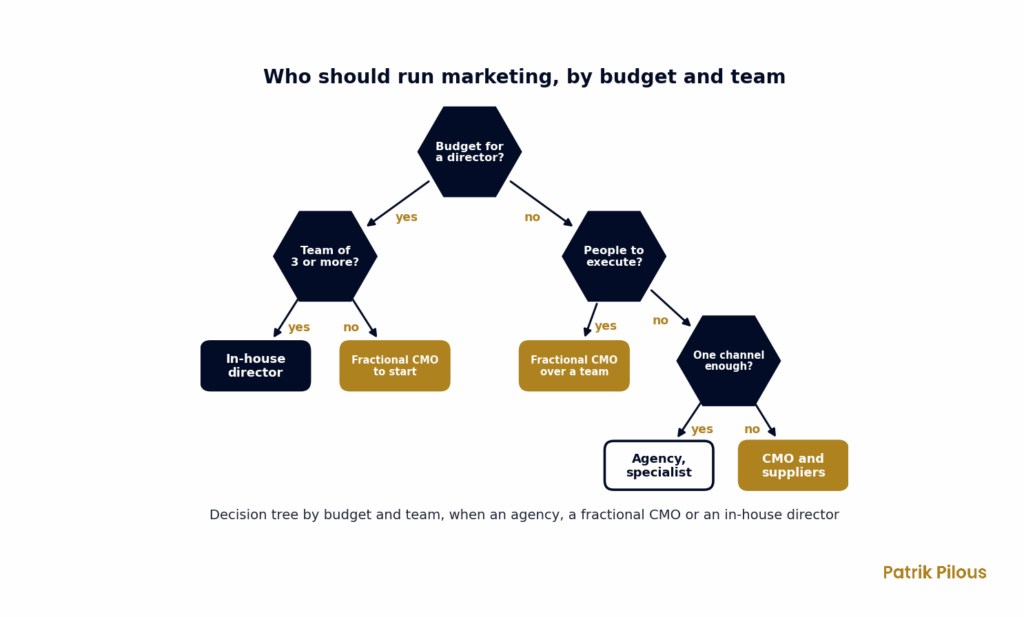
The tree is a simplification. Budget thresholds vary by industry and margin, so it contains no amounts. It asks only two questions: whether your marketing budget can cover a director’s salary including payroll contributions, and whether you already have your own people or suppliers who will actually do the work in the channels once someone gives them direction.
Where a fractional CMO does not work
A fractional CMO’s strength is that they make decisions and manage. Where decisions cannot be made or there is nothing to manage, you are paying for an expensive adviser.
- Slow decision-making. When every recommendation waits weeks for approval, the fractional CMO becomes an external consultant whose proposals sit in a queue.
- No budget for execution. A strategy without money for advertising, content, tools or people stays in a presentation. A fractional CMO will do part of the work themselves, but they cannot do all of your marketing.
- An owner who will not let go of marketing. If the owner still approves every banner and changes priorities over the phone, the CMO has nothing to own.
- A need for daily presence. A large in-house team and operations that change every day need someone on site.
- Locked-away data. Anyone who has to request every number separately spends paid time waiting.
The second weakness is capacity. A fractional CMO usually has several clients, so during peak season or a crisis they cannot be in your company all week. Ask in advance who will cover for them.
Yokoi and Bonsall in HBR recommend holding three conversations before the engagement starts, including one about what work needs to be done, and only then deciding on the role.
How to choose a fractional CMO and set up the engagement
Anyone can talk about strategy. You can tell the difference by questions that cannot be answered in general terms, and by what you agree on right at the start.
| Question | What you want to hear | Warning sign |
|---|---|---|
| How many companies do you lead at once, and how much time will you give us? | a specific number and meeting rhythm | “as needed” with no number |
| What will you do first? | review the numbers, channels, suppliers and website, then decide | a ready-made campaign plan without data |
| Which work will you handle yourself and which will you delegate? | a clear split, for example strategy themselves, PPC through a specialist | “I’ll take care of everything” |
| How will we know it is working? | revenue, margin, new customers and the cost of acquiring them | reach, likes, posts, number of outputs |
| Would you recommend switching off a channel you run yourself? | yes, and which number would show it | an evasive answer |
Before signing, write down what the CMO will decide and what they will only influence. They should decide on the marketing budget, choice of suppliers, measurement and communication, while prices and the product range usually stay with the owner. Agree a fixed rhythm, for example a meeting every two weeks and a monthly overview of the numbers, and access to all data from day one. A fractional CMO who has to email for every export from the accounts or the ad account burns part of the time you are paying for on waiting.
Then agree on a single version of the numbers: whether you manage advertising by ROAS or PNO, how you attribute orders to channels using an attribution model, and what the target for the quarter is. Without this, every supplier will report its own successes and the CMO will just retell them.
How I combine the fractional CMO role with suppliers
This is how I have been running marketing for Chlorito, an e-shop selling pool chemicals, for almost a year now. I am responsible for marketing, while the owner decides on the product range and prices. I bring him data on what people are searching for and what is selling, and every 14 days we meet with him and the person in charge of operations and expansion.
I brief and coordinate the work of a PPC specialist, social media people, graphic designers and video production. I do SEO, content strategy, analysis and demand data myself. Traffic from Google during the season from May to August 2026 grew by 90% compared with the same period last year, but that is the result of just one channel.
I describe how I set up the engagement and who it suits on the outsourced and fractional CMO page. I cover what the role involves in general in the article who a CMO is and what they really do in a company. If you do not have a clear direction yet, the starting point is marketing strategy.
Interesting questions on the topic
How much does a fractional CMO cost?
You pay a monthly retainer based on the scope of work and how much of it they do themselves. I have not found verifiable Czech pricing data. So compare offers with the cost of an in-house director from the table above.
What is the difference between an outsourced and a fractional CMO?
None. Both terms, like the English “fractional CMO”, refer to a part-time marketing director who works from outside the company.
Can an agency create a marketing strategy?
It can, if it is part of its brief and its fee does not depend on the volume of the channels it delivers itself. However, an agency is usually responsible only for its own channels, and then nobody owns the strategy across suppliers.
What does marketing outsourcing mean?
Handing over part or all of your marketing to external suppliers. It can be a single channel with an agency, or the entire leadership taken over by a fractional CMO with their own suppliers.
How much does a marketing director earn in the Czech Republic?
According to Platy.cz (a Czech salary survey), 80% of marketing directors earn roughly 69,000 to 198,000 CZK (about 2,800 to 8,100 EUR) gross per month. Including payroll contributions, that costs the company roughly 92,000 to 265,000 CZK (about 3,800 to 11,000 EUR) per month.
Euro amounts are approximate, converted at the Czech National Bank rate of 24.34 CZK per EUR on 29 October 2026.

