
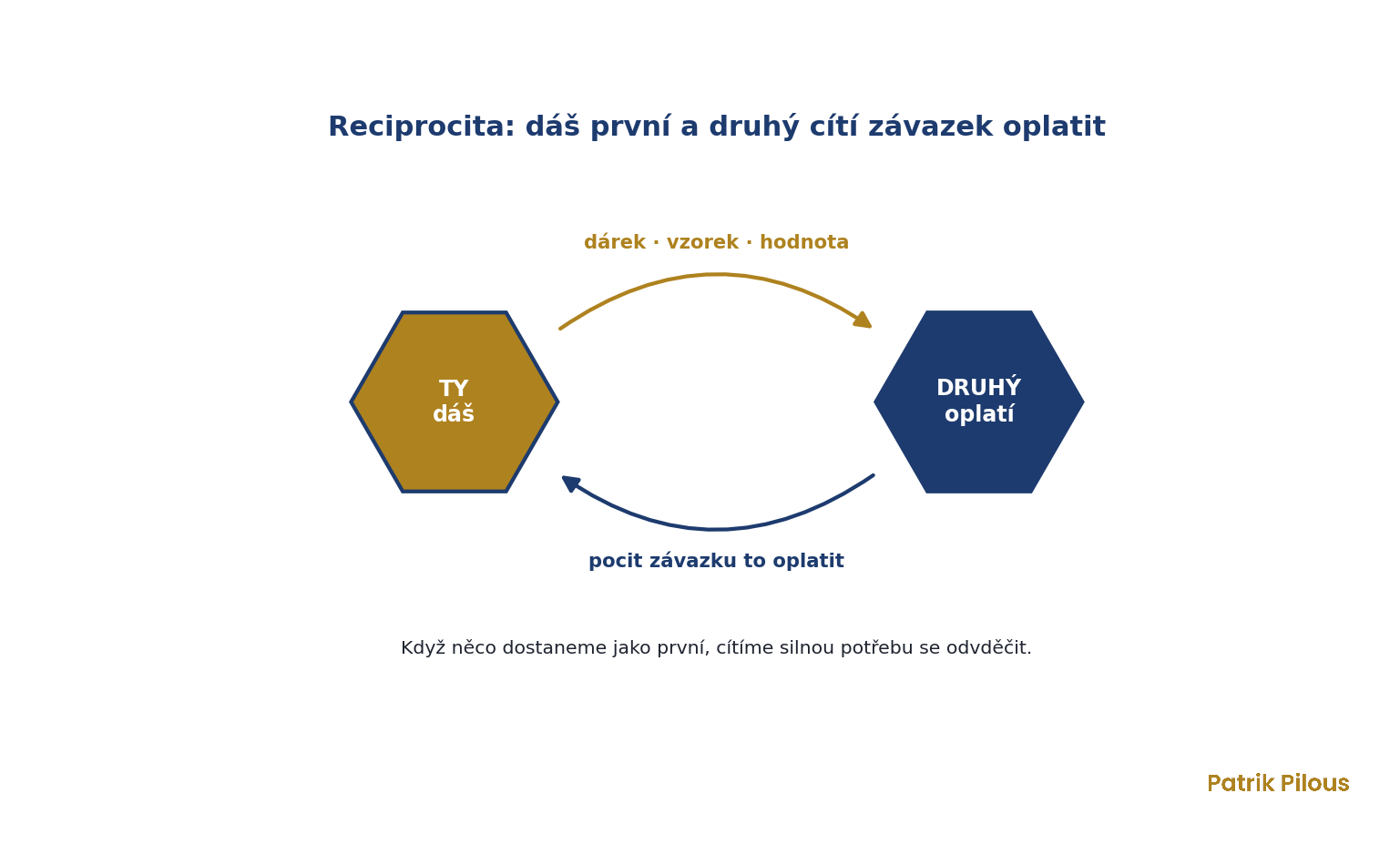
Reciprocity is a psychological principle under which we feel a strong need to repay what we have received. When someone gives us a gift, does us a favour or helps us selflessly, an uncomfortable sense of obligation arises in us until we give something back. It is one of the strongest social rules, deeply ingrained across all cultures, and traders and manipulators around the world have skilfully exploited it for centuries. You can surely recall many situations when this cognitive bias got to you too.
Classification of the cognitive bias
- Cause (Cognitive Bias Codex): Not enough meaning
- Mental area: Social
- Marketing function: Social influence
- Buyer journey: Consideration
- Cialdini’s principles: Reciprocity
- System 1 / System 2: System 1 (fast, automatic)
In a nutshell
- What it is: when we receive something first, we feel the need to repay it.
- Where you will meet it: free samples, free content, a gift with your order, a sweet with the bill.
- How to use it: give value first, with no strings attached, and the obligation will arise on its own.
A real-life story
You know the moment in the supermarket when a woman by the shelf offers you a piece of cheese or a sip of wine for free. You taste it, it is good, and suddenly it feels awkward to just walk away. You buy it. Yet you did not come for that cheese at all. That is neither chance nor the seller’s politeness. It is reciprocity in action. A small gift created a sense of obligation in you, and the easiest way to repay it is with a purchase.
Imagine Klára, who gets a small sweet with her bill in a café. A trifle worth a few crowns. And yet research has shown that this kind of gesture raises tips significantly. In one study, a waiter gave guests a sweet with the bill and the average tip jumped. When he then came back with “one more, just for you”, it rose even further. It was not about the price of the sweet but about the gesture that triggered the need to repay.
In the same way, beach vendors often force something on you, chat for a while and then ask for something in return. And most people cannot resist.
Fun fact: in a classic experiment, psychologist Dennis Regan found that when a person selflessly treats someone to a can of Coca-Cola, that person then buys more raffle tickets from them than the cola cost. A small favour came back many times over.
How reciprocity works
Reciprocity is one of the six principles of persuasion described by Robert Cialdini. It works because human cooperation has historically been built on it. Anyone who received and did not repay was seen as a freeloader, and everyone wants to avoid that. That is why, when we accept a gift, an inner pressure to return it kicks in automatically, often with interest. And crucially, the gift must come first and without conditions. As soon as it becomes “something for something”, the magic disappears and it turns into a transaction.
Reciprocity is often linked with social proof and with the way we form a favourable overall impression after a first kind gesture, which is close to the halo effect.
Use in marketing
- Samples and tastings. A classic that has worked for centuries. Anyone who has tasted feels obliged at least to consider buying.
- Free content. High-quality free articles, guides and tools build obligation before you sell anything. It is the core of content marketing.
- Lead magnet. An e-book, template or mini course in exchange for an email address. You give value first, and the contact is just a thank-you.
- A gift with the order. A small, unexpected touch in the parcel increases satisfaction and the willingness to recommend.
- Unexpected bonus. “We are adding an extra month for free” works better than a cheaper plan from the start, because it feels like a gift, not a discount.
- Personal helpfulness. Solving a problem beyond what is required creates loyalty that no advertising can buy. Good PR builds trust in a similar way.
How to defend yourself against reciprocity
- Separate the gift from the decision. Ask yourself, “Would I want this even without the gift?” A free sample does not mean you need the product.
- Accept the gift, not the obligation. Accepting a kind gesture does not mean you have to buy. Politeness does not commit you to a deal.
- Recognise the technique. When an offer follows straight after a “favour”, it is a tool, not a coincidence.
Reciprocity is strongest when it is sincere. Give people real value without expecting something straight away, and it will come back to you. People can sense a calculated gift with a catch, and the effect will turn against you.
Frequently asked questions
What is reciprocity?
A psychological principle under which we feel the need to repay what we have received. A gift or favour creates a sense of obligation in us.
What does reciprocity mean in marketing?
The strategy of giving the customer value first, such as a sample, content or a gift, which creates a natural willingness to consider a purchase or to return the favour.
Who described the principle of reciprocity?
It is best known from the work of psychologist Robert Cialdini, who lists reciprocity among the six main principles of persuasion.

