SEO consultant for e-shops
SEO for e-shops and Shoptet
E-shop SEO is about making sure people find you at the moment they want to buy. For an e-shop, that mainly means categories and filters that match what people search for, a technically clean website and descriptions that give better advice than the competition. Articles and the blog come later, once the categories are built properly.
A large share of my clients are e-shops, from fashion and pool chemicals to painting supplies. I don’t start with copy, I start with structure. First I find out what people search for and whether you have a page for it. Only then do I write and build links.
What e-shop SEO is made of

Demand and product range analysis
I compare what people search for with what you sell. The foundation is keyword research. It shows which categories, filters and products have potential and where you are missing a page altogether.

Category and filter architecture
I design the structure of categories and filter pages so that every commercial query has its own landing page. This is where most of the outcome is decided for e-shops.

Technical SEO for e-shops
Duplicates from parameters, pagination, sold-out products, redirects, speed and indexing. Things that quietly hold an e-shop back.

Category and product copy
Descriptions that answer customers' questions and help them choose. Titles and meta descriptions that earn clicks in Google.

Feeds and structured data
Product data for Merchant Center, Zboží.cz and Heureka (Czech price comparison site). They open the way into Google Shopping results and price comparison sites, and they also help in AI assistants.

Link building and mentions
Links and mentions from industry websites, reviews and comparisons. This is my work as a link builder. Without authority, even a brilliantly built e-shop won't reach the top results.
Who have I provided web and SEO consulting for?
VYNIKAJÍCÍ Na základě 42 hodnocení Zveřejněno na Google Pavel Vondruška01/09/2026 Spolupracujeme v oblasti linkbuildingu a obsahových spoluprací. Komunikace je vždy rychlá, férová a profesionální, spolupráci mohu doporučit.Zveřejněno na Google Denisa Palková26/08/2026 S Patrikem spolupracuju na marketingu Chlorita, který celý vede. Já s kolegyní máme na starosti hlavně obsah, produkci a sociální sítě. Oceňuju, že naslouchá našim nápadům a normálně s námi diskutuje o tom, co a jak by mohlo fungovat. Zároveň je ale pořád cítit, že má celý marketing pod kontrolou. Umí se rozhodnout, věci pushnout, dotáhnout a má přehled o tom, co se zrovna řeší. Komunikace s ním je rychlá, věcná a funguje bez zbytečných komplikací.Zveřejněno na Google Marek Jelok24/08/2026 Ďakujem za výbornú dlhodobú spoluprácu v linkbuildingu. S Patrikom sa vždy vieme dohodnúť k obojstrannej spokojnosti pri získavaní spätných odkazov pre klientov.Zveřejněno na Google Martina Králová13/07/2026 Spolupráce s IdeUp a Patrikem Pilousem proběhla bez problémů, komunikace byla rychlá a věcná a celý proces publikace čtyř článků na portálu Videobydlení.cz byl dobře zorganizovaný. Spolupráci doporučujeme. Tým B3 TechnologyZveřejněno na Google Petr Kutka06/07/2026 Příjemná spolupráce a odbornost. Děkuji.Zveřejněno na Google Bartosz O23/06/2026 Profesionální přístup, skvělý servis – firmu mohu jednoznačně doporučit.Zveřejněno na Google Martin Kolčák01/06/2026 Ďakujem za skvelú rýchlu a profesionálnu prácu v oblasti linkbuildingu pre klienta!Zveřejněno na Google Anna Mejsnarová18/05/2026 Mimo dobrých jednohubek Patrik zvládá i různá zákoutí online marketingu. Sama jsem ho doporučila několika klientům, což mluví samo za sebe.Zveřejněno na Google Markéta Kadeřábková13/04/2026 S Patrikem spolupracuji už několik let v oblasti SEO, copywritingu a linkbuildingu. Oceňuji jeho proaktivitu, zápal pro učení se nových věcí a ochotu ve všem vyhovět. Spolupráci s ním vřele doporučuji.Zveřejněno na Google Jan Janda25/03/2026
My SEO services
I devote the vast majority of my time and work to my ongoing, long-term SEO and link building clients. Ongoing SEO is a long-term, systematic activity in which I, as an SEO specialist, move you step by step towards the goals we have set. Below you can find out how working with me goes, along with tips on how to set up an SEO consultant’s work in general. I prefer engagements of 15+ hours a month, which allow me to get fully into the project and move it forward. More about my SEO services here.
I offer one-off SEO consulting only occasionally. And I do an SEO audit only when the client explicitly asks for one and it makes sense in their case. I have extensive experience mainly in investment and finance, fashion and B2B. I have learned to do SEO from many different sides and angles. I now have 8+ years of experience in the field.
Link building
Link building is a specific discipline for an SEO consultant or SEO specialist that focuses solely on so-called off-page SEO. This means the work does not depend so much on your website, and the SEO consultant can work with almost no input from you. On all projects where I work on an ongoing basis as an SEO consultant, I also work regularly on link building, which is an excellent complementary activity that increases the authority of both the website and individual pages.
Link building is no longer so much about buying articles. It pays to have a much richer link building mix, for example links through branded queries, work with partners, guest posts, sponsorship and well-thought-out link exchanges. Connecting the brand with business categories is the current trend, and ORM (online reputation management) may be a better name for it. Link building and brand mentions are also interesting today in light of the new LLM trends led by ChatGPT.
Why an e-shop needs different SEO from a company website
A company website has dozens of pages, an e-shop has thousands. Every category, filter and product is a separate page that can bring in a customer or, on the contrary, dilute the website’s strength through duplication. E-shop SEO is therefore mainly about working with structure and data, not individual pieces of copy.
The second difference is intent. Someone searching for “men’s running shoes” wants to choose and buy, not read an article. This is called search intent. Categories win for this kind of query in Google. When an e-shop sends a blog article to rank for it, it loses, even if the article is excellent.
Categories sell, articles advise
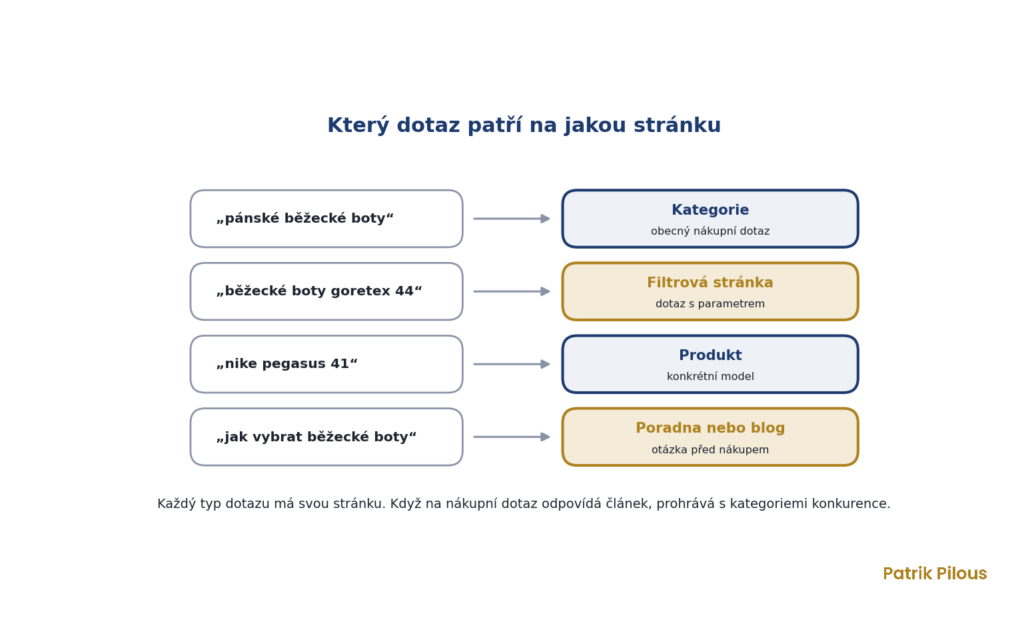
The most common mistake I see with e-shops is the wrong type of page assigned to a query. Each type of query has its own page, and each page needs different content.
General shopping queries belong to a category. Queries with a parameter, such as colour, size, material or brand, belong to a filter page. A specific model belongs to a product page. And questions like “how to choose” or “what’s the difference” belong to a buying guide or blog that links from the text back to the categories.
When this split is right, pages stop competing with each other and each one collects its own queries. When it isn’t, cannibalisation occurs. Google doesn’t know which page to show and usually doesn’t show any of them well.
Filters as landing pages
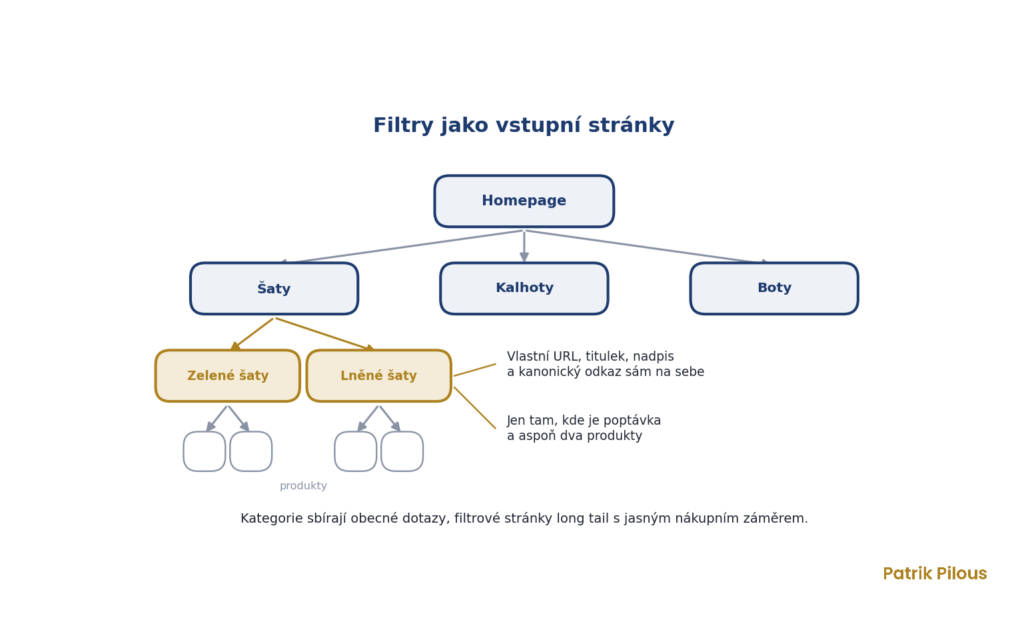
A large part of an e-shop’s search volume lies in filters. I have covered how to work with them within the overall structure in my article on website architecture and structure. People don’t just search for “dresses”, they search for “green wedding guest dresses” or “linen dresses size 42”. Each such combination is a query with clear purchase intent and usually less competition than the main category.
However, a filter only becomes a landing page when it has its own indexable URL, its own title and heading, a short text and a canonical link pointing to itself. Google usually won’t let a filter that canonicalises to its parent category into the results.
I only create a page where there is demand and where the filter has at least two products. A page with a single product offers no choice. It’s just one more weak URL.
The technical SEO issues that most often hold e-shops back
With e-shops, technical problems multiply with the number of pages. An error in a category template doesn’t show up on one page, but on thousands.
- Duplicates from parameters. Sorting, pagination and filter combinations create thousands of URLs with the same content, in other words duplicate content. They need clear rules on what gets indexed and where the canonical link points.
- Sold-out and deleted products. I redirect a product that won’t come back to the closest category or its successor. A product that will come back stays on the website with availability information.
- Redirects and 404s. After every major change to the product range or a migration, I check that old URLs lead where they should and not into a redirect chain.
- Speed and Core Web Vitals. Category listings with dozens of images tend to be the slowest pages on the website.
- Indexing and crawl budget. With a large catalogue, I make sure Google doesn’t waste crawling on endless filter combinations instead of the products that sell.
Technical fixes don’t usually show results straight away, but nothing else works without them. The best category copy won’t help if Google doesn’t index the category or confuses it with five copies of itself.
Category and product copy
A category description should help the customer choose. A short introduction at the top and more detailed text further down, for example what to look for, the differences between types and who each option suits. Generic paragraphs stuffed with keywords help neither the customer nor Google. I describe how to write copy that works for both people and search engines in my SEO copywriting section.
With products, the biggest problem is copy taken from the manufacturer, which twenty other shops use as well. You don’t have to rewrite thousands of descriptions. Start with the products that sell the most or have the highest search volume, and add what’s missing elsewhere, such as experience from the shop floor, a common customer question or a comparison with a similar model.
I keep page titles simple: the main query and the shop’s brand. I write the meta description as a reason to click on your result specifically, such as range, delivery, availability or advice.
SEO for Shoptet
A large share of Czech e-shops run on Shoptet, and it has its own specifics. It handles some things on its own, but you need to watch out for others.
- Parametric categories. In Advanced SEO, you can turn filter values into separate pages with their own URL, title, description and canonical link. For queries with a parameter, this is the most powerful tool Shoptet has.
- Two-part category description. The opening paragraph is visible straight away, and the rest of the text is hidden under “show more”. The customer sees the products, Google sees the full text.
- Automatic redirects. When a product is hidden or deleted, Shoptet automatically creates a redirect to the category and overrides it again when the product returns. It’s a good idea to check redirects after major changes to the product range.
- Bulk edits via import. Assigning products to categories in bulk is done via import, as the Shoptet API can’t do it. With a large catalogue, a well-prepared import is the difference between an hour of work and a week.
Most of my e-shop clients use Shoptet, so I know these things from practice, not from the documentation. The same principles apply to Shopify, WooCommerce or custom solutions too.
E-shops in shopping results, price comparison sites and AI
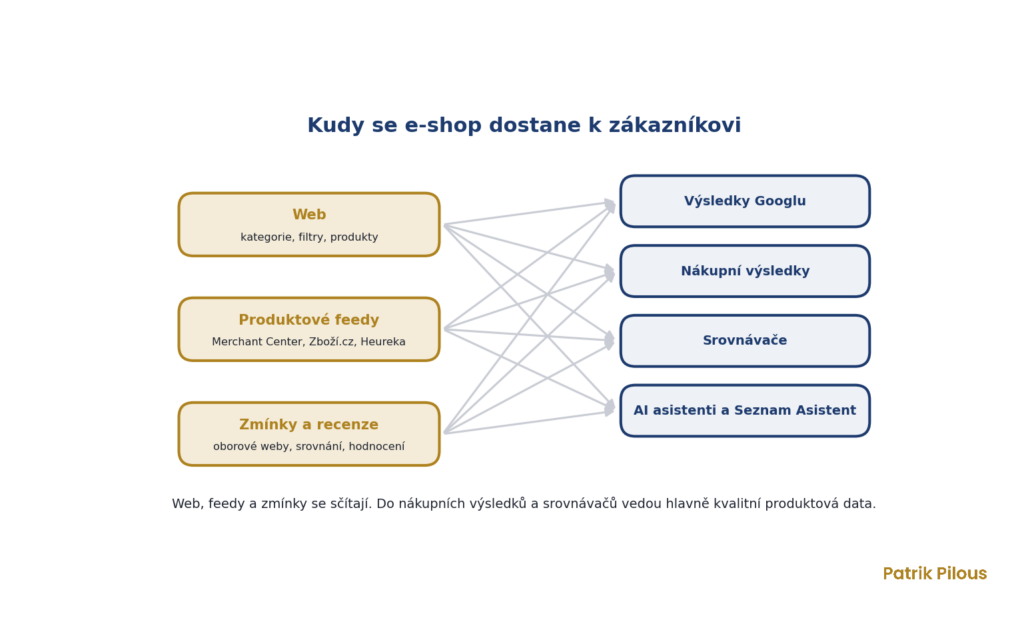
Today, customers don’t only search in Google’s classic results. They also choose in shopping results and on price comparison sites, and increasingly they ask AI assistants. You get into all these places mainly through high-quality product data.
A product feed for Google Merchant Center powers Google’s shopping results, and structured data on product pages helps Google understand price and availability. In the Czech Republic, a feed for Zboží.cz matters twice over, because Seznam Asistent draws partly on Zboží.cz and Firmy.cz. When AI assistants recommend products, they look for agreement across many sources (reviews, comparison articles and mentions), not just your own website.
I covered how to get into AI answers in general in my article How SEO and GEO work. For an online shop, the key points are that categories and products must be readable even without JavaScript, and that reviews and mentions on industry websites carry more weight today than they used to.
How we work together
- Audit and demand analysis. As part of an SEO audit, I review the website’s technical condition, Search Console and your product range, and compare them with what people are searching for. The result is a list of priorities ranked by impact on revenue, not by how easy they are to fix.
- Structure proposal. Which category and filter pages to create, merge or remove, and how to link them together.
- Implementation. Copy, titles, parametric categories, redirects and technical fixes. I either implement them myself or prepare briefs for your team or developers.
- Measurement and the next round. Every month I track rankings, click-through rate and, above all, revenue from organic search by category. I choose the next priorities based on that.
You can start with a no-obligation consultation. Use the form at the bottom of the page to tell me what you sell and where SEO is causing you the most trouble. I will get back to you with a proposal for the next steps.
How to tell if your online shop's SEO is working
The main metric is not rankings but revenue from organic search. I track it in Google Analytics by category and compare it year on year, because online shops are highly seasonal and a month-on-month comparison would be misleading.
The second metric is the number of queries the shop ranks for at all, and how many of them lead to categories and filters. When that number grows, the structure is working. You can see what this looks like in practice in the Erika Fashion case study. According to Search Console, traffic from Google grew there from 115,140 to 436,000 visits a year.
How much does SEO for an online shop cost?
It depends on the size of your catalogue and on whether you need a one-off audit or ongoing collaboration. I covered the prices of consultations and monthly retainers in my article SEO pricing.
For an online shop, it pays to start with an audit and demand analysis. It shows where the biggest opportunities lie, and you can then decide how much work makes sense.
How long does it take for SEO to show results for an online shop?
Technical fixes and new filter pages usually show up in Google within a few weeks to two months. Building authority through links and mentions takes longer, so expect something more like six months to a year.
That is why I start with what will deliver results soonest. For most online shops, that means categories and filters people search for, but for which the shop has no good page.
Should filters on an online shop be indexed?
Yes, those that people search for and that contain at least two products. Such filter pages should have their own URL, title, copy and a self-referencing canonical link.
Combinations nobody searches for, such as sorting by price or three filters at once, do not need to be indexed. They only create duplicates and use up Google’s crawl time.
Does SEO work on Shoptet too?
Yes. Shoptet has good SEO tools, especially parametric categories in Advanced SEO, custom titles and descriptions, and automatic redirects. The limitations lie mainly in the templates and in what can only be changed via import.
Most of the online shops I work with today run on Shoptet.
Are manufacturer product descriptions enough?
To start with, yes. In the long run, no. Text that twenty other shops also have will not help you stand out in Google.
Rewriting pays off mainly for the products that make up most of your revenue. For the supplementary range, it is enough to add parameters and availability to the copied description.
What is SEO for online shops
SEO for online shops is search engine optimisation of an e-commerce store. It covers the structure of categories and filters, the technical side of the website, category and product copy, product data and authority building. The goal is revenue from organic search, not just traffic.
What an ecommerce SEO consultant does for you
As an ecommerce SEO consultant, I work as one person directly on your shop, without an account manager in between. You talk to the person who analyses the data, sets the priorities and writes the briefs. That keeps decisions quick and means nothing gets lost between a meeting and the implementation.
In practice, I work alongside your team rather than replacing it. I tell your developers what to change in the templates, give your content people a structure for each category and help your marketing manager explain to the leadership why a particular fix comes first. I also like to be involved early when you plan changes to the product range, a new platform or a redesign, because that is when SEO problems are cheapest to prevent.
Who ecommerce SEO consulting suits
- Shops with a growing catalogue where categories and filters have been added over time without a clear plan.
- Shops that rely heavily on paid ads and want organic search to carry a larger share of revenue.
- Teams with their own marketers or developers who need someone to set the direction and check the outcome.
- International companies selling in the Czech Republic that need to understand the local market, including Seznam and Zboží.cz.
Common ecommerce SEO mistakes I see in practice
- Building categories around the internal product system instead of the words customers actually use.
- Leaving filter indexing to the platform’s default settings, which often means either everything or nothing gets indexed.
- Removing category texts during a redesign because they did not fit the new design.
- Changing URLs without a complete redirect plan when moving to a new platform.
- Judging SEO by traffic alone, even though traffic to the blog rarely turns into orders.
None of these mistakes is dramatic on its own. Together, they are often the reason a well-stocked shop stays below smaller competitors.
Frequently asked questions about ecommerce SEO
What does an ecommerce SEO consultant do?
An ecommerce SEO consultant finds out where your shop is losing customers from search and sets the order in which to fix it. I cover structure, technical issues, copy, product data and links. I either implement the changes myself or prepare clear briefs for your team.
Should I hire an ecommerce SEO consultant or an agency?
It depends on how much hands-on capacity you have. With me, you work directly with the person doing the analysis and making the decisions. If you need a large team to produce content at volume, an agency may suit you better, and I can also act as an independent check on its work.
Do you work with online shops outside the Czech Republic?
Yes. I work in English, and the principles of ecommerce SEO are the same on Shopify, WooCommerce or custom solutions. For the Czech market, I add local specifics such as Seznam and Zboží.cz.
Is ecommerce SEO worth it for a small online shop?
Often yes, because a smaller shop can win specific category and filter queries that larger competitors cover poorly. The key is to start with the pages that have clear purchase intent. An initial audit shows whether the opportunity is big enough to justify ongoing work.
Get in touch