
SEO specialist, expert and consultant
SEO specialist
An SEO specialist is someone who gets your website in front of people searching for what you sell. They handle the technical health of the site, content, links and measurement, so that orders and enquiries move in the end, not just the traffic chart. Whether you call them a specialist, an expert or a professional doesn’t matter. What makes the difference is the scope of the work and who actually does it.
I have been doing SEO for over eight years, long-term for e-shops, financial and B2B companies. On this page you will find what a specialist does in practice, how much it costs, when a freelancer, an agency or an in-house hire pays off better, and when I will honestly advise you against SEO.
What an SEO specialist does

Technical health of the website
So that search engines can crawl and index the site. Speed, URL structure, redirects, duplicates and e-shop filters.

Content and on-page
Pages that answer what people are really searching for. Categories, service landing pages, titles, headings and articles.

Links and mentions
The site's authority from outside. Link building and digital PR, plus brand mentions, which AI models now draw on too.

Keyword research
A map of demand. What people search for, how many times a month, and which page of the site should answer which query.

Measurement and priorities
Search Console and GA4 instead of impressions. What brought in revenue, what didn't, and what to work on next month.

Visibility in AI
How ChatGPT, Gemini or AI Overviews talk about your brand, and whether they cite you in the right contexts.
Who have I provided web and SEO consulting for?


VYNIKAJÍCÍ
Specialist, expert, professional or consultant
In Czech, these titles are used interchangeably and people search for them almost equally often. According to Ahrefs, around 800 people a month in the Czech Republic type “SEO specialista” (SEO specialist) into a search engine and about 700 type “SEO expert”. According to Marketing Miner, “SEO odborník” (SEO professional) has about 290 searches a month. I checked both in October 2026. Yet they are all looking for the same thing: someone to help them with search engines.
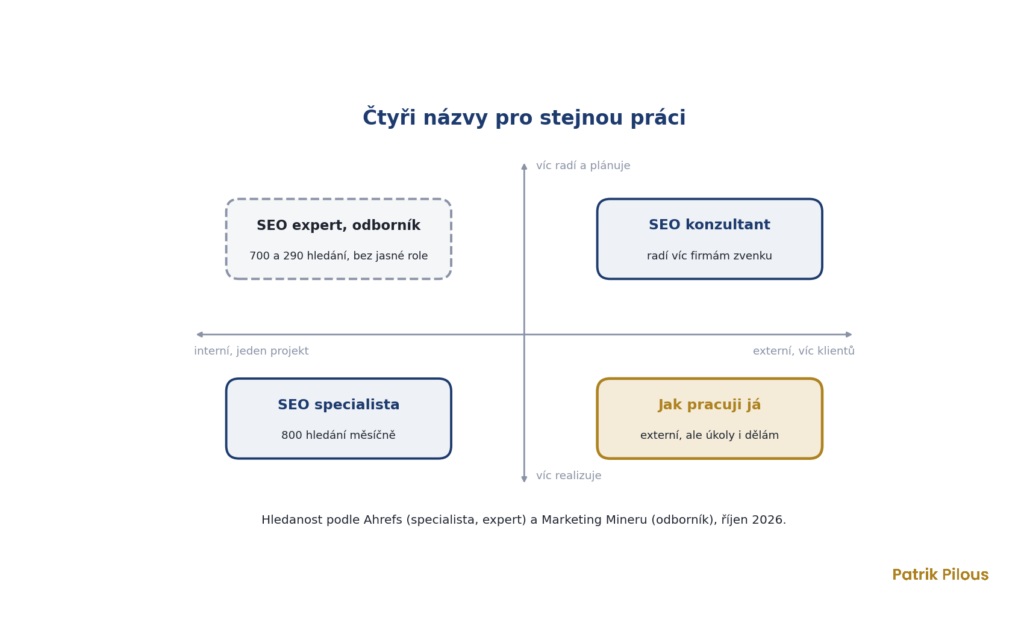
If there is any difference, it lies in where the person sits and what they do. A specialist is more often in-house or on a single project and does more of the implementation. A consultant is usually external, works for several companies and advises more. Anyone can put the word expert on their business card, so on its own it says nothing.
I am somewhere in between. I am external, but I don’t just hand over recommendations to be filed away in a drawer. I do most tasks myself or assign them to developers and check that they have been deployed. I explain why this difference matters so much in the article how to choose an SEO consultant.
What an SEO specialist does in a typical month
The idea that a specialist does an audit once and then just monitors rankings doesn’t match reality. Most of the time goes into repeated work that adds up. For an e-shop with thousands of products, it typically looks like this.
- Technical. Checking indexing in Search Console, new and removed URLs, redirects after products sell out, filters that shouldn’t be indexed.
- Content. New categories and filter pages based on demand, meaning pages for a specific filter such as “black dresses for work”. Plus copy, titles, internal linking and cleaning up pages that compete for the same query in search.
- Links. Choosing websites, arranging articles and mentions, checking that links haven’t disappeared over time.
- Measurement. Which queries and pages are rising and falling, what turned into orders, what to move up the priority list.
- Communication. Briefs for developers and copywriters, meetings with marketing, explaining why something is being done right now.
The last point is the most underestimated. A specialist who can’t negotiate a place in the developers’ queue can have a brilliant plan and nothing deployed six months later. On large projects, negotiation is half the job.
The exact hours vary by project. On the SEO pricing page, I give an example of a sensible breakdown of a monthly retainer: 4 hours of strategy, 6 hours of content, 3 hours of technical work and 2 hours of reporting. If a supplier can’t give you a breakdown like this, you don’t know what you are paying for.
What they focus on by type of website
The same specialist will do something different on every website. That is why it pays to look for someone who has already worked on your type of project. Here are the five types I work with most often, and where the biggest lever lies for each.
- E-shop. Category structure, filter pages, indexing thousands of URLs, duplicates and sold-out products. The biggest growth usually comes from a new landing page for a query you have products for but no page. More on the SEO for e-shops page.
- B2B and services. Search volumes are in the tens per month, but a single enquiry can pay for the whole annual budget. What counts are service pages, references, case studies and answers to buyers’ questions.
- Local business. Google Business Profile and Firmy.cz, reviews, the same contact details everywhere on the internet, and pages for specific cities.
- Content website or magazine. Topics based on demand and updates to old articles that are losing ground. I run several websites of my own, so I know how much work and money it takes to win a single visit from search.
- Finance and health. Google closely checks who is behind the content here. Named authors and verified sources carry more weight than elsewhere, which I know from working for investment and financial firms.
A generalist who claims to do everything equally well is usually weak at everything. An honest “I haven’t worked on this type of website” is a better sign than an instant yes.
When one specialist isn't enough
One person can handle a small website. On a larger project, SEO splits into disciplines that few people master equally well. Someone is strong in technical SEO and understands developers instantly. Someone else is at home in content and works mainly with copywriters. Link building is almost a separate craft that many SEO people don’t enjoy.
That is when a small team makes sense. One person owns the strategy and priorities, others handle technical work, copy or links. Specialisation in a content management system also plays a role. On the market you will find people who work almost exclusively with Shoptet or WordPress and know their limitations by heart. I focus most on content, site structure and link building, with a business perspective and an overlap into marketing strategy.
What matters is that the outcome has a single owner. When five people are responsible for SEO, nobody is.
When you don't need an SEO specialist
SEO doesn’t always make sense, and I would rather say so at the start than after six months of invoices. Before you hire anyone, go through four questions. Answer each one honestly, ideally with numbers.
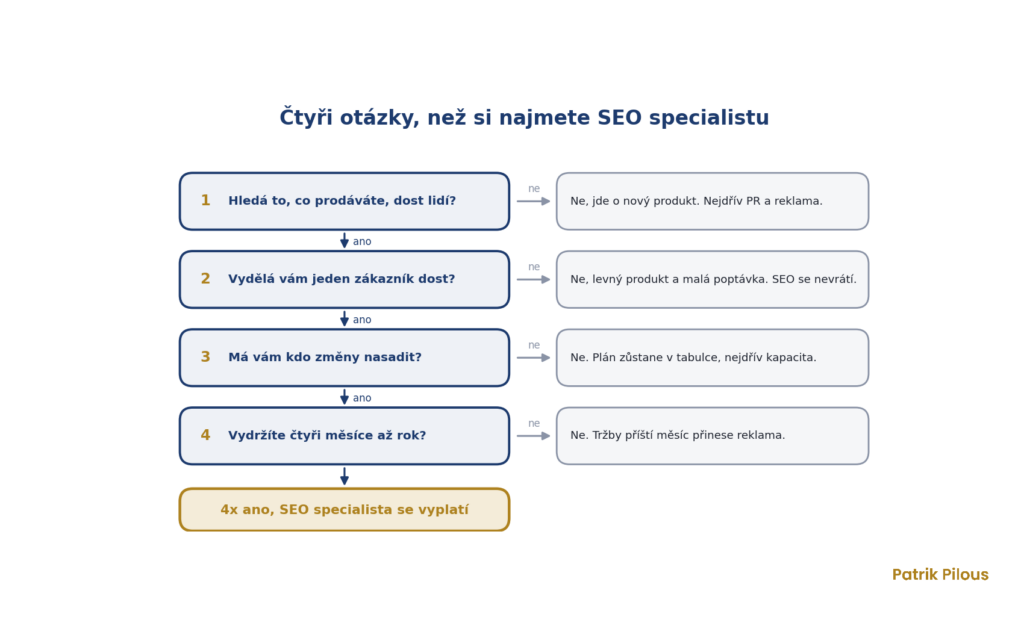
- Are enough people searching for what you sell? A new product the market doesn’t know yet has no demand for SEO to capture. That calls for advertising and PR.
- How much does one customer earn you? With low search volume and a cheap product, the investment has nothing to pay itself back from. For a B2B contract worth hundreds of thousands, a few enquiries a year are enough.
- Do you have the capacity to implement? Without a developer and someone to write copy, even the best plan stays in a spreadsheet.
- Can you wait? Google itself states that SEO takes four months to a year for changes to be implemented and show results. If you need revenue next month, start with advertising.
A no to the first or second question means starting elsewhere, because there is nothing for SEO to capture. A no to the third or fourth can be fixed, but first you need to free up people and set expectations. Often a one-off SEO consulting session is enough, and you leave with a clear yes or no and the order of the first steps.
How much an SEO specialist costs
Prices in the Czech Republic fall into clear bands. I am drawing on the overview I maintain on the SEO pricing page. All amounts exclude VAT.
- Junior freelancer or entry-level consultant, €20 to €40 per hour.
- Mid-level freelancer with three to five years of experience, €40 to €60 per hour.
- Senior freelancer or consultant with five or more years and references, €60 to €85 per hour.
- Well-known figure in SEO, €85 to €140 per hour.
- Agency that re-invoices the hours, €60 to €120 per hour.
A monthly retainer for a small website or local service comes to roughly €210 to €820, and for a mid-sized Czech e-shop €820 to €1,650. A large e-shop or corporation should budget €1,650 to €4,950 a month. For e-shops with a turnover of €2,876,500 to €8,218,600, which I work with most often, €1,650 to €2,450 a month including a link building budget makes sense.
The hourly rate alone says little about quality. A senior at €75 who picks the three things with the greatest impact in ten hours costs less than a junior at €30 who works through an entire checklist in thirty hours. The most expensive option is a €210 retainer that quietly runs for a year and delivers nothing.
In-house specialist, freelancer or agency
Three models, each suited to different situations. The most common mistake is comparing them by hourly rate. They should be compared by how much work you get in a year and how much it will cost you.
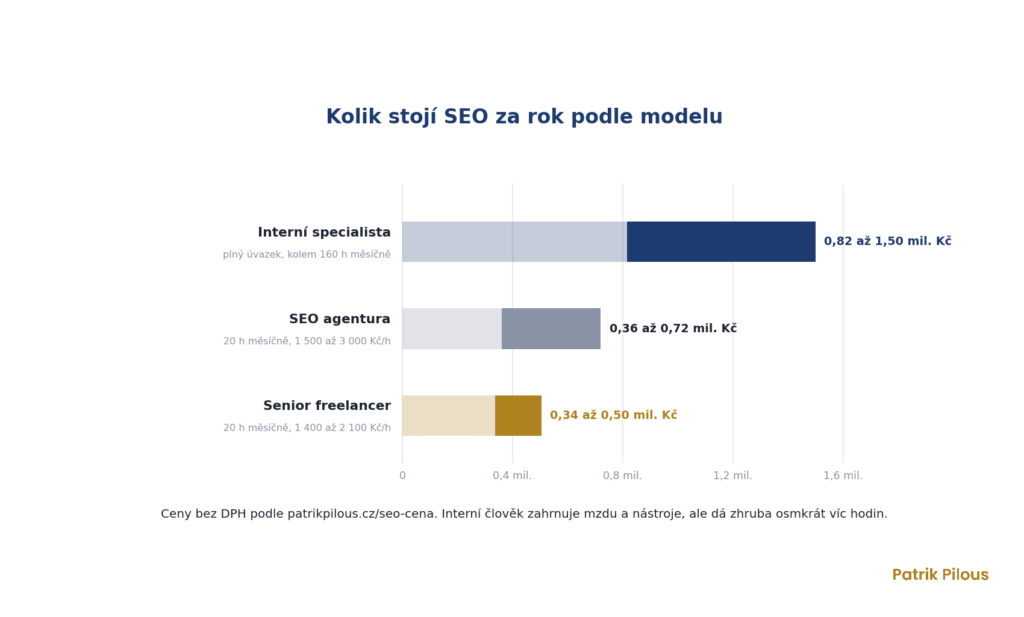
A full-time in-house specialist costs you €2,450 to €4,500 a month, meaning total payroll costs including contributions, plus tools at €330 to €620. Over a year, that is roughly €32,900 to €61,600. But you get a person for the whole month who knows the product in detail. It pays off where SEO is daily work, typically for large e-shops and media websites. You can tell because an external person’s task queue grows month after month and you keep adding hours. The risk is blind spots, because they don’t see what works elsewhere.
A senior freelancer for 20 hours a month, at a rate of €60 to €85, costs €13,800 to €20,700 a year. An agency charging €60 to €120 for the same 20 hours costs €14,800 to €29,600. For an e-shop, twenty hours a month is enough for ongoing work on content, technical issues and backlinks, but not for a complete website rebuild. The difference is not just the price. With a freelancer, you talk to the person who does the work. With an agency, you often talk to an account manager while someone else works on your website. I go into this in more detail on the SEO agency page.
Most often, I recommend a hybrid. An external senior specialist owns the strategy and priorities, and an in-house person or content manager implements them. You get more senior thinking than an agency retainer offers, and the work gets done every day.
How to spot a good specialist
I have a detailed guide with seven questions for the first meeting, how to check references and the warning signs in my article how to choose an SEO consultant. Here I cover only what you can tell within half an hour.
A good specialist asks about the business first. How you make money, what your margins are, who your three main competitors are and what success would look like for you in a year. Anyone who offers you a package before even looking at Search Console is selling a process, not a result.
The second signal is the promise. Google states plainly in its help page on hiring an SEO that no one can guarantee the number one ranking in search. It also warns against people who claim a special relationship with Google or offer priority submission. Anyone who guarantees rankings either does not understand how search engines work or is counting on you not noticing.
The third signal is access. Search Console and Google Analytics should be in your account, and the specialist gets access to them, not the other way round. Google recommends giving a new provider read-only access to Search Console at first.
What to prepare before contacting a specialist
The first meeting is half as useful again if you bring a few things. They do not need to be finished or polished. They just need to save the specialist from guessing what you already know.
- Access to Search Console and GA4, or at least a performance export for the last 12 months.
- Your three main competitors as you see them, not the ones a tool shows.
- Your margins or average order and deal value, at least as a range.
- Who implements website changes on your side and how many hours a month they have for it.
- What you have tried with SEO before, with whom, and why it ended.
From the answers to these points, I learn more in an hour than from a week-long audit. And you can tell whether the specialist asks about what matters, or is just waiting until they can send you a proposal.
How working with me works
I prefer long-term work with a commitment of at least 15 hours a month. Below that, I cannot get far enough into a project to genuinely move it forward. Two or three people support me, so I can handle larger websites too, but I personally keep the strategy and the communication with you.
- A conversation about the business. What you sell, to whom, at what margin and where the shoe pinches.
- Data. Search Console, GA4, Ahrefs and Marketing Miner. Where the demand is, where you are losing out, where the competition is weak and what already makes you money today.
- Priorities. A list of tasks ranked by impact on revenue and effort, not alphabetically.
- Implementation. Whatever I can do myself, I do. Categories, filters, copy and backlinks. I write briefs for developers so they can implement them straight away.
- Measurement and adjustments. Once a month, we look at what has changed in orders and enquiries, and adjust the plan accordingly.
The Erika Fashion case study shows what this looks like in numbers. According to Search Console, visits from Google grew from 115,140 to 436,000 a year over two years of working together, an increase of 278%. For the e-shop, I manually created over 10,000 new landing pages and earned over 300 backlinks. I also work or have worked for Manboxeo, ESET, XTB, Srovnejto, Klimafil, Stylovej, Zakeri and Booking.com.
Backlinks are a discipline of their own, and I have been building them for clients and my own websites for a long time. More on the link building page. Today, it is no longer just about the link. Brand mentions, which AI models draw on, carry the same weight.
How long before you see results
Technical fixes and indexing changes usually take effect within 4 to 8 weeks. Content needs 3 to 6 months for the pages to settle. Traffic growth comes between the third and tenth month, depending on the strength of the website and the competition.
In its video on hiring an SEO, Google said a specialist needs four months to a year before a company implements the changes and starts seeing the benefit. My experience matches this. The delay is most often caused not by SEO but by developer capacity. If you know in advance how many of their hours a month you can free up, the order of tasks can be planned around it.
Measure it correctly. Rankings and traffic are an intermediate step. In the end, orders and revenue from organic search should be moving, and that should come first in every report.
What is changing with AI search
Some people now ask ChatGPT, Gemini or Perplexity instead of Google. I can see this in Search Console for this very page. Queries arrive written as full sentences, like prompts for AI, for example asking for the names of specific technical SEO specialists.
For a specialist’s work, this means two things. The foundation stays the same: the website must be technically sound and the content must answer questions. But there is more work on the brand, mentions and the contexts in which AI talks about you. I cover this on the GEO page.
The practical consequence for choosing a specialist: ask how they measure brand visibility in AI answers and what they do with the results. The answer does not have to be complicated, but there should be one. On the other hand, anyone selling GEO as a completely new field with no connection to SEO is exaggerating.
Is an SEO expert the same as an SEO specialist?
In practice, yes. The titles specialist, expert and consultant are used interchangeably in the Czech Republic. A specialist is more often in-house and does more implementation, while a consultant is external and gives more advice.
Quality is not decided by the title, but by references you can verify and whether the person measures results in revenue.
How much does an in-house SEO specialist cost?
Total payroll costs including contributions come to roughly €2,450 to €4,500 a month, plus tools at €330 to €620. That is around €32,900 to €61,600 a year.
It pays off when there is a full-time workload of SEO. A smaller company is usually well served by an external senior specialist for 15 to 20 hours a month, which costs roughly a third as much per year.
Can an SEO specialist guarantee the number one ranking?
No. Google states plainly that no one can guarantee the number one ranking, and it warns against providers who guarantee rankings.
A reputable specialist talks about probability, timeframes and which steps will influence the result. Rankings also depend on competitors who are working on the same thing.
Does an SEO specialist need access to the website?
Ideally yes, at least to the content management system. Speed of implementation matters more than the quality of the plan. Read-only access to Search Console is enough at the start.
The Search Console and Google Analytics accounts should belong to you. The specialist is just a user you can remove at any time.
Does an SEO specialist also do optimisation for AI?
They should. Visibility in ChatGPT, Gemini or AI Overviews rests on the same foundation as SEO, with added work on the brand and mentions.
I track my clients’ visibility in AI models in Marketing Miner and Ahrefs and adjust content and link building accordingly. It is harder to measure than traffic from Google, because AI assistants have nothing like Search Console.
What an SEO specialist is
An SEO specialist is an expert in optimising websites for the Google and Seznam (Czech search engine) search engines, and now also for AI assistants. They look after the website’s technical health, content, backlinks and measurement. They are also called an SEO expert or SEO consultant; the difference lies in the scope of work, not the title.
Whether you are a client or an SEO specialist, feel free to create something like a maturity model. Look at which stage you are at in each pillar. Especially on larger projects, the marketing manager can then present this status to leadership and explain how certain steps make sense and can move everything forward. In technical SEO, for example, a well-designed filtering system that is fully indexable and covers hundreds of relevant keywords would help significantly. On some projects you simply get on with it, but on others it remains a forgotten task somewhere. An SEO consultant also has to fight for their priorities and not let them die.

Patrik Pilous
An SEO specialist for international companies in the Czech Republic
If your company is based abroad or your team works in English, Czech search has a few specifics that a foreign supplier easily misses. Seznam still plays a role alongside Google. Czech users search both with and without diacritics. Czech grammar also means one product can be searched for in several word forms. A translated website rarely covers all of this.
- Localised, not translated. Categories and service pages should follow what Czech customers actually search for, which often differs from the wording used at headquarters.
- Language versions. Correct hreflang, a clear URL structure for each country and no duplicate pages competing with each other.
- Local signals. Links from Czech websites, mentions in Czech media and consistent company details across Czech catalogues.
- Reporting for headquarters. I can work with you in English and report results so that your global marketing team can compare them with other markets.
Common mistakes when hiring an SEO expert
Most of the failed collaborations I see do not fail on skills. They fail on how the work is set up.
- Hiring without a goal. More traffic on its own is not a goal. Agree at the start which categories, services or markets should bring more orders or enquiries.
- Nobody owns SEO on your side. Someone has to approve changes, unblock developers and make decisions. Without that person, tasks wait for weeks.
- A redesign or migration without SEO. Changing the platform or URLs without a redirect plan can wipe out years of work. Bring the specialist in while the new website is being planned, not after launch.
- Switching suppliers too often. Every new specialist spends the first months getting to know the project. If you change every six months, you keep paying for the start.
- Judging the work by charts alone. Ask what was actually deployed on the website each month, not only which lines went up or down.
More questions about hiring an SEO specialist
Do I need an SEO specialist who speaks Czech for the Czech market?
For keyword research and content, yes. Machine translation misses the word forms and local phrasing Czech customers actually use. Communication and reporting can still be in English, which is how I work with international clients.
When should I bring in an SEO expert before a website redesign?
As early as possible, ideally while the structure and URLs are being planned. The specialist should prepare a redirect map, identify the pages that bring revenue and check the new website before launch. Fixing a migration afterwards is slower and more expensive.
Can an SEO specialist work alongside my existing agency?
Yes, as long as responsibilities are clearly split. I can own the SEO strategy and priorities while your agency handles implementation, advertising or design. What matters is that one person is accountable for the result.
Get in touch

