
An outsourced CMO goes through four phases in the first 90 days at a company. In the first two weeks they build a map of costs and revenue from the data, by week six they make a diagnosis and talk to people, by week ten they decide on priorities and budget, and in the final three weeks they set up a regular rhythm and the first changes. After three months you should have one number that the leadership trusts, a budget by channel with reasons, regular meetings and a list of things that have stopped being done. Do not expect a big jump in revenue in that time.
You will find a brief overview of a new marketing director’s first three months in the article Who a CMO is and what they really do in a company. Here I go one level deeper, to the individual weeks and to what you, as the owner, need to prepare.
Why the first three months matter so much
In its 2018 article Successfully transitioning to new leadership roles, McKinsey summarises studies showing that two years after taking up the role, 27 to 46% of leadership changes are seen as failures or disappointments. According to the same text, 68% of transitions stall on people and company culture, including internal politics.
McKinsey also refutes the idea that a new leader has 100 days to make an impact. 92% of leaders hired from outside and 72% of those promoted from within need well over 90 days to reach full performance. This applies to leadership roles in general, not specifically to CMOs. At a meeting of the Swiss business school IMD, 57% of around a hundred senior executives said it took them six months or longer to fully take over their last role.
So the 90 days mainly decide whether results will come at all in the months that follow. With an outsourced CMO this is more sensitive. They are in the company for only part of the week, so they have fewer hours than an in-house colleague to build relationships and understand operations, and every week lost waiting for access or decisions costs them proportionally more than it would a full-time colleague.
Which situation your company is in
Michael Watkins, a professor at IMD and author of the book The First 90 Days, builds the start in a new role around one question. What situation is the person coming into? According to him, the goal is to reach the breakeven point as soon as possible, the point at which the company needs the new leader as much as they need it.
In the article Picking the Right Transition Strategy for Harvard Business Review, he described five typical situations under the acronym STARS. A company is often in a mix of two situations, so the examples in the table are only illustrations.
| STARS situation | What it looks like in the company’s marketing | What it means for the first 90 days |
|---|---|---|
| Start-up | a new e-shop, new brand, new market or product line | more building than diagnosis, choosing the first suppliers |
| Turnaround | revenue is falling and advertising is losing money | a shortened diagnosis, first decisions as early as week two |
| Accelerated growth | demand is growing faster than the team and processes | getting measurement in order and clearly dividing work between suppliers |
| Realignment | the company is making money, but marketing is losing momentum and nobody wants to hear it | lots of conversations, data as evidence for the leadership |
| Sustaining success | marketing works, the predecessor had a good reputation | do not break what drives revenue, change gradually |
The hardest part is telling a turnaround from a realignment. In a turnaround, people see the problem and want change. In a realignment, they deny it and a radical cut meets resistance.
“In a turnaround, there is a burning platform. In a realignment, denial prevails.”
Michael D. Watkins, Picking the Right Transition Strategy, Harvard Business Review, 2009
Before the outsourced CMO starts, tell them which situation you see. Watkins points out that most traps arise when the boss and the new leader each see the severity of the problem differently.
What the company prepares before day one
Access and documents should be ready by the first day. Every day the CMO waits for permissions in Sklik (the ad platform of Seznam, the Czech search engine) or tries to find out who is allowed to sign off a change with a supplier, you are paying for someone who cannot yet decide anything. Grant access to their own account, do not send passwords.
| What to prepare | Why the CMO needs it | Who usually provides it |
|---|---|---|
| Access to GA4 and Google Search Console | traffic, conversions, traffic sources and search demand | web administrator or agency |
| Access to Google Ads, Sklik, Meta and other ad platforms | what each channel costs and what it claims credit for | PPC supplier |
| E-shop admin or CRM, export of orders for 24 months | actual revenue, new and returning customers | owner or operations |
| Marketing costs from the accounts by month, and gross margin | what marketing really costs, including suppliers | accountant |
| Supplier contracts and price lists with notice periods | what can be changed now and what only in three months | owner |
| List of people with contacts and who decides what | whom to talk to and whom to ask for approval | owner |
Appoint one person in the company who will answer the CMO’s questions by the next day. And tell your suppliers that a new person is coming and why, before the CMO writes to them.
Week by week in four phases
The split into weeks is indicative and assumes a company without an acute crisis. The order applies to big decisions that are hard to reverse. Obvious losses are stopped straight away.
Anyone who reallocates the budget before seeing the data and talking to people is guessing.
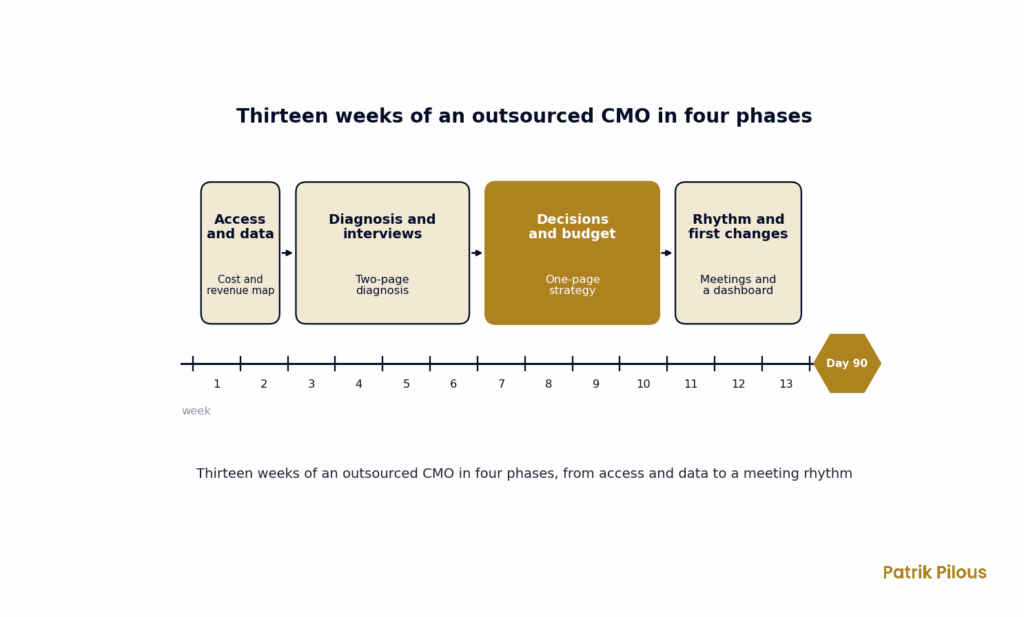
Weeks 1 to 2, access and data
The CMO checks that measurement works and puts together the first map. How much went into each channel over the past year, how much came back from it according to the data, where the numbers from different tools diverge and which of them can be verified at all. They will almost always diverge, because ad platforms claim more orders than the e-shop records. More on this in the article on attribution models.
The output is one table of costs and revenue by channel and a list of gaps in measurement. Nothing is switched off yet.
Weeks 3 to 6, diagnosis and conversations
Now it is the people’s turn. The owner, operations, customer support, sales and each supplier separately. What do you think works? What would you switch off? What do you want from marketing and not get? What do customers ask about most often?
At the same time, an audit of the website, campaigns, content and competitors runs. I describe how to put it together in the article Marketing audit. The output of week six is a two-page diagnosis. What works, where money is leaking, what needs fixing straight away and which hypotheses are worth testing.
Weeks 7 to 10, decisions and budget
This is where decisions are made about priorities for the quarter, the budget by channel, what will stop being done and who is responsible for what. A one-page marketing strategy and new briefs for suppliers are created. In a model situation, an e-shop with a turnover of 40 million CZK (about 1.6 million EUR) spends 2.8 million CZK (about 120,000 EUR) a year on marketing, which is 7% of revenue.
| Channel | Annual costs | Share | Decision after diagnosis |
|---|---|---|---|
| Google Ads, performance campaigns | 900,000 CZK (about 37,000 EUR) | 32 % | keep, set targets based on margin |
| Google Ads, own-brand campaigns | 300,000 CZK (about 12,000 EUR) | 11 % | cut by 150,000 CZK (about 6,200 EUR), test a month without them |
| Sklik | 300,000 CZK (about 12,000 EUR) | 11 % | keep |
| Meta | 600,000 CZK (about 25,000 EUR) | 21 % | cut by 150,000 CZK (about 6,200 EUR), a new customer costs the most here |
| SEO and content | 400,000 CZK (about 16,000 EUR) | 14 % | increase by 300,000 CZK (about 12,000 EUR) |
| Newsletter and other | 300,000 CZK (about 12,000 EUR) | 11 % | keep |
The total budget does not change. 300,000 CZK (about 12,000 EUR), which is 11% of marketing, moves to a channel with a long-term effect. Brand campaigns go down to test whether orders come even without them, Meta because of the highest cost per new customer. Whether to judge a channel by PNO or by margin is something I discuss in the article ROAS and PNO.
Weeks 11 to 13, rhythm and first changes
Regular meetings start for real, with a fixed agenda and one overview of the numbers. At the same time, the first changes become visible, for example a reallocated budget, new briefs for suppliers, fixed measurement or a switched-off campaign.
SEO and content respond over months. At most, only performance advertising will show up in revenue so far.
| Phase | Main output | What you get in your hands | When to be wary |
|---|---|---|---|
| Weeks 1 to 2 | map of costs and revenue | table by channel, list of measurement errors | the CMO is still waiting for access |
| Weeks 3 to 6 | diagnosis | two pages on what works and where money is leaking | a finished campaign plan without conversations |
| Weeks 7 to 10 | priorities and budget | one-page strategy, new briefs for suppliers | the budget grows and nothing is cut |
| Weeks 11 to 13 | rhythm and first changes | overview of the numbers, meeting notes | meetings are cancelled or have no agenda |
Quick wins and what can wait
Quick wins help, but there is a catch. In the article The Quick Wins Paradox for Harvard Business Review, Mark Van Buren and Todd Safferstone followed over 5,400 people in new leadership roles. Those who failed behaved similarly. They got lost in details, handled criticism badly, intimidated those around them, made hasty decisions and micromanaged people at every step. The authors recommend a different path, a collective win that the team achieves together with the new leader.
With an outsourced CMO this matters even more, because most of the work is done by suppliers. A quick win that the CMO pushes through alone, over the head of the PPC specialist or agency, may give them a number for the first report, but a month later it comes back to them as distrust from people they will be working with for a long time. Stopping an obvious loss is something else, though, and has nothing to do with micromanagement. By week six, after agreeing with the supplier, you can do the following.
- fix order tracking when GA4 or the ad platforms count incorrectly
- switch off campaigns that brought no order or assisted conversion in a year
- combine supplier reports into one overview
- stop payments for tools and services that nobody uses
On the other hand, the following will wait until after the diagnosis.
- changing a supplier
- website redesign
- new positioning or brand
- a significant budget increase
How starting as an in-house CMO differs from starting as an outsourced CMO
The principles are the same, but the execution differs. An in-house director has time and the corridors, while an outsourced one has an outside view and a limited number of hours.
| Area | In-house CMO | Outsourced CMO |
|---|---|---|
| Time in the company | the whole week, informal conversations | part of the week, conversations have to be scheduled |
| Access to data | gradually, through colleagues | needs access straight away, otherwise work stalls |
| Who does the work | their own team | mainly suppliers and a few people in the company |
| Main risk | drowns in day-to-day operations | remains an adviser whose recommendations nobody implements |
| What helps them | relationships and knowledge of operations | experience from other companies and distance |
At the Chlorito e-shop, where I lead marketing as an outsourced CMO, we meet every 14 days with the owner and with the person responsible for operations and expansion. Between meetings, I brief and coordinate the work of the PPC specialist, the social media people, the graphic designers and the video production team.
I describe how I set up outsourced marketing leadership and which companies it suits on the page outsourced and fractional CMO. You will find a comparison with an agency and a full-time marketer in the article Fractional CMO, agency or marketer.
How to tell after 90 days that it is working
Revenue is affected by the season, prices, stock and even the weather. Over 13 weeks, you can measure how it moves, but it is hard to attribute that movement to the CMO’s work, so compare it with the same period last year. Look instead at whether a system you can manage by has been created. Six things should be done.
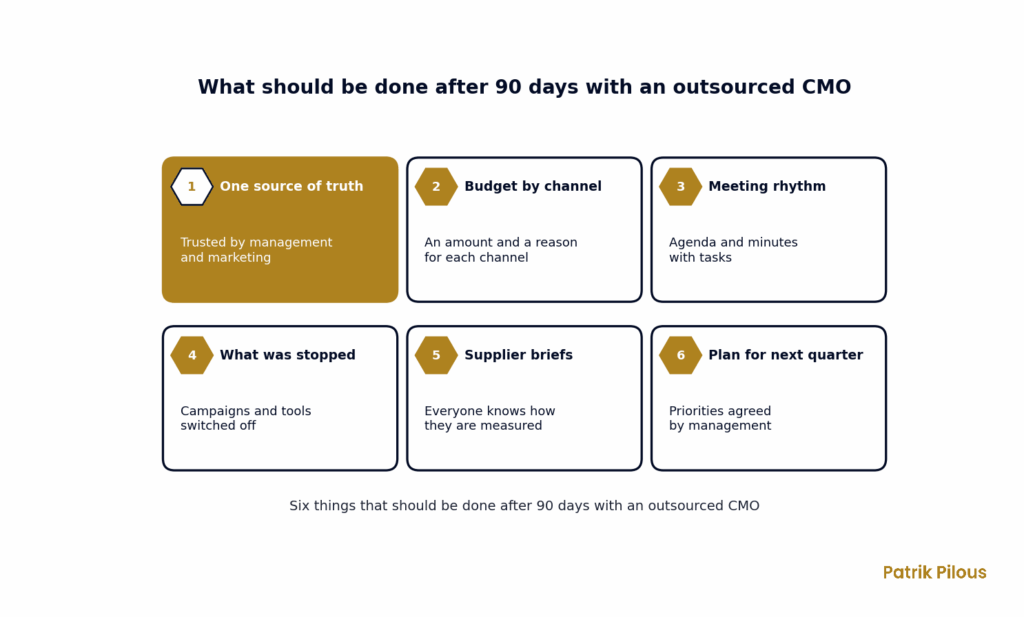
- One number of truth. A single number that management and marketing agree on, every month from the same source.
- Budget by channel. For each channel, an amount, a reason, an expected figure and who is responsible for the channel.
- A rhythm of meetings. Meetings take place as scheduled and have an agenda and minutes with tasks.
- A list of what has stopped. Campaigns, tools, subscriptions and activities without results.
- Supplier briefs. Every supplier knows which number their work is judged by.
- A plan for the next quarter. Priorities that management has agreed on.
The one number of truth does not have to be complicated. For the model e-shop in the table above, it could be the gross margin after deducting marketing. With a turnover of 40 million CZK (about 1.6 million EUR) and a margin of 35%, the company earns 14 million CZK (about 580,000 EUR) on goods, and after deducting 2.8 million CZK (about 120,000 EUR) for marketing, 11.2 million CZK (about 460,000 EUR) remains. That is not profit, as it leaves out shipping, payment fees, returns and fixed costs. If the number grows, that is a good sign. If only turnover grows and this number stays flat, marketing may simply be buying revenue at a discount.
Warning signs that the collaboration is not working
You can spot a problem before the 90 days are up, and on both sides. Without access and decisions, an outsourced CMO can do nothing, however much experience they have.
| Sign | Whose side | What to do |
|---|---|---|
| After six weeks there is no diagnosis, only ongoing observations | CMO | ask for two pages with a deadline |
| A finished campaign plan after the first week, without your data | CMO | ask which numbers it is based on |
| Access is still missing in the fourth week | company | appoint one person to provide it |
| Decisions wait for the owner for more than a week | company | agree on what the CMO approves on their own |
| Suppliers keep reporting to the owner and bypass the CMO | both sides | one overview and one meeting for everyone |
| Meetings are cancelled and rescheduled | both sides | fixed dates for the whole quarter ahead |
Two signs are purely on the company’s side and another two are on both sides. (In my view, waiting for the owner’s decision is more expensive than almost any campaign mistake, because the CMO can fix a campaign mistake on their own.)
When this plan does not apply
Thirteen weeks in four phases is a plan for a company that already does marketing and needs to pull it together. In a rescue situation, where advertising loses money every day, six weeks of diagnosis is a luxury. The first decision has to be made in the second week, and the diagnosis is completed along the way.
It is also unsuitable for a company with one working channel and one person who manages it well. There, a CMO would be an expensive extra layer. For a company with two markets and ten suppliers, on the other hand, 90 days is not enough.
Interesting questions on the topic
What is a 30-60-90 day plan?
Dividing the start into three monthly sections, with an output at the end of each. By day 14, a map of costs and revenue is ready, by day 42 the diagnosis, by day 70 the budget and priorities, and by day 90 the rhythm of meetings is running.
When will a new marketing director start delivering results?
According to McKinsey, 62% of leaders hired from outside took at least six months to have a real impact. You will see changes in management and budget within three months, and in revenue later.
How much time per week does an outsourced CMO give a company?
It depends on the agreement and the scope, mainly on the number of channels and suppliers.
What should a new CMO achieve in their first 90 days in the role?
One number of truth, a budget by channel with reasons, regular meetings and a list of what has stopped.
Euro amounts are approximate, converted at the Czech National Bank rate of 24.34 CZK per EUR on 29 October 2026.

