

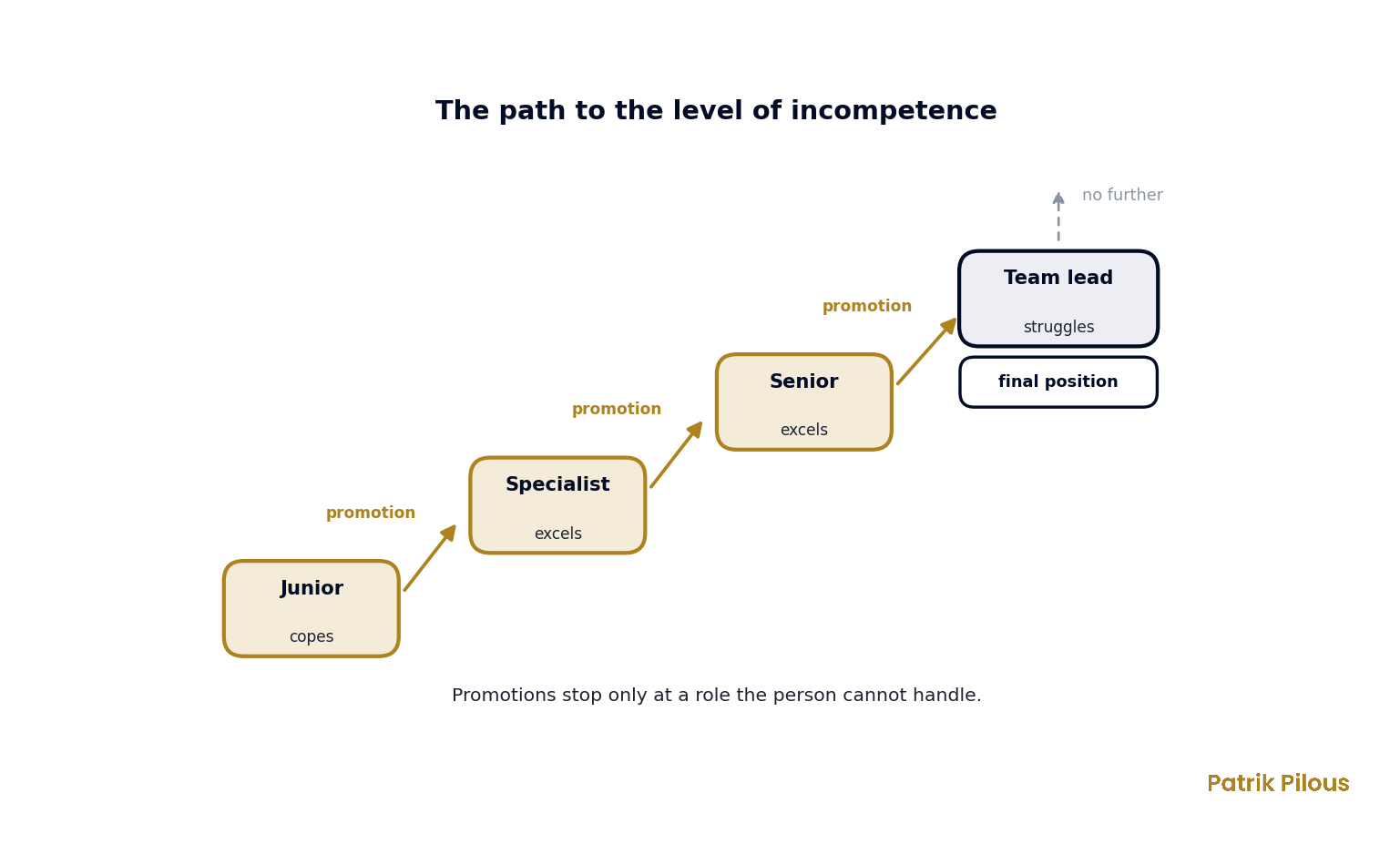
The Peter Principle is Laurence J. Peter’s satirical claim that in a hierarchy every employee rises until they reach their level of incompetence. Companies promote people for their performance in their current job, yet that says little about their abilities for a more senior role. Those who succeed in the new position move up another level, and those who fail stay where they are. The Canadian educator described it with Raymond Hull in 1969 in a book written tongue in cheek. Economists later found support for it in data, so far mainly among salespeople.
Classification
- Type of phenomenon: a satirical rule about promotion in hierarchies, later tested against data
- Bias it reveals: we treat performance in one role as proof of ability in a completely different role
- Mental area: Decision-making
- Marketing function: Team leadership and hiring
- Buyer journey: not applicable, it concerns company management
- System 1 / System 2: arises in System 1 (fast, automatic thinking) and only System 2 (slow, deliberate thinking) can expose it
In brief
- What it is: people are promoted until they reach a position they cannot handle, and there they stay.
- Why it matters: a badly filled leadership role worsens the results of the whole team, not just one person.
- Where you will meet it: the best PPC specialist becomes head of the team, the best salesperson becomes sales director.
- How to avoid it: promote based on ability for the new role and offer specialists a path to grow without managing people.
A real-life story
Laurence J. Peter taught in Vancouver and later taught education at the University of Southern California. He wrote The Peter Principle with Raymond Hull, and it was published in 1969 by the New York publisher William Morrow. It is written as satire with a straight face. For example, it describes the “lateral arabesque”, where a company moves an incompetent person aside and gives them a longer title on their business card.
When Peter died in 1990, The New York Times published his obituary with a headline saying his principle satirised business. So it is an exaggeration. Whether it also holds outside the book remained a question without data for a long time.
The answer came from the study Promotions and the Peter Principle, which was also published in the Quarterly Journal of Economics in 2019. In the 2018 working paper, Alan Benson of the University of Minnesota, Danielle Li of MIT and Kelly Shue of Yale analysed data on 53,035 salespeople from 214 American companies between 2005 and 2011. Of these, the companies promoted 1,531 people to manager.
Doubling sales raised the chance of promotion by 14.3% relative to the baseline probability. For those promoted, however, it worked the other way round: twice the sales before promotion was associated with a 7.5% drop in the sales of each subordinate.
How the Peter Principle works
A promotion is both a reward for the past and a bet on the future. The company sees how well a person does their current job, but a leadership role requires different skills, such as delegating, giving feedback, planning capacity and making decisions about people, which they never had to try as a specialist. A salesperson who closes deals brilliantly on their own cannot yet teach five other people to do the same.
The second half is asymmetry. Those who succeed in the new role move on. Those who fail usually stay, because demotion is unpleasant for both the company and them, and Peter calls this final placement in the book.
In 2004, Stanford economist Edward Lazear added a statistical explanation in the Journal of Political Economy. Promotion comes after an exceptionally good period that includes an element of luck. After the promotion, performance returns to the average, so you will see a decline even if the person has not changed at all.
According to Lazear, any promotion rule leads to this, so the decline on its own does not prove a mistake by the company. Companies that take this into account, Lazear says, set a higher bar for promotion. The rest is the psychology of the person doing the promoting. Numbers from the current job are concrete and look good in a meeting, whereas you cannot see the ability to lead people in any report.
The Peter Principle in marketing
Marketing and sales are an ideal environment for the Peter Principle. A specialist’s performance is easy to measure, so promotions are based on it too. Team leadership, however, is harder to measure and shows results with a long delay, often only when people start leaving the team.
- The best specialist as head of the team. The PPC specialist with the highest campaign return or the best copywriter gets the manager’s job. The company loses a top expert and gains an uncertain manager.
- The best salesperson as sales director. This is exactly the situation Benson’s team measured. The salespeople who became better bosses were those who had previously sold in teams and shared deals with colleagues, but companies did not promote them for it.
- An agency career only through managing people. When the only route to a higher salary is becoming an account or team leader, it is precisely the person who does client work best who leaves it.
- Promotion as the only reward. A company that cannot recognise performance other than with a title pushes into management even people who do not want it.
- External hiring based on a portfolio. The same mistake happens in hiring. A head of marketing chosen for great campaigns at a previous job faces the same leap into a different role, only without knowing the company.
As a model example, imagine the best PPC specialist who, after being promoted to a management position, plans capacity, runs interviews, approves budgets and works out why a junior is falling behind instead of fine-tuning campaigns, while her former campaigns are managed by a less experienced colleague.
What the data on salespeople showed
The study by Benson, Li and Shue is so far the strongest empirical support for the Peter Principle, at least for salespeople. The table summarises the main figures from the 2018 working paper, as also described in the NBER summary.
| Finding | Figure | What it means |
|---|---|---|
| Sample | 53,035 salespeople, 214 companies | data from sales software, 2005 to 2011 |
| Chance of promotion | 14.3% higher with double the sales | companies promote mainly based on sales |
| Subordinates’ sales | 7.5% lower when the boss had double the sales | the best sellers were worse leaders |
| Better selection | 30% higher contribution from managers | the authors’ model estimate for selection based on managerial potential, not a measured result |
| Collaboration | better managers, but it did not help with promotion | shared deals predicted good leadership |
The authors stress that companies need not be acting foolishly. Promoting based on sales is a clear incentive for the whole sales force and prevents favouritism. Companies where managers led larger teams, and where the quality of the boss therefore mattered more, gave less weight to sales and more to collaboration experience when promoting, so they partly protected themselves against the Peter Principle.
The measure of a manager has its limits. The study assesses a boss only by the sales of their people, so it does not see their other work. A 2010 simulation by Alessandro Pluchino and colleagues in the journal Physica A found that organisations would be more efficient if they promoted at random, and it earned them the Ig Nobel Prize in management. However, it is a simulation that assumes performance in the new role does not depend on the previous one at all, so it applies to real companies only to a limited extent.
How to guard against the Peter Principle
Promotion based on performance cannot and should not be abolished. But you can separate the reward for good work from the decision about who will lead people.
- Assess abilities for the new role. In the study, collaboration experience predicted a good boss, whereas high sales tended to predict a worse one. Before a promotion, let the candidate lead a project or train a newcomer and track the team’s results through marketing KPIs. For a candidate to lead a PPC team, this could be the return on campaigns managed by junior colleagues under their guidance.
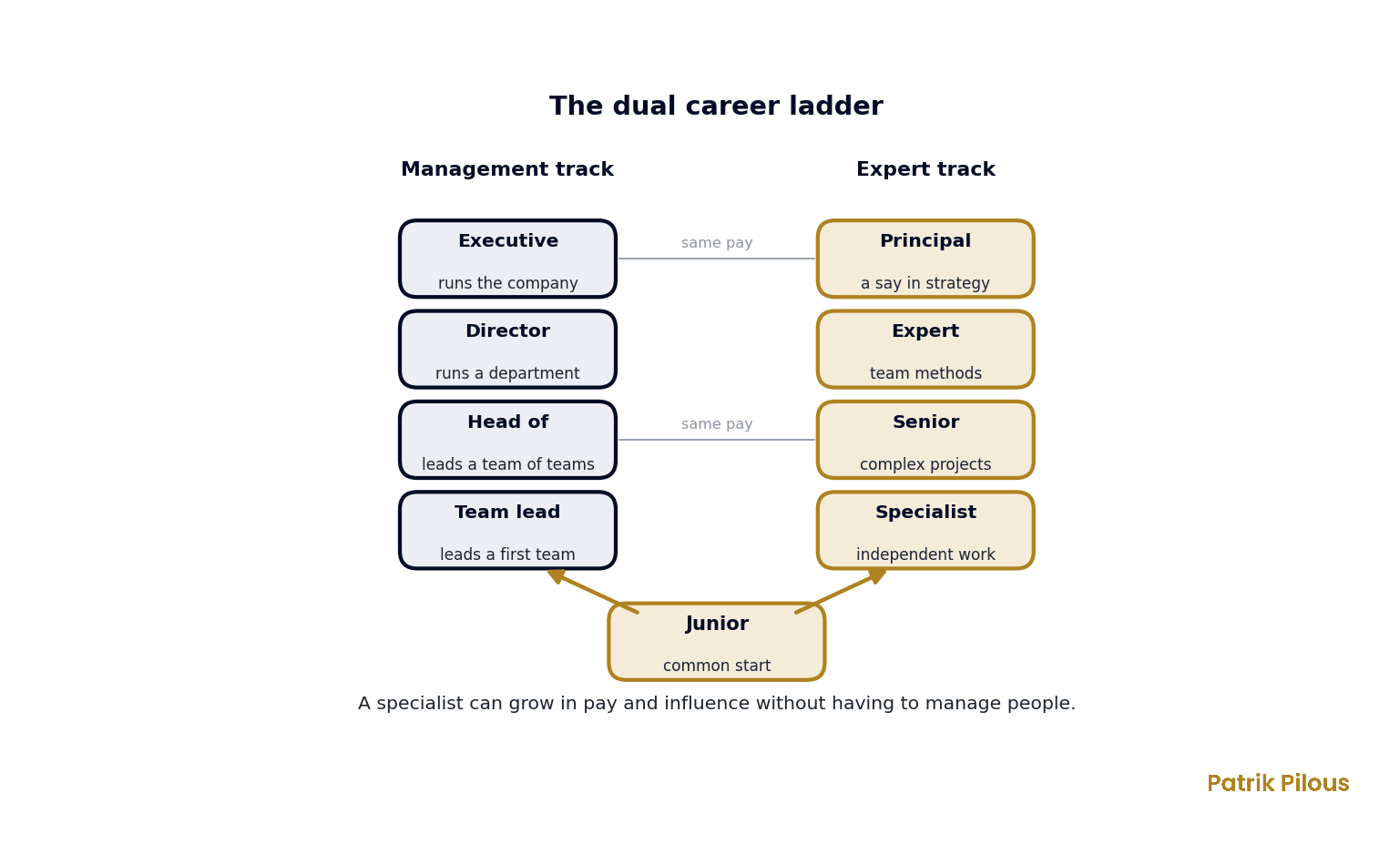
- Build a dual career ladder. A specialist grows in salary and seniority without managing people. As early as 1986, Thomas Allen and Ralph Katz of MIT asked in an article in R&D Management whether this is a solution or a managerial illusion. In my view, what decides it is whether the expert track has the same pay and the same say.
- Reward in ways other than promotion. Benson’s team found that companies with strong commissions and bonuses gave less weight to sales when promoting. Money therefore takes over part of the motivation.
- Promote on a trial basis with a way back. If a person can return to a specialist position without embarrassment, they will not get stuck in a role that does not suit them. A trial period of a few months will show how the team is doing under its new boss.
If no one in the team can yet handle the leadership role, you do not have to fill it with your best specialist. You can bridge the gap for a while with an outsourced or fractional CMO until you have someone ready.
How it connects with other biases
On the side of the person doing the promoting, the halo effect is at work. Excellent numbers in one discipline colour the whole judgement of a person, so a boss assumes that the best salesperson can also lead and teach others, an ability they have never seen in them. On top of that, the new manager may not realise it themselves, because, as the Dunning-Kruger effect describes, those who lack a skill are also worse at recognising that they lack it.
Add to this the overconfidence effect in whoever decides on the promotion and believes they can spot talent at first glance. The Peter principle also has an older sibling. Parkinson’s law appeared as a satire in The Economist in 1955, and both texts poke fun at how hierarchies grow and fill up with people.
Interesting questions on the topic
What is the Peter principle?
A rule stating that people in a hierarchy rise until they reach a position they cannot handle. They then stay in it.
Is the Peter principle scientifically proven?
It started as a satire, but a study by Benson, Li and Shue using data from 214 companies found results that match it, at least for salespeople. The best salespeople were more likely to be promoted, and their teams then sold less.
What is a dual career ladder?
A system in which a specialist can progress in pay and seniority without having to manage people.
Why might random promotion work?
In a computer simulation by Pluchino and colleagues, it proved more effective because performance in the new role did not depend on performance in the previous one. For a real company, the lesson is more a warning against blindly promoting the best performers.

