

Groupthink is a way of making decisions in which a cohesive group puts agreement ahead of a critical assessment of the options. People in the team swallow their doubts because they do not want to spoil the atmosphere or hold things up. Everyone then reads the silence of the others as agreement. In the early 1970s, psychologist Irving Janis described it as a set of eight symptoms, which is why in Czech it is also called the groupthink syndrome. According to Janis’s model, it mainly threatens cohesive teams that care a great deal about good relationships.
Classification
- Type of phenomenon: a theory of how cohesive groups make decisions
- Bias it feeds: we take the group’s agreement as proof that the decision is good
- Mental domain: Social
- Marketing function: Strategy, campaign approval, brainstorming, the agency and client relationship
- Buying journey: not applicable, it happens inside the company before launch
- System 1 / System 2: pressure to agree works in System 1 (fast, automatic), critical assessment needs System 2 (slow, deliberate)
In a nutshell
- What it is: a team reaches agreement faster than it can properly test the proposal.
- Why we do it: disagreeing costs energy and puts relationships at risk, whereas agreement is comfortable and looks like success.
- Where you will meet it: in brainstorming sessions, when the leadership approves a campaign, in a rebrand or in a long-running agency and client relationship.
- How to avoid it: let genuine disagreement be heard before the boss speaks, and run a pre-mortem before approval.
A real-life story
The word groupthink was coined by the American journalist William H. Whyte. In March 1952 he used it in Fortune magazine for rationalised conformity, the belief that a group’s view is reasonable and right in itself. Irving Janis brought the term into psychology, first in November 1971 with an article in Psychology Today and a year later with the book Victims of Groupthink.
The book’s main case was the Bay of Pigs invasion. On 17 April 1961, about 1,400 Cuban exiles landed on the southern coast of Cuba and the Cuban army defeated them within two days, even though the plan had been approved by a team of exceptionally capable people around President Kennedy who trusted one another and had no doubt about success.
Adviser Arthur Schlesinger had serious reservations. In his 1965 memoir A Thousand Days he later admitted that he managed only a few timid questions, because the way the meetings ran smothered his urge to speak up. Janis made exactly this self-censorship one of the symptoms in his analysis.
The second frequently cited case is the Space Shuttle Challenger. On 28 January 1986 it broke apart 73 seconds after launch, and all seven crew members died. The Rogers Commission found that the decision to launch was flawed. The management of the contractor Thiokol had originally recommended in writing against launching below 53 °F (about 12 °C), but then reversed its position under pressure from NASA, against the view of most of its own engineers, who feared how the rocket motor seals would behave in the cold.
The commission spoke of a flawed decision-making process; the interpretation as groupthink was added later by psychologists. In 1989, James Esser and Joanne Lindoerfer coded the statements in the commission’s report and found signs of groupthink roughly twice as often as counter-examples. This is the interpretation of two authors based on a single quantitative analysis.
How groupthink works
Janis described the conditions in which groupthink arises most easily. They include a cohesive team, isolation from outside critics, a strong boss who makes clear what they want to hear, and pressure of time or high stakes. When a director says “I like this” at the start of a meeting, the rest of the team is more likely to look for ways to support the proposal.
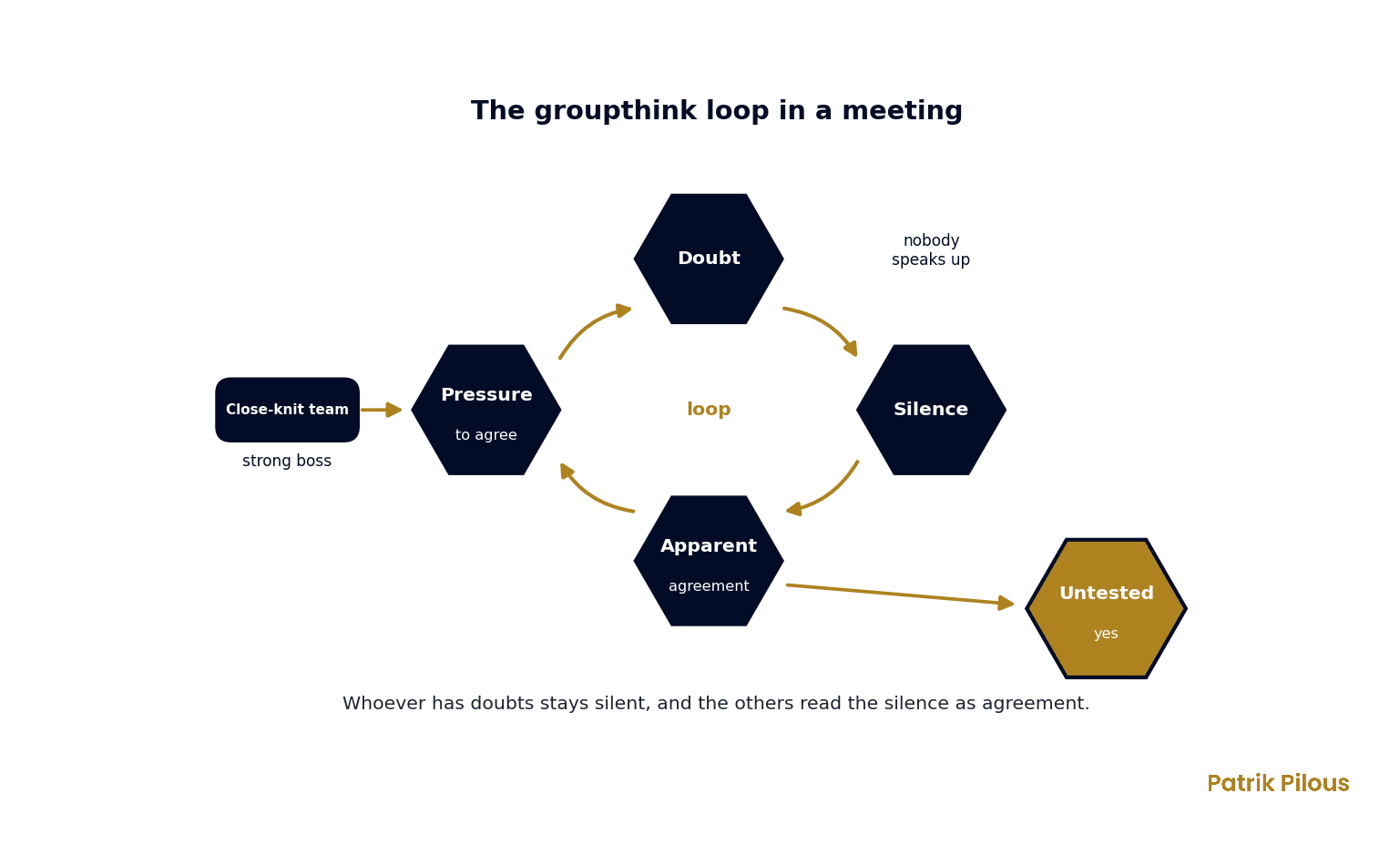
Then a loop kicks in. Everyone who has doubts sees nodding heads around them and concludes they are in the minority, so they keep the doubt to themselves, which adds to the impression of unanimity that leads others into the same silence. And everyone is acting in good faith.
Janis’s model describes eight symptoms. They are warning signs to reflect on, and according to Ramon Aldag’s analysis in The Psychologist, Janis himself warned that a few of them are not enough for a diagnosis. The second column of the table shows a model meeting; the quotes are invented.
| Symptom according to Janis | How it sounds in a model meeting |
|---|---|
| Illusion of invulnerability | “With this budget, it can’t fail.” |
| Rationalising warnings | “The test was on a small sample, don’t worry about it.” |
| Belief in the group’s morality | “We’re doing it for a good cause, people will understand.” |
| Stereotyped view of the opponent | “The competition doesn’t have the nerve for this.” |
| Pressure on critics | “Don’t hold us up, we launch on Friday.” |
| Self-censorship | the doubt stays in a private chat |
| Illusion of unanimity | “So we’re all in favour.” |
| Mindguards | the assistant keeps a critical email from reaching the boss |
Groupthink in marketing
Marketing is approved in rooms where everyone wants the campaign to succeed and where people have known each other for years, so in my view groupthink has almost ideal conditions here, because a critic risks being seen as the one holding things back.
- Brainstorming where the first idea wins. As soon as the most senior person praises an idea, the other suggestions start to resemble it. Have everyone write down their ideas on their own before you start discussing them.
- A campaign approved inside a bubble. In April 2017, Pepsi released an advert in which Kendall Jenner hands a police officer a can at a demonstration. It was made by the in-house studio Creators League, and the company pulled it roughly a day after release, apologising that it had missed the mark. I do not know from the outside how the decision was made internally, but isolation from people outside the team is one of Janis’s conditions.
- A rebrand without customers. In October 2010, Gap replaced its decades-old logo with the blue square. After about a week of criticism it went back to it, and brand head Marka Hansen admitted that the company had missed the opportunity to involve the online community. Again, this is only an illustration; the decision-making inside Gap is not documented. More on what carries brand value in the article what is branding.
- An agency that doesn’t push back on the client. A model situation: an agency has worked with a client for five years, the team works well together and nobody wants to risk a contract worth 150,000 CZK (about 6,200 EUR) a month. So everyone nods through a weak strategy.
- A strategy nobody from outside has seen. A team that has run the same channels for years easily develops an illusion of invulnerability and waves away numbers that don’t add up as exceptions. A regular outside view helps, for example from an independent marketing strategist.
Pepsi pulled the advert within a day and Gap its logo after about a week. Whether criticism was voiced in meetings, we don’t know, but customers supplied it publicly, with an impact on the brand.
What research says about groupthink
Groupthink is a famous concept with weak empirical support. In a 1998 review, James Esser pointed out that for the hundreds of publications citing the theory there are only dozens of empirical studies. According to an earlier review by Won-Woo Park, most of them support Janis’s hypotheses only partly.
A 1984 laboratory experiment by Callaway and Esser even showed that groups with moderate cohesion made the best decisions, which does not quite fit Janis’s idea of high cohesion as the main risk of a bad decision. In 2000, Park tested 23 predictions of the theory, as Aldag reports, and only 2 were confirmed, while 7 came out the opposite way.
So I treat the eight symptoms as a useful checklist for a meeting. The claim that a cohesive team necessarily makes worse decisions is not supported by the data.
How to guard against groupthink
Janis also proposed remedies and held up the Kennedy team’s decision-making during the Cuban Missile Crisis in October 1962, a year and a half after the Bay of Pigs, as a model. His recommendations include that the boss should not reveal their own preferences and that, after a preliminary consensus, a “second chance” meeting should be held (summary of Janis’s proposals).
- The boss speaks last. Once a superior states their view, they add the authority effect to the group pressure. Let the others speak first, ideally in writing.
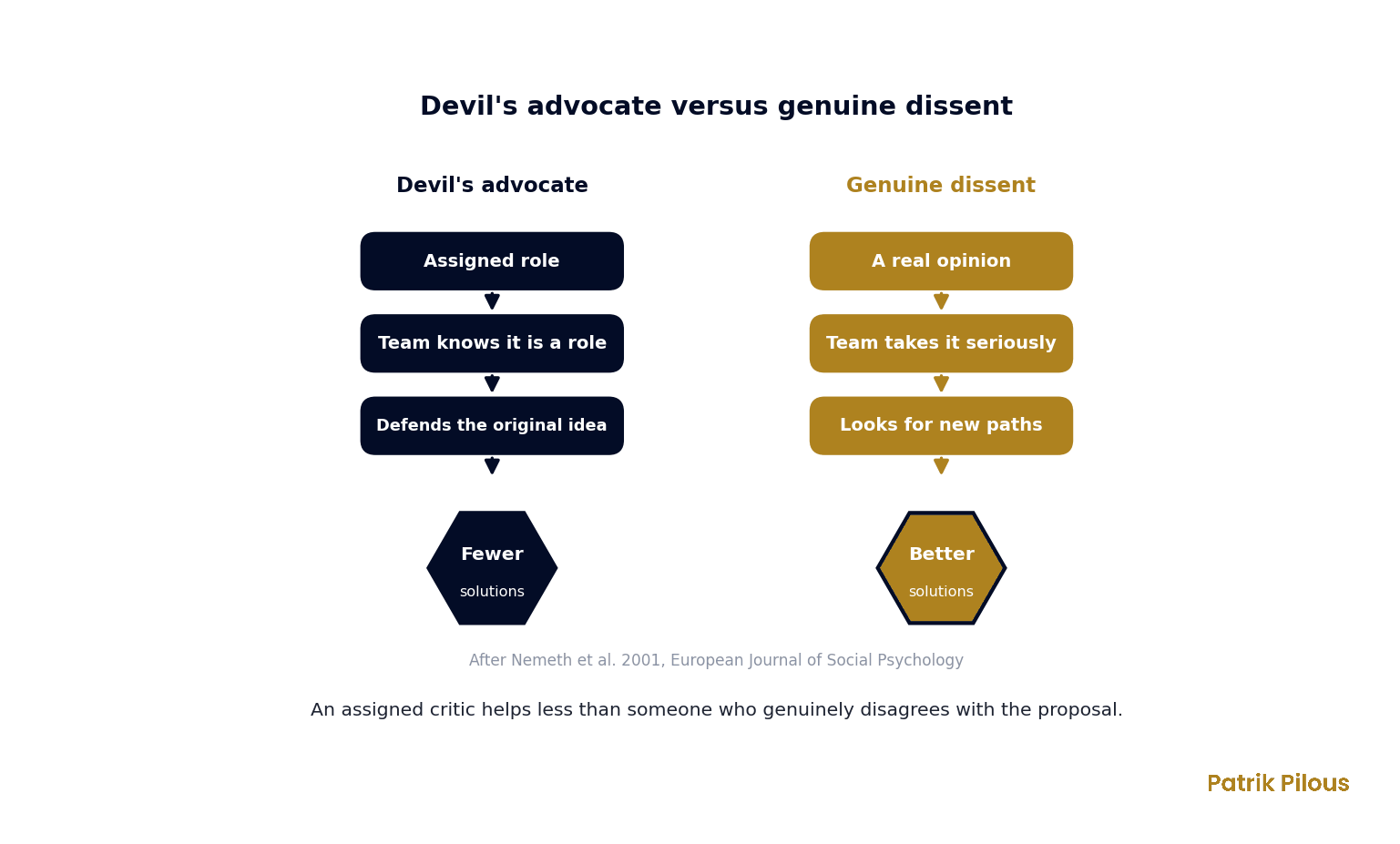
- Look for genuine disagreement. In 2001, Charlan Nemeth and her co-authors found that a group with a genuine minority view came up with better solutions than all three variants with an assigned devil’s advocate. It is a single laboratory experiment, so I treat it as a guide.
- Run a pre-mortem. In the Harvard Business Review in September 2007, Gary Klein described a method in which the team imagines that the project has already failed and everyone writes down why. According to Klein, this gives a voice to people who would otherwise not express their reservations during planning.
- Let outsiders in. Janis recommended inviting experts who would challenge the team. For a campaign, that means testing with customers; for a rebrand, research before launch.
- Give the decision a second chance. The day after approval, call a short meeting where everyone says what still bothers them about the decision.
The main advantage of a pre-mortem is that it turns disagreement into a task. Whoever names a reason for failure is doing what was asked and need not fear being seen as a pessimist.
How it connects with other biases
Groupthink rests on the in-group effect. The more a team prides itself on sticking together, the worse it listens to criticism from outside. Inside, confirmation bias is at work, because the group looks for data that confirm the chosen path and rationalises the rest away.
The bandwagon effect and social proof describe how we follow the crowd, mostly strangers. Groupthink is their version in a small room, where people know each other and care about their relationships. Janis’s illusion of invulnerability also closely resembles the overconfidence effect, except that the team shares it and its members confirm it for one another.
Interesting questions on the topic
What is groupthink?
Groupthink is when a cohesive team puts agreement ahead of critical evaluation and approves a decision that nobody has properly examined.
Who coined the term groupthink?
The word was used by the journalist William H. Whyte in 1952 in Fortune magazine. The psychologist Irving Janis turned it into a theory with eight symptoms in 1971 and 1972.
What are the symptoms of groupthink?
Janis described eight of them. The easiest to recognise are self-censorship and the illusion of unanimity, where we interpret silence as agreement.
Does a devil’s advocate help against groupthink?
A little. According to one experiment by Nemeth, a person who genuinely disagrees with a proposal works better than a colleague who is only playing the critic.
Is groupthink scientifically confirmed?
Only partly. It relies mainly on historical cases, and laboratory studies confirm Janis’s predictions only in part.
Euro amounts are approximate, converted at the Czech National Bank rate of 24.34 CZK per EUR on 29 October 2026.

