

The Broken Windows Theory holds that visible signs of neglect, such as a broken window or a wall covered in graffiti, signal to people that nobody enforces the rules here. More disorder follows, and gradually more serious rule-breaking too. It was named in 1982 by the American authors James Q. Wilson and George L. Kelling. As a guide for policing it remains controversial, but field experiments from the Netherlands have confirmed that disorder in the surroundings changes how people behave. For marketing, this second level is the most useful one.
Classification
- Type of phenomenon: a criminological theory about how the environment shapes behaviour, driven by social norms and a cognitive shortcut
- Bias it feeds: we judge the state of the whole from one small detail
- Mental domain: Social
- Marketing function: Website, customer experience, reviews, brand
- Customer journey: across the board, most of all at first impression
- System 1 / System 2: arises in System 1 (fast, automatic thinking) and only System 2 (slow, deliberate thinking) can correct it
In a nutshell
- What it is: visible disorder signals that rules are not being followed, and people then behave worse.
- Why it matters: customers read small mistakes as proof of how a company handles everything else.
- Where you will meet it: broken links, 404 errors, expired promotions, unanswered reviews, a dusty shop window.
- How to use it: fix small things quickly and regularly, before they become the norm.
A real-life story
The theory began with the article Broken Windows, which Wilson and Kelling published in March 1982 in the American magazine The Atlantic. They started from an experiment in Newark, New Jersey, where police officers patrolled on foot instead of by car. According to an evaluation by the Police Foundation, the foot patrols did not reduce crime. But people felt safer.
The authors explained this by order on the street: in their view, one unrepaired window is a signal that nobody cares, so breaking another costs nothing. They drew support from a 1969 experiment by Stanford psychologist Philip Zimbardo, more a demonstration with two cars than a controlled experiment. He left a car without number plates and with its bonnet open in the Bronx, and a similar one in Palo Alto, California.
In the Bronx, the first “vandals” arrived within ten minutes. They were a family with a young son, and they took the radiator and the battery. Within 24 hours, everything of value had disappeared from the car. The car in Palo Alto stood untouched for over a week, until Zimbardo himself hit it with a sledgehammer, and then passers-by joined in.
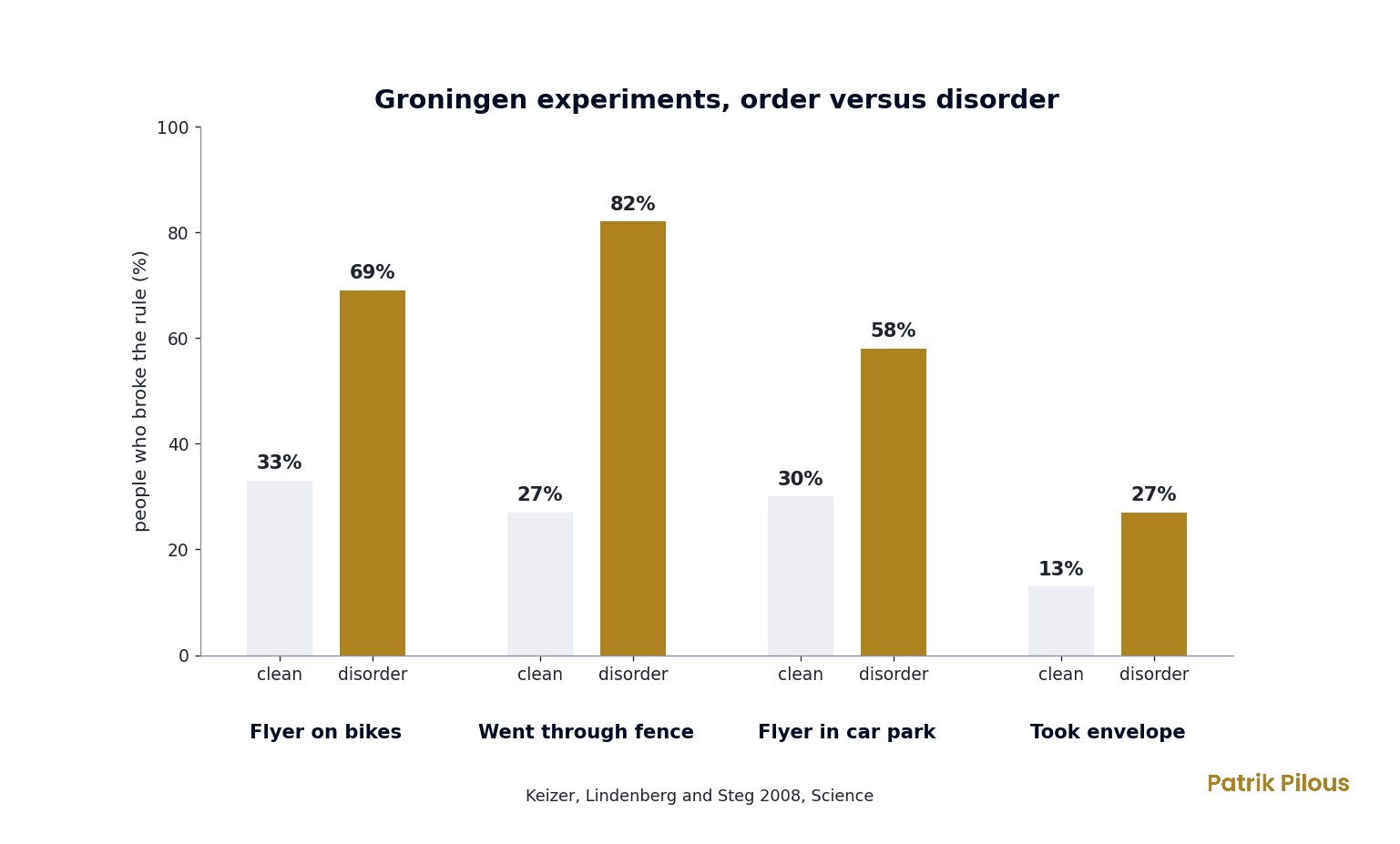
A real test only came in 2008. Kees Keizer and colleagues from the University of Groningen published six field experiments in the journal Science, carried out by one team in a single Dutch city, under the title The Spreading of Disorder. In an alley full of bicycles, they attached a flyer to the handlebars. With a clean wall, 33% of 77 people threw it away; with a graffiti-covered wall, 69% did, even though a sign prohibiting graffiti hung on it.
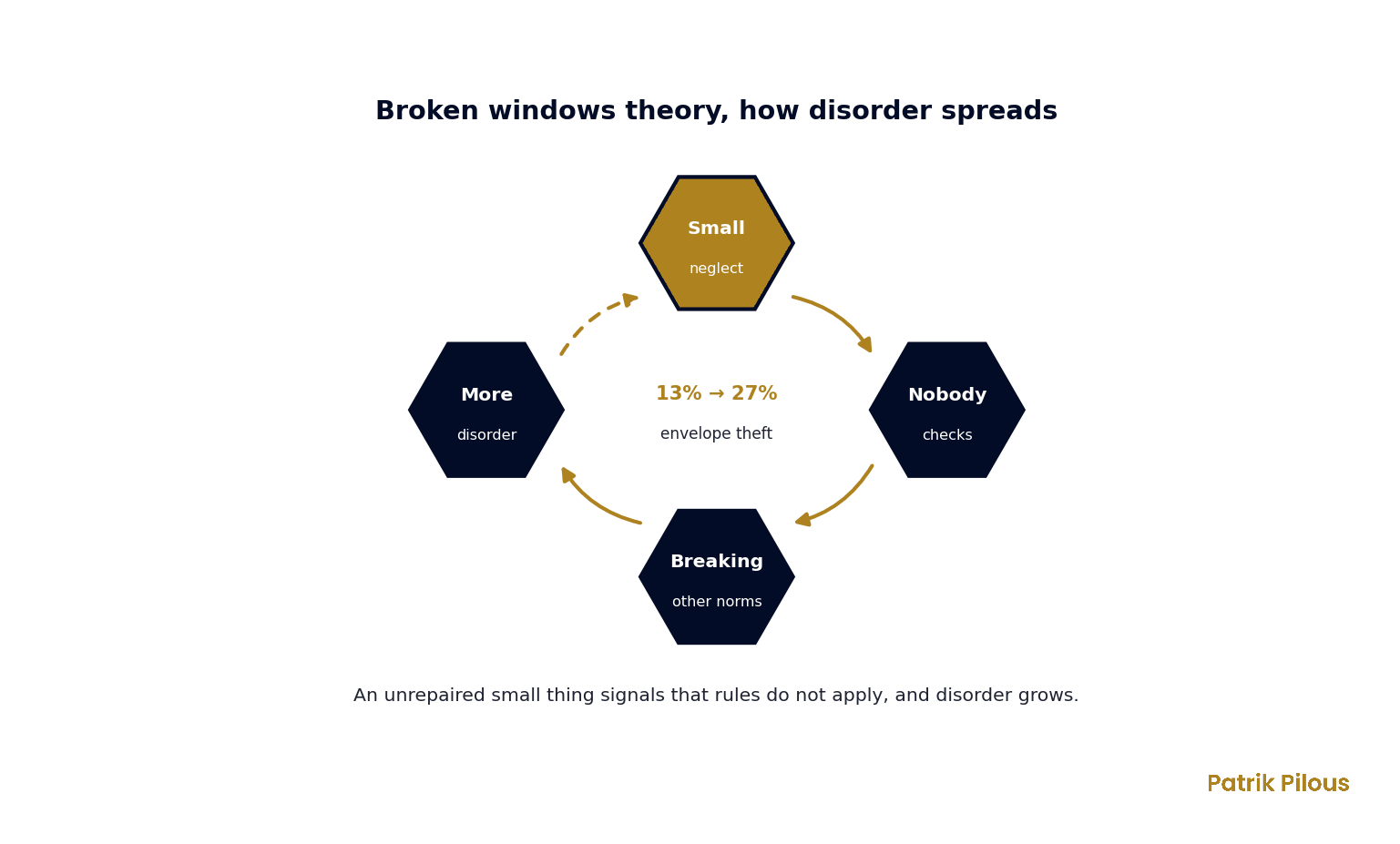
The envelope experiment is the most unsettling. An envelope with a window, through which a five-euro note was visible, stuck out of a postbox. When the postbox was clean, 13% of passers-by took it; when it was covered in graffiti, 27% did. Litter around the postbox had almost the same effect (25%), and breaking one norm roughly doubled the breaking of an entirely different norm. The authors call this cross-norm inhibition: a visibly broken rule weakens respect for other rules too.
How the Broken Windows Theory works
The mechanism rests on social norms. In every place, we quickly estimate what is allowed, and the fastest cue is the traces left by others, in other words reverse social proof. A graffiti-covered wall or litter under a “no littering” sign tells everyone passing by that people here routinely break the rules and nobody around seems to mind, so their own small offence will easily get lost among the others.
Disorder spreads across the boundaries of individual rules: bicycles locked to a fence despite a ban raised the share of people who squeezed through a gap in the fence instead of walking around from 27% to 82%. According to the authors, the overall willingness to follow norms weakens.
On a housing estate, it might look like this. Next to a full bin stands one bag. Within a week there are five. None of the people who brought them sees themselves as the cause of the mess, because they only added one more item to a pile that was already there and that nobody was clearly looking after.
The Broken Windows Theory in marketing
A website, an online shop and a physical store all have their broken windows, from which a customer forms an overall impression within a few seconds of whether anyone is looking after things here and whether this company can be trusted with an order and with money.
Applying the theory to websites is my own analogy; research has not tested it directly. Close to it is a 2002 Stanford study on how people judge the credibility of websites. In it, 2,684 people gave ratings, and the look of the page came up in 46.1% of their comments, more often than anything else. It did not examine the spread of disorder.
- 404 errors and broken links. According to Google’s help documentation, 404 errors do not lower a site’s rankings by themselves. But a person who lands on an empty page from a newsletter becomes wary. Deal with dead URLs that have traffic or backlinks using a 301 redirect.
- Expired promotions and old dates. A Black Friday banner in March or a latest news item from 2021 says that nobody maintains the website.
- Unanswered reviews. Criticism without a response is a broken window for every subsequent reader. Negative information carries more weight, as described by the negativity bias, and in my view a factual reply pays off more than another glowing star rating.
- Typos in copy. From a mistake in a product name or a price list, a customer easily concludes that the company handles orders with the same care.
- The store and technical debt. An empty shelf, an unlit letter on the shop sign, a dusty shop window or an overturned basket by the entrance work like the graffiti in Groningen. On a website, the equivalent is technical debt in SEO, and a regular technical SEO audit finds it before everyone gets used to it.
The theory also applies inside a company. When a team sees that nobody has fixed a broken report or an outdated internal guide for a year, it takes this as tacit agreement that standards need not be kept, and then sets the same bar for work that customers see.
Criticism of the Broken Windows Theory
The theory is famous mainly because of the New York police. From 1994, Mayor Rudolph Giuliani and Police Commissioner William Bratton turned it into a tough crackdown on minor offences, and the number of misdemeanour arrests nearly doubled by 2000. Crime in the city fell sharply during the 1990s, and so an article by two academics became a model that police policy in other American cities, such as Los Angeles, also claimed to follow.
In 2006, Bernard Harcourt and Jens Ludwig re-examined the data from New York precincts for the years 1989 to 1998. Crime fell most where it had previously risen most during the crack epidemic, which fits better with regression to the mean. Nor did the Moving to Opportunity experiment, involving around 4,600 low-income families, confirm a direct link between disorder and crime.
A 2019 meta-analysis by criminologist Anthony Braga and colleagues summarised 30 independent tests. Interventions against disorder do reduce crime, but only modestly. Community collaboration and fixing problem places came out best, while aggressive punishment of individuals brought no significant reduction.
Philadelphia provided strong evidence for fixing the environment. In 2018, Charles Branas and colleagues randomly assigned 541 vacant lots, cleaned up some of them and planted grass, and in poor neighbourhoods around the restored lots, shooting incidents then fell by up to 29%. Kelling himself wrote in 2015 that broken windows was never meant to be a mass arrest programme.
How to fix broken windows on your website and in your store
In Groningen, one graffiti-covered wall was enough, so what matters most is what the customer sees first.
The criticism also shows a limit. In Philadelphia, fixing the environment helped, while tough punishment of individuals did not hold up in the meta-analysis, which is why the points below fix the website and processes rather than punishing anyone.
- Regular link checks. Once a month, run your website through a crawler and Google Search Console and fix the 404 errors that links or visits lead to.
- An end date for every promotion. Every banner, discount code, landing page and email campaign gets an end date at launch, plus the name of the person who will take it down.
- A deadline for reviews. Set how many working days the company has to respond to every review, for example two.
- A second pair of eyes before publishing. Copy, price lists, newsletters and product descriptions are read by a second person before they go out.
- Buying through the customer’s eyes. Once a quarter, go through the journey from ad to delivery as a new customer and note every small thing that makes you pause.
Speed of repair matters most. A broken link that survives two monthly checks stops being visible to the team, which is why every small issue should have a clear owner.
How it relates to other cognitive biases
On the customer’s side, the broken windows theory is driven by the halo effect. From one visible detail, such as a typo or a dead link, the brain infers the quality of the whole company, including complaints handling and delivery, which cannot be seen. On the behavioural side, the herd effect comes into play.
For a company, it pays to separate mess from bad intent. Hardly anyone ever causes broken windows on a website on purpose. They come from inattention and overload, as Hanlon’s razor describes, so looking for someone to blame achieves less than regular maintenance with deadlines.
Interesting questions on the topic
What is the broken windows theory?
A theory stating that visible signs of neglect attract more disorder and worse behaviour. It was formulated by James Q. Wilson and George L. Kelling in 1982.
Who carried out the abandoned car experiment?
Psychologist Philip Zimbardo of Stanford, in 1969. It involved just two cars, one in the Bronx and one in Palo Alto.
Does the broken windows theory hold?
Partly. The Groningen experiments showed that disorder increases the breaking of other norms. As a policing strategy of harshly punishing minor offences, however, it has not proved effective in meta-analyses.
Do 404 errors hurt you in Google?
According to Google, they do not lower a website’s rankings on their own. They mainly bother the people who come across them.

