

The placebo effect is an improvement brought about by the expectations and context of treatment, even when the active substance is missing. The placebo itself is something inactive, typically a sugar pill or a sham procedure, and the patient perceives it as treatment. When the patient then feels better, part of that comes from the expectations linked to the treatment and often also from the natural course of the condition, which would have eased over time on its own. The same mechanism works outside medicine too. Price, brand, packaging or someone else’s recommendation change how a product tastes and how well it works in the customer’s eyes.
Classification
- Type of phenomenon: a psychological expectation effect that changes experience
- Cause (Cognitive Bias Codex): Not enough meaning
- Mental area: Perception and expectations
- Marketing function: Price, brand, packaging, product experience
- Customer journey: product use and post-purchase evaluation
- System 1 / System 2: System 1 (automatic, and according to research mostly unconscious)
In brief
- What it is: the expectation that something will work changes the actual experience or performance.
- Why it matters: price and brand influence what customers experience with a product and how well they perform with it.
- Where you will see it: with wine, coffee, cosmetics or food supplements, and anywhere quality is hard to measure.
- How to use it: do not undermine your own product with unnecessary discounts, and give customers a reason to expect a good result that you then actually deliver.
A real-life story
The word placebo is Latin for “I shall please”. It comes from a verse of the Latin Bible that opened the evening prayers for the dead, and it entered medicine as the name for a medicine meant to please the patient rather than cure them. Jeffrey Aronson examines the history of the word in the BMJ.
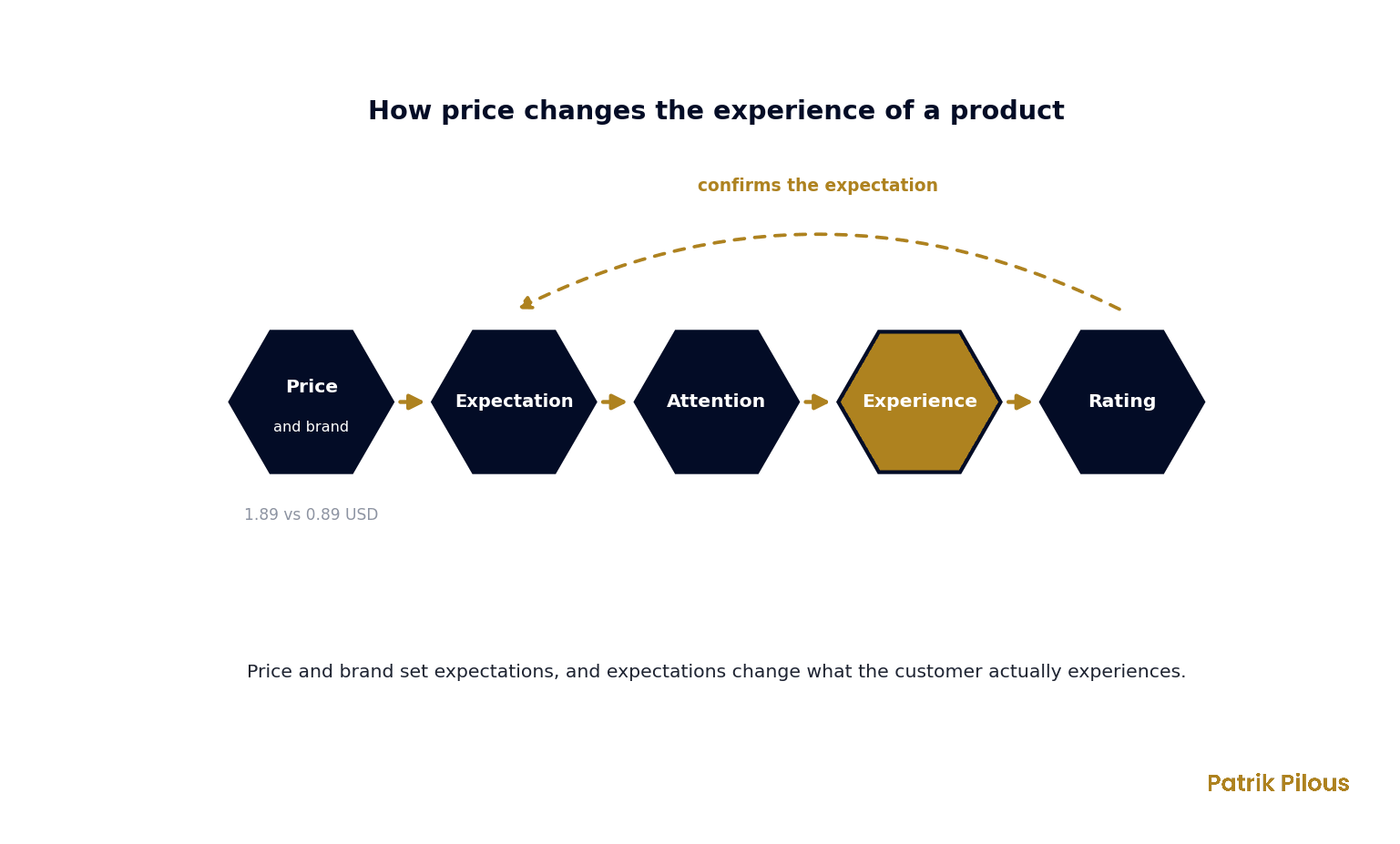
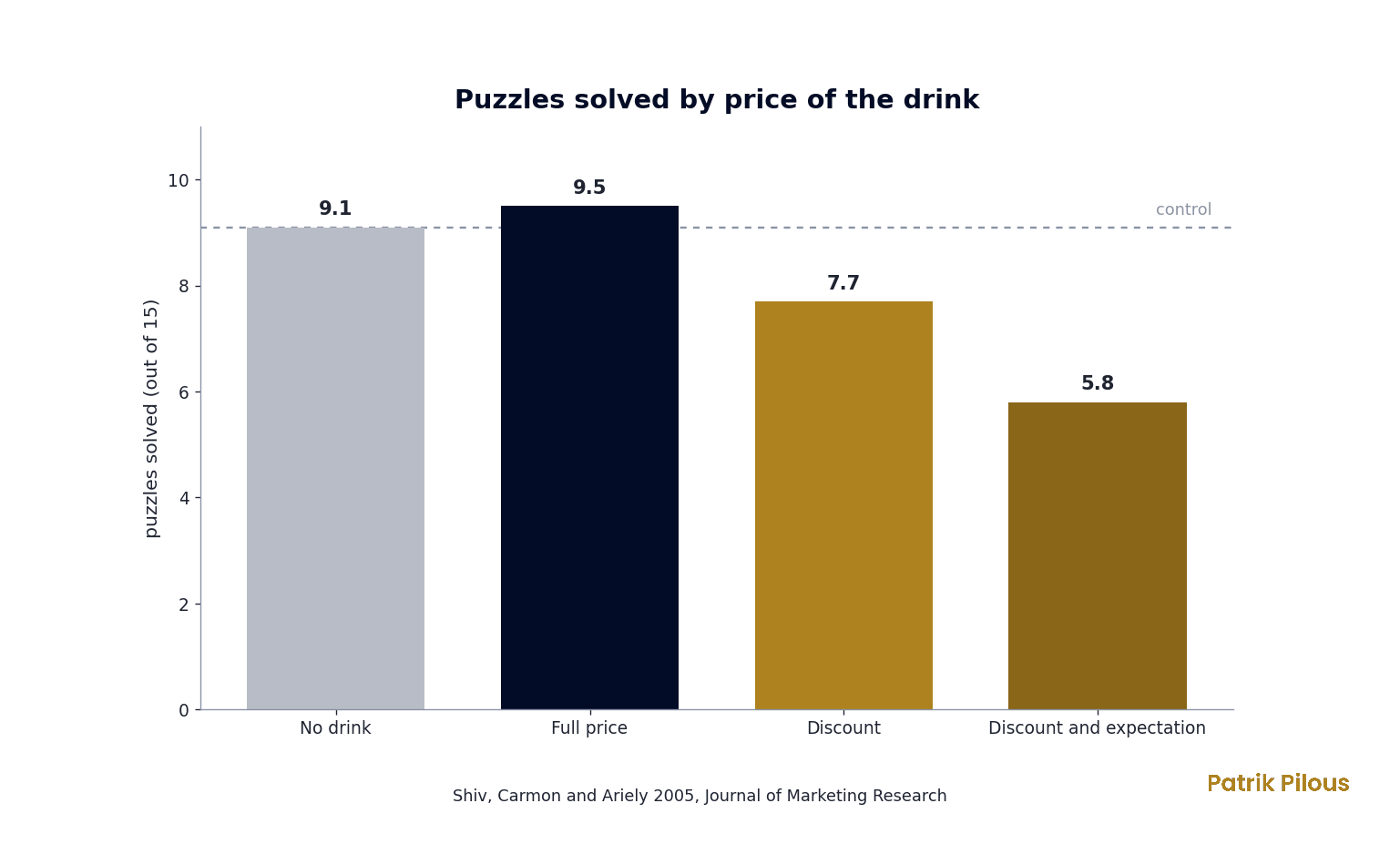
Baba Shiv, Ziv Carmon and Dan Ariely brought the placebo into marketing. In 2005 they published the study Placebo Effects of Marketing Actions in the Journal of Marketing Research. A total of 125 participants received a SoBe energy drink that was supposed to improve concentration, and then had 30 minutes to solve 15 word puzzles. One group was told that the drink had cost the regular price of $1.89. The other was told that the researchers had bought it at a discount for $0.89.
The full-price group solved 9.5 puzzles on average, the discount group 7.7. The control group, which drank nothing, scored 9.1. What gets lost in retellings is that the full price barely raised performance, whereas the discount cut it by a fifth, and when participants thought about the drink’s effectiveness before the task, performance in the discount group fell as low as 5.8 puzzles.
Imagine a company wine tasting. You pour the same wine once from a bottle priced at 690 CZK (about 28 EUR) and once from a bottle priced at 129 CZK (about 5.3 EUR). According to the wine price tag study described in the next section, the more expensive bottle would most likely get the better rating.
How the placebo effect works
The brain does not perceive a product blindly. Before you taste it, it already has a prediction based on price, brand, packaging or recommendations, and it then builds the resulting experience from the actual signal and from what it expected, and the less clear the signal, the more weight expectation carries.
This was confirmed by a 2008 study by Hilke Plassmann and colleagues in PNAS. Twenty people tasted wine inside an MRI scanner: a $5 wine once labelled at $45, and a $90 wine labelled at $10. With the higher price tag they rated the taste better, and their medial orbitofrontal cortex, an area linked to the experience of pleasantness, showed stronger activation.
When they tasted the same wines eight weeks later without prices, the differences disappeared. So the difference in ratings was created by the price information. The study has only 20 participants and they did not pay for the wine.
A 2008 study by Rebecca Waber, Shiv, Carmon and Ariely in JAMA had a similar outcome. Eighty-two volunteers received mild electric shocks to the wrist and then a placebo pill presented as a new painkiller. At a price of $2.50 per pill, 85% of people reported relief; when it was discounted to 10 cents, only 61% did.
The placebo effect in marketing
The placebo effect in marketing means that the signals around a product change its real benefit. Customers also pay for the expectation that price and brand set for them, and companies most often forget this the moment they reach for a discount.
- Discounts as a signal of lower quality. If you sell something whose quality customers cannot judge straight away, such as cosmetics or supplements, a permanent 40% discount can hurt not only your margin but also the experience. A free gift with purchase or a larger pack works better.
- Brand as medicine. In 1981, Alan Branthwaite and Peter Cooper found in the BMJ that branded tablets helped women with headaches more than the same tablets without the brand. This held true even for the placebo, and most of all for regular users of the brand.
- Price anchor. A high anchored price sets expectations of quality even before tasting, as Plassmann’s wine study showed. In luxury goods, this is taken further by the Veblen effect, where a higher price increases demand.
- Packaging and description. A heavier glass, a description of origin, careful packaging or a serving ritual raise expectations before the first sip. This is the framing of the product.
- When you say what. In 2006, Leonard Lee, Shane Frederick and Ariely served nearly 400 pub-goers in Cambridge beer with a few drops of balsamic vinegar, as reported in Psychological Science. It tasted worse only to those who learned about the vinegar before tasting; learning about it after tasting did not change the rating significantly.
In B2B, a prestigious office address or a carefully prepared proposal works the same way, setting the client’s expectations of quality even before the first meeting. I see repeat experience as the limit. Expectations lift the first impression, but repeat purchases depend on what customers experience with the product over weeks and months.
Where the placebo has its limits
The placebo’s reputation is exaggerated. In 2001, Asbjørn Hróbjartsson and Peter Gøtzsche compared 130 studies in the New England Journal of Medicine in which placebo was compared with no treatment. Comparing with no treatment subtracts the natural course of the illness and regression to the mean, which are otherwise attributed to the placebo. For outcomes of the “recovered or did not recover” type, the placebo then had no significant effect.
Their Cochrane review from 2010 covered 202 studies and 60 conditions. According to it, placebo generally has no important clinical effect, but it can influence what patients report themselves, mainly pain and nausea, and even here it is hard to separate a real effect from biased reporting.
| Study | Participants | What changed | Result |
|---|---|---|---|
| Shiv et al. 2005 | 125 | discount on the drink | 7.7 vs 9.5 puzzles |
| Plassmann et al. 2008 | 20 | wine price tag | better taste and brain activity |
| Waber et al. 2008 | 82 | placebo price | relief 61% vs 85% |
| Kaptchuk et al. 2010 | 80 | open-label placebo | relief 59% vs 35% |
For marketing, one thing follows from this. The marketing placebo changes the customer’s experience and performance, as with the puzzles in the study by Shiv and colleagues, but it does not change the properties of the product itself. The studies have small samples. Dan Ariely, co-author of two of them, is also the author of another paper that PNAS retracted in 2021 over fabricated data.
In 2010, Ted Kaptchuk and colleagues gave 80 patients with irritable bowel syndrome pills labelled placebo, as reported in PLoS ONE. After three weeks, 59% reported relief compared with 35% without pills, but the study is small.
Nocebo, when expectations do harm
Nocebo is the opposite phenomenon. Negative expectations cause problems that would not otherwise occur. For example, a person reads a list of side effects and then feels some of them even after an inactive pill.
The small SAMSON study in the New England Journal of Medicine from 2020 showed this strikingly. Sixty people who had stopped taking cholesterol medication because of side effects rotated month by month between the drug, a placebo and an empty pack, and because they did not know whether they were taking the drug or the placebo, they had the same expectations for both. Roughly 90% of the symptoms they reported on the drug also appeared on the placebo. This is not medical advice. Always make decisions about medication with your doctor.
In marketing, you will see nocebo with negative reviews. A loud complaint under a product sets other customers up to expect a problem.
How to guard against the placebo effect
As a customer, you cannot fully guard against the placebo effect; it runs automatically. But you can separate the experience from the signal that influenced it.
- Test blind. Compare wine, coffee, cosmetics or two similar tools without the price tag and logo. If the difference disappears, you are paying for the story.
- Ask what can be measured. With a food supplement or software, look for data; how you feel in the first week is not enough.
- Watch your discount reflex. When the cheaper option “doesn’t feel right”, ask yourself whether it is just the price tag in your head.
- Test your own marketing too. In an A/B test, measure customer behaviour, such as returns and repeat purchases, alongside ratings right after purchase.
As a company, you do not need to guard against the placebo, just do not abuse it. An inflated price on an average product can be exposed by a reviewer’s blind test, and then you pay with your reputation.
How it connects with other biases
The placebo effect rests on the same foundation as the halo effect. One prominent attribute, here price or brand, colours the perception of everything else. In Plassmann’s wine study, this showed up even in brain activity during tasting.
Closely related are the Pygmalion effect, where a boss’s high expectations raise a person’s performance, and processing fluency, because what is easy to read and looks high quality also seems more trustworthy. In the beer with vinegar study, the order of the information was decisive.
Interesting questions on the topic
What is a placebo?
An inactive substance or a sham procedure that a person perceives as treatment, typically a sugar pill in drug trials.
What is the difference between placebo and nocebo?
The placebo effect is an improvement caused by positive expectations. Nocebo is a deterioration caused by negative expectations, for example symptoms after reading a package leaflet.
Does a placebo work even if I know it is a placebo?
According to a small 2010 study by Kaptchuk, in some cases it does, for subjective symptoms. However, the result needs larger-scale verification.
Is the placebo effect a cognitive bias?
Strictly speaking, no. It changes the experience itself, and it is triggered by the same mental shortcuts as anchoring or the halo effect.
Euro amounts are approximate, converted at the Czech National Bank rate of 24.34 CZK per EUR on 29 October 2026.

