

Impostor syndrome (often also spelled imposter syndrome) is the belief of a capable person that they have not earned their successes and that the people around them will soon see through them. They put success down to luck or hard work, almost never to their own ability. The phenomenon was described in 1978 by American psychologists Pauline Rose Clance and Suzanne Imes, and you will not find it in diagnostic manuals.
Classification
- Type of phenomenon: a psychological phenomenon, not a diagnosis or a classic cognitive bias
- The bias that feeds it: we attribute success to luck or hard work, and failure to our own incompetence
- Cause (Cognitive Bias Codex): Not enough meaning
- Mental area: Self-assessment
- Marketing function: Pricing and offer, presenting results, positioning, personal brand
- System 1 / System 2: it arises in System 1 (fast, automatic) and can only be overridden through System 2 (slow, deliberate) and hard data
In brief
- What it is: the feeling that you are a fraud, even when the results say otherwise.
- Why it matters: people who feel this way ask for less money and hide their own results.
- Where you will see it: a freelancer’s price quote, a new CMO’s first meeting, a monthly client report, the website of a company that says nothing about its expertise.
- How to avoid it: collect evidence of your work and compare yourself with what other people actually produce.
A real-life story
For five years, Clance and Imes worked at Georgia State University in Atlanta with more than 150 high-achieving women, both in therapy and on university courses. They included women with doctorates as well as students with outstanding results. They published their observations in 1978 in the journal Psychotherapy: Theory, Research & Practice under the title The Imposter Phenomenon in High Achieving Women.
Their accounts were strikingly similar. Students believed the admissions committee had accepted them by mistake, and they put excellent exam results down to luck or a marking error. A head of department said she only had the job because someone had overestimated her abilities. Not one of them was unsuccessful. All they lacked was an inner sense of success.
To be fair, it is worth saying what the study was not. It consisted of clinical observations with no control group and no statistics, mostly of white middle- and upper-class women aged 20 to 45, about a third of whom had come to therapy for a completely different problem. In a footnote, the authors wrote that they saw the phenomenon less often in men, and added themselves that this needed to be tested. Later research did not confirm their estimate.
The largest summary so far was compiled by Dena Bravata and colleagues for the Journal of General Internal Medicine. Their systematic review Prevalence, Predictors, and Treatment of Impostor Syndrome from December 2019 covered 62 studies with 14,161 participants and found the phenomenon in both men and women. Prevalence ranged from 9% to 82%, depending on which questionnaire and which cut-off a study used.
Take a typical scene from an ordinary coworking space. On a Friday evening, a freelancer is writing a quote for an SEO audit. They type 40,000 CZK (about 1,600 EUR), delete it, type 28,000 CZK (about 1,200 EUR) and then add a free consultation, because what if the client finds out that anyone could do it?
How impostor syndrome works
Clance and Imes described a self-reinforcing cycle. The fear that your “stupidity” will be exposed leads to overwork and concealment. The hard work brings a good result and praise, you feel relief for a while, and then the next task starts and the fear returns, because you explained the success by hard work, so there is no evidence left in your mind to lean on next time.
The authors drew on attribution research, which looks at what people credit their results to. In a 1976 review, psychologist Kay Deaux summarised that we explain unexpected success with a temporary cause, such as luck or effort. Our expectations then stay the same. So you file your fifth satisfied client in your head as just another lucky break.
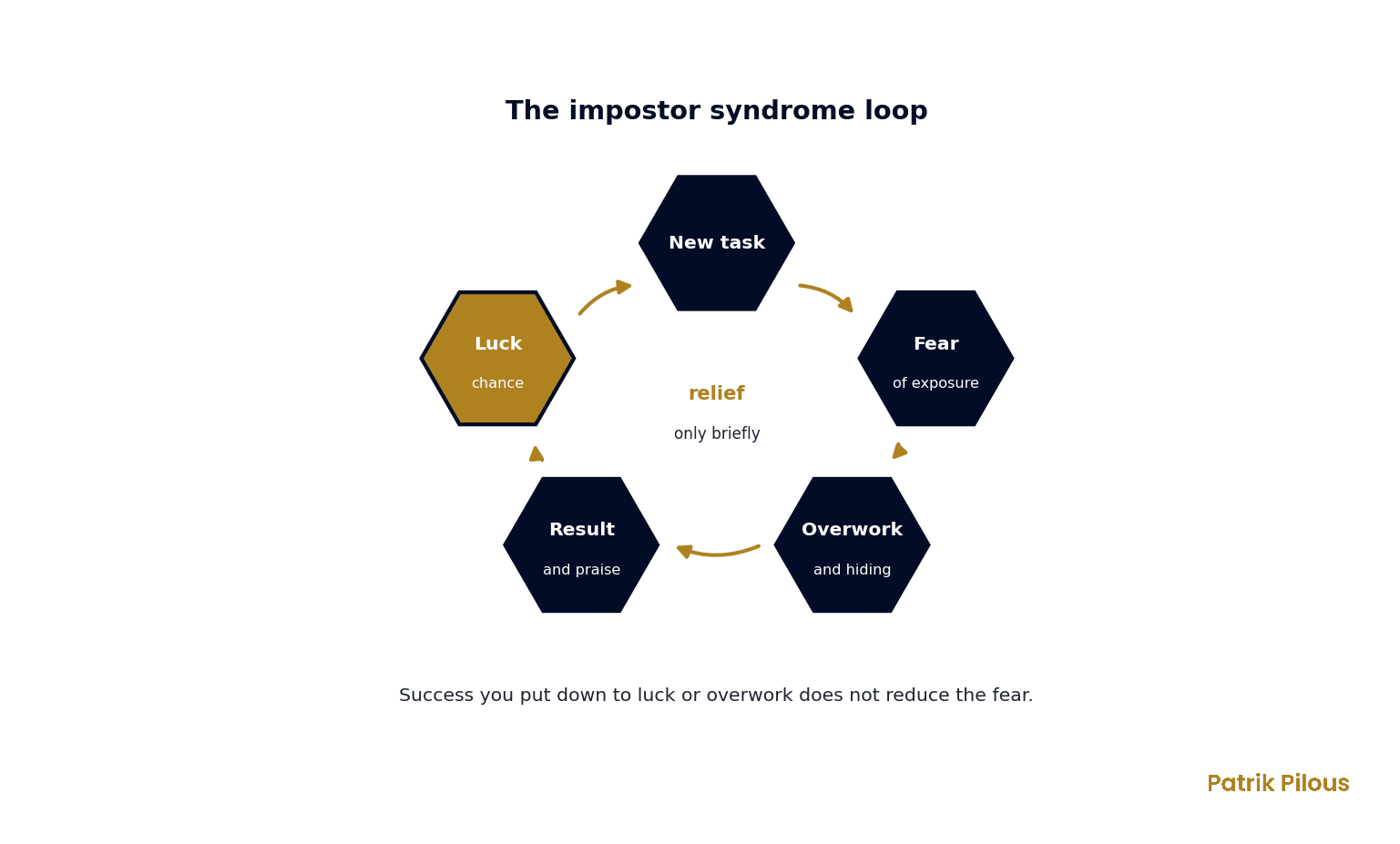
The cycle is loudest at moments of change. Manfred Kets de Vries of INSEAD opens his 2005 Harvard Business Review article The Dangers of Feeling Like a Fake with the case of a newly promoted manager who, despite his education and track record, feared his incompetence would be exposed. A promotion, a new role in the team, your first big client or a higher hourly rate are exactly these moments.
Impostor syndrome in marketing
Consultants and freelancers sell something invisible: their own judgement. That is why impostor syndrome feeds straight into their prices and into how they talk about themselves.
- Pricing. If you feel like a fraud, you anchor your price to your fear of what the client will think and leave the value of the work aside. The study Inspecting the Dangers of Feeling like a Fake, based on 238 Austrian professionals, found a weak negative correlation of −0.25 between impostor feelings and salary. These figures do not prove causation.
- Asking for your fee. You postpone a higher hourly rate or a share of the results “until the numbers are even better”. The same study shows that impostor feelings are also linked to poorer knowledge of the labour market and lower career adaptability, and that the statistical link to salary runs precisely through these.
- Presenting results to a client. In your report you hide a 40% rise in organic traffic behind seasonality and spend three pages explaining a drop. The client then sees that you do not believe in your own results.
- A newcomer to the field. When you are starting out, you see how much you do not know, and you stay quiet. Meanwhile, a louder colleague with half your knowledge wins the projects, a situation described as the Dunning-Kruger effect.
- A brand that says nothing about its expertise. A company with 15 years of experience has a website with no case studies and no names of the people who do the work. A competitor with less experience who puts itself on show then looks like the greater authority.
You end up paying for the uncertainty yourself, through a lower hourly rate and through projects that go to louder competitors. A client only knows as much about your expertise as you show them.
Is impostor syndrome an illness?
No. You will not find it in the DSM, the American Psychiatric Association’s diagnostic manual, as Bravata’s review also points out. The original study uses the word phenomenon (impostor phenomenon). However, Bravata et al. found that it often goes hand in hand with depression and anxiety and is associated with poorer job performance and burnout.
The concept also has its critics. In 2021, Ruchika Tulshyan and Jodi-Ann Burey wrote Stop Telling Women They Have Imposter Syndrome in Harvard Business Review. They argue that the label turns a reaction to a biased and exclusionary environment into a personal flaw of the individual, and a company can then pretend the problem lies only in its employees’ heads, not in the culture it created itself.
Most studies in Bravata’s review measured the phenomenon with the Clance IP Scale, a questionnaire Clance published in 1985. It has 20 statements about how you assess your own abilities and how you accept praise and success. For each one, you mark on a scale of 1 to 5 how well it fits you, giving a score of 20 to 100. Studies do not agree on the cut-off: some treat 62 points as the threshold, others only count scores above 80 as strong symptoms. An online impostor syndrome test is therefore a self-assessment that no professional has evaluated.
How to deal with impostor syndrome
According to Clance and Imes, more success alone will not break the cycle. What helps is replacing impressions with data and giving them less room in decisions about money.
- Keep an evidence folder. Clance and Imes asked their clients to write down positive feedback and how they brushed it off. Save client thank-you notes, figures from reports, testimonials and LinkedIn recommendations in one place and open it before every price quote.
- Look at other people’s work. In Kruger and Dunning’s third study, a grammar test, the top quarter also underestimated themselves at first. After they marked the tests of five other participants, they raised the estimate of their own percentile. Go through your competitors’ audits or proposals and you will find out where you really stand.
- Price according to the market. Find out what others charge for similar work and build your price on that. An overview of how much SEO costs can help you get your bearings.
- Separate hard work from ability. For each success, write down which decision was yours. For example, choosing the keywords or switching off a loss-making channel was your judgement.
- Say it out loud. The authors recommended a group where a woman discovers that others share the same feeling. Among freelancers, that is often a beer with a colleague who admits the same thing.
If the feeling grows into long-term anxiety or low mood, do not wait. Bravata et al. show a frequent link with depression, and for that it is worth seeing a psychologist, not downloading another productivity app.
How it interacts with other biases
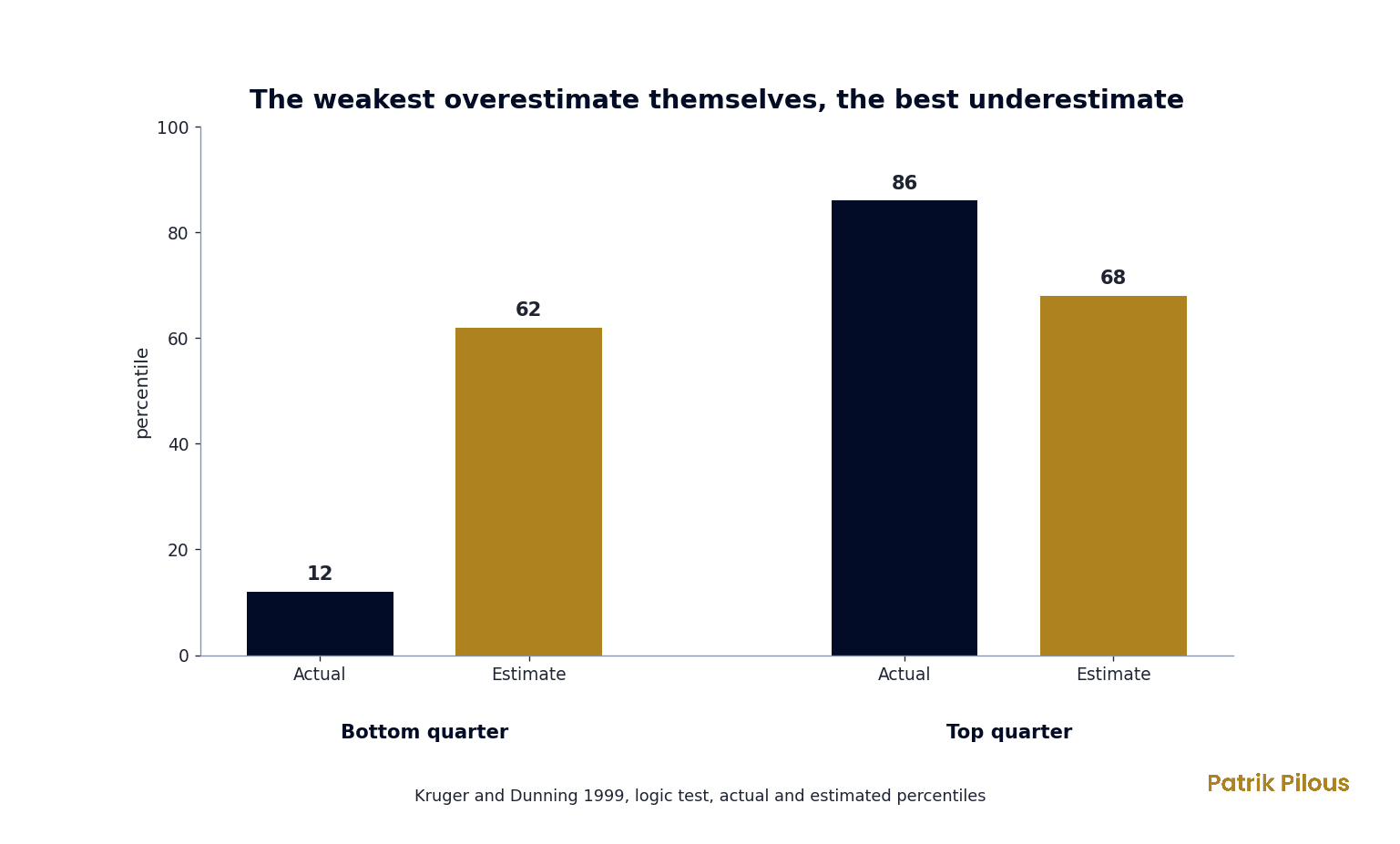
Impostor syndrome is the mirror image of the Dunning-Kruger effect. In Kruger and Dunning’s original 1999 study, Unskilled and Unaware of It, the weakest quarter on a logic test scored at the 12th percentile on average but estimated themselves at the 62nd. The top quarter was at the 86th percentile, yet before receiving any feedback they guessed the 68th. They estimated their own score accurately; where they went wrong was in judging everyone else.
A related concept is the overconfidence effect, which pulls judgement in the opposite direction. Kruger and Dunning explained the underestimation by top performers by the fact that capable people assumed others knew the correct answers too. This is close to the curse of knowledge. What is obvious to you seems worthless, and confirmation bias then readily finds every mistake that confirms your insecurity.
Interesting questions on the topic
Is it spelled imposter or impostor syndrome?
Both are used. Clance and Imes wrote “imposter” in the title of their study and “impostor” straight away in the abstract. In Czech, the established term is “syndrom podvodníka”.
Is impostor syndrome a diagnosis?
No, you will not find it in the DSM diagnostic manual.
Is there an impostor syndrome test?
The best known is the Clance IP Scale, with 20 statements and a score from 20 to 100 points. It is a self-assessment questionnaire in which you rate each statement on a scale of 1 to 5.
Does it only affect women?
No. The original study only looked at women, but a review of 62 studies found it in both men and women.
What is the difference between impostor syndrome and the Dunning-Kruger effect?
The Dunning-Kruger effect mainly describes weak performers who overestimate themselves. Impostor syndrome troubles capable people who underestimate themselves.
Euro amounts are approximate, converted at the Czech National Bank rate of 24.34 CZK per EUR on 29 October 2026.

