

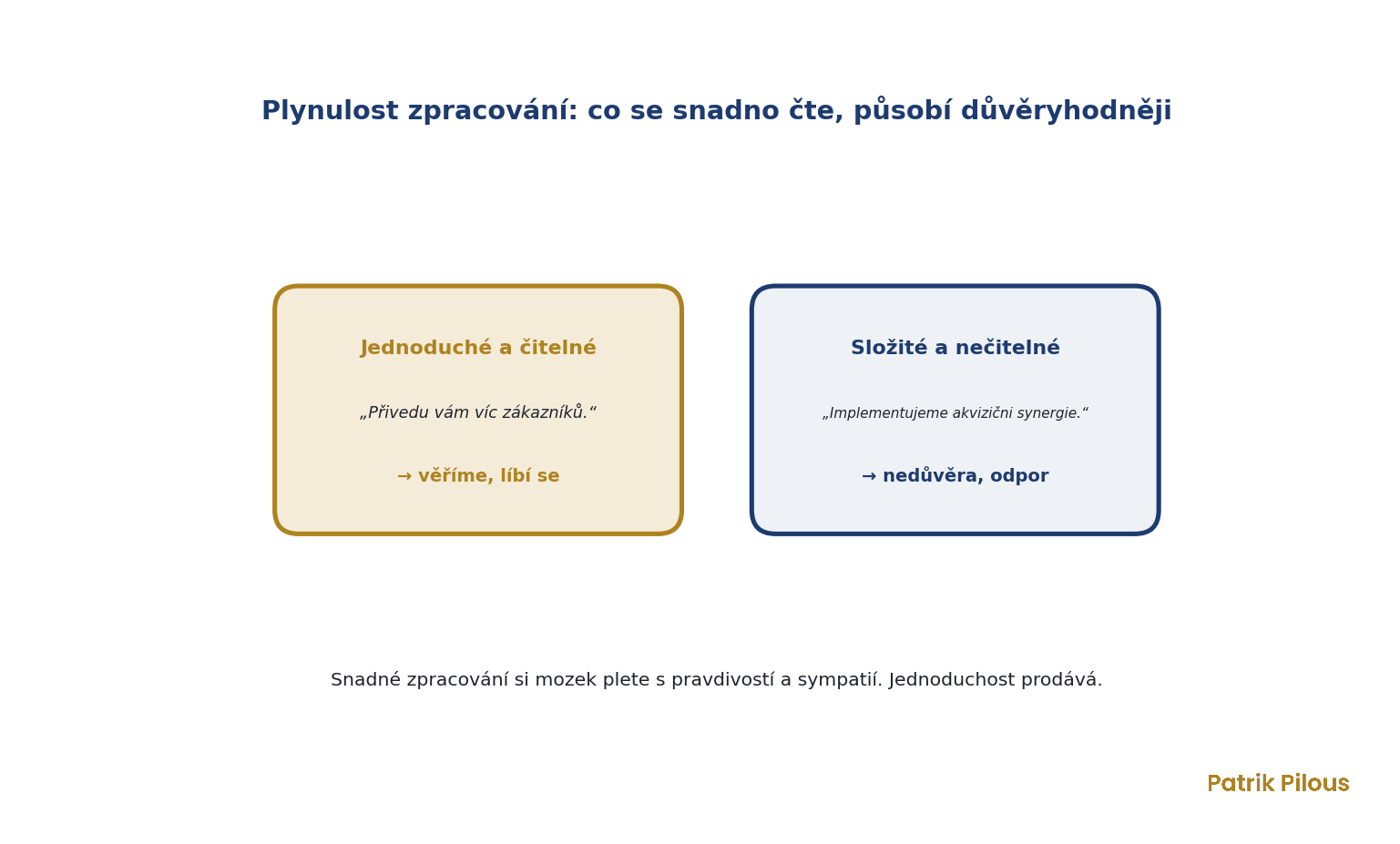
Processing fluency (in Czech also called cognitive ease) is a cognitive bias in which we perceive what our brain processes easily and smoothly as more true, more trustworthy and more likeable. Simply put, when something is easy to read, pronounce or understand, we like it more and are more likely to believe it. Conversely, complex, illegible or convoluted content makes us distrustful and resistant, even if it says the same thing. This is crucial for content, websites and SEO. Clarity is not just about being polite to the reader. It directly affects trust, conversions and people’s willingness to read to the end.
Classification
- Cause (Cognitive Bias Codex): Not enough meaning
- Mental area: Perception and judgement
- Marketing function: Content and trust
- Customer journey: across all stages (content and clarity)
- Cialdini’s principles: not applicable
- System 1 / System 2: System 1 (fast, automatic)
In a nutshell
- What it is: what is easy to process seems more true and more likeable.
- Why we do it: the brain confuses ease of processing with truth and quality.
- Where you’ll encounter it: text readability, fonts, brand names, slogans, design.
- How to use it: write and design simply so that content can be processed effortlessly.
A real-life story
In 2006, researchers Adam Alter and Daniel Oppenheimer showed that ease of processing affects even something as incredibly serious as money. They found that shares of companies with more pronounceable ticker symbols performed better shortly after their stock market debut than shares with tongue-twisting abbreviations. Investors subconsciously trusted what was easier to pronounce. Two years later, psychologists Song and Schwarz demonstrated that people considered instructions printed in a hard-to-read font more difficult to carry out, and that rhyming statements seem more true than non-rhyming ones, even though they say the same thing.
You know this from experience too. A website with clear, readable type and short paragraphs feels more trustworthy than a dense wall of small text. A slogan that is easy to remember and flows nicely sticks with you, and you believe it more than a complicated sentence. And a brand with a simple, easy-to-pronounce name feels more approachable than one with an unpronounceable name. In every case, what matters is how easily the brain processes it.
How processing fluency works
When the brain processes something effortlessly, it creates a pleasant feeling of ease. However, the brain confuses this feeling with other things: truth, liking and quality. Easy things therefore seem more true and better, even though ease has nothing to do with the content. Processing fluency is what lies behind the illusory truth effect, where a repeated (and therefore more easily processed) claim sounds more true, and behind the mere exposure effect, where we prefer what is familiar. It is also the flip side of the curse of knowledge, because experts reduce fluency with jargon.
Use in marketing
- Write simply. Short sentences, everyday words, no unnecessary jargon. Clear text feels more trustworthy and people are more likely to read it to the end. That is the core of good SEO copywriting.
- Take care over readability. A readable font, sufficient size, contrast and airy paragraphs increase both fluency and trust. Jakob’s Law and the conventions people are used to will also put this to the test.
- Simple names and slogans. People remember an easy-to-pronounce brand name and a fluent, possibly rhyming tagline, and they trust it more. More in the article on advertising slogans.
- Structure and format. Headings, bullet points and short paragraphs reduce the effort of reading. What is easy to scan is easy to accept.
- Visual simplicity. Clean design without unnecessary clutter looks professional and trustworthy because it is easy to process.
- Consistency. Repeated and familiar elements are processed more fluently, which increases trust. This also ties in with the halo effect of first impressions.
What increases fluency
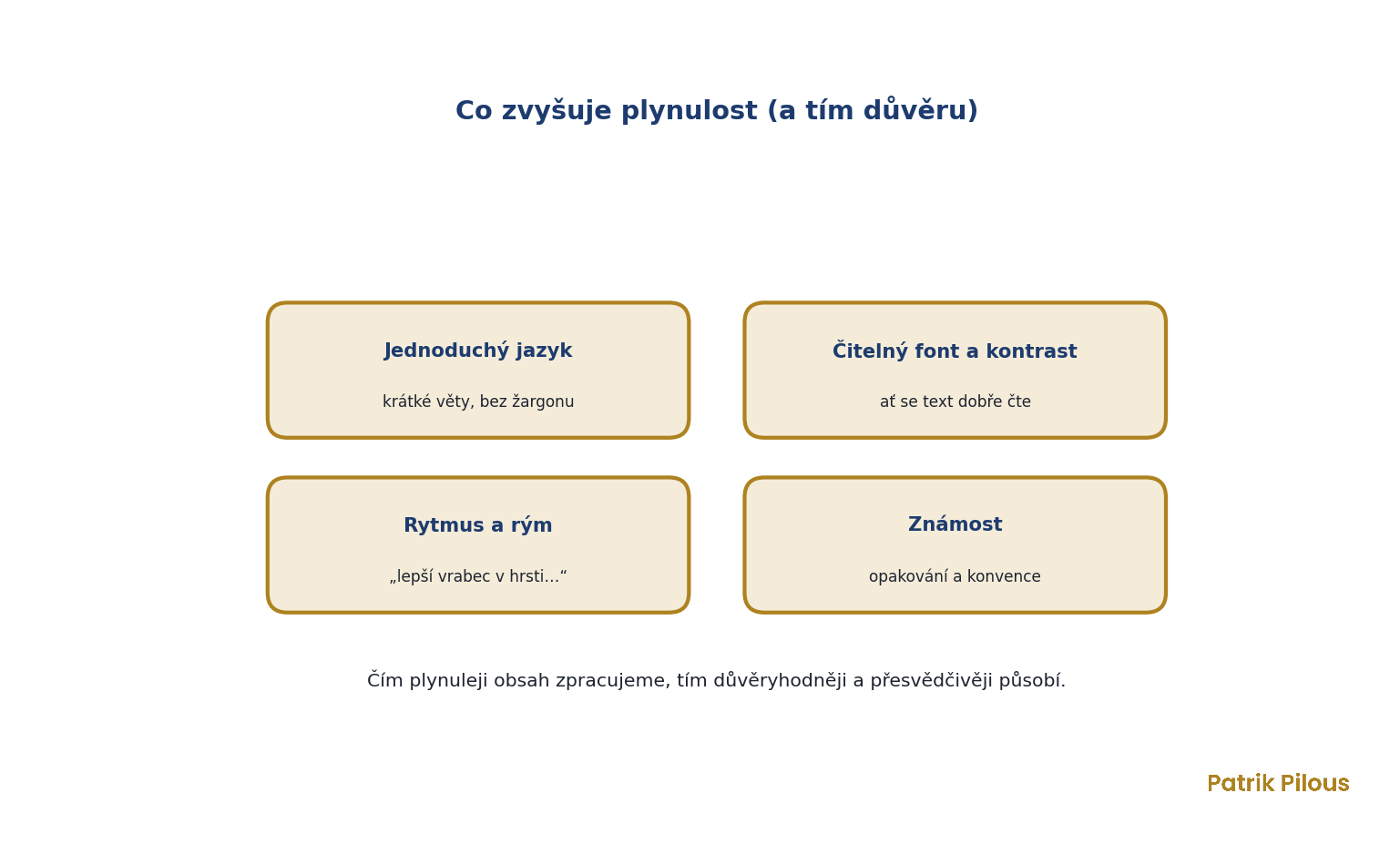
The good news is that fluency can be actively built. It is not about a single trick but about the interplay of several elements that together reduce the reader’s effort to a minimum. When content is simple in language, readable in form, catchy in rhythm and familiar through repetition, the brain takes it in without resistance and grants it trust. That is why a clear website or leaflet often beats one that is technically perfect but unreadable.
How (not) to be fooled by fluency
- Don’t confuse easy with true. Just because something flows nicely or rhymes doesn’t mean it is true.
- Beware of complexity as a signal. Convoluted text isn’t necessarily smarter. Often it is just more poorly written.
- Slow down on important matters. Don’t judge serious decisions by how easy they are to read about.
How it connects with other biases
Processing fluency is the engine that drives several other biases. It lies behind the illusory truth effect (what is repeated is easier to process and therefore seems more true) and the mere exposure effect (what is familiar is processed more fluently and therefore appeals to us). It is also the exact opposite of the curse of knowledge: while experts destroy fluency with jargon, good copywriters deliberately increase it. For content creation, this leads to a simple conclusion that few people actually follow. Write so that reading costs the reader no effort at all.
Frequently asked questions
What is processing fluency?
A cognitive bias in which we perceive what our brain processes easily and smoothly as more true, more trustworthy and more likeable.
How does processing fluency affect trust?
The brain confuses ease of processing with truth and quality. Readable, simple content therefore feels more trustworthy than complex content, even when they say the same thing.
How can you increase fluency in content?
With simple language, a readable font, short sentences, a clear structure and, where appropriate, rhythm or rhyme in slogans.

