

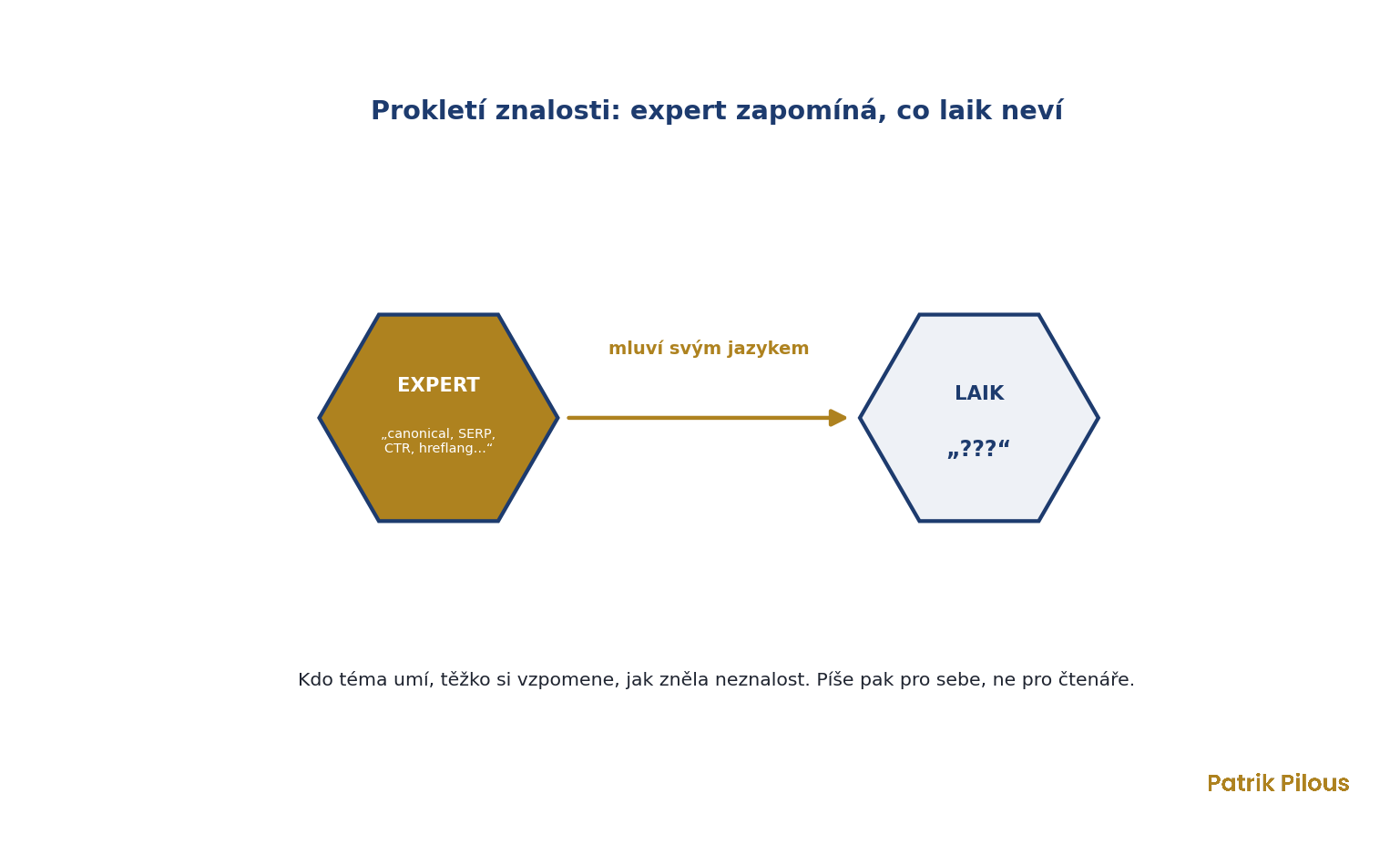
The curse of knowledge is a cognitive bias in which a person who understands something well loses the ability to imagine what it is like not to know the topic. Once you have understood something, it is hard to put yourself in the shoes of someone who is only just discovering it. That is why experts speak and write in a way laypeople cannot follow: they use jargon, skip the basics and assume knowledge their audience does not have. In marketing, content and SEO, this is one of the most common and most expensive mistakes. You end up writing for yourself and your colleagues instead of for the customer, who arrived with a completely different level of knowledge.
Classification
- Cause (Cognitive Bias Codex): Not enough meaning
- Mental area: Social and communication
- Marketing function: Content and communication
- Customer journey: across all stages (content and clarity)
- Cialdini’s principles: not applicable
- System 1 / System 2: System 1 (fast, automatic)
In a nutshell
- What it is: people who know a topic cannot imagine what it is like not to know it.
- Why we do it: we cannot switch off our own knowledge.
- Where you will meet it: expert texts, guides, product descriptions, presentations.
- How to use it: write simply, for the reader, not for yourself and your colleagues.
A real-life story
The best proof came in 1990 from psychologist Elizabeth Newton in her work at Stanford. In the experiment, one person tapped out the rhythm of a well-known song on a table and the other had to guess which song it was. The tappers were sure listeners would recognise it in roughly half of cases. In reality, listeners guessed only around 3% of them. The tappers heard the melody in their heads and could not imagine that the other person heard only a series of disconnected taps. That is exactly how an expert text sounds in the expert’s head compared with the reader’s. Brothers Chip and Dan Heath also popularised this example in their book Made to Stick.
Imagine Martin, an experienced SEO specialist, writing a service page for a website. He writes a sentence full of terms like canonical, indexing, SERP and clicks. He sees nothing complicated in it, because it is his daily bread. But the customer, an e-shop owner, finishes reading with no idea what it will actually bring them, and leaves. Martin did not write wrong information, he just wrote it for another Martin, not for his customer. A very good approach that has worked for me is to speak the language of money and benefits. Almost everyone understands that.
How the curse of knowledge works
Once we gain some knowledge, it becomes obvious to us and we cannot switch it off. The brain assumes that what we know, the other person knows too, which is close to the Dunning-Kruger effect, only from the opposite side. While a beginner overestimates themselves, an expert overestimates the knowledge of their audience. The result is communication that misses the mark. It is also related to framing, because how you present a message matters, and to the illusory truth effect, where a clear and fluent message seems more credible than a complicated one.
Use in marketing and content
- Write for the customer, not for the industry. Explain the benefit, not the technicalities. “I will bring you more customers from Google who will buy from you” works better than a list of acronyms.
- Replace jargon with examples. Instead of a technical term, use an image or a story from the reader’s life. People remember concrete things better.
- Test it on a layperson. Ask someone outside the field to read the text. Wherever they get stuck, the curse of knowledge has struck.
- Answer your audience’s questions. Write about what the customer is really looking for and what troubles them, not what is interesting to you.
- Simplify the claim. A strong, clear slogan beats a clever but vague phrase. I cover this in my article on advertising slogans.
- Back it up with trust. A clearly explained benefit plus social proof from similar customers persuades more than an expert lecture. For my clients, I always choose similar businesses I have already helped.
The curse of knowledge in practice, clarity sells
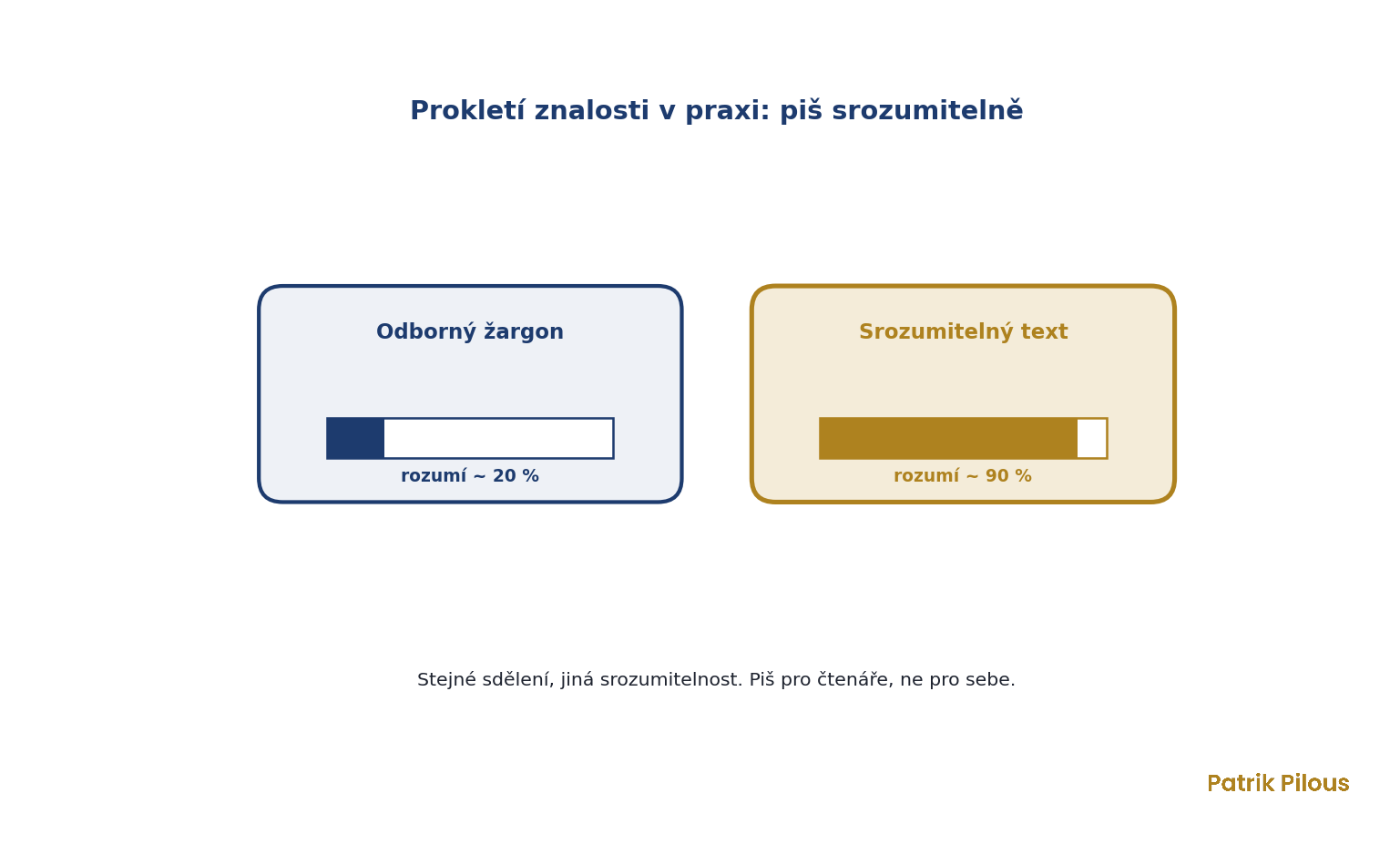
The difference between a text written for experts and a text written for readers is not cosmetic, it is huge. The same message can make things clear to one reader and completely lose another, depending only on how much jargon and how many unspoken assumptions it contains. And because people do not finish reading texts they cannot understand, the curse of knowledge directly costs you conversions and search rankings, where clarity and meeting user intent play an ever greater role.
How to guard against the curse of knowledge
- Ask what the reader does not know. Before you start writing, picture a specific layperson and their level of knowledge.
- Explain jargon or leave it out. Either explain every technical term or replace it with an everyday word.
- Have someone read it. Feedback from someone outside the field is the best cure.
How it connects with other biases
The curse of knowledge is in fact the mirror twin of the Dunning-Kruger effect. That effect describes how a beginner overestimates themselves, while the curse of knowledge describes how an expert overestimates the knowledge of others. In content, it links with framing and the mere exposure effect, because clear and familiar wording feels friendlier. The conclusion for content creation is clear: write simply and test on people outside the field. You will find more examples of how psychology influences marketing in the encyclopedia of cognitive biases.
Frequently asked questions
What is the curse of knowledge?
A cognitive bias in which a person who understands something loses the ability to imagine what it is like not to know the topic, and therefore communicates unclearly.
Who researched the curse of knowledge?
A well-known study is Elizabeth Newton’s 1990 song-tapping experiment. Chip and Dan Heath also popularised the topic in their book Made to Stick.
How can you guard against the curse of knowledge when writing?
Write for a specific layperson, explain jargon or leave it out, and have someone outside the field read the text.

