
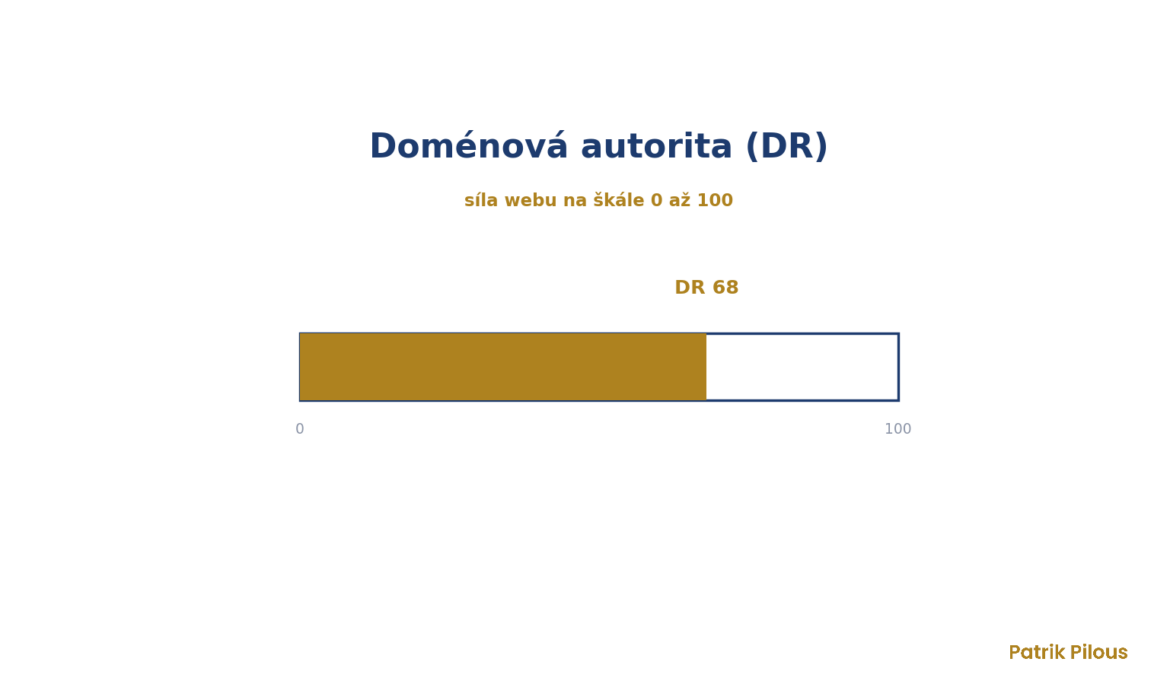
Domain authority is a number that tries to express, in a single figure, how strong and trustworthy a website is in the eyes of search engines. The scale usually runs from 0 to 100, and the higher the score, the better the website’s starting position (and the more expensive or valuable links from that domain are). It is important to understand one thing right at the start. Domain authority is not a metric from Google or Seznam (Czech search engine). It was invented by SEO tools to turn the complex reality of backlinks into one easy-to-understand number. IT IS AN ESTIMATE of a domain’s authority. Moz calls it Domain Authority (DA), Ahrefs calls it Domain Rating (DR). Even so, it is a useful rough indicator, because it quickly tells you what kind of website you are dealing with.
The problem is that many business owners and SEO consultants do not know how to interpret the numbers or how much weight to give them. DR is simply not gospel. It is an indicator, and you need to know how to interpret it.
Where the word comes from
The word authority comes from the Latin auctoritas, which meant standing, influence and the ability to make your view prevail. In the Roman world, a person had auctoritas when their word carried weight, even without formal power. This exact meaning carried over into SEO, and it is closely linked to how strongly the authority effect affects us in general. Domain authority does not say that you are right, but that others trust your website enough to link to it. The English term Domain Rating then turns this standing into a measurable score.
A short history of domain authority
Its roots go back to 1998, when Larry Page and Sergey Brin introduced the PageRank algorithm. It was the first to calculate a page’s importance based on how many links point to it and how good they are. Over time, Google stopped publicly showing specific PageRank values, which created demand for a replacement. So Moz came up with the Domain Authority metric, and Ahrefs later with Domain Rating. Both try to imitate the logic of PageRank using their own map of links across the web, which I know from my daily work described in what SEO is. They are not numbers from Google, but estimates built on the same principle. Strong websites link to strong websites.
How domain authority works from an SEO perspective
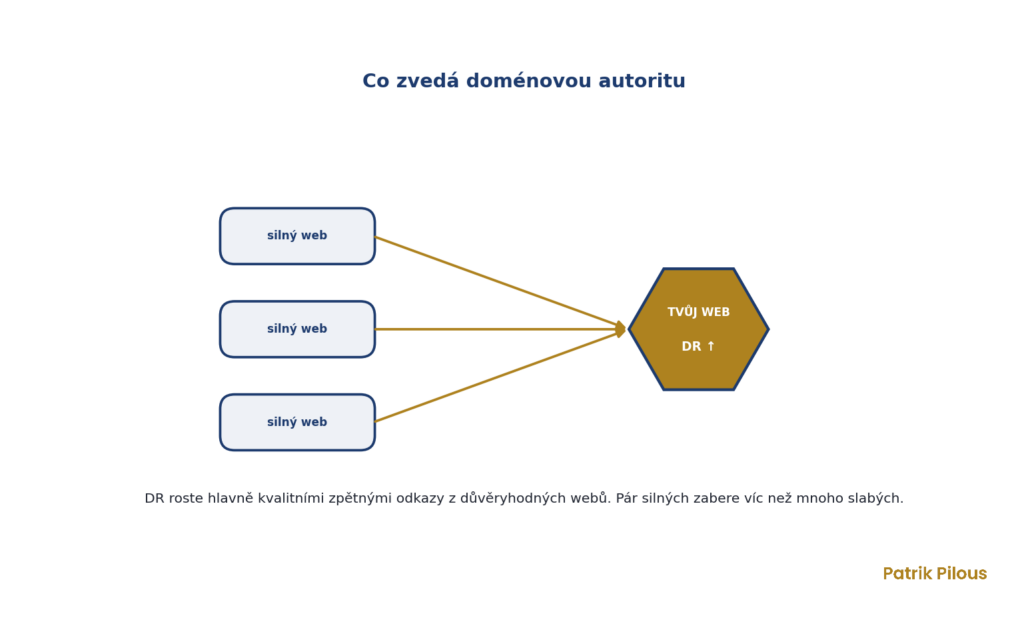
Domain authority grows mainly through high-quality backlinks from trustworthy websites. More links do not automatically mean a higher score (although that is partly true).
A few links from genuinely strong and topically related websites raise authority more than hundreds of weak ones, which is exactly the aim of well-planned link building. In practice, I use it as a quick yardstick in competitor analysis and when assessing prospects for collaboration. When I see a competitor with much higher authority, I know that I will not overtake them with content alone straight away, and that work on links will be needed too. On the other hand, estimated traffic in Ahrefs and its structure is a much stronger argument for collaboration (and for evaluating results).
Why domain authority matters
Authority is a shortcut that saves time. Instead of manually going through every website’s link profile, one number gives you a rough idea of its strength. That is invaluable in competitor analysis, when choosing websites to work with, and when estimating how realistic it is to reach certain rankings, which I always look at as part of an SEO audit. At the same time, it is a number you can only trust to a degree. It can be artificially inflated, it varies from tool to tool, and it says nothing about whether a website has good content. That is why I treat it as a gauge on the dashboard, not as a goal in itself.
Where it goes further
Domain authority is really a digital version of how trust works between people. We tend to trust those whom others trust. This is the principle of social proof, and it is also closely linked to how we judge the quality of the whole based on one prominent signal, which is called the halo effect. A link from a strong website is essentially a recommendation, just like when a respected person gives you a reference. And watch out for a trap. A high authority number can create an impression of quality even where there is nothing behind it, exactly as the halo effect does in the human mind.
Most common mistakes
- Treating domain authority as an official Google metric that directly affects rankings.
- Taking DR into account when estimated traffic is very low or non-existent.
- Chasing a high number through lots of weak links instead of a few high-quality ones, often just because of the herd effect, since everyone else does it.
- Comparing authority across different tools, even though Moz and Ahrefs calculate it differently.
- Ignoring content and intent on the assumption that high authority will deliver rankings on its own.
Questions about domain authority
What is domain authority?
An estimate of a website’s strength and trustworthiness on a scale of 0 to 100, calculated by SEO tools based on the number and quality of backlinks. Moz calls it Domain Authority, Ahrefs calls it Domain Rating.
Is domain authority a Google metric?
No. Google does not provide any such public number. It is an estimate by SEO tools that imitates the logic of the original PageRank algorithm.
How do you increase domain authority?
Mainly by earning high-quality backlinks from trustworthy and topically related websites through consistent link building. A few strong links do more than many weak ones.

