Technical SEO consultant
Technical SEO, audits and consulting
Technical SEO is the work of making sure a search engine can crawl your website, understand it and include it in the results. When something is broken here, even the best content and links will not help, because Google either cannot see the pages or does not understand them.
As a technical SEO consultant, I do not hunt for the hundreds of errors that tools report. I look for the ones that are really costing you traffic, verify each one directly on the website and rank them by impact. The result is a list your developer can start working on straight away.
What technical SEO is made of

Crawling and indexing
Whether the crawler can reach all your important pages and whether Google actually adds them to its index. This is where everything else begins.

Structure and internal links
Logical URLs, a sensible page depth and links that guide both crawlers and people to your most important pages.

Duplicates and canonical links
Parameters, URL variants and copies of content that dilute the strength of your website. Clear rules on what gets indexed and what does not.

Redirects and error pages
404 pages, redirect chains and old URLs after a migration. An old URL with backlinks that ends in a 404 loses the strength of those links.

Speed and Core Web Vitals
Loading speed, page stability and responsiveness. Especially for templates that are repeated across hundreds of pages.

Structured data and AI bots
Markup for rich results in search and access for AI search bots, which do not run JavaScript.
Who have I provided website and SEO consulting for?
VYNIKAJÍCÍ Na základě 42 hodnocení Zveřejněno na Google Pavel Vondruška01/09/2026 Spolupracujeme v oblasti linkbuildingu a obsahových spoluprací. Komunikace je vždy rychlá, férová a profesionální, spolupráci mohu doporučit.Zveřejněno na Google Denisa Palková26/08/2026 S Patrikem spolupracuju na marketingu Chlorita, který celý vede. Já s kolegyní máme na starosti hlavně obsah, produkci a sociální sítě. Oceňuju, že naslouchá našim nápadům a normálně s námi diskutuje o tom, co a jak by mohlo fungovat. Zároveň je ale pořád cítit, že má celý marketing pod kontrolou. Umí se rozhodnout, věci pushnout, dotáhnout a má přehled o tom, co se zrovna řeší. Komunikace s ním je rychlá, věcná a funguje bez zbytečných komplikací.Zveřejněno na Google Marek Jelok24/08/2026 Ďakujem za výbornú dlhodobú spoluprácu v linkbuildingu. S Patrikom sa vždy vieme dohodnúť k obojstrannej spokojnosti pri získavaní spätných odkazov pre klientov.Zveřejněno na Google Martina Králová13/07/2026 Spolupráce s IdeUp a Patrikem Pilousem proběhla bez problémů, komunikace byla rychlá a věcná a celý proces publikace čtyř článků na portálu Videobydlení.cz byl dobře zorganizovaný. Spolupráci doporučujeme. Tým B3 TechnologyZveřejněno na Google Petr Kutka06/07/2026 Příjemná spolupráce a odbornost. Děkuji.Zveřejněno na Google Bartosz O23/06/2026 Profesionální přístup, skvělý servis – firmu mohu jednoznačně doporučit.Zveřejněno na Google Martin Kolčák01/06/2026 Ďakujem za skvelú rýchlu a profesionálnu prácu v oblasti linkbuildingu pre klienta!Zveřejněno na Google Anna Mejsnarová18/05/2026 Mimo dobrých jednohubek Patrik zvládá i různá zákoutí online marketingu. Sama jsem ho doporučila několika klientům, což mluví samo za sebe.Zveřejněno na Google Markéta Kadeřábková13/04/2026 S Patrikem spolupracuji už několik let v oblasti SEO, copywritingu a linkbuildingu. Oceňuji jeho proaktivitu, zápal pro učení se nových věcí a ochotu ve všem vyhovět. Spolupráci s ním vřele doporučuji.Zveřejněno na Google Jan Janda25/03/2026
Why everything else rests on technical SEO
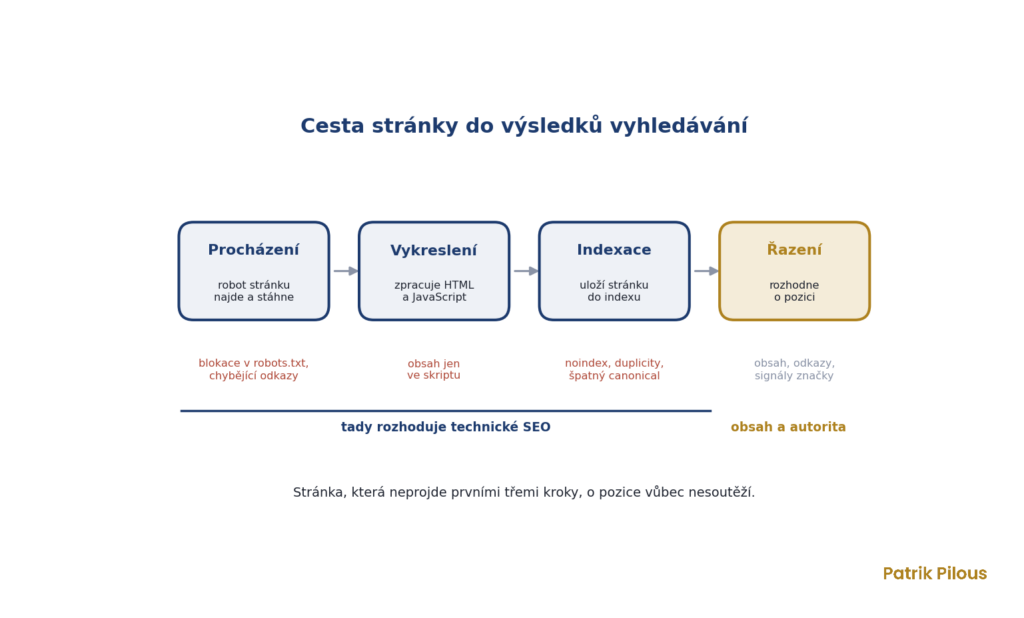
Technical SEO mainly looks after the first three steps. A page that Google does not add to its index will not appear in the results, however good its content is. That is why I start with a technical check for every new client, even if they came to me about content or links.
The most common technical errors I see on websites
Most technical problems keep recurring. The main difference is how many pages they affect.
- Pages that are not indexed. An accidentally set noindex, a block in robots.txt or pages that Google has crawled but not added to its index.
- Duplicates. URL variants with parameters, with or without a trailing slash, and the same content on several URLs. This is mainly solved with a canonical link; read more in the article on duplicate content.
- 404 error pages and redirect chains. Old URLs with backlinks that lead nowhere, or that pass through three redirects instead of a single 301 redirect.
- Incomplete or outdated sitemap. A sitemap that is missing important pages or, on the contrary, contains redirected and deleted URLs.
- Content available only through JavaScript. Text or links that are only loaded by a script. Google can usually handle them; according to Vercel’s measurements, the crawlers of OpenAI, Anthropic and Perplexity cannot.
- Slow templates. One heavy category or article template slows down hundreds of pages at once. This is measured with Core Web Vitals.
- Language versions. Incorrect or missing hreflang, which causes Google to show Czech users the Slovak version and vice versa.
How I carry out a technical audit
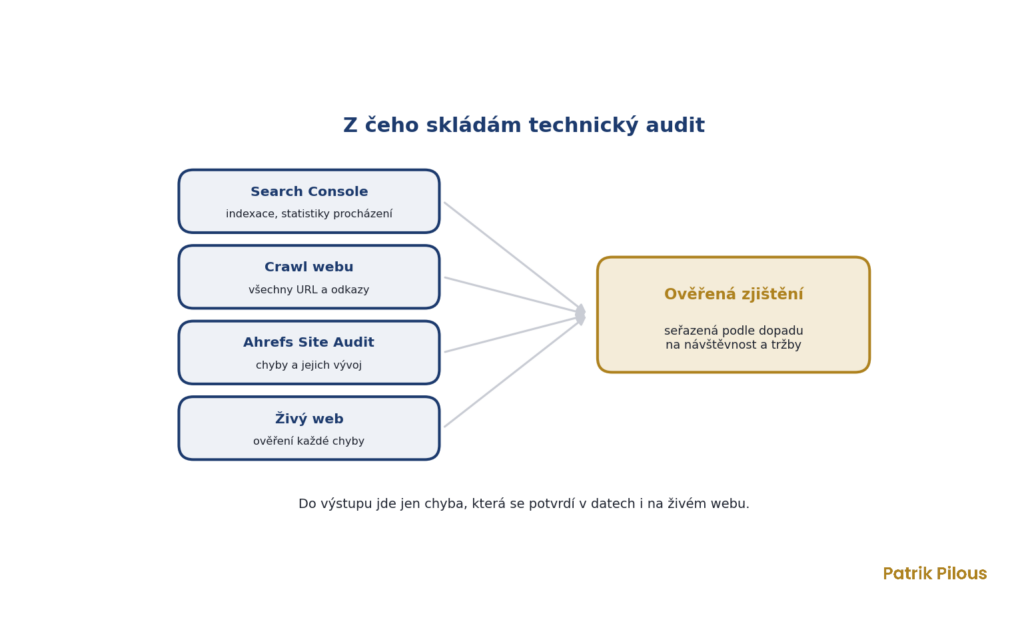
Audit tools today can generate hundreds of warnings in a few minutes. Their weakness is that they do not distinguish between a real problem and a mere formal shortcoming. That is why I build the audit from several data sources and verify every finding on the live website.
The foundation is Search Console, mainly the indexing report, crawl stats and inspection of specific URLs. On top of that, my own crawl of the website and Ahrefs Site Audit. Only when an error is confirmed both in the data and on the website does it make it into the output. You can find details of what the audit includes on the SEO audit page.
Priorities, not a list of errors
The goal of technical SEO is not a 100% score in a tool. A website with a score of 70 can earn more than a website with a score of 95 if the pages that generate revenue are in good shape.
That is why I rank errors by how many important pages they affect and how much traffic is at risk. Fixing indexing on the main categories comes before a missing alt text on an image in the footer. I describe how I set priorities in general under SEO strategy.
Technical SEO for AI search engines
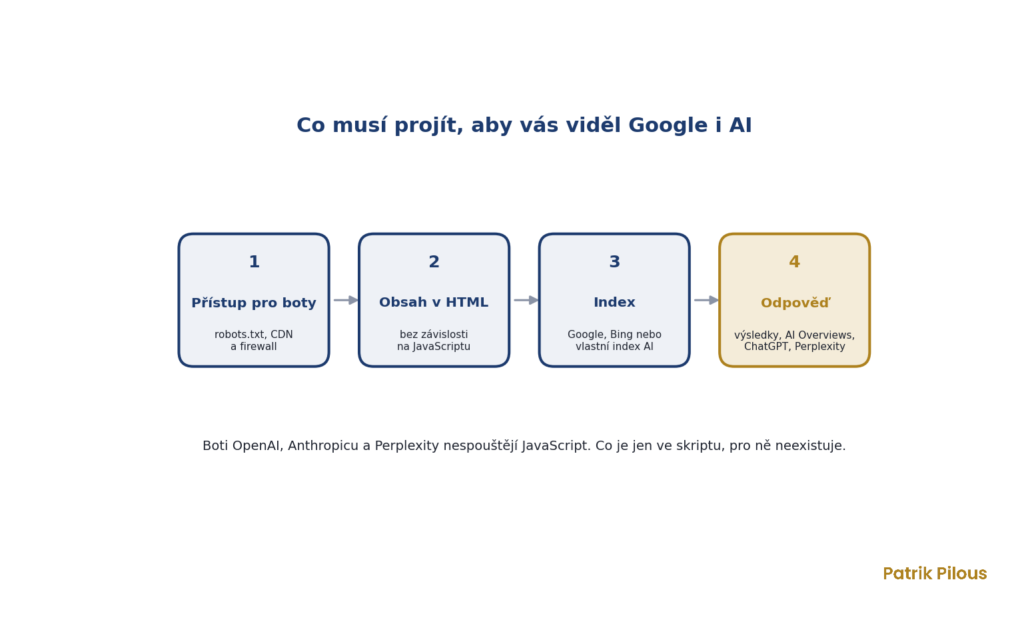
Today people also search in ChatGPT, Perplexity and Google’s AI Overviews. Technically, this brings three new checks that were not needed before.
The first is access for bots. AI search bots such as OAI-SearchBot or PerplexityBot must not be blocked in robots.txt, and they must not be quietly blocked by a CDN or firewall either. The second is content in the HTML. According to Vercel’s measurements, the crawlers of OpenAI, Anthropic and Perplexity do not run JavaScript, so anything loaded only by a script does not exist for them. The third is a setting in Search Console, where you can now exclude your website from Google’s AI features.
I have gone into more detail on where AI gets its results from in the article How SEO and GEO work.
Migrations and major website changes
The most traffic is lost during a redesign or a change of platform or domain. Forgetting to redirect just a few important URLs is enough for a website to lose rankings it has built up over years.
For a migration, I prepare a redirect map from old URLs to new ones, check the staging version before launch and monitor indexing and errors in Search Console during the first weeks after launch. It is one of the few situations where technical SEO pays off when handled in advance, not only once traffic has dropped.
How we work together
- Technical audit. I go through the Search Console data, the crawl and the live website and write up the verified findings.
- Priorities. Each finding gets an estimate of impact and effort, and the items with the greatest impact go to the top.
- Briefs for developers. For each error, the specific URLs, a description of the problem and a proposed solution. On Shoptet, WordPress and other common platforms, I often make the fixes myself.
- Implementation check. After the fixes, I verify that the change has really taken effect on the website and in Search Console.
You can request a technical audit straight away or start with a no-obligation consultation, where I will tell you whether your website needs a full audit or whether fixing a few things is enough. Enter your website address and what is bothering you in the form at the bottom of the page, and I will get back to you with the next steps.
What does technical SEO include?
Crawling and indexing of the website, URL structure and internal links, duplicates and canonical links, redirects and error pages, speed, the mobile version, language versions, structured data and access for search engine and AI bots.
For e-shops, it mainly involves working with filters and parameters; read more on the SEO for e-shops page.
How much does a technical SEO audit cost?
It depends mainly on the size and complexity of the website. Auditing a company website with dozens of pages is different work from auditing an e-shop with hundreds of thousands of URLs.
I have covered indicative prices in the article SEO pricing.
How often should you do a technical audit?
A major audit makes sense before and after every significant change to the website, such as a redesign or a change of platform. Otherwise, a major audit once a year with ongoing checks in between is enough.
In between, I recommend keeping an eye on Search Console, especially the indexing report. It will show most new problems before they affect your traffic.
Do I need a developer for the fixes?
It depends on the error and the platform. Titles, redirects or the indexing of individual pages can be fixed without a developer on most content management systems.
Changes to templates, speed or rendering usually require a developer. For those, I prepare briefs so that they do not have to guess anything.
Can technical SEO help even without new content?
Often yes, especially if the website is losing pages from the index or has significant duplication. The fix then unlocks the potential of the content you already have.
In the long run, however, the technical side alone is not enough. It is the foundation on which content and links are built.
What technical SEO is
Technical SEO is the part of SEO that ensures a search engine can crawl, render, understand and index a website. It covers indexing, URL structure, duplicates, redirects, speed, structured data and access for search engine and AI bots.
When it makes sense to hire a technical SEO consultant
Most of my clients get in touch at one of these moments:
- Traffic has dropped and nobody knows why. Content and links have not changed, but rankings have, which often points to a technical cause.
- A redesign, migration or new platform is coming. This is the cheapest time to get technical SEO right.
- The website is large or complex. E-shops with filters, websites with several language versions or thousands of URLs, where one template affects many pages.
- You have a marketing team but no technical specialist. Your team needs someone who can translate data from Search Console into specific tasks for developers.
If your website is small and stable, you often do not need ongoing technical SEO. A one-off check is usually enough.
Common mistakes when fixing technical SEO
- Fixing everything a tool reports. Developers spend time on warnings that have no effect on traffic, while the real problem remains.
- Combining robots.txt and noindex. If a page is blocked in robots.txt, Google cannot see its noindex tag, and the URL can stay in the index.
- Canonical links pointing to the wrong URLs. For example, to redirected or non-indexable pages, which gives Google conflicting signals.
- No check after deployment. A fix that works on staging can be overwritten by the next release. That is why I always verify changes on the live website.
Questions about technical SEO audits
What is the difference between a technical SEO audit and a full SEO audit?
A technical SEO audit focuses on whether search engines and AI bots can crawl, render and index your website. A full SEO audit also covers content, keywords and links. If your website has serious technical problems, I recommend fixing them first, because the other work depends on them.
What do you need from me to start a technical SEO audit?
Mainly access to Google Search Console, ideally with access to analytics as well. It also helps to know which platform your website runs on and whether any major changes are planned. Read-only access is enough for the audit itself.
Do I need a technical SEO consultant if I already have a developer?
A good developer builds a working website, but does not necessarily follow how Google crawls and indexes it. As a technical SEO consultant, I decide what needs fixing and why, and your developer then implements it. The two roles complement each other.
Get in touch