SEO strategy
SEO strategy for companies and e-shops
An SEO strategy is a plan that tells you what to do in SEO, in what order and why. It is based on your business goals, on what people search for and on what your competitors are doing. Without one, SEO is just a list of tasks from an audit that never gets finished.
I build the strategy so that work can start as soon as it is handed over. No hundred-page document left in a drawer, just clear priorities for the coming months that I, your team or your developers can work from.
What an SEO strategy is made of

Goals and measures of success
First, we agree on what SEO should deliver: enquiries, revenue or new markets. That determines how success is measured and which priorities we choose.

Demand analysis
What people search for, how much of it there is and what their intent is. It shows where the potential lies and where you are missing a page entirely.

Competitors and search results
Who ranks at the top for your topics today, with which pages and how strong their website is. This shows where you can win quickly and where it will take time.

Priorities by impact
Every task gets an estimate of impact and effort. The things that deliver the most for the least work go to the top.

Content and link plan
Which pages to create, which to improve and where to get links and mentions from. Specifically, with page names and topics.

Measurement and review
A strategy is not set in stone. Every month I compare it with the data and adjust it based on what works.
Who have I provided web and SEO consulting for?
VYNIKAJÍCÍ Na základě 42 hodnocení Zveřejněno na Google Pavel Vondruška01/09/2026 Spolupracujeme v oblasti linkbuildingu a obsahových spoluprací. Komunikace je vždy rychlá, férová a profesionální, spolupráci mohu doporučit.Zveřejněno na Google Denisa Palková26/08/2026 S Patrikem spolupracuju na marketingu Chlorita, který celý vede. Já s kolegyní máme na starosti hlavně obsah, produkci a sociální sítě. Oceňuju, že naslouchá našim nápadům a normálně s námi diskutuje o tom, co a jak by mohlo fungovat. Zároveň je ale pořád cítit, že má celý marketing pod kontrolou. Umí se rozhodnout, věci pushnout, dotáhnout a má přehled o tom, co se zrovna řeší. Komunikace s ním je rychlá, věcná a funguje bez zbytečných komplikací.Zveřejněno na Google Marek Jelok24/08/2026 Ďakujem za výbornú dlhodobú spoluprácu v linkbuildingu. S Patrikom sa vždy vieme dohodnúť k obojstrannej spokojnosti pri získavaní spätných odkazov pre klientov.Zveřejněno na Google Martina Králová13/07/2026 Spolupráce s IdeUp a Patrikem Pilousem proběhla bez problémů, komunikace byla rychlá a věcná a celý proces publikace čtyř článků na portálu Videobydlení.cz byl dobře zorganizovaný. Spolupráci doporučujeme. Tým B3 TechnologyZveřejněno na Google Petr Kutka06/07/2026 Příjemná spolupráce a odbornost. Děkuji.Zveřejněno na Google Bartosz O23/06/2026 Profesionální přístup, skvělý servis – firmu mohu jednoznačně doporučit.Zveřejněno na Google Martin Kolčák01/06/2026 Ďakujem za skvelú rýchlu a profesionálnu prácu v oblasti linkbuildingu pre klienta!Zveřejněno na Google Anna Mejsnarová18/05/2026 Mimo dobrých jednohubek Patrik zvládá i různá zákoutí online marketingu. Sama jsem ho doporučila několika klientům, což mluví samo za sebe.Zveřejněno na Google Markéta Kadeřábková13/04/2026 S Patrikem spolupracuji už několik let v oblasti SEO, copywritingu a linkbuildingu. Oceňuji jeho proaktivitu, zápal pro učení se nových věcí a ochotu ve všem vyhovět. Spolupráci s ním vřele doporučuji.Zveřejněno na Google Jan Janda25/03/2026
My SEO services
I devote the vast majority of my time and work to my ongoing, long-term clients for SEO + link building. Ongoing SEO is a long-term, continuous activity in which I, as an SEO specialist, move you step by step towards the goals we have set. Below you can find out how working with me goes, along with tips on how to set up work with an SEO consultant in general. I prefer engagements of 15+ hours a month, which allow me to get fully into the project and move it forward. More about my SEO services here.
I provide one-off SEO consulting only occasionally. And I do an SEO audit only when the client explicitly asks for it and it makes sense in their case. I have extensive experience mainly in investment and finance, fashion and B2B. I have learnt to do SEO from different sides and angles. I now have 8+ years of experience in the field.
Link building
Link building is a specific discipline for an SEO consultant or SEO specialist that focuses solely on so-called off-page SEO. This means the work is not so dependent on your website, and the SEO consultant can work almost without your involvement. On all projects where I work on an ongoing basis as an SEO consultant, I also work regularly on link building, which is a great complementary activity that increases the authority of both the website and individual pages.
Link building is no longer so much about buying articles; it is good to have a much richer link building mix. For example, links through branded queries, work with partners, guest posts, sponsorship and well-thought-out exchanges. Connecting the brand with business categories is the current trend, for which ORM (online reputation management) may be a better term. Link building and brand mentions are also interesting today given the new LLM trends, led by ChatGPT.
Why SEO without a strategy does not work
The most common situation companies come to me with looks like this. They have an audit with a hundred recommendations, they have fixed some of them, they are writing articles and traffic is flat. The problem is not that they are doing nothing. The problem is that they are doing things in no particular order and with no link to what makes the company money.
An audit tells you what is wrong with the website. A strategy tells you what to fix first, what to add and what not to deal with at all. Often a small share of the tasks delivers most of the result, and a strategy is the way to find that share.
How I build an SEO strategy
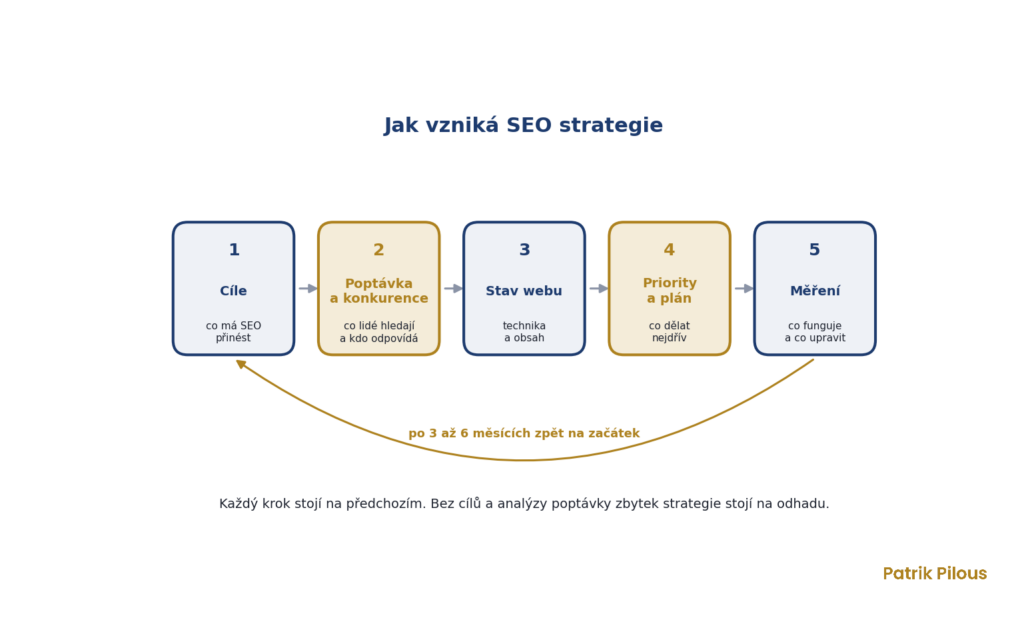
The process has five steps: goals, demand and competitors, the state of the website, priorities and the plan, and finally measurement. Each one builds on the previous one. When one is skipped, typically the goals or the demand analysis, the rest of the strategy rests on guesswork.
I start with goals and measures of success. Then comes keyword research and competitor analysis, which show what people search for and who answers them today. Next is the technical state of the website from the SEO audit, and only from all of this do I put together priorities and a plan for the coming months.
The last step is measurement, which leads back to the beginning. After three to six months, the data shows which assumptions held, and the strategy is adjusted.
How I set priorities
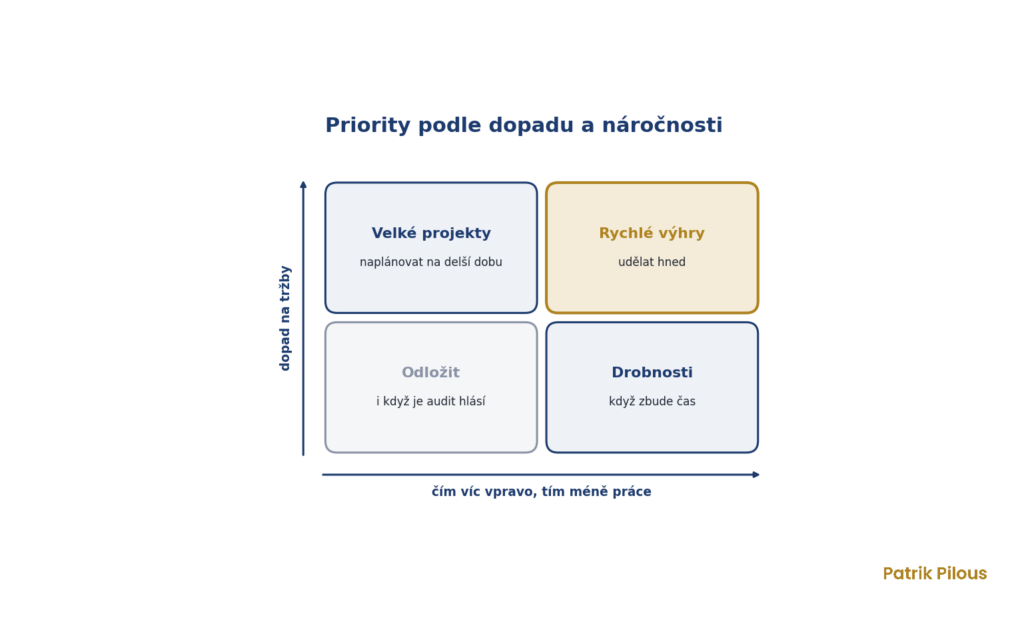
I assess every task by two questions: what impact it has on traffic and revenue, and how much work it takes. This produces a simple matrix that determines the order.
Quick wins go to the top, meaning things with high impact and low effort. Typically pages in positions 5 to 15 that are missing just a little, indexing fixes, or titles on pages with many impressions and a low click-through rate. Large projects with high impact, such as rebuilding the website structure, are planned over a longer period. Tasks with low impact and high effort are postponed, even if an audit would flag them as errors.
What matters is assessing the impact on the business, not on the numbers in tools. A ranking for a query nobody buys from makes a nice chart, but it is not a result.
Three pillars and how to balance them
SEO rests on three pillars: content, technical SEO and authority. The strategy decides how much energy each of them gets, and that differs for every website.
- Content. Pages that answer what people are searching for, in the right format. What matters is search intent, not word count. I write texts according to the principles of SEO copywriting.
- Technical SEO. A website that a search engine can crawl, understand and add to its index. On small websites it is usually done quickly; on e-shops and large websites it is often the most important part. More on the technical SEO page.
- Authority. Links and mentions from relevant websites. Without them, you will only rarely reach the top results in a competitive field, even with excellent content. I work on this as a link builder.
A new website needs technical SEO and content first; an established website with good content usually needs authority. A strategy that gives all three pillars the same amount of work regardless of the state of the website is just a template.
SEO strategy by type of website
The same process leads to completely different priorities on different websites. It differs most depending on how the website makes money.
- E-shop. The strategy rests mainly on categories, filters and product data. I describe this in detail on the SEO for e-shops page.
- B2B company. Lower search volume, but every enquiry is highly valuable. The strategy relies on service pages, solutions for specific industries and content for each stage of the decision, because several people usually decide on a purchase.
- Local business. What matters most is your Google profile and Firmy.cz listing, reviews and pages for specific locations. More in the article on local SEO.
- Content website. The key is breadth of topic coverage, freshness and internal linking between articles.
For B2B companies and services, it pays to connect the strategy with the customer journey. Someone who is only just discovering they have a problem needs different content from someone who is already choosing a supplier.
SEO strategy in the age of AI
Today people also search in ChatGPT, Perplexity and Google’s AI Overviews. A strategy therefore cannot focus only on rankings, but also on whether AI mentions you when someone asks about your field.
In practice, this means three extra things. Cover the sub-questions around the main topics too, because when answering, AI also looks into a range of related queries. Build brand mentions on the websites that AI cites in your field. And measure visibility in AI answers alongside traditional rankings. I go into this in detail in the article How SEO and GEO work.
What you get
The output is a strategy you can start working with straight away. It usually contains these parts.
- Goals and measures that show us SEO is working.
- An overview of opportunities from the demand and competitor analysis.
- A prioritised list of tasks with estimates of impact and effort.
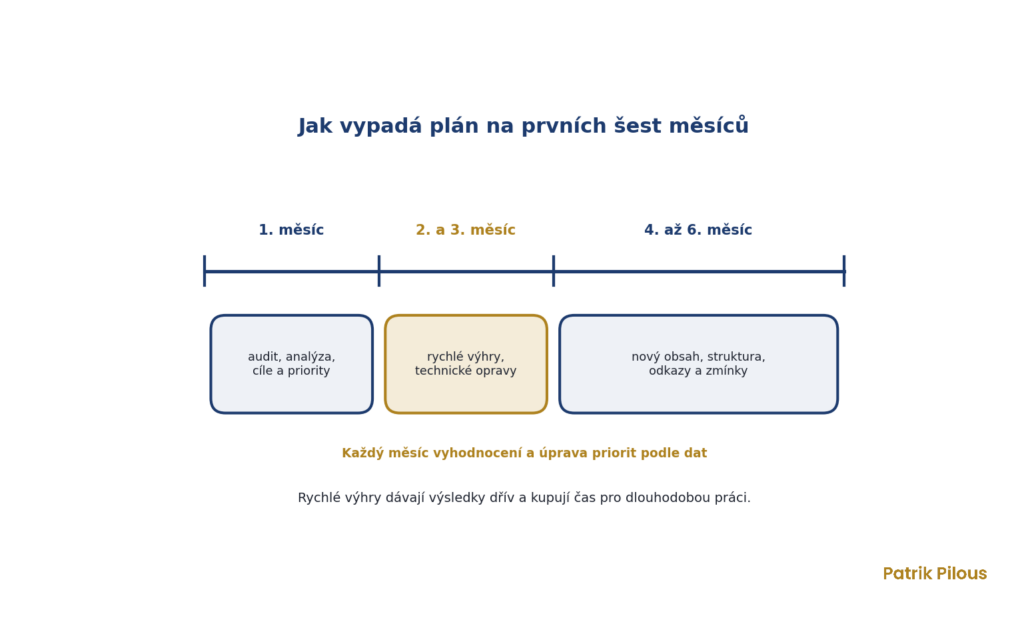
- A plan for the next three to six months: who does what and when.
- A proposal for content and link sources, specifically with page names and topics.
I can simply prepare the strategy and hand it over to your team, or keep working from it and evaluate the results every month. You can start with a no-obligation consultation. We will go through your goals and website, and I will tell you whether you need a full strategy or whether a few changes will do. Just fill in the form at the bottom of the page.
How to tell whether the strategy is working
The main measure is set by the goals from the first step. For an e-shop, I track revenue from organic search; for services, the number of enquiries. I track them year on year, because month-on-month comparisons are distorted by seasonality.
Below that, I track leading indicators. The number of queries the website ranks for, the share of pages in the top 10, click-through rate and search volume for your brand. When they grow, the strategy is heading in the right direction, even if revenue has not yet reflected it.
What does an SEO strategy contain?
Goals and measures of success, demand and competitor analysis, prioritised tasks with estimates of impact and effort, and a specific plan for the coming months. Plus a proposal for content and link sources.
A good strategy is short and specific. Every point must make clear what needs to be done and why.
How long does it take to create an SEO strategy?
For a smaller website it usually takes two to three weeks, and longer for a large e-shop or a multilingual website. Most of the time goes into analysing demand and the competition.
If an up-to-date audit and keyword research already exist, it goes faster.
How much does an SEO strategy cost?
It depends on the size of the website and whether I only prepare the strategy or keep working to it afterwards. I have broken down the prices of consultations and monthly retainers in the article SEO pricing.
In ongoing work together, the strategy is the first step, followed by work according to the plan.
How long does it take for an SEO strategy to show results?
Quick wins, such as fixing indexing or adjusting titles, show results within weeks. New content and links usually take three to six months, and longer in competitive industries.
That is why the strategy starts with the tasks that will deliver results first. This buys time for the long-term work and also shows that SEO works.
Does a small website need an SEO strategy too?
Yes, it is just shorter. Even for a small website, what matters is which queries to target and which page to have for them.
For a small local business, the strategy fits on one page. It still saves months of work on things that bring nothing.
What an SEO strategy is
An SEO strategy is a plan that sets out what to do in SEO, in what order and why. It is based on business goals, an analysis of demand and the competition, and the state of the website. It includes priorities based on the impact on revenue, a content and link plan, and a way of measuring results.
Get in touch