Keyword research you can actually work with
Keyword research
Keyword research maps what people in your field search for and how often, and assigns each query to the page on your website that should answer it. It shows where you are missing pages, where your own pages are stealing rankings from each other and where competitors are ahead of you.
A table of keywords with search volumes is not research. Any tool can export one in five minutes. From me, you get a living spreadsheet in which every keyword has a target page, a priority and a status, and from it a list of tasks. Strengthen this page, create this one, merge these two.
My keyword research process

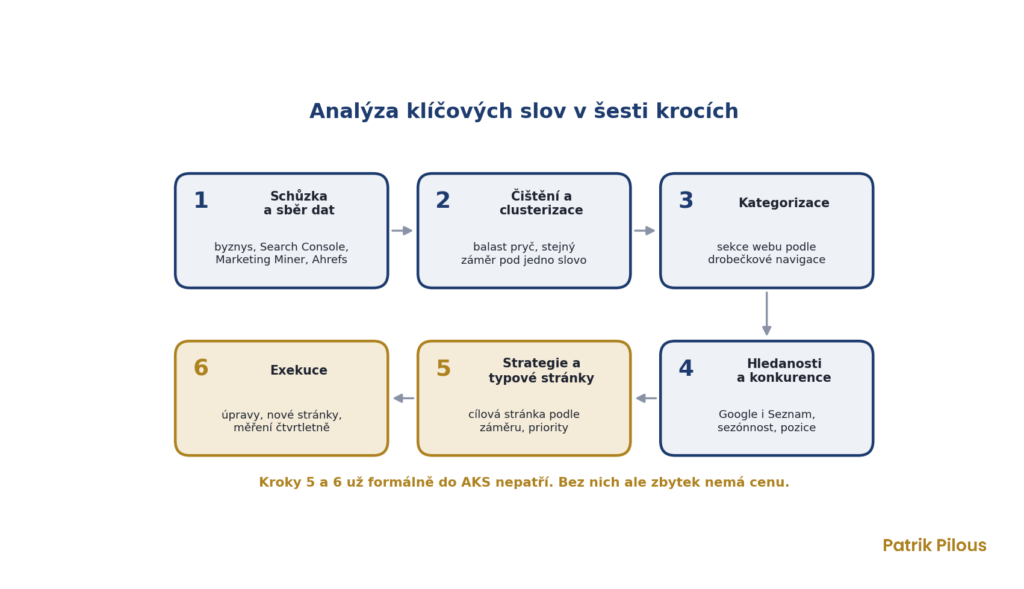
1. Meeting and data collection
First, I check whether keyword research makes sense for you. Then I collect queries from Search Console, Marketing Miner, Ahrefs and competitors.

2. Cleaning and clustering
From thousands of queries, I throw out the noise and group keywords with the same intent under one main keyword.

3. Categorisation
I sort keywords by website section or topic, but only if the client will really use it.

4. Search volumes and competitors
I add search volume, seasonality, the rankings of your website and your competitors, and the pages they rank with.

5. Strategy and page types
Each keyword gets a target page based on intent. What to strengthen, what to create and what to merge.

6. Execution
The most important step, which is no longer part of the keyword research itself. Page edits, new pages and measurement.
Who have I provided website and SEO consulting for?
VYNIKAJÍCÍ Na základě 42 hodnocení Zveřejněno na Google Pavel Vondruška01/09/2026 Spolupracujeme v oblasti linkbuildingu a obsahových spoluprací. Komunikace je vždy rychlá, férová a profesionální, spolupráci mohu doporučit.Zveřejněno na Google Denisa Palková26/08/2026 S Patrikem spolupracuju na marketingu Chlorita, který celý vede. Já s kolegyní máme na starosti hlavně obsah, produkci a sociální sítě. Oceňuju, že naslouchá našim nápadům a normálně s námi diskutuje o tom, co a jak by mohlo fungovat. Zároveň je ale pořád cítit, že má celý marketing pod kontrolou. Umí se rozhodnout, věci pushnout, dotáhnout a má přehled o tom, co se zrovna řeší. Komunikace s ním je rychlá, věcná a funguje bez zbytečných komplikací.Zveřejněno na Google Marek Jelok24/08/2026 Ďakujem za výbornú dlhodobú spoluprácu v linkbuildingu. S Patrikom sa vždy vieme dohodnúť k obojstrannej spokojnosti pri získavaní spätných odkazov pre klientov.Zveřejněno na Google Martina Králová13/07/2026 Spolupráce s IdeUp a Patrikem Pilousem proběhla bez problémů, komunikace byla rychlá a věcná a celý proces publikace čtyř článků na portálu Videobydlení.cz byl dobře zorganizovaný. Spolupráci doporučujeme. Tým B3 TechnologyZveřejněno na Google Petr Kutka06/07/2026 Příjemná spolupráce a odbornost. Děkuji.Zveřejněno na Google Bartosz O23/06/2026 Profesionální přístup, skvělý servis – firmu mohu jednoznačně doporučit.Zveřejněno na Google Martin Kolčák01/06/2026 Ďakujem za skvelú rýchlu a profesionálnu prácu v oblasti linkbuildingu pre klienta!Zveřejněno na Google Anna Mejsnarová18/05/2026 Mimo dobrých jednohubek Patrik zvládá i různá zákoutí online marketingu. Sama jsem ho doporučila několika klientům, což mluví samo za sebe.Zveřejněno na Google Markéta Kadeřábková13/04/2026 S Patrikem spolupracuji už několik let v oblasti SEO, copywritingu a linkbuildingu. Oceňuji jeho proaktivitu, zápal pro učení se nových věcí a ochotu ve všem vyhovět. Spolupráci s ním vřele doporučuji.Zveřejněno na Google Jan Janda25/03/2026
Why a keyword table is not yet research
I have seen dozens of keyword research projects that ended up in a drawer. Thousands of rows, nice charts, and nobody knew what to do with it the next morning. The problem was not the data. What was missing was the step that turns data into decisions.
That is why my keyword research does not stop at search volume. Each keyword states which page should rank for it and, if the website already appears for that keyword, which page ranks for it today and whether the two match. The differences give you a ready-made work list for the coming months.
The second thing I look at at the start is whether keyword research makes sense at all. Really. A small website with twenty services often does not need a thousand keywords in a spreadsheet, but ten well-written pages. A large e-shop, on the other hand, is just guessing which categories and filters to create without keyword research.
How to do keyword research in six steps
I have used the same process for years, and I build it so the output goes straight into work. The order of the steps is not random. A mistake in the first two carries through to everything that follows.
1. Meeting and data collection
First, I listen to how the business works, what it sells with the highest margin and where it is heading. Then I collect queries from all sources at once, including how customers and sales staff talk about the products. Search Console shows what the website already appears for. Marketing Miner and Ahrefs add related and long-tail queries and competitor data. I consider collection the most underrated part. With a poor dataset, even a perfect rest of the process will not help.
2. Cleaning and clustering
Collection always picks up noise: keywords outside the product range, other brands, Slovak word forms. But the cleanup must not be aggressive. I keep related keywords with search volume, even if they are not an exact fit. Then I group keywords with the same intent under one main keyword and add up their search volumes. You do not want “šaty” and “saty” (the same word for dresses, with and without diacritics) listed separately in your research. From an optimisation point of view, it is one query.
3. Categorisation
Categorisation takes a lot of time, so I discuss with the client in advance whether they need it. Filtering by target page or by website section is often enough. I then take the category from the target page’s breadcrumb navigation, not from a guess, so it matches the website structure.
4. Adding search volumes and competitors
For each keyword, I add search volume on Google and on Seznam (Czech search engine), monthly seasonality, and the rankings of your website and of three to five competitors. I can see which pages competitors rank with, and the best of them can inspire your website structure too.
5. Strategy and page types
This is where the real value is created. What we want to win, with what priority and with what type of page. It also includes a review of the website architecture so that pages do not overlap and cause keyword cannibalisation.
6. Execution
Formally, it is no longer part of keyword research, but without it the research stays a document in a drawer. Have your keyword research done by someone who will then work with it. That is why I do it mainly for clients I continue with in ongoing SEO cooperation.
One page per keyword, based on intent
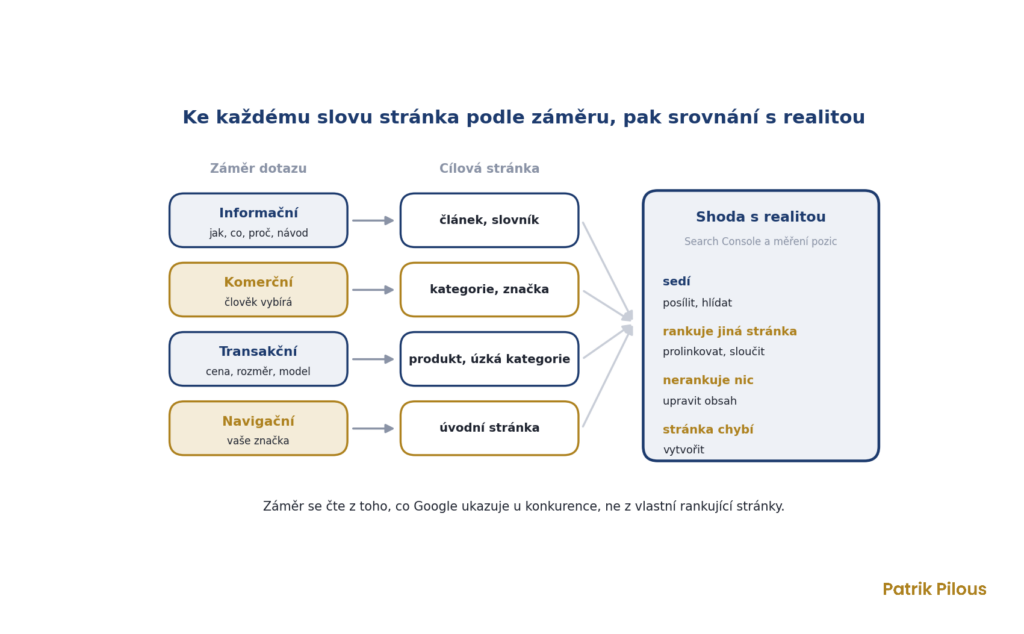
The most important column in my keyword research is the target page. I do not decide it by where the keyword appears in the text, but by search intent. Someone searching for how to choose running shoes wants a guide. Someone searching for women’s running shoes wants to browse products. Each of those queries needs a different type of page.
I use four types of intent, and for each only a few page types that stand a chance. With mixed intent, the deciding factor is which page type dominates the SERP.
- An informational query (how, what, why, guide) belongs on an article or a glossary entry.
- A commercial query, where the person is choosing, belongs on a category or brand page.
- A transactional query with a price, size or specific model belongs on a product or a narrow category.
- A navigational query for your brand belongs on the homepage.
Then I compare the target page with reality, meaning the page Google shows for the query according to Search Console and rank tracking. The match ends up in one of four states. It matches, a different page ranks, nothing ranks, or the page is missing. Each state means different work, and together they make up the plan for the coming months.
One trap I have run into. Your own ranking page does not determine intent. If your article ranks for a commercial query, it does not mean the query is informational. What matters is what Google shows for your competitors.
Clustering by SERP overlap
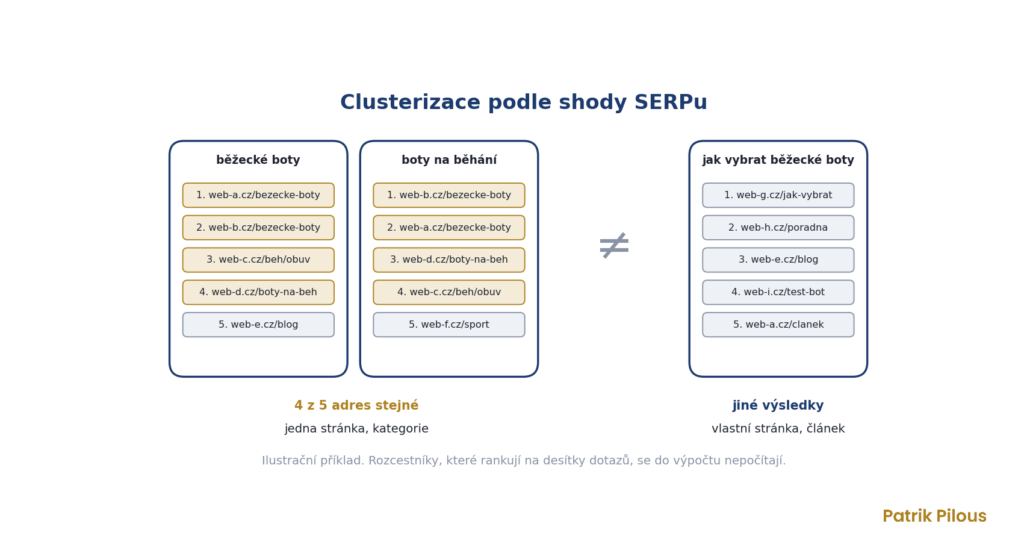
I do not decide which queries belong on one page by how similar the words are, but by the search results. When most of the same URLs rank for two queries in the SERP, it is a strong signal that they share one intent and one page is enough. When the results differ, you need two pages.
I calculate the overlap from data I already have in the keyword research, from the rankings of your website and competitors in a single measurement. There is one exception I have to watch. I exclude hub pages that rank for dozens of different queries from the calculation, otherwise they would merge everything into one giant cluster.
Where SERP data is missing, a second signal helps: semantic similarity between keywords calculated by a language model. I only record neighbours above a similarity threshold, because without a threshold the model pairs even keywords that have nothing in common. For an e-shop with thousands of queries, this combination saves a lot of manual sorting, but I check the borderline cases by hand.
Keyword research as a living spreadsheet, not a document for the drawer
I used to hand over keyword research as a finished file. Today, for my clients, it is one living sheet in the main SEO spreadsheet. Each row is a keyword, next to it the target page, the reality, competitor rankings and measurement history. Manual edits by the client and by me survive every update.
I track rankings in Keyword Miner by Marketing Miner, which measures your website and up to five competitors in the top 20 on Google and Seznam (Czech search engine) in a single SERP. One keyword costs 50 credits, so I do not track rankings for all the thousands of keywords, only for a selection based on priority and search volume. The other keywords get their rankings for free from Google Search Console.
Once a quarter, I add new queries that have appeared in Search Console, refresh search volumes and measure selected keywords again. This shows me what has moved, where the ranking page has changed and what is still missing.
How to choose keywords to target
Out of thousands of queries, you end up working with a smaller share. I choose the ones that meet several conditions at once, and search volume is not top of the list.
- Relevance. The query matches what you actually sell.
- Intent. The person is looking for what your page can give them.
- Business value. A keyword with lower search volume and clear purchase intent earns more than a generic query with a poor conversion rate.
- A realistic chance. Who is in the top 10 and whether you have anything to compete with.
- Closeness to the first page. Queries you already rank for in positions 5 to 20 usually move fastest for my clients.
AI queries and keyword research
Today, people also ask ChatGPT, Gemini and AI Overviews in Google. Google states that AI Overviews and AI Mode may use a technique called query fan-out. It breaks one question down into a series of related queries and assembles the answer from the results. For keyword research, this means covering the whole topic carries more weight than one strong keyword. That is why I also include long questions from Search Console and assign them to the page that answers them.
At the same time, Google says you do not need any special optimisation for AI features, the same SEO fundamentals apply. Good keyword research is therefore also a foundation for visibility in AI. It shows the topics and questions you need to have an answer for. I measure the AI prompts themselves separately, using a different method, and I write more about it on the GEO page.
The most common mistakes in keyword research
I have seen most of them in research that a client received from someone else and brought to me to bring back to life.
- Research without execution. A finished spreadsheet that nobody opened.
- Search volume without intent. A category is pushed for an informational query, and it does not work.
- Company jargon. Targeting the terms you use to describe your service, not the ones customers use.
- Aggressive cleanup. Along with keywords outside the product range, related keywords that bring in buyers get thrown out too.
- One-off approach. Research from two years ago that new pages are still being built on.
Can you do keyword research yourself?
For a smaller website, yes. You can handle a few dozen to a few hundred queries with free tools: Search Console, the Keyword Planner in Google Ads and keyword suggestions in Sklik. I describe the paid tools I use on my page about SEO tools.
For an e-shop with thousands of products, or a website whose entire structure will be built on the keyword research, a mistake in the data is expensive. A badly merged cluster means two pages competing for the same positions, or one page that matches nobody’s intent.
How much keyword research costs
On the market, keyword research costs roughly €370 to €2,050. Most often it costs around €1,050. The lower end of the range is research for a single category. The upper end is a whole e-shop with URL mapping, proposed filter pages and a content plan.
For a mid-sized project, I consider a budget of €620 to €1,050 reasonable. I give an exact price after an initial meeting, once I know what the keyword research needs to solve. Write to me using the form at the end of this page and tell me what you need help with. You will find a detailed breakdown of SEO service prices in the article how much SEO costs.
What is AKS?
AKS is the abbreviation for keyword research (analýza klíčových slov). It maps what people in your industry search for and how often, and it assigns a page on your website to each query.
It serves as the basis for your website structure, copy, categories and PPC campaigns.
How do you do keyword research?
Collect queries from Search Console and other tools, clean them up, group keywords with the same intent and add search volume and competition data.
Then assign a target page to each cluster based on intent and compare it with what ranks today. The differences are your work plan.
How many keywords should the research include?
It depends on the website. For a smaller website, hundreds of queries are enough. For an e-shop, it is usually thousands.
More important than the number is whether the research also covers long-tail queries and questions, not just a handful of the most searched keywords.
How often should keyword research be updated?
For clients I work with long term, once a quarter. I add new queries from Search Console, refresh search volumes and measure selected keywords.
One-off research without updates goes out of date, as both demand and competition change.
Can keyword research also be used for PPC?
Yes. You will see the competitiveness and cost per click in Google Ads and Sklik, and above all the landing pages you are missing.
A campaign pointing to a page that is too general lowers your conversion rate. Keyword research shows you where to create a more specific category.
What is keyword research
Keyword research (AKS) is a map of demand in search engines. It tells you what people in your industry search for, how often, with what intent and which page on your website should answer it. Without assigning keywords to pages, it is just a list of queries.
Let me know