

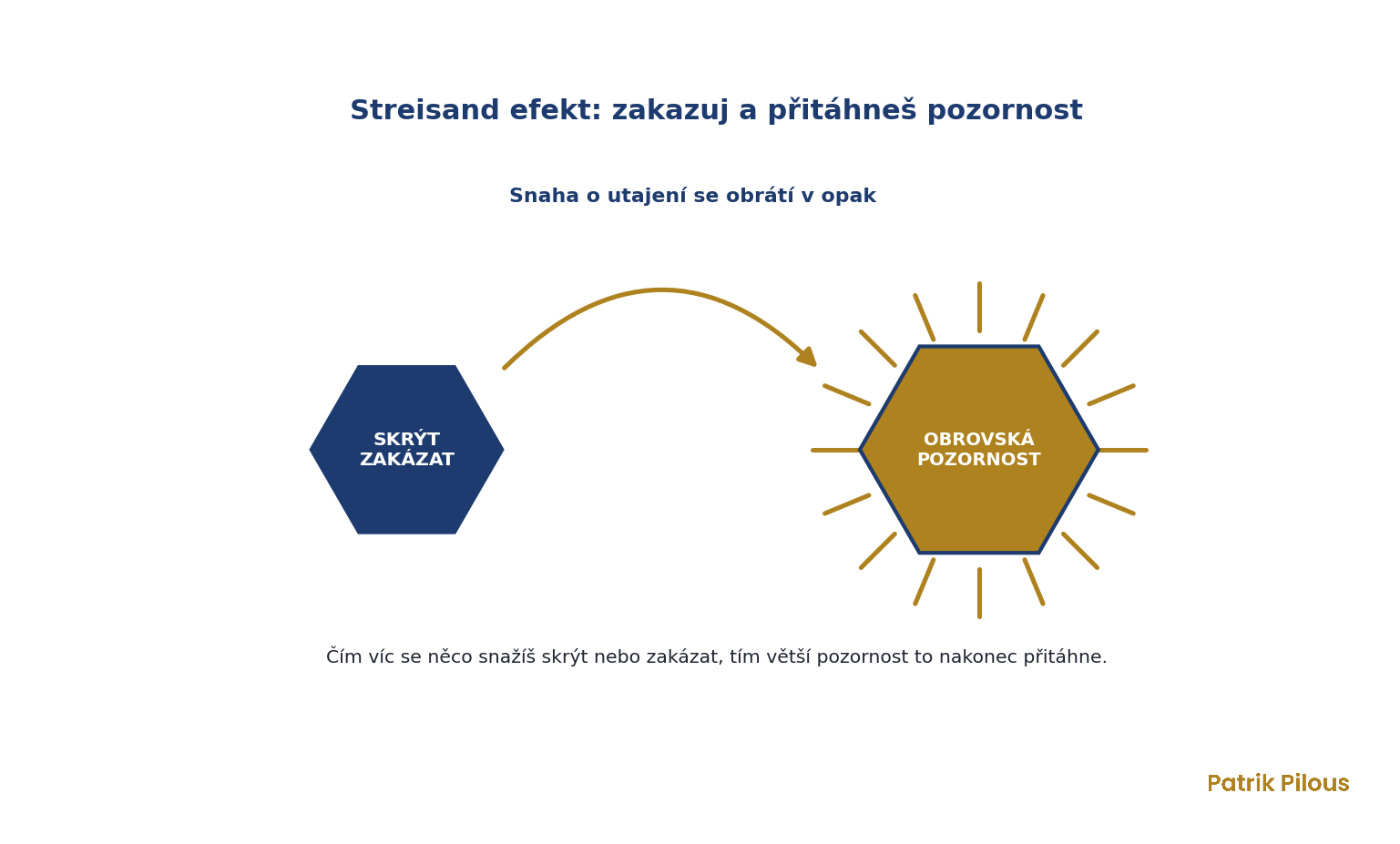
The Streisand effect (also called the Barbra Streisand effect) is a phenomenon where an attempt to hide, delete or ban a piece of information backfires and draws far more attention to it than if nothing had been done. Instead of disappearing, the thing spreads across the internet. Behind it is psychological reactance: as soon as someone forbids us something or tries to hide it, it instantly becomes more interesting and we want to see it all the more. Forbidden fruit simply tastes best, and online this rule applies twice over.
Classification of the cognitive bias
- Cause (Cognitive Bias Codex): The need to act fast
- Mental area: Social and emotional
- Marketing function: Scarcity and PR
- Buyer journey: across all stages (reputation and PR)
- Cialdini’s principles: Scarcity
- System 1 / System 2: System 1 (fast, automatic)
In a nutshell
- What it is: trying to hide something paradoxically increases attention.
- Where you will meet it: deleting reviews, lawsuits over criticism, censorship, “don’t tell anyone about this”.
- How to use it: never silence criticism by force, deal with it openly, and use scarcity carefully.
A real-life story
Let’s go straight to the story that gave this effect its name. The year is 2003, and the singer Barbra Streisand sues a photographer for an incredible 50 million dollars. His offence? As part of a project documenting erosion of the Californian coastline, he took an aerial photo that also showed her villa in Malibu. Before the lawsuit, exactly six people had downloaded the photo (and two of them were her own lawyers). But once the media started writing about the lawsuit, more than 400,000 people viewed the image within a single month. Barbra wanted to hide her house. Instead, she showed it to the whole world.
After all, this pattern repeats throughout history. Banned books sold best, because the ban turned them into a must-have. When a regime tried to silence an idea, it usually only made it stronger. And today it only takes a company trying to delete one unpleasant review or sue a critic, and the internet pulls together and spreads it a thousand times further than what the company originally tried to hide.
Fun fact: the psychologist Jack Brehm named this mechanism reactance back in the 1960s. In short, when we feel our freedom is threatened (by a ban, for example), we feel defiance and a desire to reassert that freedom. The easiest way to do that is to want exactly what is being taken away from us.
How the Streisand effect works
The whole thing rests on two levers. The first is the reactance mentioned above, our resistance to being restricted. The second is scarcity: we automatically see whatever is rare and hard to get as more valuable, which is the same engine that drives FOMO. When you try to hide something, you make it scarce and at the same time send the signal “there’s something worth seeing here”. Add social proof to that, because once others start sharing it, we want to see what it’s about too. The result is an avalanche of attention that nobody can stop.
Use in marketing (and above all, how not to get burned)
- Never silence criticism by force. Deleting reviews, threatening legal action or censoring comments are the fastest way to turn a small problem into a media scandal. Respond openly.
- Treat a bad review as an opportunity. A polite, factual response to criticism comes across better than ten glowing reviews. This ties in with how trust is built through PR.
- Take care in crisis communication. Trying to “sweep it under the carpet” almost always ends in the Streisand effect. Transparency is cheaper than secrecy.
- Scarcity by design, not in panic. A deliberately limited edition is appealing. But a desperate attempt to pull something down is even more appealing, just in the wrong way.
- Build attention with content, not bans. In the long run, repeated presence (the mere exposure effect) works better than a one-off scandal.
- Reactance in copy too. A subtle “this isn’t for everyone” can raise interest. But it is a tool that is easy to overdo.
How to protect yourself from the Streisand effect
- Before you delete anything, consider the impact. Ask yourself: how many people see it now, and how many will see it if I try to hide it?
- Don’t feed the trolls. Overreacting to minor criticism makes it more visible. Sometimes the best response is to stay calm.
- Fix the cause, not the symptom. If the criticism is justified, fix what caused it. Silencing the symptom only makes the problem bigger.
The Streisand effect is a fine lesson in humility for every brand. Online, there is no “delete” button that actually works. You only have a choice: respond openly, or pour oil on the fire yourself.
Frequently asked questions
What is the Streisand effect?
A phenomenon where an attempt to hide or ban a piece of information backfires and draws far more attention to it than if nothing had been done.
Where does the name Streisand effect come from?
From the case of the singer Barbra Streisand, who in 2003 sued over an aerial photo of her villa and unintentionally caused hundreds of thousands of people to view it.
How can you protect yourself from the Streisand effect in marketing?
Don’t silence criticism by force, respond openly and factually, and fix the root of the problem instead of trying to hide it.

