
A marketing audit is an independent review of a company’s entire marketing before a big decision. It answers two questions. Is what you pay for today actually making money? And where should your next crown go? It is typically done before an owner puts more money into advertising or hires a new agency, because a bigger budget amplifies everything that is already running, including the mistakes.
When measurement overstates one channel’s results by half, an extra million can end up where it returns the least. An audit uncovers such mismatches before the money is gone, because it puts every supplier’s figures side by side and compares them with the revenue in your accounts. The output is a short list of priorities and tests, with a one-page budget decision.
Where the term comes from
The marketing audit was described by Philip Kotler, William T. Gregor and William H. Rodgers III in 1977 in an article for Sloan Management Review. Kotler later carried the definition they built there on four characteristics into his textbook Marketing Management.
“A comprehensive, systematic, independent, and periodic examination of a company’s marketing environment, objectives, strategies, and activities.”
Philip Kotler, William T. Gregor and William H. Rodgers III, The Marketing Audit Comes of Age, Sloan Management Review, 1977
Four characteristics distinguish an audit from a routine campaign check.
- Comprehensive. It covers all the main areas of marketing, not just the one that is currently on fire.
- Systematic. It follows a fixed order, from objectives and environment down to individual activities, so nothing important gets left out.
- Independent. It is done by someone who is not assessing their own work. An internal team can do it if it sits outside the department being reviewed.
- Periodic. It is not commissioned only when sales are falling.
The fourth characteristic is the one least observed. Companies get an audit when something is not working. Few think of it before a planned budget increase, yet that is exactly when it is cheapest, because nothing has been spent yet.
Why the audit comes before the money
According to Gartner, large companies in North America and Europe are spending 7.8% of revenue on marketing in 2026, and 56% of the marketing leaders surveyed say their budget is not enough for their planned strategy. For a Czech e-shop this is not a benchmark, just context. Even there, extra money is found mainly by reallocating.
Companies have the data for this, they just rarely use it. In a 2022 Gartner survey of 377 marketing analytics users, data influenced only 53% of marketing decisions.
A third of respondents said decision makers pick out only the data that confirms their view, and a quarter said intuition wins in the end even when the analytics team presents the numbers. One of the main obstacles they named was data that does not match across sources.
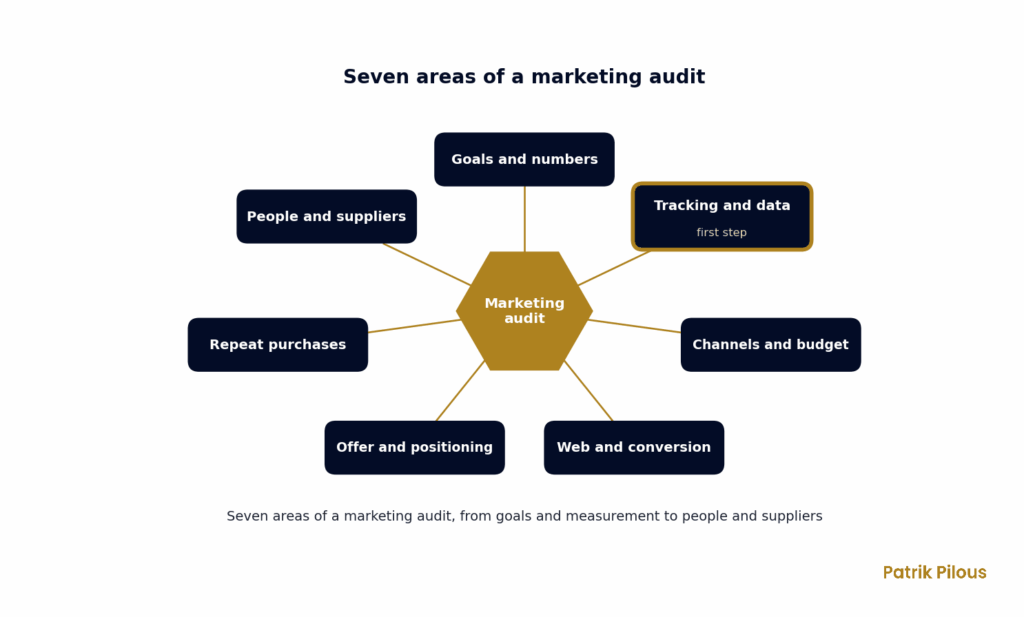
The seven areas of a marketing audit
In their article, Kotler and his colleagues worked with areas such as environment, objectives, strategy, organisation and systems. For an e-shop or a smaller company with revenue in the tens of millions, I think a more practical split into seven areas works better.
- Goals and numbers. Whether there is a business goal in crowns and who is responsible for it.
- Measurement and data. Whether Analytics, the e-shop admin, the ad platforms and the accounts all show the same picture.
- Channels and budget. What each channel costs and what it really brings in.
- Website and conversion rate. Whether the website sells or just receives visits.
- Offer and positioning. How the company differs from its closest competitors in price, range, delivery or service, and whether the customer can tell.
- Customers and repeat purchases. How much revenue comes from returning customers and what the company does to secure a second purchase.
- People and suppliers. Who does what and to what brief, who checks the results and who owns the accounts.
Measurement is reviewed first
Without reliable data, channel performance can only be guessed at. The basic test takes an hour. Compare last month’s revenue in the e-shop admin with the revenue in GA4 and with the total conversions the ad platforms claim. A small gap between the admin and GA4 is normal (tracking blockers, declined cookies, cancellations, a different definition of revenue). When GA4 shows a third less than the admin, I take that as a rough threshold: find the cause first, and only then make decisions based on Analytics.
The second test is a single version of the truth. Ask three people how much Google Ads brought you last year. If you get three different numbers, you have your first audit finding. I explain why platforms fight over the same order in my article on attribution models.
Channels and budget based on real costs
A channel’s costs also include the agency fee, tools, design work and your own people’s time, otherwise every channel looks better than it is. Only with full costs does it make sense to calculate ad cost as a share of revenue, that is PNO and ROAS, and compare it with your margin.
Campaigns on your own brand deserve special attention. In a large-scale experiment at eBay, described by Tom Blake, Chris Nosko and Steven Tadelis in an NBER working paper, ads on brand keywords had no measurable short-term benefit. People searching for eBay found it even without the paid link. A smaller e-shop whose competitors bid on its name may see a different result, so it is better to test it.
Customers who come back
No supplier has this area in their report. As US context, the spring 2026 The CMO Survey found that companies’ customer acquisition budgets are 26% higher than their retention budgets, up from 19.6% in autumn 2024. Yet according to respondents’ self-assessment, retention performance grew by 12.8% over the last 12 months, while acquisition grew by only 7.4%.
For an e-shop, this raises a question. What percentage of revenue comes from people who have bought a second time, and how much does bringing them back cost compared with a new customer? I describe how to calculate customer lifetime value in my article on CLV.
Marketing audit checklist
The table serves as an outline for a marketing audit.
| Area | What to check | Warning sign |
|---|---|---|
| Goals and numbers | business goal in crowns, margin, marketing goal, who is responsible for it | the goal is “more visibility” or “growth” with no number |
| Measurement and data | revenue in the admin versus GA4 and ad platforms, conversion setup | the suppliers’ combined revenue exceeds turnover |
| Channels and budget | full costs and return of each channel over 12 months | nobody can say what the most expensive channel delivered |
| Website and conversion rate | conversion rate by device and landing page, speed, basket, delivery and payment | mobile converts at half the desktop rate and nobody deals with it |
| Offer and positioning | how the company differs, range, prices versus competitors, reviews | only the owner can explain the difference from competitors |
| Customers and repeat purchases | share of returning customers, second purchase, emails, loyalty programme | emails only go out for sales |
| People and suppliers | contracts, briefs, who approves the budget, who owns the accounts | the supplier both proposes and evaluates its own budget |
If you have the data and access to hand, you can work through the table yourself in a day or two. What matters is how serious the findings are, not how many there are, because a single error in measurement or in the briefs to suppliers carries through to every other area, and fixing one channel then fixes nothing.
How to do a marketing audit in five steps
Most of the time goes into the second and fourth steps.
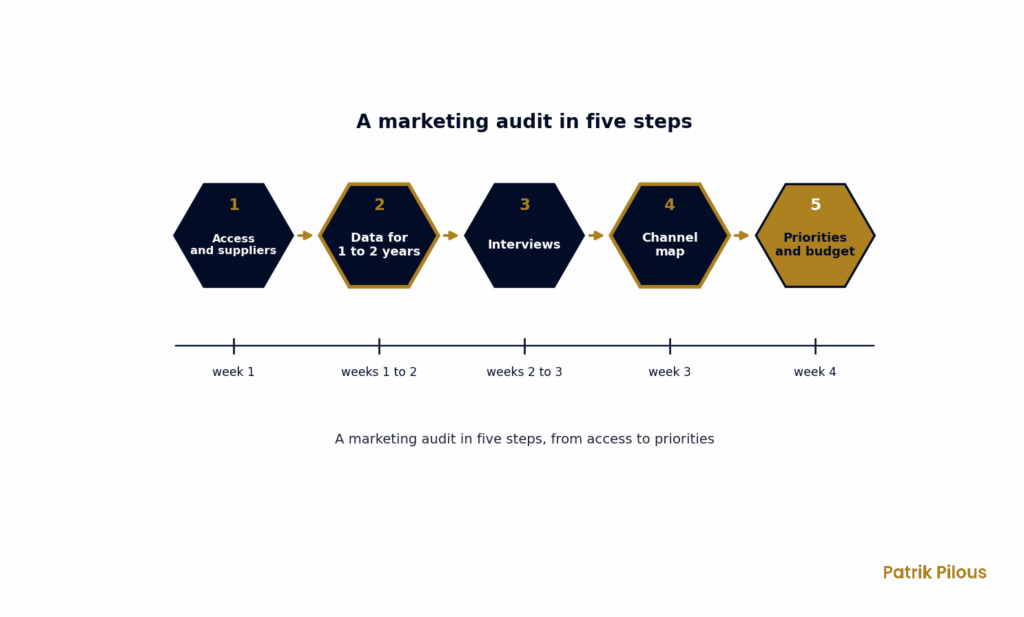
1. Access and a list of suppliers
Read access to GA4, Search Console, the ad platforms, the e-shop admin and the email tool. Plus a list of everyone working on your marketing, with their contract and monthly fee.
2. Data for 12 to 24 months
A year is the minimum to see seasonality. Two years show whether growth is not just a recovery after a weak period. You collect revenue, orders, margin, costs by channel, and new versus returning customers, all by month.
3. Interviews
With the owner, the operations staff, customer support and each supplier separately. You ask what they do, how they are measured, what they are missing and what they would do with extra money. A contradiction between what the owner says and what the agency does is often the most valuable finding of the whole audit.
4. A channel map with costs and returns
One table where each channel has its full costs, revenue according to the supplier, revenue according to GA4, and PNO. These are different attribution views, not proof of real contribution, but they show which channels need testing before you put more money into them.
5. Priorities and decisions
From the findings, you pick five to seven steps ranked by their impact on revenue and margin. Each one states who will do it, by when, what it costs and how you will know it worked.
A model case, an e-shop with 40 million CZK (about 1.6 million EUR) in revenue
The numbers are made up, but put together the way things look in practice. An e-shop with revenue of 40 million CZK (about 1.6 million EUR) excluding VAT and a gross margin of 30%, three suppliers and an email tool. GA4 measures 37 million CZK (about 1.5 million EUR) for the year, 7.5% less than the admin, so it can be trusted. The owner wants to put an extra million into Meta ads, because the Meta report shows the best numbers.
| Channel | Annual costs | Revenue according to supplier | Revenue according to GA4 | PNO according to GA4 |
|---|---|---|---|---|
| Google Ads, agency | 2,040,000 CZK (about 84,000 EUR) | 16,000,000 CZK (about 660,000 EUR) | 11,000,000 CZK (about 450,000 EUR) | 18,5 % |
| Meta, freelancer | 1,080,000 CZK (about 44,000 EUR) | 9,000,000 CZK (about 370,000 EUR) | 3,500,000 CZK (about 140,000 EUR) | 30,9 % |
| SEO, agency | 360,000 CZK (about 15,000 EUR) | 12,000,000 CZK (about 490,000 EUR) | 9,500,000 CZK (about 390,000 EUR) | 3,8 % |
| Email, tool | 60,000 CZK (about 2,500 EUR) | 5,000,000 CZK (about 210,000 EUR) | 2,800,000 CZK (about 120,000 EUR) | 2,1 % |
The sum of revenue that suppliers claim for themselves is 42 million, more than the entire turnover, because several systems claim the same order. Advertising costs and supplier fees, excluding VAT and the time of in-house staff, come to 3.54 million CZK (about 150,000 EUR), 8.9% of turnover. According to the Meta report, PNO comes out at 12%; according to GA4, it is 30.9%, which is above the 30% gross margin, and after shipping and payment fees the channel would be losing money according to GA4.
Does this mean Meta does not work? Not necessarily. The acquisition report in GA4 attributes revenue to the source of the visit in which the purchase took place, and social media advertising may only start the purchase. The audit therefore recommends testing how many orders the advertising actually adds, for example by switching it off in some regions for four weeks. Until the test result is in, I would rather cut the Meta budget than add a million.
The second finding is in Google Ads. Let’s say 540,000 CZK (about 22,000 EUR) of the budget goes on a brand campaign. The eBay result is a reason for your own test, not a promise. If the test shows a similar result, up to 540,000 CZK (about 22,000 EUR) may be freed up. The third finding is cheap email with a PNO of 2.1% that only sends discount offers, and the fourth is tracking that nobody has checked for two years, so even the figures in the table above are not entirely reliable.
The result for the owner is different from what he came in with. No extra million for now. First two tests and a tracking fix, then a decision based on data in two months.
A one-page audit output
Nobody reads a fifty-page audit. An output you can make decisions from fits on one page, and you can build a marketing strategy directly from it.
| Field | What goes in it |
|---|---|
| State of the numbers | turnover, margin, number of customers, marketing costs in CZK and as a percentage of turnover |
| What to trust | which data sources match and which do not, and by how much |
| What works | channels that make money after margin and variable costs |
| Where money leaks | specific campaigns and amounts |
| Five to seven priorities | the step, who does it, the cost, how you will know the result |
| Budget decision | what to add, what to cut, what to switch off, what to test first |
The last line matters most. It shows whether the owner, after reading it, knows what to do with the money next month.
Who should do the audit and how long it takes
The agency that manages your channels is the worst choice for an audit. It does not have to lie; it is enough that it is assessing its own work, and it will hardly recommend taking money away from itself and putting it elsewhere.
| Who does the audit | Advantage | Weakness |
|---|---|---|
| The agency that manages your channels | knows the accounts in detail | assesses its own work |
| In-house marketing | knows the company and its history | assesses itself, lacks comparison |
| An agency pitching for the work | often free | the audit is part of the sale |
| An independent consultant or outsourced CMO | does not defend any channel | does not know the history of decisions as well as the in-house team |
How long does it take? For an online shop the size of the model company, I would say four to six weeks of calendar time, with the actual work taking roughly half of that, because the longest waits are usually for access, exports from the accounts, materials from suppliers and interview dates.
As an outsourced and fractional CMO, I start with exactly this kind of review and immediately fix what is most urgent, because without it the budget cannot be managed. When a company only needs a one-off decision on direction, an audit followed by a proposed marketing strategy is enough.
When an audit makes no sense
A review of seven areas is unnecessarily expensive in these situations.
- The online shop is so young that it has nothing to compare against, not even one full season in its sector.
- Marketing consists of one channel and one person who runs it well and can show results.
- The decision has already been made and the audit is only meant to serve as an alibi.
- Nobody in the company has time to act on the findings in the next two months.
- The company is in the middle of its main season, when campaigns should not be touched.
The method itself also has a weak spot. An audit describes the past and is good at finding where money leaks, but it cannot read from historical data a new channel or idea the company has not yet tried, which is why it needs to be followed by a strategy with its own hypotheses and tests.
Interesting questions on the topic
What is the difference between a marketing audit and a marketing analysis?
A marketing analysis usually examines one thing, such as the market, competitors, customers or campaign performance. An audit reviews all of marketing at once and ends with a recommendation on what to do with the budget.
How do you do a marketing audit yourself?
Start with the second area in the table. Compare revenue in your admin with GA4 and with the sum of conversions reported by suppliers, and if they do not match, you know where to start. A full do-it-yourself audit runs into the problem of independence, because it is hard to assess objectively decisions you made yourself.
What does a marketing strategy audit include?
It checks whether the company has a business goal in numbers, a defined customer, positioning and a channel plan, and whether the budget across channels matches these decisions.
How often should a marketing audit be repeated?
As a guide, a major one once a year before budget planning, sooner if there is a big change in channels, suppliers, tracking or management. In between, a quarterly check of tracking and the channel map is enough.
How does it differ from an SEO audit?
An SEO audit examines one channel in depth: the website’s technical side, content, links and search demand for topics. A marketing audit looks at all channels at once and at SEO only in terms of cost and return.
Euro amounts are approximate, converted at the Czech National Bank rate of 24.34 CZK per EUR on 29 October 2026.

