

Hanlon’s Razor is a rule that advises against attributing to malice what can be adequately explained by error, ignorance, carelessness or overload. The original English wording speaks of stupidity, but in this entry I speak of ordinary human failure, because I think it fits work better. It dates from 1980 and serves as a heuristic for moments when you do not know why someone acted the way they did. The name refers to Ockham’s Razor, the philosophical rule that advises against adding assumptions without necessity.
Classification
- Type of phenomenon: a thinking rule (heuristic) against misattributing causes
- Bias it reveals: the fundamental attribution error and the tendency to read ambiguous behaviour as hostile
- Mental domain: Social
- Marketing function: customer care, reviews, client relationships, team management
- Customer journey: after purchase and during complaints
- System 1 / System 2: System 1 (fast, automatic) sees intent, System 2 (slow, deliberate) applies the razor
In brief
- What it is: before you accuse someone of malice, check whether an ordinary mistake explains it.
- Why it matters: when judging other people’s behaviour, we overestimate character and underestimate circumstances, so we easily see an attack.
- Where you meet it: an angry customer email, a one-star review, a client who has not replied for a week, a colleague who forgot a deadline.
- How to use it: ask first and check the facts. Consider intent only when there is a repeated pattern or a clear benefit to the other side.
A real-life story
The rule is named after Robert J. Hanlon, who submitted it to the second volume of Arthur Bloch’s collection of humorous laws, Murphy’s Law Book Two (1980). Page 52 contains the sentence “Never attribute to malice that which is adequately explained by stupidity.” According to research by the Quote Investigator website, he was a computer programmer from Scranton, Pennsylvania.
The idea is much older. In The Sorrows of Young Werther from 1774, Johann Wolfgang Goethe has the hero write in a letter dated 4 May that misunderstandings and indolence perhaps cause more confusion in the world than cunning and malice. According to the original text, the last two are certainly rarer.
In the novella Logic of Empire (Astounding Science Fiction, March 1941), Robert A. Heinlein has a character reproached for attributing to villainy conditions that are simply the result of stupidity. The razor only became widely known in 1990 through the hacker dictionary Jargon File.
A model scene from an online shop. On Sunday evening, a customer writes a one-star review saying they “deliberately sent a broken item and are now playing dead”. On Monday morning, the owner reads it as an attack and prepares a sharp reply. In the system, however, he discovers that the complaint form was not working over the weekend and the customer’s email ended up in spam, so both sides ran into the same technical fault and each saw it as the other’s intent.
How Hanlon’s Razor works
The razor targets a tendency that Stanford psychologist Lee Ross named the fundamental attribution error in 1977. When judging other people’s behaviour, we overestimate the person’s character and underestimate the situation. An earlier experiment by Edward Jones and Victor Harris from 1967 showed that people attributed the opinion in essays about Fidel Castro to their authors even when they knew the experimenter had assigned them the side.
The second component is hostile attribution bias. In 1980, American psychologist Kenneth Dodge described how aggressive boys in ambiguous situations more often see malicious intent behind a peer’s behaviour and retaliate. A meta-analysis by Bram Orobio de Castro and colleagues from 2002 summarised 41 studies with 6,017 participants and confirmed the link.
The strength of the effect varied considerably between studies. The data also come from children and adolescents, so applying them to adults at work is my own reasoning. I base it on the fact that the related fundamental attribution error is documented in adults.
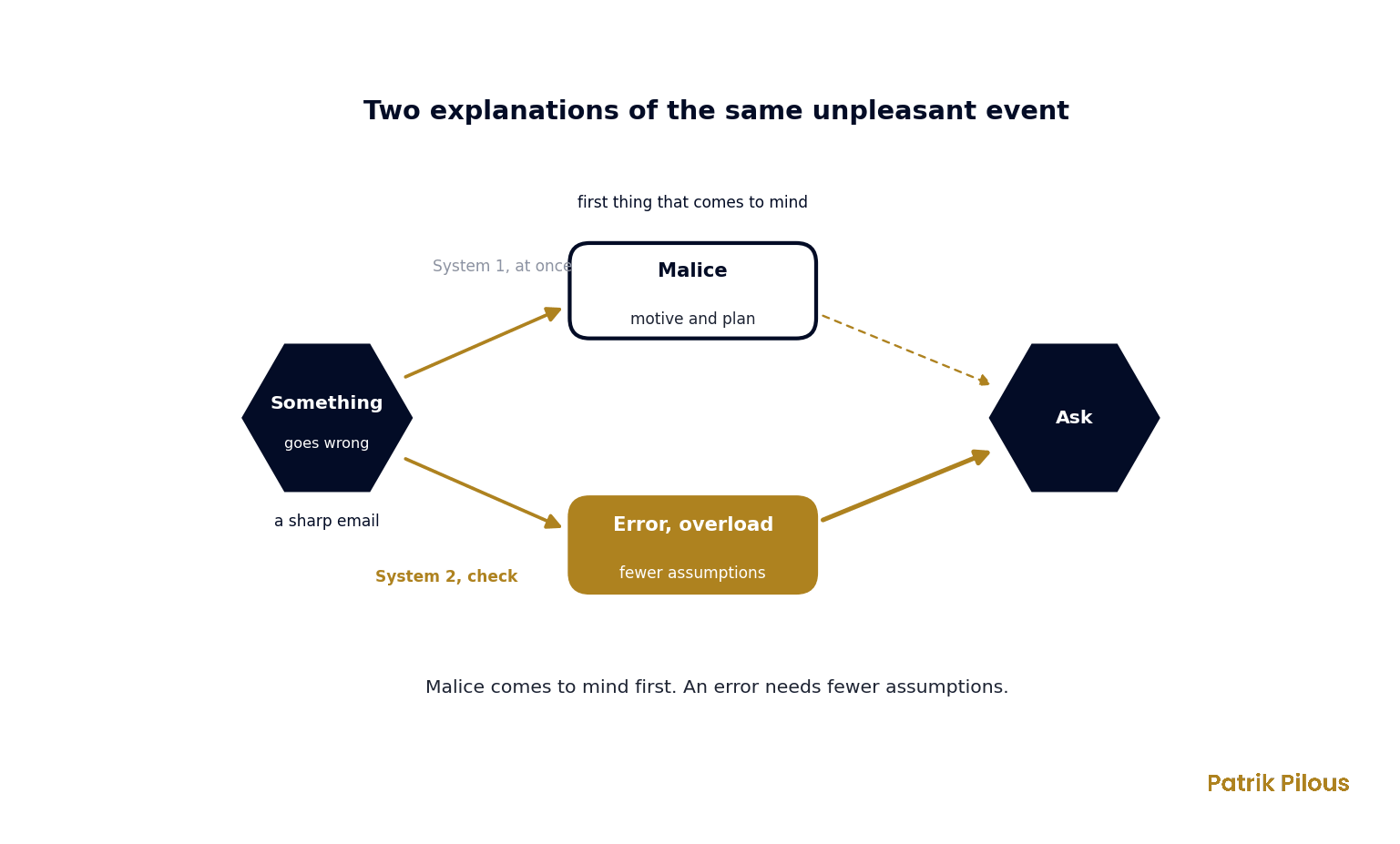
When something unpleasant happens, the brain looks for someone to blame. Intent is the quickest explanation, because it provides a story and someone to be angry with. A mistake or overload requires information you usually do not have at that moment, such as how many messages the person received that day, what broke for them, what they actually knew about the matter and what brief they were given.
In a report from June 2025, Microsoft states that the average worker receives 117 emails a day and skims most of them in less than a minute. The figure illustrates overload, but says nothing about any specific unanswered email. The data come from Microsoft’s own tools, so take them with a pinch of salt.
Hanlon’s Razor slows this race down. It makes you state both explanations and ask which one needs fewer assumptions. Intent assumes a motive and a plan, a mistake only ordinary carelessness.
Hanlon’s Razor in marketing
In marketing and sales, you deal with people whose circumstances you cannot see. The customer does not see your warehouse and you do not see their day. Responding with an attack to something that was not an attack then costs you customers and contracts.
- An angry customer. A sharp email is often a reaction to disappointed expectations, such as a parcel that arrived three days late. Respond to the facts, meaning the order number, the shipment status, the reason for the delay and the new date, and leave the other side’s tone aside.
- A negative review. One star with an accusation of fraud may be a misunderstanding about delivery or a refund. A factual public reply matters, because bad news weighs more than good news, as the negativity bias describes.
- A client who does not reply. A week of silence after a proposal does not have to mean rejection. With that much overload, it may simply have got lost. Send a short reminder with one specific question.
- A colleague who is “sabotaging”. Late materials usually stem from other priorities or an unclear brief. Before you raise it at a meeting, ask what they knew. Some failures are also explained by the Peter principle, according to which people get promoted until they reach a position they cannot handle.
- Competitors and campaign errors. A competitor with a similar slogan may have come up with it on their own. A campaign that burned through a monthly budget overnight is usually down to a wrongly set daily limit or targeting. Before you blame the agency, go through the account’s change history.
The common first step is a question instead of an accusation. Checking costs one email or phone call, whereas an accusation that turns out to be false will, in my view, damage the relationship with a customer or colleague for much longer than the original mistake itself would have.
When Hanlon’s Razor does not apply
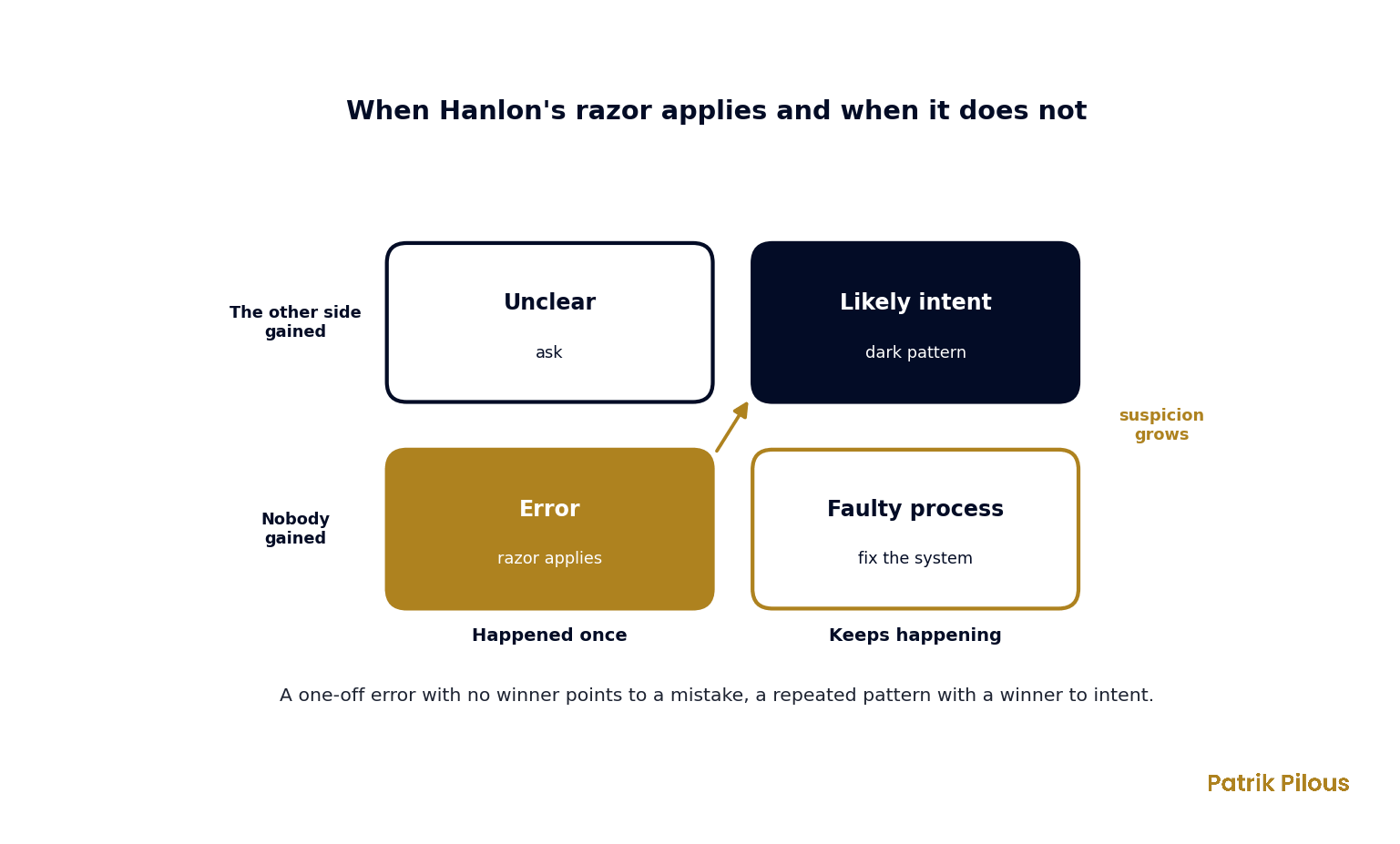
The razor comes from a humorous book and has not been scientifically tested. It only tells you which explanation to start with, and it does not rule out malice. Anyone who applies it thoughtlessly will be led by the nose by people who fake mistakes on purpose.
A typical example is manipulative interface design (dark patterns). The ICPEN network of consumer protection authorities, together with the US FTC, reviewed a total of 642 subscription websites and apps at the beginning of 2024.
Almost 76% of them used at least one possible dark pattern, most often hidden or delayed price information and pre-selected options. When a website repeatedly makes it hard to leave, the design reflects a decision that someone approved.
| Signal | More likely a mistake | More likely intent |
|---|---|---|
| Repetition | happened once | the same pattern keeps returning |
| Who gains | nobody, it harms both sides | the other side, at your expense |
| Reaction after being told | apology and correction | denial, nothing changes |
| Direction of errors | errors go both ways | errors always go in their favour |
In my view, the strongest signal is the direction of errors. When a supplier “makes a mistake” on an invoice three times in a quarter and each time in their own favour, coincidence becomes harder to explain.
How to use Hanlon’s Razor
The rule only works if you apply it before you reply. A few habits are enough.
- Write down both explanations. Add the innocent version to your suspicion, such as overload, ignorance, a technical fault or a different brief.
- Ask before you reply. The question “Could you describe what happened?” often reveals a misunderstanding.
- Wait before replying. Reply to a sharp email or review no sooner than an hour later and only after reading the whole conversation.
- Watch for a pattern. Forgive one mistake. At the third identical mistake in the same direction, reconsider the relationship and keep a record of the cases. The three-mistake threshold is my rule of thumb.
- Fix the system. When the same mistake recurs with different people, the problem lies in the process, for example in a form, a brief, an automated email or the complaints policy.
Point five is the most valuable for a company. According to my rule of thumb, ten angry customers with the same complaint usually mean one faulty thing in the process that only needs fixing once, such as a broken link in a confirmation email.
How it relates to other biases
The fundamental attribution error has a sibling in the actor-observer asymmetry, according to which we explain our own mistakes by circumstances and other people’s by their character. However, Bertram Malle’s 2006 meta-analysis of 173 studies found no asymmetry overall and showed it only for negative events, which is exactly the case with late deliveries, sharp emails, missed deadlines and campaign errors, where Hanlon’s Razor is most useful.
With people outside your own team, blaming them is even easier, as the in-group bias describes. Once suspicion arises, confirmation bias kicks in and you start looking for evidence of intent.
Ockham’s razor, named after the English philosopher William of Ockham (c. 1287 to 1347), advises against adding assumptions without necessity. According to the Stanford Encyclopedia of Philosophy, it is a cautious method, so a simpler explanation is not automatically true, and the well-known formulation does not appear word for word in Ockham’s writings. You will find more mental shortcuts in the overview of cognitive biases.
Interesting questions on the topic
What is Hanlon’s razor?
A rule that advises against attributing to malice what can be explained by error, ignorance, inattention or overload.
Who came up with Hanlon’s razor?
Robert J. Hanlon, who submitted the sentence to the book Murphy’s Law Book Two in 1980. Goethe and Heinlein had already written a similar idea.
What is the difference between Hanlon’s razor and Ockham’s razor?
Ockham’s razor advises against adding assumptions without necessity, but a simpler explanation is not automatically true. Hanlon’s razor applies it to human behaviour, where intent requires more assumptions than error.
Does Hanlon’s razor also apply to companies?
For one-off mistakes, yes. With repeated patterns that the company benefits from, such as making it hard to cancel a subscription, assume it is deliberate.

