

The Golem effect (golem efekt in Czech) is a psychological phenomenon in which low expectations lead to poorer performance. A boss or teacher decides in advance that someone is not up to a task and starts treating them accordingly. They give the person less room and less trust. The person senses this, loses motivation and their performance really does drop, so the original expectation is confirmed. It is the negative counterpart of the Pygmalion effect, where high expectations raise performance.
Classification of the cognitive bias
- Cause (Cognitive Bias Codex): Not enough meaning
- Mental domain: Social
- Marketing function: Team leadership, customer relationships
- Customer journey: across all stages, mainly existing customer care
- Cialdini’s principles: not applicable
- System 1 / System 2: System 1 (fast, automatic)
In brief
- What it is: low expectations of a person worsen their performance and then seem to be confirmed.
- Why we do it: we put our first impression into a box and then look for evidence that it fits.
- Where you will meet it: a new colleague after their first slip or a “weak” salesperson, but also a “problem” client and a customer segment that nobody believes in.
- How to avoid it: separate a single mistake from your overall judgement and give everyone the same start.
A story from life
The effect takes its name from a Prague legend. According to the legend, at the end of the 16th century Rabbi Judah Loew ben Bezalel kneaded a Golem from clay taken from the banks of the Vltava to protect the Jewish town. But the Golem gradually grew stronger, slipped out of control and began to destroy what it was meant to protect. According to the legend, its remains lie in the attic of the Old New Synagogue. The story was passed down orally for centuries and only appeared in print in the 19th century.
The name came from a 1982 study. In the Journal of Educational Psychology, Elisha Babad, Jacob Inbar and Robert Rosenthal observed 26 trainee physical education teachers and 202 pupils. Teachers prone to bias treated the pupils they expected little from worse, and these pupils then achieved poorer results. Teachers without bias treated everyone the same.
Robert Rosenthal was the same psychologist who, 14 years earlier with Lenore Jacobson, described the Pygmalion effect in the classroom by telling teachers that a randomly chosen fifth of the pupils were children about to blossom, and then watching how the teachers began to treat them. One line of research thus produced two effects, one on each side of expectations.
How the Golem effect works
The effect has four steps that go round in a circle. First, an expectation forms, often from a single slip or from someone else’s remark such as “he’s hard to work with”. Then the behaviour of the person holding the expectation changes. They explain less, check more and speak more coldly. The other side notices, even though nobody says anything out loud, and in the end performance drops, which confirms to the first side that they were right.
The most treacherous part is that it all happens unintentionally. The boss does not think they are harming anyone; they think they are simply making a realistic assessment of the person’s abilities, and they record every further slip as proof. That is why the golem effect is hard to spot from the inside.
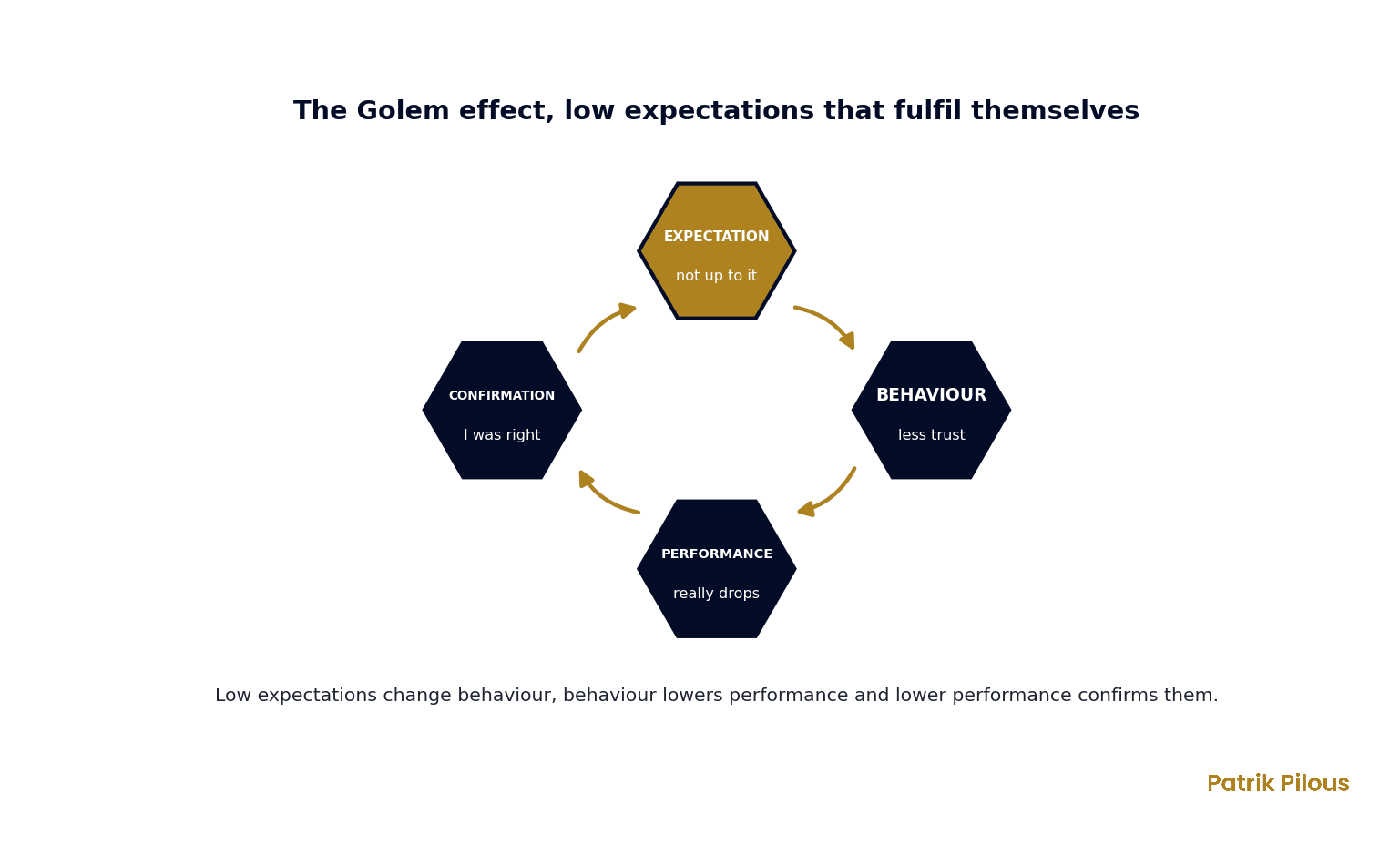
Jean-François Manzoni and Jean-Louis Barsoux brought the effect into companies. In 1998, in the Harvard Business Review, they described the set-up-to-fail syndrome. After the first disappointment, the boss entrusts the subordinate with less and corrects them more. The subordinate reads this as distrust, withdraws and stops coming up with ideas.
The boss sees this as confirmation of their judgement. Meanwhile, each of them sees the problem in the other.
The Golem effect in marketing and in companies
In marketing, the golem effect does not hide only in relationships between people. We behave the same way towards channels, campaigns and entire customer segments that we do not believe in from the start, and then we are surprised that the results confirm exactly what we thought before the first test.
- Salespeople and leads. When the head of sales gives a “weaker” salesperson poorer leads, their numbers will be worse and the head of sales will feel vindicated. Distribute leads randomly or by a rule, and only then compare.
- Customer segments. A segment labelled as “low value” gets slower support and worse offers. Customers leave and the segment looks even less valuable. Check whether a low CLV is not the result of your own approach.
- Channels and campaigns. A channel nobody believes in gets the smallest budget and the weakest creative, and nobody optimises it. Then it really does not work. Before you write it off, give it one fair test with the same care as your main channel.
- Agency and client relationships. An agency that sees a client as “problematic” sends them fewer ideas and replies formally. The client is dissatisfied and confirms the label. It works the same way in reverse.
- A new person on the team. The first few weeks strongly influence how the boss will treat them for a long time. One mistake at the start can easily set the label for months.
What all these examples have in common is that a poor result does not have to be the cause of distrust. It may be its consequence.
How to guard against the Golem effect
Defence does not rest on goodwill but on checking your own judgement as strictly as someone else’s performance.
- Separate the mistake from the person. One botched presentation is information about that presentation, not about a whole career. Write down exactly what happened and do not generalise.
- Measure everyone the same way. Identical goals and conditions will reveal whether the difference lies in performance or in approach.
- Watch for small signals. Whose messages do you reply to most slowly? Who do you not give important tasks to? That is usually where an expectation sits that you have not even noticed.
- Say it out loud. Manzoni and Barsoux recommend an open conversation in which the boss admits that the relationship has slipped. They might start with a sentence such as “I feel we haven’t been working well together for the last few months, and I want to know how much of that is my fault”.
- Give a second chance with the same support. A new task with full support is the fairest test. A task designed for the person to fail proves nothing.
The opposite question also helps. If your best person made the same mistake, would you draw the same conclusion from it?
How it connects with other biases
The Golem effect is driven by confirmation bias. Once a boss has a label in their head, they notice the mistakes that confirm it and overlook the successes that refute it. The halo effect in its negative form does the rest, when a single weak trait recolours the whole picture of a person.
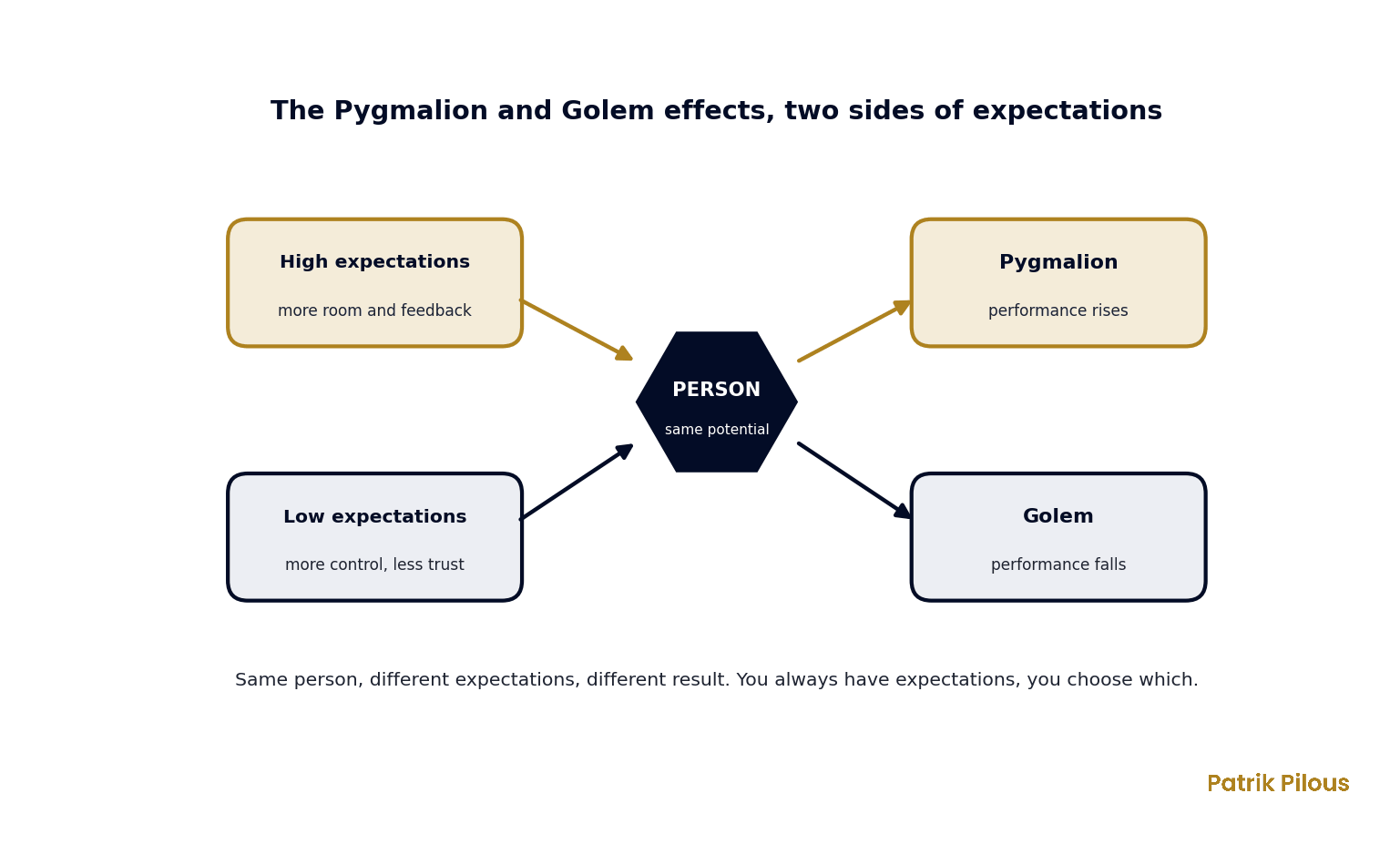
The overconfidence effect also plays a part. A manager who is confident they can size people up after the first week does not check their assessment. High and fair expectations, on the other hand, raise performance, as the Pygmalion effect shows, so while you always have expectations, you can influence what they are.
Interesting questions on the topic
What is the Golem effect?
A psychological phenomenon in which a boss’s or teacher’s low expectations lead to poorer performance by a person, which seemingly confirms those expectations.
What is the difference between the Pygmalion and Golem effects?
The Pygmalion effect describes how high expectations improve performance. The Golem effect is its opposite.
Why is the effect named after the Golem?
After the Prague legend of the Golem, created by Rabbi Loew as a protector, which slipped out of control. Low expectations turn against their purpose in the same way.
How can I recognise the Golem effect in a company?
When you give someone worse tasks and less feedback than others and their performance then declines. You can check it by giving them the same conditions as everyone else for a while and watching whether their performance evens out.

