

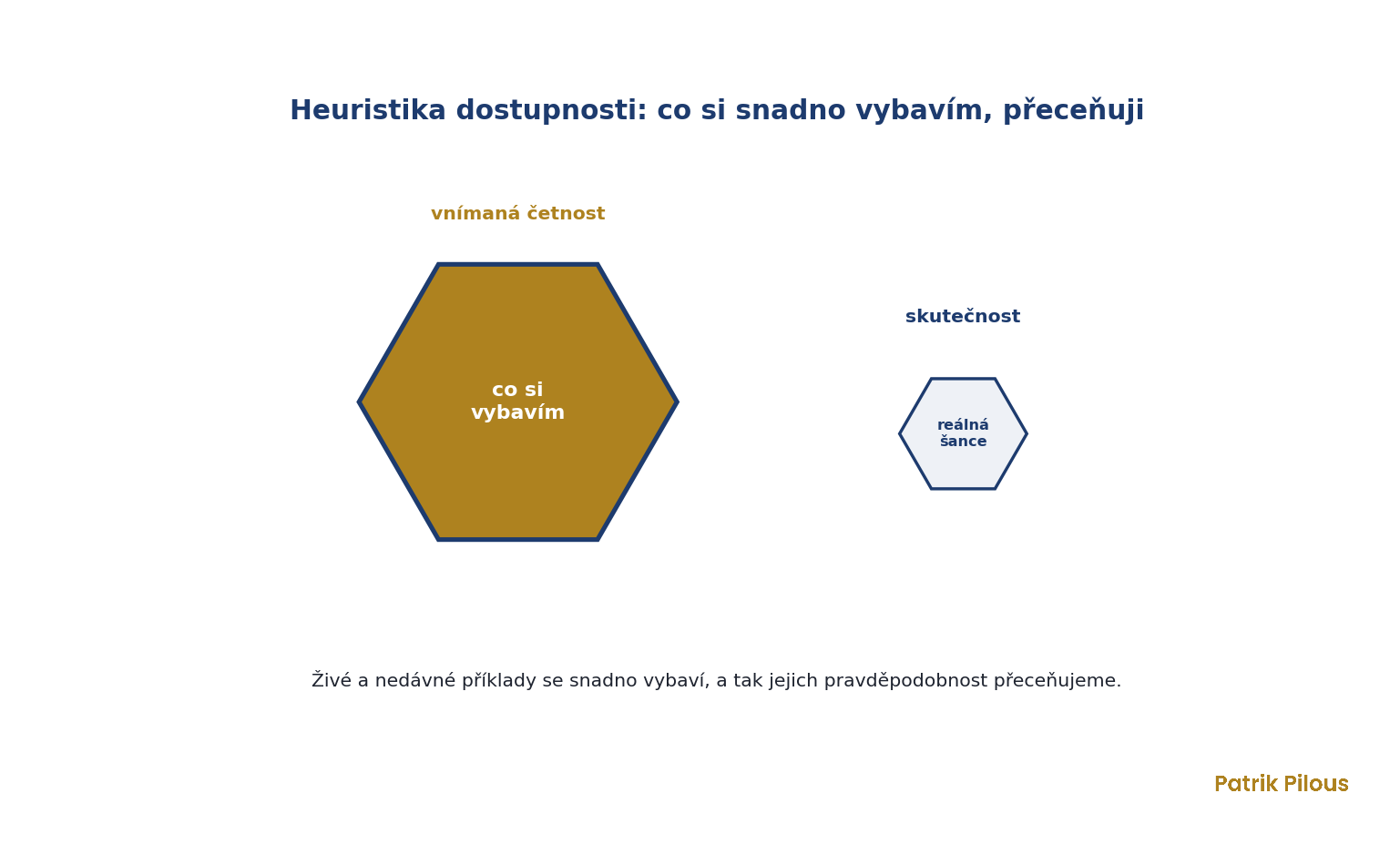
The availability heuristic is a cognitive bias in which we estimate how common or likely something is by how easily it comes to mind. Whatever we recall quickly, because it is vivid, recent or emotionally powerful, we consider more common than it really is. The brain confuses ease of recall with actual frequency. That is why we fear things that make the news more than those that threaten us far more often but are simply not talked about.
Classification of the cognitive bias
- Cause (Cognitive Bias Codex): Too much information
- Mental area: Probability judgement
- Marketing function: Memory and perception
- Buyer journey: Consideration
- Cialdini’s principles: not applicable
- System 1 / System 2: System 1 (fast, automatic)
In brief
- What it is: what we recall easily, we consider more common and more likely.
- Why we do it: the brain confuses ease of recall with actual frequency.
- Where you’ll encounter it: fear of flying, media scandals, the brand that comes to mind first.
- How to use it: be easy to recall at the moment of decision.
A real-life story
The effect was described by psychologists Amos Tversky and Daniel Kahneman in a famous paper from 1973. In one experiment, they asked people whether English has more words that begin with the letter K or more words that have K in the third position. Most answered that more words begin with K, because such words are easier to recall. In reality, there are roughly three times as many words with K in the third position. Ease of recall beat the facts.
You know this from everyday life too. After news of a plane crash, many people are afraid to fly, even though air travel is statistically much safer than driving a car. Car accidents don’t make the national news, whereas a plane crash does. And because it comes to mind easily, we overestimate its likelihood.
How the availability heuristic works
When we have neither the time nor the data for an accurate estimate, the brain uses a shortcut. It asks itself how easily something comes to mind and judges how common it is accordingly. Vivid, recent and emotionally charged memories are easy to recall, so they get too much weight in the estimate. The effect is linked to the mere exposure effect, because what we see often is easy to recall, and to the illusory truth effect, where repetition increases credibility.
Use in marketing
- Be the first thing that comes to mind. The brand a customer remembers first has a huge advantage. This is called top of mind.
- Strong, specific stories. One vivid story of a satisfied customer sticks more than a table of numbers.
- PR and media presence. Repeated appearances in the media keep a brand easy to recall. Good PR helps with this.
- Visuals and emotions. An emotionally powerful image is easier to recall than dry information.
- Reminders at the right time. Be visible at the moment the customer is dealing with the need you meet.
How to protect yourself against the availability heuristic
- Look for data, not impressions. Ask for the actual numbers, not for whatever happens to come to mind.
- Beware of fresh news. We overestimate whatever is currently in the media. Distance helps.
- Don’t mistake loudness for frequency. What is talked about a lot isn’t necessarily common.
How it connects with other biases
The availability heuristic works together with the mere exposure effect and the illusory truth effect, and together they form the foundation of brand building. When you see a brand often, it comes to mind more easily, which is availability. Repeated exposure also makes you like it more, which is the mere exposure effect. And a repeated claim about its quality starts to sound more true to you, which is the illusory truth effect. That is why brands are built through patient repetition. At the moment of purchase, the one that comes to the customer’s mind first wins.
Frequently asked questions
What is the availability heuristic?
A cognitive bias in which we estimate the frequency or likelihood of something by how easily we recall it, not by actual data.
How can the availability heuristic be used in marketing?
By being easy to recall at the moment of decision, that is, by building top of mind through repeated presence, strong stories and PR.

