

The paradox of choice (also known as choice overload) is a cognitive bias where too many options bring paralysis instead of freedom. It would seem that the more options we have, the better, because it is easier to pick exactly what suits us. In reality, as the number of options grows, deciding becomes so demanding and stressful that we often do nothing at all, or we walk away from the choice dissatisfied, feeling that we missed out on something better. In marketing, this means one uncomfortable truth: a wider range can sell worse than a narrower one. It is therefore often better to keep the offer clear and point it straight at one or a few products that are best for both the company and the customer.
Classification of the cognitive bias
- Cause (Cognitive Bias Codex): Need to act fast
- Mental area: Decision-making
- Marketing function: Price and value (and UX)
- Buyer journey: Decision
- Cialdini’s principles: not applicable
- System 1 / System 2: System 1 (System 2 overload)
In a nutshell
- What it is: too many options lead to paralysis and lower satisfaction.
- Where you will come across it: packed online shops, long menus, too many plans, endless scrolling.
- How to use it: narrow down and guide the offer rather than overwhelm.
A real-life story
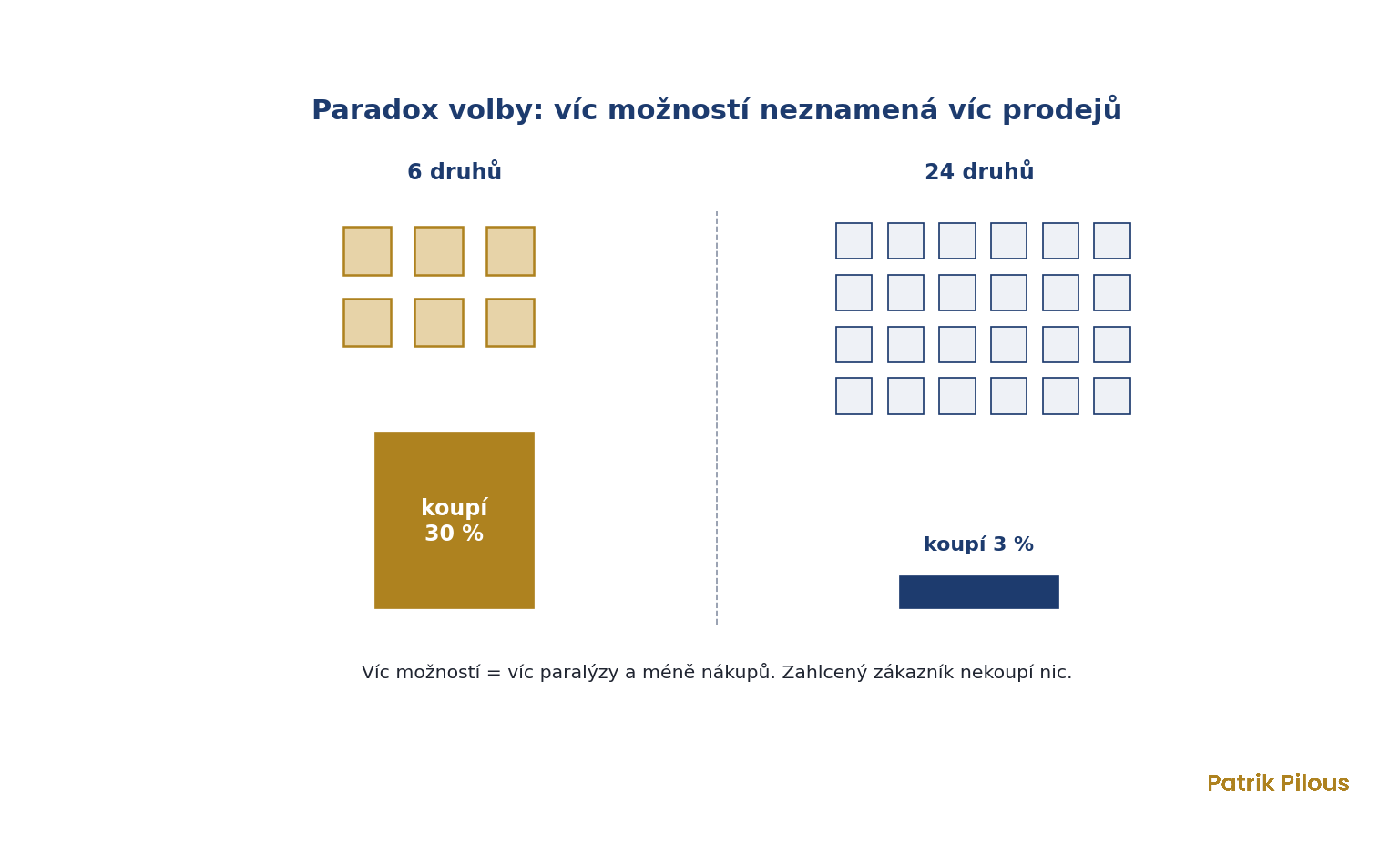
Let’s look at an experiment that has become a textbook example. Psychologists Sheena Iyengar and Mark Lepper set up a jam tasting stand in an upmarket grocery store. On one occasion they displayed 24 varieties, on another just 6. The large selection did attract more people to taste, that much is true. But when it came to buying, the numbers turned upside down. At the stand with 24 varieties, only 3% of people bought a jam. At the stand with 6 varieties, 30% of people bought one, ten times as many. The smaller selection sold many times better, because people were able to make a decision.
You know this well from your own sofa. You open Netflix, you want to watch a film, and you spend half an hour scrolling through an endless list until you finally give up and go to bed. That is not laziness, that is the paradox of choice. When there are too many options, the brain freezes.
After all, financial advisers deal with the same problem. It turned out that when a company offers its employees too many pension savings funds, fewer of them sign up for the scheme at all. Every added fund sounds like a better offer, but in reality it puts people off.
The book The Paradox of Choice, which made this phenomenon famous, was written by psychologist Barry Schwartz. His main idea is surprisingly liberating. Fewer options often mean not only an easier decision but also greater satisfaction with what we eventually choose, because we worry less about everything we might have missed, and our brain also finds it much easier to get its bearings in the offer.
How the paradox of choice works
Every extra option means more comparing, more thinking and another chance to make a mistake. Beyond a certain point, deciding becomes so exhausting that the brain would rather avoid it altogether. On top of that comes the fear of choosing wrongly and missing out on something better, which is the same engine as with loss aversion and FOMO. That is exactly why, in sales, a cleverly built offer, such as the decoy effect or well-set anchoring, works better than a long list nobody can find their way around.
Use in marketing
- Narrow the offer. Fewer product variants or plans often boost sales. When you offer everything, you sell almost nothing.
- Guide the choice. Labels such as “most popular” or “recommended” ease the weight of the decision. Customers are happy to follow a cue.
- Pre-filled and default options. A sensible default makes the hard decision for the customer and simply offers it for approval.
- Filters and guides. When an online shop has a huge range, help customers narrow down their options with a filter or a selection guide so they do not get stuck.
- Working with prices. Three clear plans beat ten confusing ones. A cleverly built trio in pricing decides for the customer.
- Gradual disclosure. Do not show all the options at once. Guide the customer step by step so that at each moment they choose from just a few variants.
How to protect yourself from the paradox of choice
- Set your criteria in advance. Before you start choosing, decide on two or three things that matter to you and ignore the rest.
- Settle for good enough. Do not look for the perfect choice, look for one that meets your criteria. You will save time and nerves.
- Narrow the choice yourself. Pick a few finalists and decide between them. Choosing from a short list is easier than from an endless one.
For a marketer, the paradox of choice is liberating news. You do not need the widest offer on the market. Often the clearest one is enough, one where the customer can decide quickly and calmly. Less but clear beats more but confusing.
Frequently asked questions
What is the paradox of choice?
A cognitive bias where too many options lead to paralysis, poorer decisions and lower satisfaction instead of the expected freedom.
What did the jam experiment show?
At the stand with 24 varieties, only 3% of people bought jam; at the stand with 6 varieties, 30% did. The smaller selection sold ten times better.
How can the paradox of choice be used in marketing?
Narrow the offer, guide customers with a “most popular” label, use sensible default options and lead the customer through the choice step by step.

