
The decoy effect is a cognitive bias in which adding a third, deliberately less attractive option changes how we choose between the two original ones. That third option is not meant to sell. It is only there to make one of the original options look like the clear winner next to it. Left to ourselves, we would have chosen differently.
Classification of the cognitive bias
- Cause (Cognitive Bias Codex): The need to act fast
- Mental area: Decision-making
- Marketing function: Price and value
- Buyer journey: Decision
- Cialdini’s principles: not applicable
- System 1 / System 2: System 1 (fast, automatic)
In a nutshell
- What it is: a third “planted” option redirects the choice between two others.
- Where you will meet it: pricing tables, popcorn and coffee sizes, plans and subscriptions.
- How to use it: place a slightly worse decoy next to your target option so the target looks like the best deal.
A real-life story
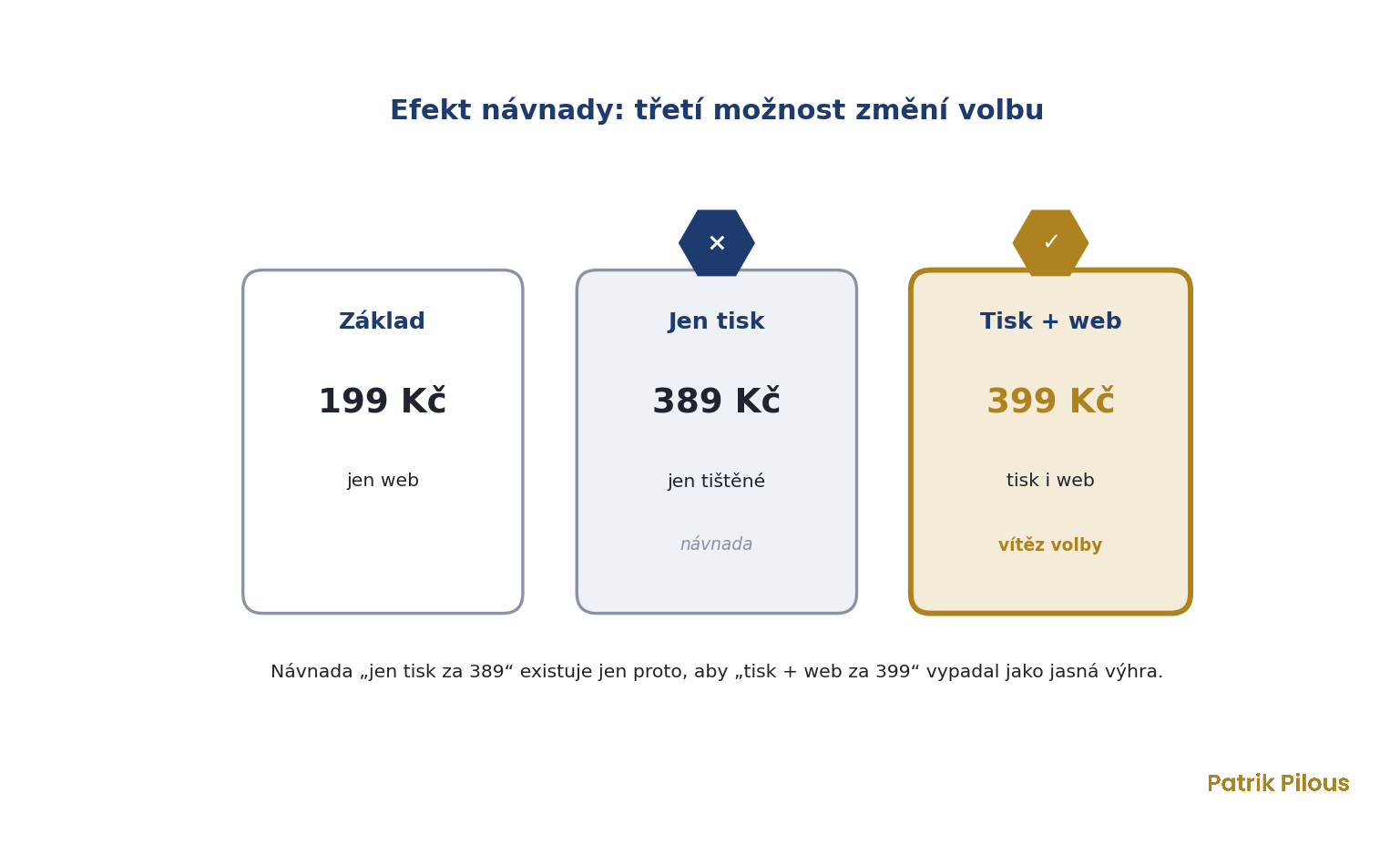
The weekly business magazine The Economist once offered subscriptions in three versions: web only for 59 dollars, print only for 125 dollars, and print plus web also for 125 dollars. When people in a test saw this, the overwhelming majority chose the last one, because “for the same price I get the web version for free”. The middle option, print only for 125, was bought by almost no one. So why was it there? It was the decoy. Once it was removed from the offer, people suddenly started choosing completely differently, and more of them went for the cheapest option. That seemingly pointless middle option brought the publisher significantly higher revenue. In B2B services and SaaS, this is used almost all the time, and it works extremely well.
It is similar with popcorn at the cinema. Small for 60, large for 120. You would hesitate. But add a medium for 110, and the large one suddenly looks like a steal you simply have to take. The medium size hardly sells, yet it does its job.
How the decoy effect works
Our brain is not good at judging absolute value. It is, however, excellent at comparing. When we have two options that are hard to compare (cheaper and weaker versus more expensive and better), deciding feels uncomfortable. The decoy solves this problem. It is the “worse twin” of one of the options: it offers less for almost the same price. This creates an easy comparison, and our choice tilts almost by itself towards the option that clearly beats the decoy.
The technical term for this is asymmetric dominance. The decoy is dominated by one option (which is better in every respect), but not by the other. The brain latches onto that simple comparison and ignores the rest. It is related to anchoring, where the first number sets the reference point, and to loss aversion, because with a decoy we feel we would “lose out” if we did not take the seemingly best option.
Asymmetric dominance effect and related biases
In research, the decoy effect is also called the asymmetric dominance effect or the attraction effect. Joel Huber, John Payne and Christopher Puto described it in 1982 in experiments on consumer choice. The name explains the mechanism. One option beats the decoy on every attribute, and the other option does not. That one-sided advantage is what makes the target look like the winner.
The decoy effect is easy to confuse with the compromise effect. In the compromise effect, the middle option wins simply because it sits between two extremes, and you avoid both the cheapest and the most expensive choice. In the decoy effect, the winning option does not have to be in the middle. It wins because it sits next to a clearly worse version of itself. Many pricing pages use both biases at the same time, which is why the two are often mixed up.
Use in marketing
- Three-tier pricing. A classic in SaaS and subscriptions. The middle or top plan is designed so that, thanks to the decoy, it looks like the best value for money.
- A targeted decoy for the premium option. Want to sell premium? Place next to it an option that costs almost the same but offers much less. Premium becomes the obvious choice.
- Sizes and packs. Drinks, popcorn, product bundles. The medium size often serves only as a decoy that pushes the customer towards the large one.
- Order and highlighting. Label the target option “most popular” and place it next to the decoy. Combining the decoy effect with social proof is powerful.
- Add-ons and upselling. “For an extra 50 CZK (about 2.1 EUR) you get twice as much” works because the small option becomes the decoy for the larger one.
- Decide what you want to sell. First choose your target product, and only then design the decoy around it. Without a clear target, the decoy does not work. This fits into the wider view of price in the marketing mix.
How to design decoy pricing step by step
- Choose the target option. This is the plan or product you want most customers to pick, ideally because it also suits them best.
- Find the competing option. This is the one customers would choose without a decoy, usually the cheaper plan.
- Build the decoy close to the target. Give it a similar price but clearly less value. For example, a basic plan at 20 EUR, a target plan at 50 EUR, and a decoy at 45 EUR with half the features of the target.
- Make the comparison easy. Show all options in one table, with the same attributes in the same order, so the gap between decoy and target is obvious at a glance.
- Measure the result. Compare the offer with and without the decoy. Look at the share of the target option and at total revenue, not only at one of them.
Common mistakes when using the decoy effect in marketing
- The decoy is too attractive. If people actually buy it, it takes sales from the target instead of supporting it.
- The decoy is absurd. An option that makes no sense at all looks like a trick. Customers notice it and start to distrust the whole offer.
- Too many options. With five or six plans, the simple comparison disappears and people postpone the decision.
- Pushing the wrong product. If the target option does not fit the customer, you gain a sale now and lose it later through cancellations, refunds and complaints.
- Unclear differences. If the decoy and the target differ in small print only, the comparison does not happen and the decoy has no effect.
How to defend yourself against the decoy effect
- Evaluate options on their own. Ask “do I need this option?”, not “which is the best deal among those on offer?”.
- Ignore the obviously weak option. If one option clearly makes no sense, it is probably a decoy. Set it aside mentally and decide again.
- Go back to your need. Start from what you actually want, not from what looks like the best deal.
Frequently asked questions
What is the decoy effect?
A cognitive bias in which adding a third, deliberately less attractive option changes the choice between the two original ones and tilts it towards the target option.
What is an example of the decoy effect?
The Economist subscription: the middle “print only” option at the same price as “print + web” existed only to make the combined option look like the clear winner.
How can you use the decoy effect in pricing?
Place a slightly worse option at a similar price next to the target option, so the target stands out as the best value for money.
Frequently asked questions about the decoy effect
What is decoy pricing?
Decoy pricing is a pricing strategy that adds an option mainly to make another option look better. The decoy costs about the same as the target but offers clearly less. Its job is not to sell but to make the target look like the obvious choice.
What is the asymmetric dominance effect?
It is the research name for the decoy effect. The decoy is dominated by one option, which is better in every respect, but not by the other. This one-sided comparison shifts your preference towards the option that dominates the decoy.
How is the decoy effect used in marketing?
Most often in three-tier pricing tables, subscription plans, product sizes and bundles. The marketer first chooses the product to sell and then adds a slightly worse option at a similar price next to it. It works best when the comparison is simple and the target option genuinely suits the customer.
Euro amounts are approximate, converted at the Czech National Bank rate of 24.34 CZK per EUR on 29 October 2026.

