

The Pygmalion effect is a psychological phenomenon in which our expectations influence another person’s behaviour so strongly that those expectations end up fulfilling themselves. When you believe someone will succeed, you treat them differently, giving them more room and more trust, and in doing so you genuinely help them succeed. It works the other way round too. In the Czech context and in sociology, you may also come across the term self-fulfilling prophecy.
Classifying the cognitive bias
- Cause (Cognitive Bias Codex): Not enough meaning
- Mental area: Social
- Marketing function: Social influence
- Buying journey: across all stages (relationship with the brand)
- Cialdini’s principles: not applicable
- System 1 / System 2: System 1 (fast, automatic)
In a nutshell
- What it is: your expectations can change another person’s actual results.
- Where you’ll see it: leadership, school, the customer–brand relationship, VIP treatment.
- How to use it: set high but fair expectations for people and act accordingly.
A real-life story
The effect takes its name from a Greek myth. The sculptor Pygmalion carved a statue of a woman so beautiful that he fell in love with it. He believed so strongly that she was alive that the goddess Aphrodite took pity on him and brought the statue to life. Expectation and belief literally created reality. This is also where George Bernard Shaw’s play Pygmalion got its title. The play inspired the famous musical My Fair Lady, in which a professor turns a simple flower girl into a lady simply by treating her as one.
The effect was confirmed scientifically by an experiment that would probably not get past an ethics committee today. In 1968, psychologists Robert Rosenthal and Lenore Jacobson went into a school and told teachers that, according to a test, certain pupils had exceptional potential and were about to blossom. In reality, those pupils had been chosen completely at random. Yet by the end of the year, these randomly chosen pupils had genuinely improved their results more than the others. The only thing that had changed was the teachers’ expectations. Without realising it, the teachers gave them more attention, harder tasks and kinder feedback.
Imagine Tomáš, a newly appointed team leader. He immediately decides that one new hire “is going to go far”. Without being aware of it, he starts giving that person more interesting work, spending more time with them and cheering them on more. The new hire grows and really does improve. Tomáš’s expectation came true, but not because he judged the talent well. He helped create that talent through his own behaviour.
Fun fact: the effect has a dark sibling called the golem effect. When we expect little from someone, we treat them more coldly, give them dull tasks and fewer chances, and their performance then genuinely gets worse. Low expectations fulfil themselves just as reliably as high ones.
How the Pygmalion effect works
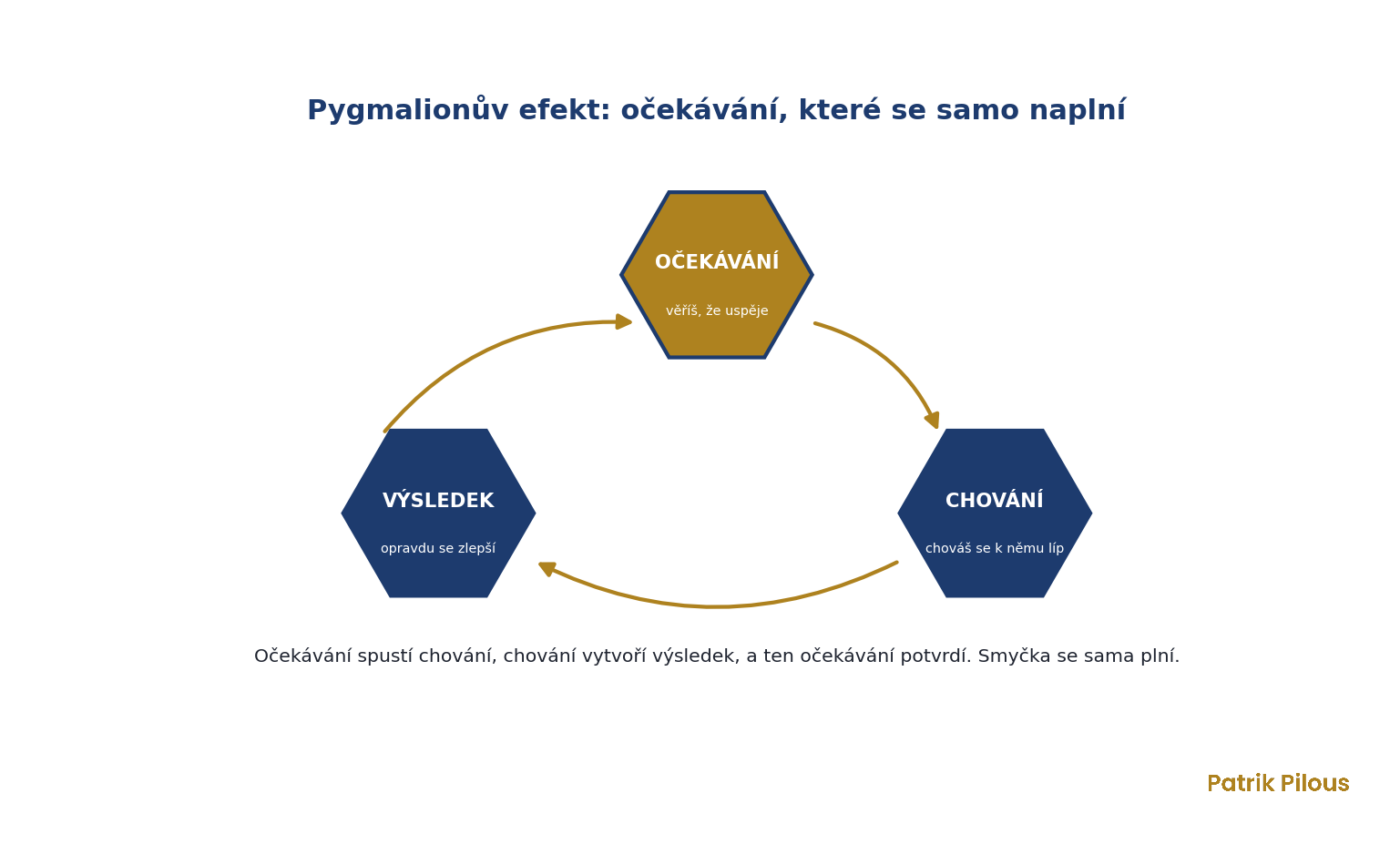
It is a classic example of a self-fulfilling prophecy, a term introduced by the sociologist Robert Merton. Expectations trigger small, often unconscious signals in our behaviour: a different tone of voice, more or less time, more demanding or more trivial tasks, more or less trust. The other person responds to these signals and their performance shifts in the direction we expected. The result then confirms our original expectation and the loop closes.
In the world of brands, it works in a similar way. The expectations a customer forms based on a brand also influence how they actually experience the product. Closely related are the halo effect, where a single impression colours the whole evaluation, and social proof, because we often adopt our expectations from the people around us.
Use in marketing
- VIP treatment. When you treat customers as exceptional, they start behaving accordingly. A premium approach creates loyal customers.
- Expectations set by the brand. What a brand promises is what the customer experiences. Strong brand positioning changes how a product is perceived even before purchase.
- Encouraging onboarding. “You’re one of our most active users” can turn a newcomer into an active member, because they try to live up to that role.
- Status and roles in a community. Labels such as “expert” or “top reviewer” motivate better behaviour, as people try to live up to the label.
- Leading sales and marketing teams. A manager’s expectations carry over into people’s performance. Show your belief in your people openly and specifically.
- Customer support. Treating a customer as a fair partner reduces conflict, because they start behaving like one.
How to work with the Pygmalion effect
- Be aware of your expectations. The label you mentally give someone affects how you treat them. Watch out for negative ones in particular.
- Raise the bar. Higher, fair expectations bring out more in people than scepticism does. Don’t confuse this with unrealistic pressure.
- Give people a chance beyond first impressions. The golem effect starts where you write someone off too early.
The Pygmalion effect is a reminder that expectations are not just a passive estimate. They are an active force that helps shape the outcome. Whether you lead a team or build a brand, your belief in people is part of what they eventually become.
Frequently asked questions
What is the Pygmalion effect?
A psychological phenomenon in which our expectations influence another person’s behaviour so strongly that the expectations fulfil themselves. Higher expectations lead to better performance.
Who described the Pygmalion effect?
It is best known from the 1968 experiment by Robert Rosenthal and Lenore Jacobson, in which teachers’ expectations improved the results of randomly selected pupils.
What is the opposite of the Pygmalion effect?
The golem effect, where low expectations lead to poorer performance because we treat the person accordingly.

